Market Summary
Executive Summary and Global Market Analysis
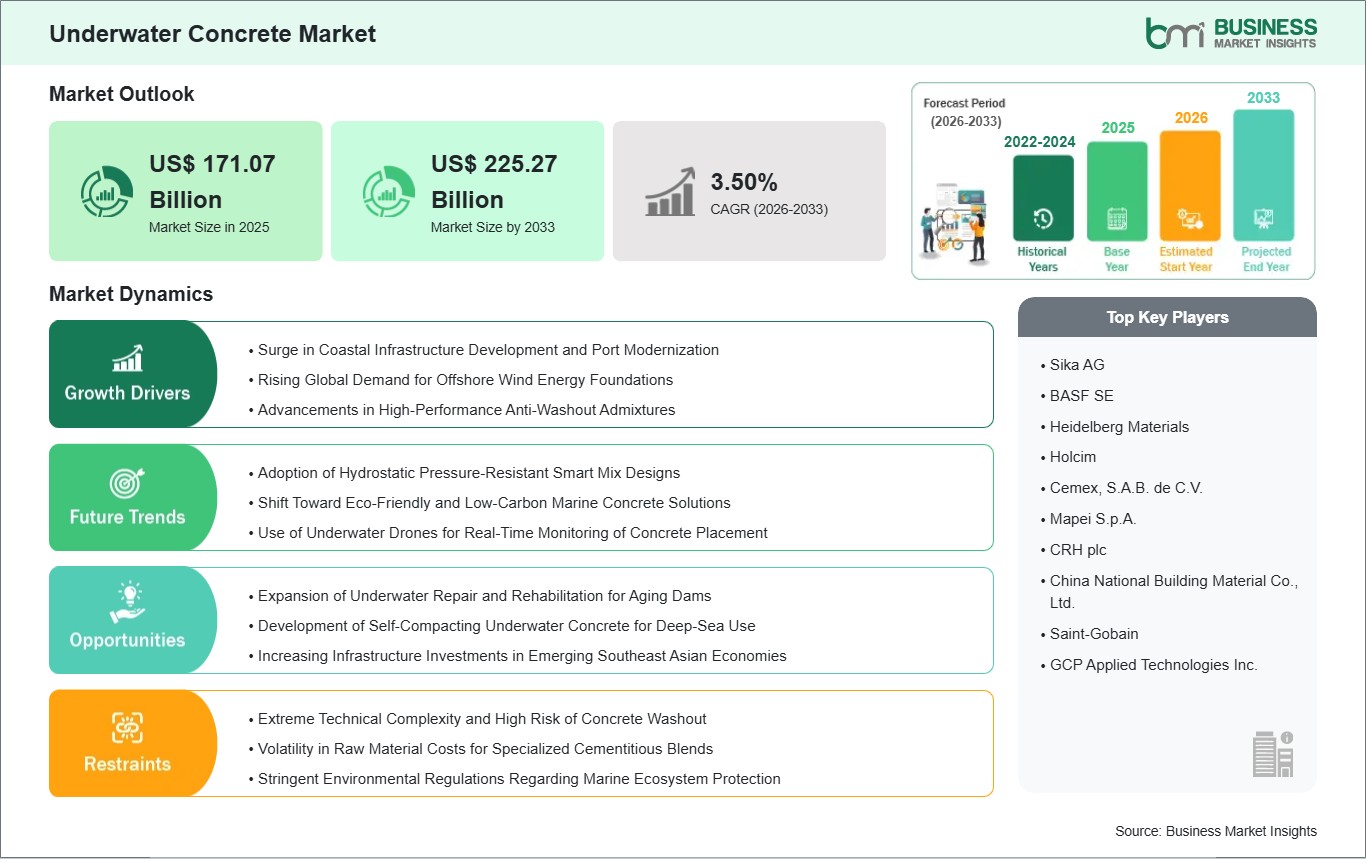
The world market for underwater concrete is in a period of technical advancement and growth, motivated by the fundamental necessity for robust marine and hydraulic structures. Unlike conventional concrete work, underwater concrete work demands specific chemical formulations that include anti-washout admixtures and advanced plasticizers that can keep concrete cohesive when submerged. The market is presently dominated by a dual approach that includes both new construction work along coastlines and the vital maintenance of existing structures such as dams and tunnels. The shift towards renewable energy harvesting structures such as massive foundations for wind turbines has generated a huge market demand for structures that can endure the corrosive environment of the sea.
Innovation in technology continues to be the foundation of this industry, and it has moved towards more self-compacting and smart monitoring mixes that minimize the potential for structural voids. Despite the challenges that this industry faces, such as high operational costs and environmental concerns surrounding marine construction, innovation in "green" concrete and more efficient forms of laying, such as the advanced pump method, is helping to overcome these issues. From a geographical perspective, this market is very localized in coastal regions and areas of high hydroelectric potential. As this market continues to move forward, it is likely to do so in a manner that ensures its sustainability in a world of climate change uncertainty.
Segment Analysis
Underwater Concrete Market Segmentation
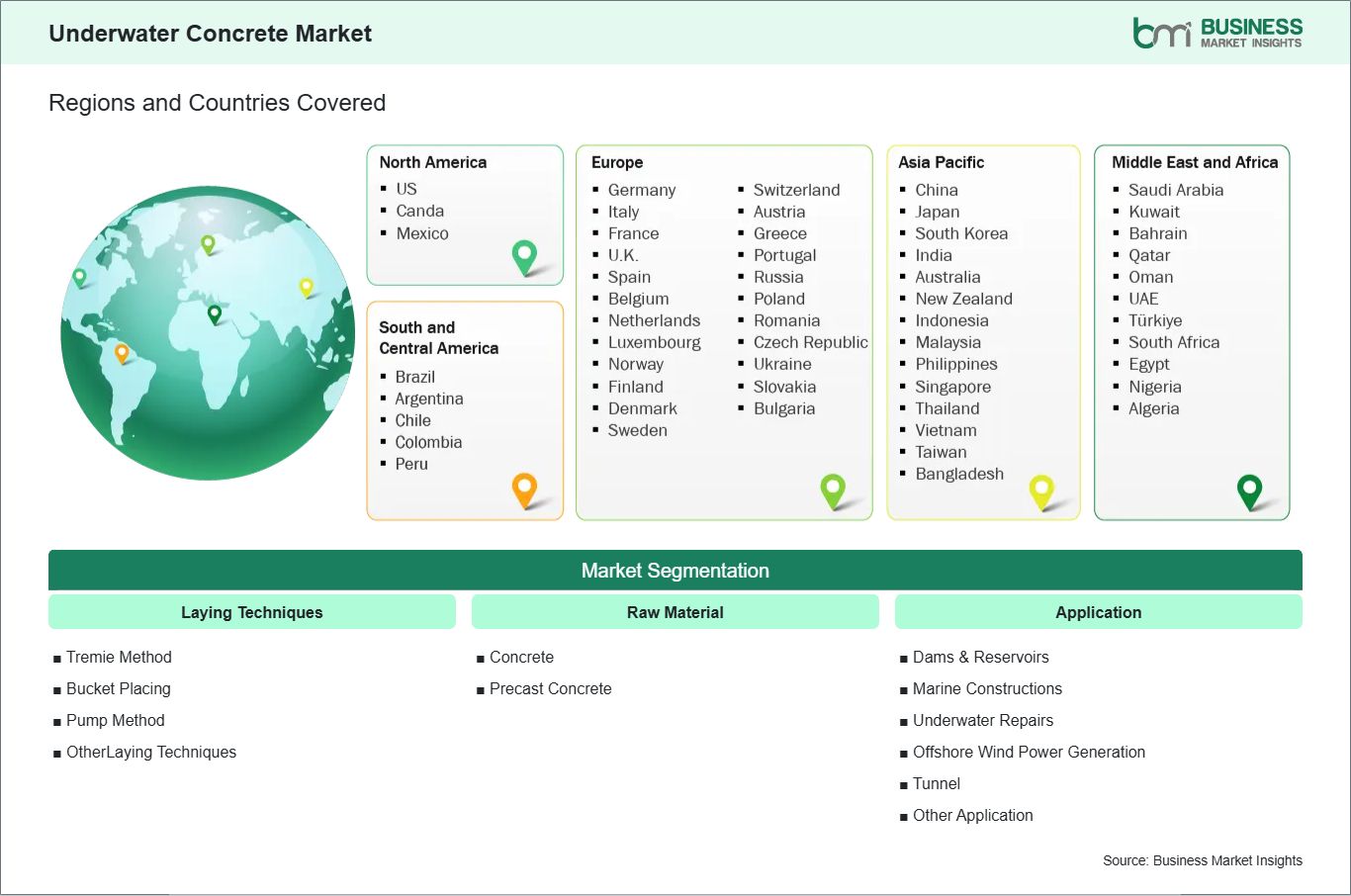
Key segments that contributed to the derivation of the Underwater Concrete market analysis are laying techniques, raw material, and application.
- By laying techniques, the underwater concrete market is segmented into Tremie Method, Bucket Placing, Pump Method, and Other laying techniques. The Tremie Method segment dominated the market in 2025.
- By raw material, the underwater concrete market is segmented into Concrete and Precast Concrete. The Concrete segment dominated the market in 2025.
- By application, the underwater concrete market is segmented into Dams & Reservoirs, Marine Constructions, Underwater Repairs, Offshore Wind Power Generation, Tunnel, and Other applications. The Marine Constructions segment dominated the market in 2025.
Market Forces
Underwater Concrete Market Drivers and Opportunities
Surge in Coastal Infrastructure Development and Port Modernization
The expansion of maritime trade across the globe has led to the need to rapidly modernize or build new deep-sea ports, which has been the main driving force behind the underwater concrete market. This is because, with the increase in the size of ships, the need to deepen existing ports or build more robust structures like quays or breakwaters has also increased. Underwater concrete forms the basis for these structures, as they can be used to build massive structures without the need to build costly coffer dams. This saves a lot of time and money in the construction process.
Moreover, the increase in the level of the sea and the rise in the number of extreme weather conditions have prompted governments to invest in coastal defense infrastructure and flood barriers. Such infrastructure needs high-performance underwater concrete that has the ability to endure the hydrostatic pressure and the corrosive action of chloride ions in the presence of seawater. Such a need exists in areas where the population along the coastal areas is high. This ensures a consistent demand for special cement products that endure in the most hostile aquatic environments.
Expansion of Underwater Repair and Rehabilitation for Aging Dams
A significant opportunity within the market lies in the maintenance and life-extension of aging hydroelectric dams and water reservoirs. Many of these structures, built several decades ago, are now showing signs of underwater erosion, scouring, and structural fatigue. Traditional repair methods often involve draining the reservoir, which is economically disruptive and environmentally damaging. Specialized underwater repair concrete, formulated with advanced polymers and anti-washout agents, allows for in-situ repairs while the facility remains operational. This capability is vital for maintaining global energy security and water management without sacrificing utility uptime.
The opportunity is further magnified by the development of specialized injection and grouting techniques that can seal deep-water cracks and reinforce foundations under high pressure. As global safety standards for large-scale water retention structures become more stringent, dam operators are increasingly adopting proactive maintenance schedules. Manufacturers who can provide high-early-strength mixes that bond effectively to existing submerged surfaces are positioned to capture this growing niche. The shift toward sustainable asset management ensures that the rehabilitation segment will become an increasingly important revenue stream for the underwater construction industry.
Size and Share Analysis
Underwater Concrete Market Size and Share Analysis
The global Underwater Concrete market is experiencing steady growth, with market size and share analysis reflecting evolving treatment preferences and competitive dynamics among key players. The report evaluates important subsegments categorized within laying techniques, raw material, and application, highlighting their respective contributions to overall market performance.
By laying techniques, the Tremie Method subsegment dominated the market in 2025 due to its reliability in preventing cement washout during deep-water pours. This gravity-fed system ensures the concrete is discharged below the water surface, maintaining mix integrity and structural density in large-scale hydraulic projects.
By raw material, the Concrete subsegment dominated the market in 2025 because of its adaptability to complex underwater molds and site-specific environmental conditions. High-performance wet-mix designs allow for the seamless integration of anti-washout admixtures, providing superior bonding and strength compared to standardized precast elements.
By application, the Marine Constructions subsegment dominated the market in 2025 owing to the massive global investment in port expansions, bridge piers, and coastal defense systems. The continuous need for durable foundations in saltwater environments drives the high-volume consumption of specialized underwater mixes.
Report Coverage
Underwater Concrete Market Report Coverage and Deliverables
The "Underwater Concrete Market Size and Forecast (2022 - 2033)" report provides a detailed analysis of the market covering below areas:
- Underwater Concrete market size and forecast at the regional and country levels for segments covered under the scope
- Underwater Concrete market trends, as well as drivers, restraints, and opportunities
- Underwater Concrete market analysis covering key trends, regional framework, major players, regulations, and recent developments
- Industry landscape and competition analysis covering market concentration, heat map analysis, prominent players, and recent developments for the Underwater Concrete market
- Detailed company profiles, including SWOT analysis
Geographic Insights
Underwater Concrete Market Geographic Insights
The geographical scope of the Underwater Concrete market report is divided into: North America, Asia Pacific, Europe, Middle East & Africa, and South & Central America. North America held the largest share in 2025.
North America stands as the dominant region in the global underwater concrete market, a leadership position driven by extensive coastal protection projects and the critical need to modernize aging inland water infrastructure. The United States, in particular, has a high density of dams and bridges that require consistent underwater repair and reinforcement to meet updated safety regulations. Significant federal funding for infrastructure and the expansion of major ports along the Atlantic and Gulf coasts have solidified a consistent demand for high-grade underwater mixes. Additionally, the region is a pioneer in the offshore wind sector, with numerous large-scale projects along the East Coast requiring specialized concrete foundations for deep-water installations.
The dominance is further supported by a highly advanced construction ecosystem that prioritizes the use of innovative admixtures and automated placement technologies. North American engineering firms lead in the development of sophisticated laying techniques that minimize environmental disruption to sensitive marine habitats, a key requirement under local environmental laws. The presence of major global chemical and cement companies in the region facilitates rapid material testing and deployment. As North America continues to invest in climate-resilient infrastructure and the transition to clean energy, the demand for high-performance, durable underwater concrete is expected to remain the highest globally, setting the standard for quality and technical execution.
Industry Activity
Recent Developments
The Underwater Concrete market is evaluated by gathering qualitative and quantitative data post primary and secondary research, which includes important corporate publications, association data, and databases. A few of the key developments in the Underwater Concrete market are:
- In September 2024, Holcim Group announced the launch of low-carbon and high-durability concrete solutions designed for marine and underwater infrastructure, supporting sustainable coastal and offshore construction projects.
- In June 2024, Heidelberg Materials AG announced expansion of its sustainable concrete portfolio, including products suitable for underwater and marine applications with reduced CO₂ emissions.
- In October 2023, Sika AG launched advanced anti-washout admixtures for underwater concreting, improving cohesion and performance in marine and submerged construction environments.
Trust & Transparency
Research Methodology
The market analysis combines proprietary research with secondary data from government agencies, company disclosures, regulatory filings, industry databases and expert interviews. Market estimates are validated through data triangulation, cross-market benchmarking and analyst
review.
View Full Research Methodology
Key Sources Referred:
American Chemistry Council (ACC)International Council of Chemical Associations (ICCA)European Chemical Industry Council (Cefic)China National Packaging Industry Association (CNPIA)Indian Institute of Packaging (IIP)Japan Packaging Institute (JPI)Gulf Petrochemicals and Chemicals Association (GPCA)Company WebsitesCompany Annual ReportsCompany Investor Presentations