Market Summary
Executive Summary and Global Market Analysis
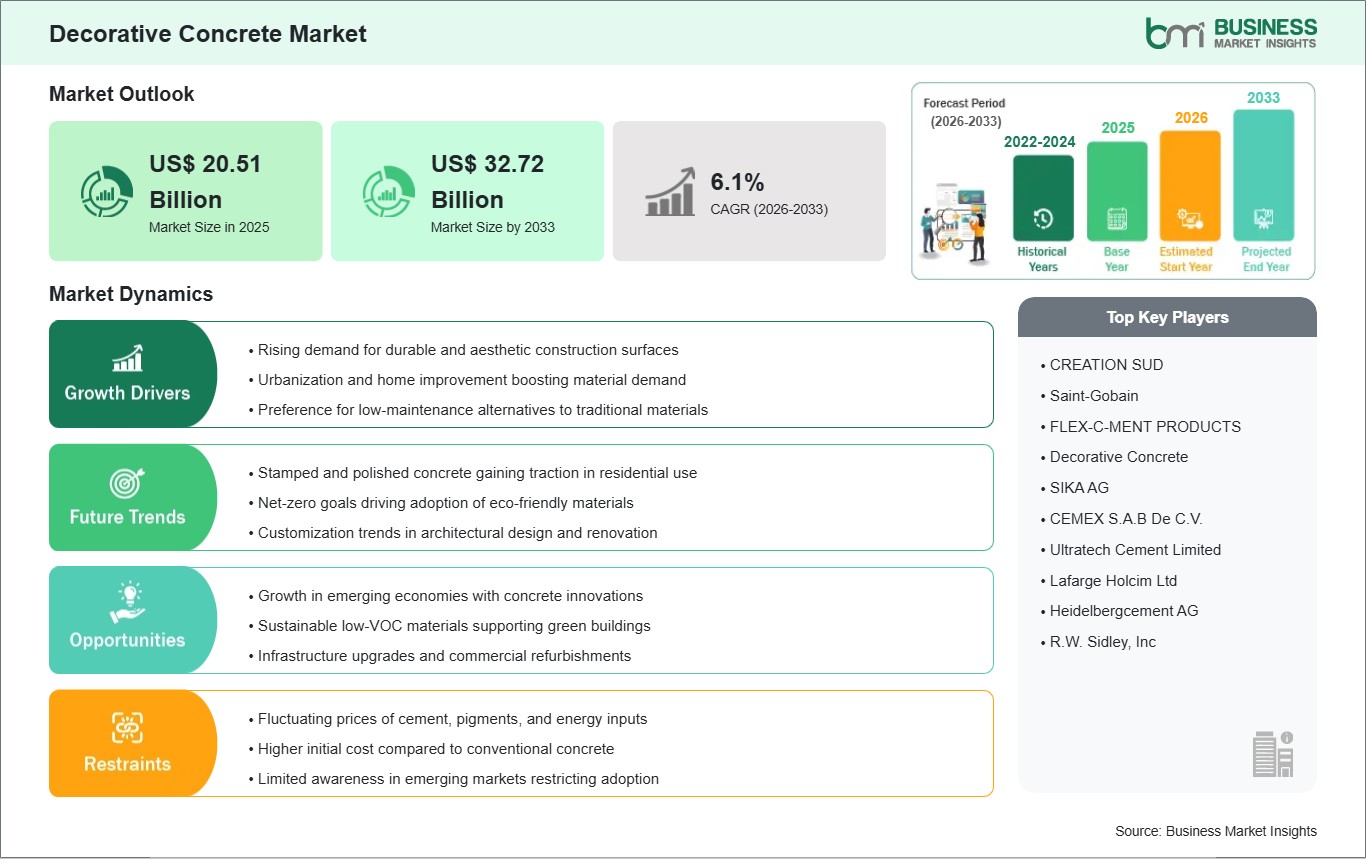
Decorative concrete is important in modern construction and design. It improves surfaces with visual appeal while also offering durability and lasting performance. These solutions are common in residential, commercial, and public infrastructure projects. They serve as effective tools for enhancing visuals, protecting surfaces, and ensuring structural longevity. Decorative concrete can imitate natural stone, wood, or tile patterns and provide versatility in color, texture, and finish. It also leads to low-maintenance surfaces, better weather resistance, and environmentally friendly building practices. The benefits include strong durability, design flexibility, less upkeep, and higher property value. Market growth is mainly driven by urban development, increased construction spending, and the demand for attractive yet functional surfaces. Advances in stamping, staining, and overlaying methods also support this growth.
However, the decorative concrete market faces challenges, such as high initial installation costs that can limit adoption, and improper application may hurt performance or visual quality. Specialized skills are necessary for design, finishing, and curing processes. The quality of materials and climate factors can also affect longevity. Despite these challenges, opportunities are growing due to rising interest in sustainable materials, innovative surface techniques, and the demand for unique, high-end finishes. Future market developments will likely concentrate on eco-friendly formulations, improved application technologies, and design trends that blend aesthetics with long-lasting durability.
Segment Analysis
Decorative Concrete Market Segmentation
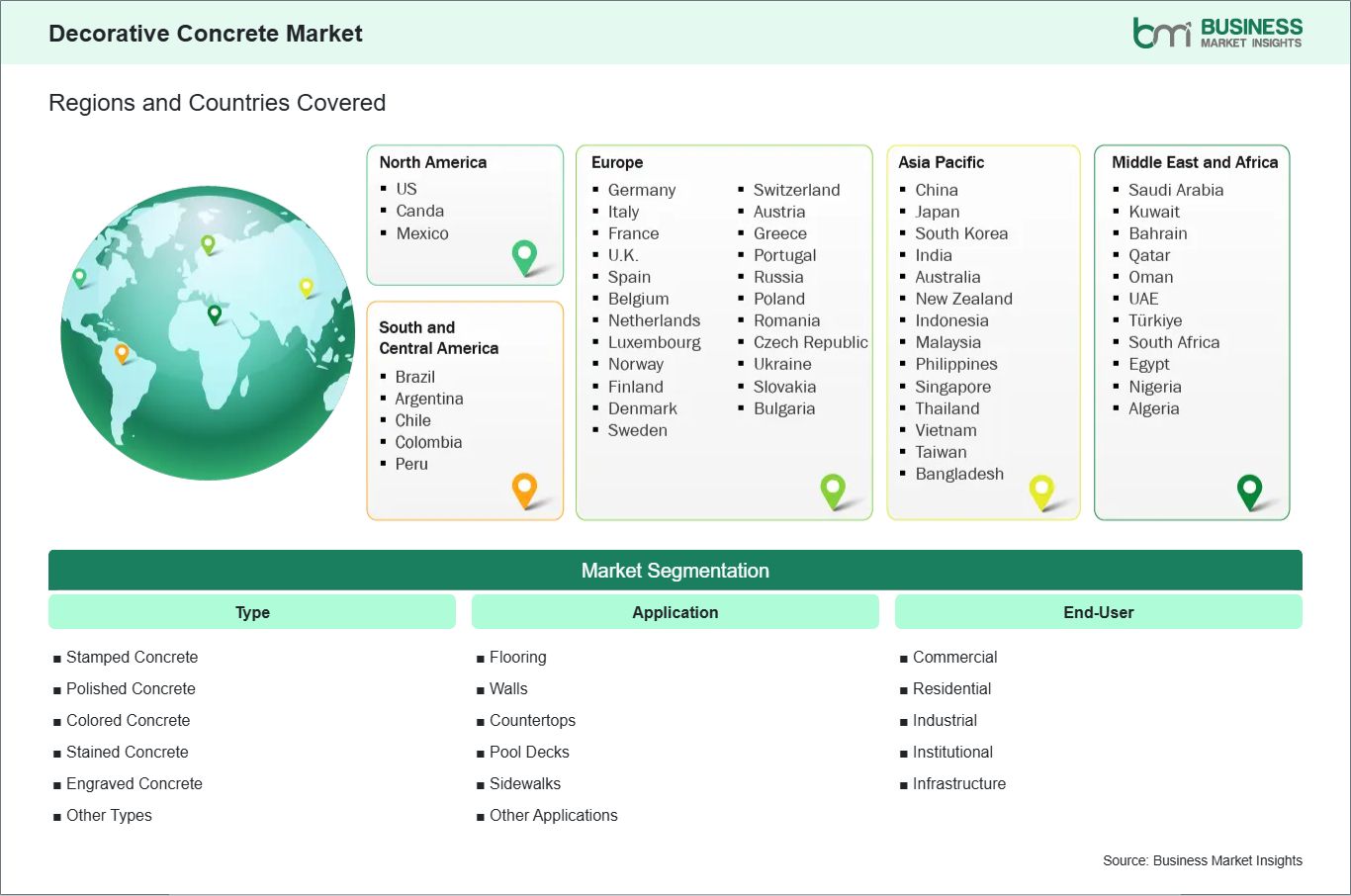
Key segments that contributed to the derivation of the decorative concrete market analysis are type, application, and end-user.
- By type, the decorative concrete market is segmented into stamped concrete, polished concrete, colored concrete, stained concrete, engraved concrete, and other types. The stamped concrete segment dominated the market in 2025.
- By application, the market is categorized into flooring, walls, countertops, pool decks, sidewalks, and other applications. The flooring segment dominated the market in 2025.
- By end-user, the decorative concrete market is segmented into commercial, residential, industrial, institutional, and infrastructure. The residential segment dominated the market in 2025.
Market Forces
Decorative Concrete Market Drivers and Opportunities
Rising Demand for Aesthetic and Durable Construction Surfaces
Property owners and developers are increasingly choosing decorative concrete to improve the appearance and durability of buildings and outdoor spaces. These options are cost-effective compared to natural stone, wood, or tiles, while providing better durability and requiring less maintenance. Decorative concrete fulfills modern design needs by allowing for custom patterns, colors, and textures without affecting structural strength. Its use in busy areas, commercial buildings, and home renovations is increasing due to the demand for stylish and strong surfaces. Advances in stamping, staining, and polishing techniques are also broadening its uses. Market growth is driven by urbanization, expanding infrastructure, and a growing awareness of design value, making decorative concrete a popular choice for current construction projects.
Opportunities in Eco-Friendly and Sustainable Concrete Solutions
There is increasing interest in environmentally responsible decorative concrete products, such as low-carbon mixes, recycled aggregates, and permeable finishes. This trend reflects a growing focus on green construction practices and energy-efficient building materials. Eco-friendly decorative concrete reduces environmental impact, supports sustainable urban development, and meets stricter building regulations. Innovations in colored, stamped, and polished surfaces using sustainable materials are attracting architects, designers, and developers seeking both aesthetics and ecological compliance. The push toward green building certifications and sustainable infrastructure creates strong opportunities for manufacturers to offer high-performance, visually appealing, and environmentally conscious concrete solutions that align with global sustainability goals.
Size and Share Analysis
Decorative Concrete Market Size and Share Analysis
The decorative concrete market demonstrates steady growth, with size and share analysis revealing evolving trends and competitive positioning among key players. The report further examines subsegments categorized within type, application, and end-user, offering insights into their contribution to overall market performance.
Based on type, the stamped concrete subsegment dominates the decorative concrete market. Stamped concrete offers great aesthetic flexibility, durability, and cost savings. It can mimic the look of natural stone, brick, wood, or tile, giving a high-end appearance without the cost of real materials. These surfaces are commonly used in driveways, patios, walkways, and public outdoor spaces. Their dependable performance, minimal upkeep, and lasting finish make stamped concrete the preferred option for homeowners, architects, and developers who want durable, attractive, and affordable solutions to improve property value and outdoor appearance.
Report Coverage
Decorative Concrete Market Report Coverage and Deliverables
The "Decorative Concrete Market Size and Forecast (2022 - 2033)" report provides a detailed analysis of the market covering the following areas:
- Decorative Concrete market size and forecast at global, regional, and country levels for all the key market segments covered under the scope
- Decorative Concrete market trends, as well as market dynamics such as drivers, restraints, and key opportunities
- Decorative Concrete market analysis covering key market trends, global and regional framework, major players, regulations, and recent market developments
- Industry landscape and competition analysis covering market concentration, heat map analysis, prominent players, and recent developments for the decorative concrete market
- Detailed company profiles, including SWOT analysis
Geographic Insights
Decorative Concrete Market Geographic Insights
The geographical scope of the decorative concrete market report is divided into five regions: North America, Asia Pacific, Europe, Middle East & Africa, and South & Central America. The Asia Pacific Decorative Concrete Market is segmented into China, Japan, South Korea, India, Australia, New Zealand, Indonesia, Malaysia, the Philippines, Singapore, Thailand, Vietnam, Taiwan, Bangladesh, and the Rest of Asia Pacific. Asia Pacific's fast urbanization and growing construction industry make it a top region for decorative concrete market growth. The demand comes from significant residential, commercial, and infrastructure development, as well as increased investment in quality flooring, patios, and public spaces. Rising awareness of durable, low-maintenance, and visually adaptable surfaces boosts the use of stamped, polished, and colored concrete.
Furthermore, the growing consumer preference for attractive yet affordable construction materials, along with government efforts promoting modern infrastructure and sustainable building practices, strengthens the Asia Pacific's role as a major center for decorative concrete production and consumption.
Industry Activity
Recent Developments
The decorative concrete market is evaluated by gathering qualitative and quantitative data post-primary and secondary research, which includes important corporate publications, association data, and databases. A few of the key developments in the decorative concrete market are:
- In March 2026, Amrize introduced the EVERtect high-performance concrete range at the CONEXPO-CON/AGG in Las Vegas, aimed at providing builders with customizable strength and reliability for various construction projects. This range sets a higher standard in the building industry across the US and Canada, featuring precision-engineered mixes for demanding performance needs. The IMAGItect decorative concrete variant offers superior performance for architectural projects, characterized by high durability, low maintenance, and a variety of colors, patterns, and textures.
- In November 2025, AMC Concrete expanded its residential concrete services and coverage in Middle Tennessee. The updates include improved project management to address the increasing demand for high-quality installations such as driveways, patios, and concrete slabs. Their services encompass driveway replacement, new construction, sidewalks, stamped and decorative concrete, drainage corrections, slab preparation, and surface repairs, with a notable rise in demand for decorative finishes as homeowners seek durable outdoor enhancements.
Trust & Transparency
Research Methodology
The market analysis combines proprietary research with secondary data from government agencies, company disclosures, regulatory filings, industry databases and expert interviews. Market estimates are validated through data triangulation, cross-market benchmarking and analyst
review.
View Full Research Methodology
Key Sources Referred:
World Bank - Global Trade IndicatorsEuropean Chemicals AgencyInternational Council of Chemical AssociationsInternational Monetary Fund (IMF)World Trade Organization (WTO)International Trade Administration (ITA)Company WebsitesCompany Annual ReportsCompany Investor Presentations