Polymer Concrete Market Outlook (2022-2033)

Historic Data: 2022-2024   |   Base Year: 2025   |   Forecast Period: 2026-2033
Report Content: Market Scope, Market Segmentation, Market Dynamics, and Competitive Analysis

Report Coverage:
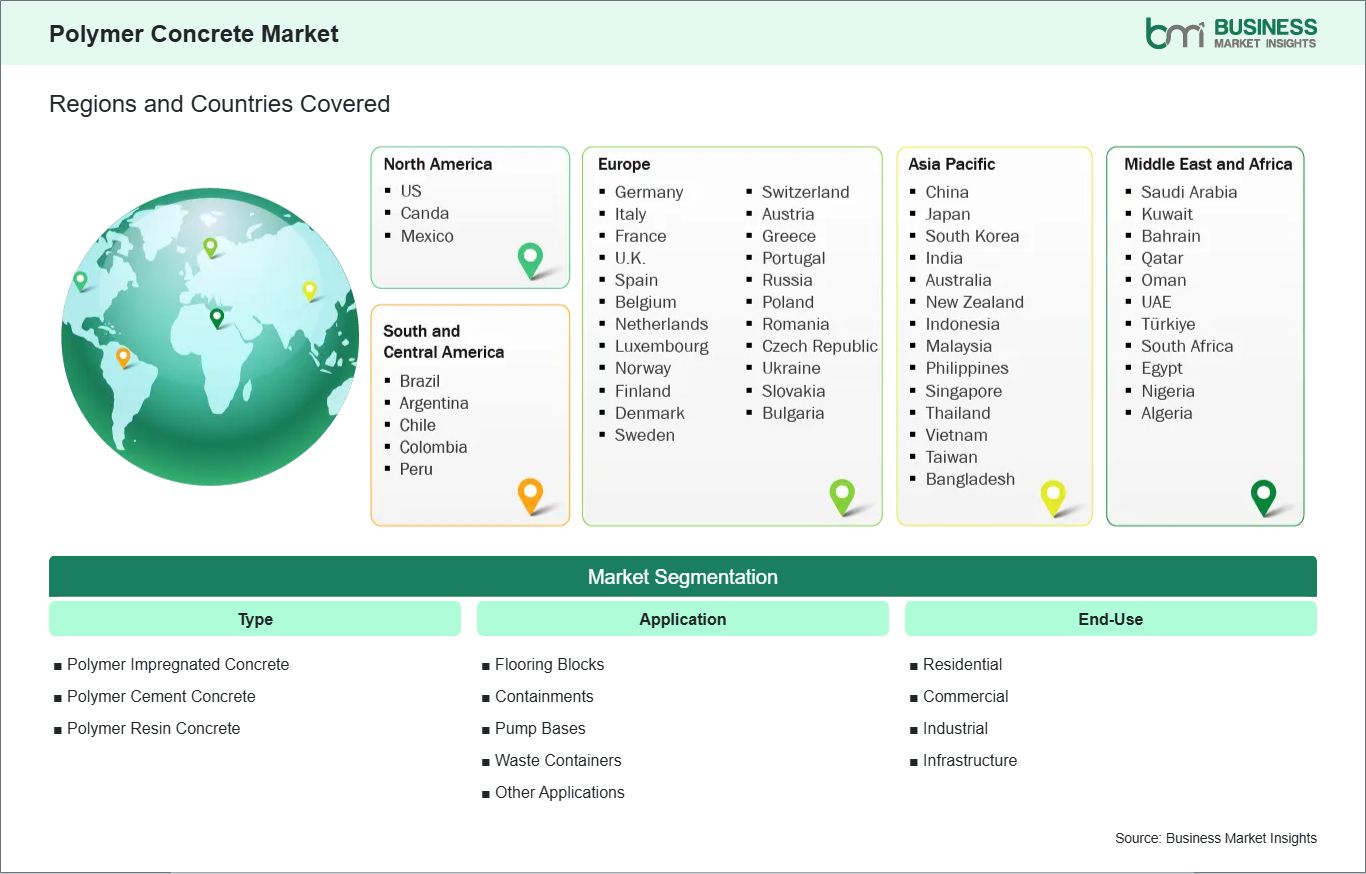
  • Type (Polymer Impregnated Concrete, Polymer Cement Concrete, Polymer Resin Concrete)
  • Application (Flooring Blocks, Containments, Pump Bases, Waste Containers, Other Applications)
  • End-Use (Residential, Commercial, Industrial, Infrastructure)

No. of Pages: 426
Report Code: BMIPUB00034181
Category: Chemicals and Materials
Polymer Concrete Market

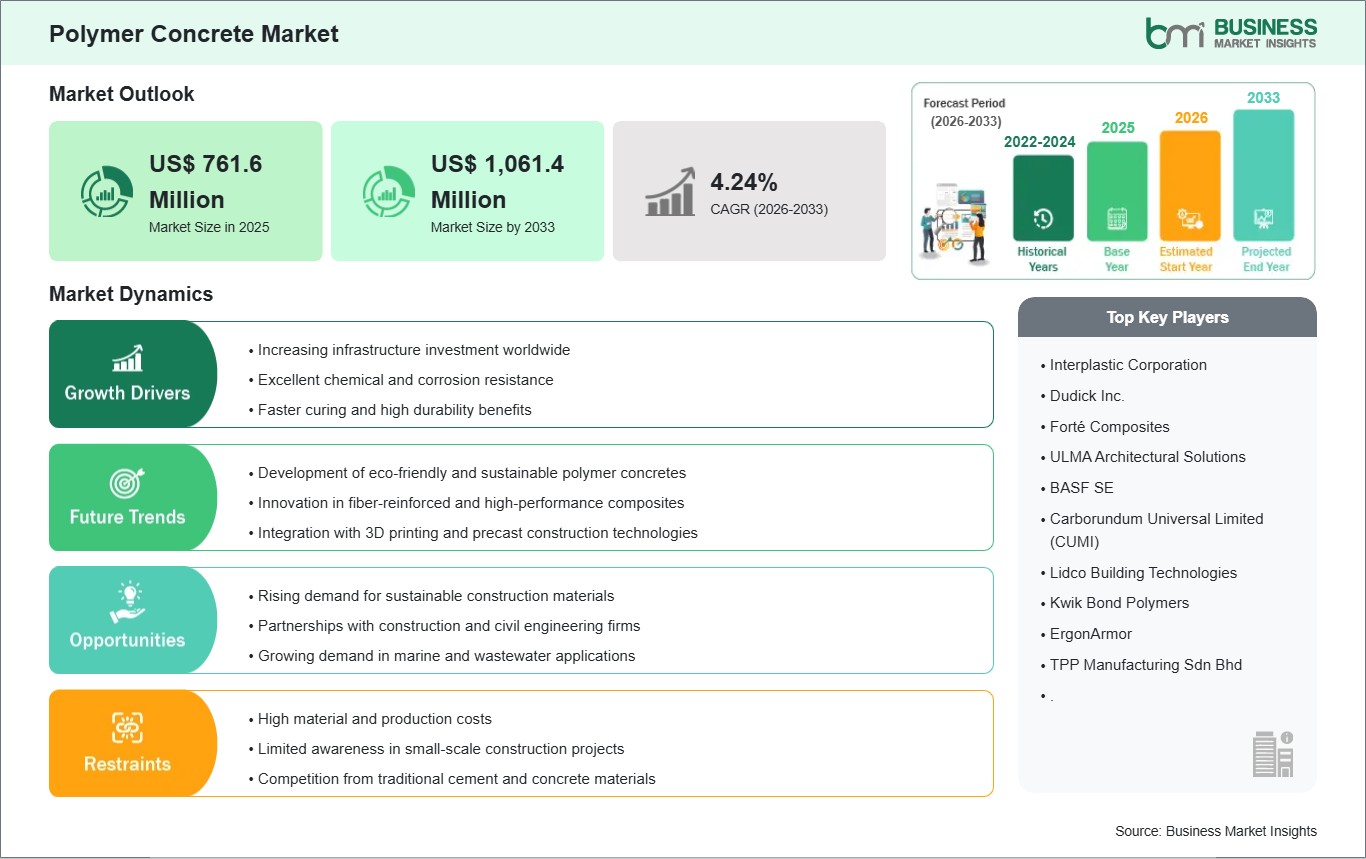
The Polymer Concrete Market size is expected to reach US$ 1,061.4 million by 2033 from US$ 761.6 million in 2025. The market is estimated to record a CAGR of 4.24% from 2026 to 2033.

Executive Summary and Global Market Analysis:

The polymer concrete market is growing at a rapid pace. This is because the demand for high-performance construction materials is growing in infrastructure, industrial, and commercial construction. Polymer concrete is one such material that is produced using aggregates and polymer-based binders. It is known for its high mechanical strength, resistance to corrosive materials, rapid curing, and high durability. It is ideal for industrial flooring, precast structures, bridge decks, and applications in corrosive environments. It is used in chemical plants, wastewater treatment facilities, and offshore structures.

Technological innovation is one of the factors driving the polymer concrete market. Manufacturers are using advanced technology to develop polymer-based composites to enhance the impact resistance, shrinkage resistance, and heat stability of polymer concrete. Self-leveling and lightweight polymer concretes are being developed to address the requirements of modern construction techniques. The use of recycled aggregates in combination with sustainable resin is also becoming more popular, reflecting the increased environmental awareness and governmental initiatives to use green materials in construction. Competitive strategies in the polymer concrete market are focused on differentiating the products, offering solutions for specific applications, and expanding operations in new markets.

Major players in the market are investing in R&D for high-strength and chemically resistant polymers, collaborating with construction companies, and expanding operations in different regions to fulfill the rising demand for the material. Market forces such as urbanization, industrialization, and governmental initiatives for construction through public-private partnerships are creating new growth opportunities for the polymer concrete market in both developed and developing countries. Thus, the polymer concrete market has a positive outlook in terms of growth.

Polymer Concrete Market - Strategic Insights:

global-market-strategic-framework
Get more information on this report

Polymer Concrete Market Segmentation Analysis:

Key segments that contributed to the derivation of the polymer concrete market analysis are type, application, and end‑use.

  • By Type, the polymer concrete market is segmented into polymer impregnated concrete, polymer cement concrete, and polymer resin concrete. The polymer resin concrete segment dominated the market in 2025.
  • Based on Application, the polymer concrete market is classified into flooring blocks, containments, pump bases, waste containers, and others. The flooring blocks segment dominated the market in 2025.
  • On the basis of End‑Use, the polymer concrete market is categorized into residential, commercial, industrial, and infrastructure. The infrastructure segment dominated the market in 2025.

Polymer Concrete Market Drivers and Opportunities:

Increasing infrastructure investment worldwide

The polymer concrete market is growing rapidly with the increase in infrastructure development projects. Governments and individuals are investing huge amounts in infrastructure development projects such as roads, bridges, tunnels, and industrial buildings. These infrastructure development projects require high-strength construction materials to withstand heavy loads, corrosive chemicals, and environmental factors. Polymer concrete is one such product with high mechanical strength, long-lasting performance, and high resistance to corrosive chemicals compared to normal concrete. It is being increasingly used in infrastructure development projects. As a result, it is being widely used in industrial floors, bridge decks, precast structures, and airport runways.

In the Asia Pacific region, polymer concrete is being increasingly used due to the rapid growth in infrastructure development projects. Many infrastructure development projects are being executed in Asian countries such as China, India, and Southeast Asian countries. Moreover, the infrastructure development projects executed in these regions require high-strength construction materials to withstand heavy loads, corrosive chemicals, and environmental factors. As polymer concrete is one such product with high mechanical strength, long-lasting performance, and high resistance to corrosive chemicals compared to normal concrete, it is being increasingly used in infrastructure development projects.

Furthermore, technological advancements in polymer formulations are expanding its application potential. Modified resins, including epoxy, polyester, and vinyl ester, allow for tailor-made polymer concrete with specific properties such as high thermal stability, low permeability, and improved adhesion. These innovations support the growing adoption of polymer concrete in critical infrastructure where longevity and reliability are non-negotiable. With infrastructure spending projected to increase globally, polymer concrete is poised to capture a larger share of the construction materials market, particularly in sectors that demand high durability and rapid project completion.

Rising demand for sustainable construction materials

The sustainability concerns and regulatory pressures are boosting polymer concrete demand on a global level, as the construction industry is looking for environmentally friendly alternatives to traditional building materials. The traditional method of preparing concrete contributes to carbon emissions, while polymer concrete is using recycled materials, which are environmentally friendly. The construction industry is focusing on green building certifications and energy-efficient buildings, which has made polymer concrete a popular choice for environmentally friendly construction projects.

The use of polymer concrete in infrastructure rehabilitation and maintenance activities is contributing to sustainability, as this material is highly resistant to chemicals, water, and abrasion, which extends its life expectancy, thereby reducing material consumption and maintenance activities. In urban areas, polymer concrete is used in infrastructure rehabilitation, such as pipelines, bridge overlays, and precast modules, which are boosting its demand, as this material is highly beneficial for infrastructure maintenance activities, especially in urban areas where infrastructure is aging.

Manufacturers are using new technologies to develop polymer concrete using low VOC resins, which are biodegradable, to meet the environmental regulations in Europe, North America, and Asia, where environmental regulations are becoming more stringent.

Global construction trends emphasize the integration of sustainable materials without compromising performance. With governments incentivizing green construction and private developers aiming for long-term cost efficiency, polymer concrete adoption is rising across commercial, industrial, and transportation projects. Increasing collaboration between resin manufacturers, construction firms, and research institutes is also accelerating innovation, creating formulations that optimize mechanical properties while minimizing environmental footprint. As sustainability continues to shape the construction landscape worldwide, polymer concrete is expected to play a pivotal role in eco-conscious infrastructure development and maintenance.

Polymer Concrete Market Size and Share Analysis:

The polymer concrete market demonstrates steady growth, with size and share analysis highlighting evolving trends and competitive dynamics among key players. The report examines subsegments categorized within type, application, and end‑use, offering insights into their contribution to overall market performance.

By Type, the polymer resin concrete subsegment dominated the market in 2025, driven by strong demand in high‑strength structural and architectural applications.

Based on Application, the flooring blocks subsegment dominated the market in 2025, owing to its durability, chemical resistance, and rapid‑curing properties.

On the Basis of End‑Use, the infrastructure subsegment dominated the market in 2025, supported by increased investments in infrastructure projects and the demand for long‑lasting construction materials.

Polymer Concrete Market Report Highlights:

Report Attribute Details
Market size in 2025 US$ 761.6 Million
Market Size by 2033 US$ 1,061.4 Million
Global CAGR (2026 - 2033)4.24%
Historical Data 2022-2024
Forecast period 2026-2033
Segments Covered By Type
  • Polymer Impregnated Concrete
  • Polymer Cement Concrete
  • Polymer Resin Concrete
By Application
  • Flooring Blocks
  • Containments
  • Pump Bases
  • Waste Containers
  • Other Applications
By End-Use
  • Residential
  • Commercial
  • Industrial
  • Infrastructure
Regions and Countries Covered
North America US, Canada, Mexico
Europe Belgium, Austria, Finland, Denmark, Greece, Poland, Romania, Russia, Ukraine, Czech Republic, Slovakia, Bulgaria, Italy, Luxembourg, Germany, Switzerland, France, Netherlands, Norway, Portugal, Spain, Sweden, United Kingdom
Asia-Pacific Australia, China, India, Japan, South Korea, Indonesia, Malaysia, Philippines, Singapore, Thailand, Vietnam, Bangladesh, New Zealand, Taiwan
South and Central America Brazil, Argentina, Peru, Chile, Colombia
Middle East and Africa Bahrain, Kuwait, Oman, Qatar, Saudi Arabia, United Arab Emirates, Turkiye, South Africa, Egypt, Algeria, Nigeria
Market leaders and key company profiles
  • Interplastic Corporation
  • Dudick Inc.
  • Forté Composites
  • ULMA Architectural Solutions
  • BASF SE
Get more information on this report

Polymer Concrete Market Report Coverage and Deliverables:

The "Polymer Concrete Market Size and Forecast (2022 - 2033)" report provides a detailed analysis of the market covering below areas:

  • Polymer Concrete Market size and forecast at global, regional, and country levels for all the key market segments covered under the scope
  • Polymer Concrete Market trends, as well as drivers, restraints, and opportunities
  • Polymer Concrete Market analysis covering key trends, global and regional framework, major players, regulations, and recent developments
  • Industry landscape and competition analysis covering market concentration, heat map analysis, prominent players, and recent developments for the Polymer Concrete Market
  • Detailed company profiles, including SWOT analysis

Polymer Concrete Market Geographic Insights:

The geographical scope of the Polymer Concrete Market report is divided into North America, Asia Pacific, Europe, Middle East & Africa, and South & Central America. North America held the largest share in 2025.

Regionally, the polymer concrete market exhibits diverse growth patterns influenced by industrial development, infrastructure spending, and environmental regulations. North America dominates the market, with the U.S. leading in industrial flooring, bridge decks, and wastewater infrastructure applications. Advanced construction technologies, high demand for corrosion-resistant solutions, and substantial public and private infrastructure investments support the region’s market leadership.

In the Asia Pacific, rapid urbanization, industrial expansion, and large-scale infrastructure projects drive polymer concrete demand. China, India, Japan, and South Korea are major contributors, with a focus on durable industrial floors, precast elements, and chemical-resistant coatings for manufacturing facilities. Government initiatives promoting sustainable and long-lasting construction materials accelerate market adoption.

Europe emphasizes sustainability, regulatory compliance, and high-performance construction materials. Germany, France, and Italy are key markets, with significant adoption in wastewater treatment plants, bridge construction, and industrial flooring. Manufacturers focus on eco-friendly polymer binders, high-durability composites, and specialized formulations for harsh environmental conditions.

The Middle East & Africa market is emerging, primarily driven by industrial, commercial, and urban infrastructure development. Countries such as the UAE, Saudi Arabia, and South Africa are investing in modern construction technologies and polymer-based materials to enhance the durability and longevity of industrial and urban projects.

South & Central America is developing steadily, with Brazil and Argentina leading adoption in industrial flooring, chemical-resistant structures, and precast elements. Growth is supported by infrastructure modernization, industrial expansion, and partnerships with North American and European polymer concrete producers to facilitate technology transfer and product availability.

global-market-geography
Get more information on this report

Polymer Concrete Market Research Report Guidance:

  • The report includes qualitative and quantitative data in the Polymer Concrete Market across type, application, end‑use and geography.
  • The report starts with the key takeaways (chapter 2), highlighting key trends and outlook of the Polymer Concrete Market.
  • Chapter 3 focuses on the research methodology of the study.
  • Chapter 4 includes ecosystem analysis.
  • Chapter 5 highlights the major industry dynamics in the Polymer Concrete Market, including factors that are driving the market, prevailing deterrents, potential opportunities, as well as future trends. Impact analysis of these drivers and restraints is also covered in this section.
  • Chapter 6 discusses the Polymer Concrete Market scenario, in terms of historical market revenues, and forecast till the year 2033.
  • Chapters 7 to 10 cover Polymer Concrete Market segments across type, application, end‑use and geography across North America, Asia Pacific, Europe, the Middle East & Africa, and South & Central America. They cover the market revenue forecast and factors driving the market.
  • Chapter 11 describes the competitive analysis along with the heat map analysis for the key players operating in the market.
  • Chapter 12 describes the industry landscape analysis. It provides detailed descriptions of business activities such as market initiatives, new developments, mergers, and joint ventures globally, along with a competitive landscape.
  • Chapter 13 provides detailed profiles of the major companies operating in the Polymer Concrete Market. Companies have been profiled on the basis of their key facts, business descriptions, products, financial overview, SWOT analysis, and key developments.
  • Chapter 14, i.e., the appendix, is inclusive of a brief overview of the company, a list of abbreviations, and a disclaimer.

Polymer Concrete Market News and Key Development:

The Polymer Concrete Market is evaluated by gathering qualitative and quantitative data post primary and secondary research, which includes important corporate publications, association data, and databases. A few of the key developments in the polymer concrete market are:

  • In April 2024, Sika AG completed the acquisition of Kwik Bond Polymers, LLC, a U.S. specialist in polymer systems for concrete infrastructure refurbishment, adding concrete polymer‑based refurbishment solutions (e.g., polymer concrete bridge deck and surface systems) to Sika’s portfolio and strengthening its global footprint in concrete repair technologies.
  • In January 2025, Vebro Polymers Asia announced the launch of a phthalate‑free (PF) polyurethane concrete flooring formulation under its vebrocrete PF product line a polymer concrete flooring system designed for industrial, chemical, food & beverage and hygiene‑critical environments with enhanced safety and sustainability characteristics.

Key Sources Referred:

  • International Organization for Standardization (ISO)
  • American Society for Testing and Materials (ASTM International)
  • Bureau of Indian Standards (BIS)
  • Environmental Protection Agency (EPA), USA
  • European Chemicals Agency (ECHA)
  • Central Pollution Control Board (CPCB), India
  • Ministry of Chemicals and Fertilizers, India
  • American Chemistry Council (ACC)
  • Indian Chemical Council (ICC)
  • European Chemical Industry Council (Cefic)
  • Specialty Chemical Association of India (SCAI)
  • Company Websites
  • Company Annual Reports
  • Company Investor Presentations
The List of Companies - Polymer Concrete Market
  • Interplastic Corporation
  • ,
  • Dudick Inc.
  • ,
  • Forté Composites
  • ,
  • ULMA Architectural Solutions
  • ,
  • BASF SE
  • ,
  • Carborundum Universal Limited (CUMI)
  • ,
  • Lidco Building Technologies
  • ,
  • Kwik Bond Polymers
  • ,
  • ErgonArmor
  • ,
  • TPP Manufacturing Sdn Bhd
  • .
Frequently Asked Questions
How big is the Polymer Concrete Market?

The Polymer Concrete Market is valued at US$ 761.6 Million in 2025, it is projected to reach US$ 1,061.4 Million by 2033.

What is the CAGR for Polymer Concrete Market by (2026 - 2033)?

As per our report Polymer Concrete Market, the market size is valued at US$ 761.6 Million in 2025, projecting it to reach US$ 1,061.4 Million by 2033. This translates to a CAGR of approximately 4.24% during the forecast period.

What segments are covered in this report?

The Polymer Concrete Market report typically cover these key segments-

  • Type (Polymer Impregnated Concrete, Polymer Cement Concrete, Polymer Resin Concrete)
  • Application (Flooring Blocks, Containments, Pump Bases, Waste Containers, Other Applications)
  • End-Use (Residential, Commercial, Industrial, Infrastructure)

What is the historic period, base year, and forecast period taken for Polymer Concrete Market?

The historic period, base year, and forecast period can vary slightly depending on the specific market research report. However, for the Polymer Concrete Market report:

  • Historic Period : 2022-2024
  • Base Year : 2025
  • Forecast Period : 2026-2033
  • Who are the major players in Polymer Concrete Market?

    The Polymer Concrete Market is populated by several key players, each contributing to its growth and innovation. Some of the major players include:

  • Interplastic Corporation
  • ,
  • Dudick Inc.
  • ,
  • Forté Composites
  • ,
  • ULMA Architectural Solutions
  • ,
  • BASF SE
  • ,
  • Carborundum Universal Limited (CUMI)
  • ,
  • Lidco Building Technologies
  • ,
  • Kwik Bond Polymers
  • ,
  • ErgonArmor
  • ,
  • TPP Manufacturing Sdn Bhd
  • .
  • Who should buy this report?

    The Polymer Concrete Market report is valuable for diverse stakeholders, including:

    • Investors: Provides insights for investment decisions pertaining to market growth, companies, or industry insights. Helps assess market attractiveness and potential returns.
    • Industry Players: Offers competitive intelligence, market sizing, and trend analysis to inform strategic planning, product development, and sales strategies.
    • Suppliers and Manufacturers: Helps understand market demand for components, materials, and services related to concerned industry.
    • Researchers and Consultants: Provides data and analysis for academic research, consulting projects, and market studies.
    • Financial Institutions: Helps assess risks and opportunities associated with financing or investing in the concerned market.

    Essentially, anyone involved in or considering involvement in the Polymer Concrete Market value chain can benefit from the information contained in a comprehensive market report.

    Available Report Formats

    pdf-format excel-format pptx-format
    Buy Now
    Sales Assistance
    +1 646 791 7070 (US & UK)
    Customization Form

    Please tell us your area of interest
    (Market Segments/ Regions and Countries/ Companies)