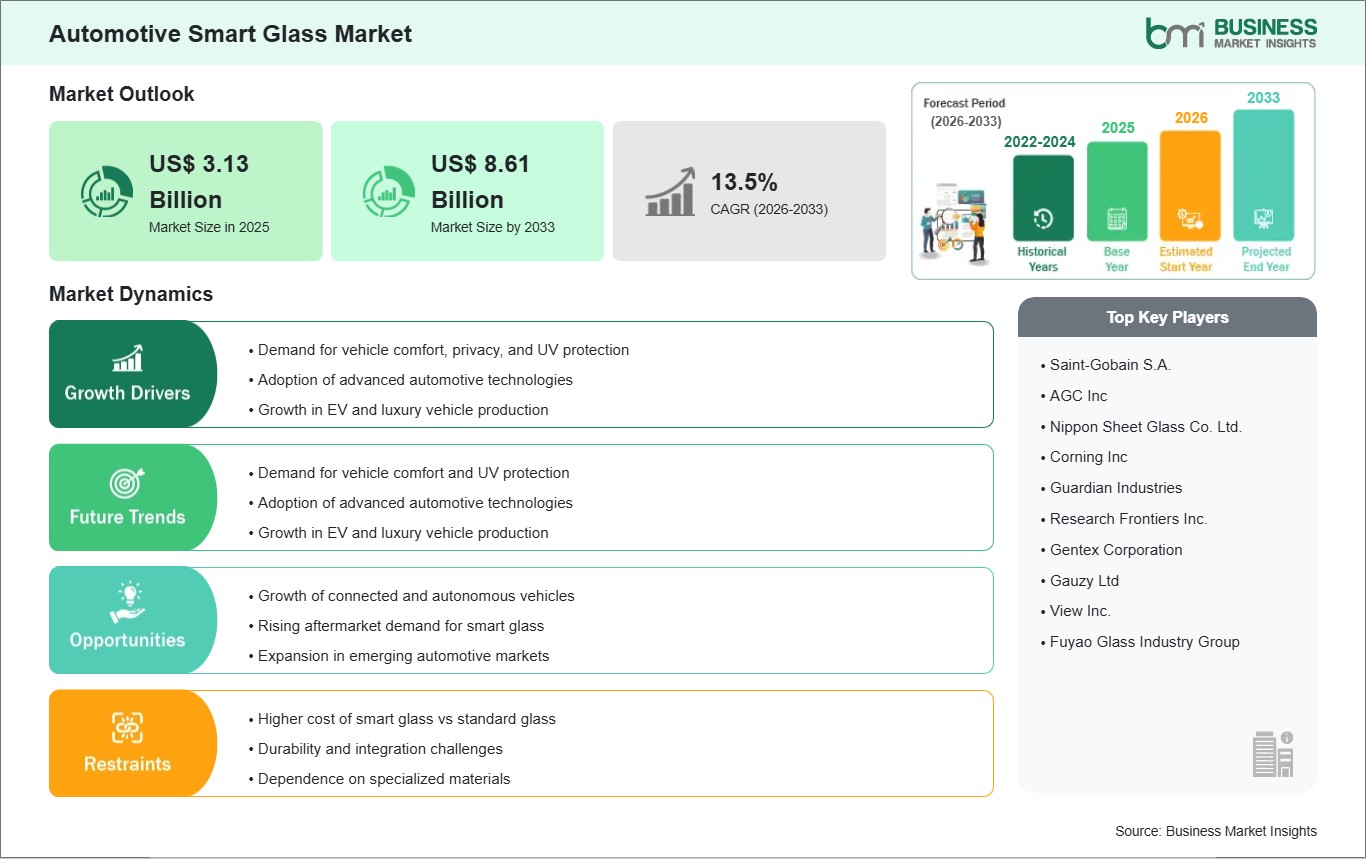
Automotive Smart Glass market size is expected to reach US$ 8.61 billion by 2033 from US$ 3.13 billion in 2025. The market is estimated to record a CAGR of 13.5% from 2026 to 2033.
Automotive smart glass is a technology that changes how much light, heat, and transparency it lets in. It responds to electrical signals or environmental changes. This glass is commonly found in sunroofs, windshields, side windows, rear windows, and interior partitions. It improves passenger comfort, energy efficiency, privacy, and driving safety. By using technologies like electrochromic, suspended particle device (SPD), and polymer dispersed liquid crystal (PDLC), smart glass helps control solar exposure, reduce glare, and provide thermal insulation. It optimizes cabin temperature, lowers the need for air conditioning, and enhances the overall driving experience. This makes it a valuable part of modern vehicles.
Demand for automotive smart glass is increasing in both premium and mid-range vehicle segments. More consumers prefer comfort, style, and advanced in-car technology. The fast growth of electric vehicles (EVs), connected cars, and self-driving platforms speeds up this trend. Smart glass helps save energy and improves battery efficiency by reducing heat load. Automakers are using smart glazing to set their models apart with features like panoramic roofs, dynamic tinting, and user-controlled transparency. Stricter energy-efficiency rules and emission reduction goals are pushing manufacturers to adopt technologies that improve thermal management and vehicle performance. More focus on passenger safety and driver assistance systems is also encouraging market growth. Smart glass can cut down glare and enhance visibility. When combined with sensors, heads-up displays, and advanced driver-assistance systems (ADAS), it boosts functionality. Improvements in material science and manufacturing are allowing for lighter, more durable glass options that meet automotive safety standards without sacrificing performance. As production increases and supply chains develop, costs are slowly becoming more competitive, making it easier to adopt this technology beyond luxury vehicles.

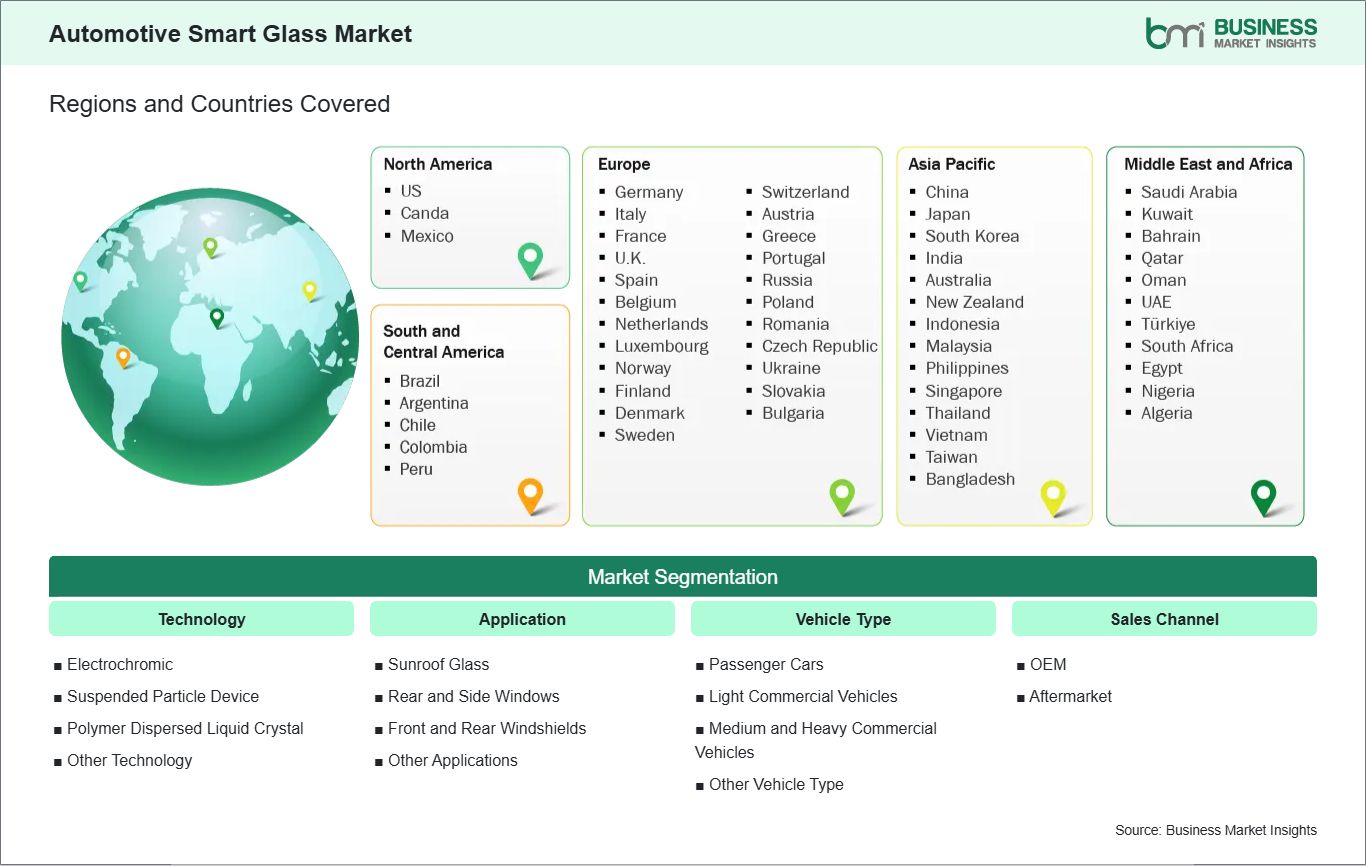
Key segments that contributed to the derivation of the Automotive Smart Glass market analysis are technology, application, vehicle type, and sales channel.
The global automotive smart glass market is driven by rising consumer demand for better in-vehicle comfort, energy efficiency, and stylish design. Smart glass technologies such as electrochromic, suspended particle device (SPD), and polymer dispersed liquid crystal (PDLC) allow for control of light transmission, glare reduction, and heat management inside vehicle cabins. These features greatly boost passenger comfort by maintaining ideal interior temperatures and decreasing the need for air conditioning. The quick growth of electric vehicles (EVs) also fuels demand, as smart glass can reduce energy use by lowering solar heat gain, which helps extend driving range and improve battery efficiency. Automakers are adding panoramic sunroofs, adaptive windshields, and switchable privacy glass to stand out and meet changing consumer expectations. Increasing awareness of sustainability, along with stricter emission and fuel-efficiency rules, is pushing the use of technologies that improve thermal insulation and overall vehicle performance. As vehicle electrification and the integration of high-end features continue to rise worldwide, the demand for smart glazing solutions is expected to grow steadily.
The automotive smart glass market is driven by the integration of new automotive technologies and a stronger focus on safety, connectivity, and design innovation. Modern vehicles are increasingly using advanced driver-assistance systems (ADAS), heads-up displays (HUDs), ambient lighting systems, and connected interfaces. These features require compatible and multifunctional glazing solutions. Smart glass helps by improving visibility through glare reduction, enabling adaptive tinting, and providing surfaces for display projection and sensor integration. Automakers are using smart glazing to improve vehicle looks, create futuristic interiors, and offer personalized user experiences with user-controlled transparency and shading features. Advances in conductive coatings, laminated glass structures, and control electronics are boosting durability, switching speed, and reliability while meeting strict automotive safety standards. Additionally, the push for lightweight materials to enhance fuel efficiency and electric vehicle (EV) performance is driving the development of thinner and more energy-efficient smart glass solutions. As automotive manufacturers focus on safety, innovation, and digital integration, the demand for intelligent glazing systems is growing in both luxury and mid-range vehicle segments, supporting ongoing global market growth.
The electrochromic segment dominated the market in 2025. Electrochromic smart glass is popular because it offers precise light control, saves energy, and integrates easily with vehicle electronics. Its ability to adjust tint levels improves passenger comfort, cuts glare, and manages temperature better, making it a top choice for premium and electric vehicles.
The sunroof glass segment is the leader as large panoramic sunroofs become important design and comfort features in modern cars. Smart sunroofs enhance the cabin’s look while reducing heat gain and UV exposure, catering to luxury and energy efficiency.
Growth in e-commerce, logistics, and urban mobility has increased demand for light commercial vehicles with comfort and efficiency features. Smart glass boosts driver comfort, lowers cabin heat during long hours, and helps fleet operators achieve better functionality and stand out.
The aftermarket segment dominated the market in 2025. The aftermarket segment leads thanks to rising consumer interest in vehicle customization and feature upgrades. More available retrofit smart tinting solutions and greater awareness of energy-saving and privacy benefits are driving strong demand beyond OEM installations.
| Report Attribute | Details |
|---|---|
| Market size in 2025 | US$ 3.13 Billion |
| Market Size by 2033 | US$ 8.61 Billion |
| Global CAGR (2026 - 2033) | 13.5% |
| Historical Data | 2022-2024 |
| Forecast period | 2026-2033 |
| Segments Covered | By Technology
|
| Regions and Countries Covered | North America
|
| Market leaders and key company profiles |
|
The "Automotive Smart Glass Market Size and Forecast (2022–2033)" report provides a detailed analysis of the market covering below areas:
The geographical scope of the Automotive Smart Glass market report is divided into five regions: North America, Asia Pacific, Europe, Middle East & Africa, and South & Central America. The Automotive Smart Glass market in the Asia Pacific is expected to grow significantly during the forecast period.
The Asia-Pacific Automotive Smart Glass market is segmented into China, Japan, South Korea, India, Australia, New Zealand, Indonesia, Malaysia, the Philippines, Singapore, Thailand, Vietnam, Taiwan, Bangladesh, and the Rest of Asia.
The Asia-Pacific region is the fastest-growing market for automotive smart glass. This growth is fueled by high automotive production, rapid urbanization, and greater use of vehicle technologies. Key players in this market include China, Japan, South Korea, and India. These countries have well-established automotive manufacturing systems and increasing electric vehicle (EV) industries. The rising demand for premium vehicles, panoramic sunroofs, and improved in-cabin comfort is driving the integration of smart glass in mid-range and luxury vehicles. Additionally, government support for vehicle electrification and energy efficiency encourages automakers to use glazing technologies that lower heat load and enhance battery performance. The region's strong electronics manufacturing base also aids the integration of smart glass with advanced driver-assistance systems (ADAS), heads-up displays, and connected car technologies. This strengthens Asia-Pacific's role as a key production and innovation center.
North America and Europe also hold significant shares in the global automotive smart glass market. Their positions are supported by technological leadership, demand for premium vehicles, and strict environmental regulations. The United States leads North America in adoption, driven by consumer preference for luxury vehicles and advanced comfort features. There are also strong investments in EV development and smart mobility solutions. In Europe, countries like Germany, France, and the United Kingdom focus on energy-efficient vehicle design and compliance with strict emission standards. This promotes the use of smart glazing for thermal management and weight reduction. Automakers and glass manufacturers in these regions are working on innovations like faster-switching electrochromic systems, better UV and infrared blocking, and lightweight laminated structures. Meanwhile, emerging markets in Latin America and the Middle East are gradually adopting smart glass as vehicle ownership increases and automotive manufacturing grows. The rising localization of production, strategic partnerships between OEMs and technology providers, and investments in sustainable manufacturing practices are all helping to strengthen the global supply chain. Across regions, support from regulations, vehicle electrification, and a growing demand for comfort, safety, and design innovation are expected to drive long-term growth in the automotive smart glass market.

The Automotive Smart Glass market is evaluated by gathering qualitative and quantitative data post primary and secondary research, which includes important corporate publications, association data, and databases. A few of the key developments in the Automotive Smart Glass market are:
The Automotive Smart Glass Market is valued at US$ 3.13 Billion in 2025, it is projected to reach US$ 8.61 Billion by 2033.
As per our report Automotive Smart Glass Market, the market size is valued at US$ 3.13 Billion in 2025, projecting it to reach US$ 8.61 Billion by 2033. This translates to a CAGR of approximately 13.5% during the forecast period.
The Automotive Smart Glass Market report typically cover these key segments-
The historic period, base year, and forecast period can vary slightly depending on the specific market research report. However, for the Automotive Smart Glass Market report:
The Automotive Smart Glass Market is populated by several key players, each contributing to its growth and innovation. Some of the major players include:
The Automotive Smart Glass Market report is valuable for diverse stakeholders, including:
Essentially, anyone involved in or considering involvement in the Automotive Smart Glass Market value chain can benefit from the information contained in a comprehensive market report.
Please tell us your area of interest
(Market Segments/ Regions and Countries/ Companies)