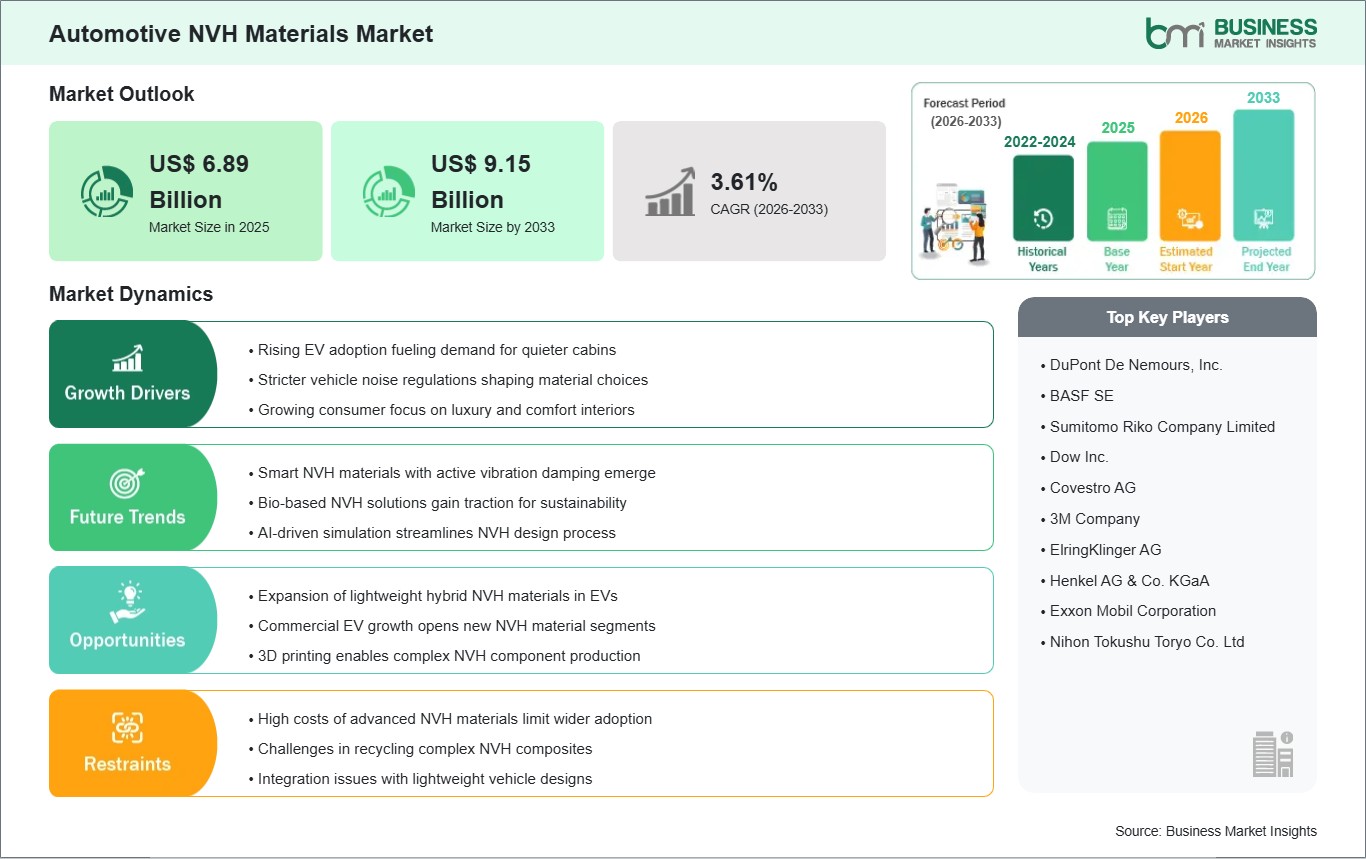
The Automotive NVH Materials Market size is expected to reach US$ 9.15 Billion by 2033 from US$ 6.89 Billion in 2025. The market is estimated to record a CAGR of 3.61% from 2026 to 2033.
Automotive NVH (Noise, Vibration, and Harshness) materials are specialized substances engineered to absorb, dampen, or block unwanted sounds and mechanical oscillations within a vehicle. Its key product categories include rubber dampers, polyurethane foams, thermoplastic polymers, and acoustic insulators. These technologies deliver significant clinical and economic value by reducing driver fatigue through quieter cabin environments, offering efficient solutions for vibration isolation that extend the lifespan of sensitive electronic components, and ensuring compliance with increasingly strict global noise emission standards. Market expansion is primarily attributed to the rising global demand for vehicle comfort, a growing geriatric population sensitive to cabin harshness, and government mandates requiring lower external noise footprints in urban environments. Furthermore, the integration of lightweight, high-performance composites, which provide superior sound absorption without significantly increasing vehicle mass, is substantially improving the efficiency of modern fuel-conscious and electric platforms.
However, several challenges can restrain market growth: high initial procurement and integration costs, particularly for advanced multi-layered acoustic laminates and specialty engineering resins, can limit adoption in price-sensitive entry-level segments. Stringent regulatory hurdles, such as the EU's evolving standards for recyclable automotive components and VOC (Volatile Organic Compound) emissions from interior materials, lengthen the time-to-market and increase development overhead for manufacturers. Additionally, the industry faces constraints due to the complexity of weight-versus-performance trade-offs, where the drive for vehicle lightweighting often conflicts with the traditional mass-based approach to sound damping, requiring highly specialized and often more expensive material innovations.
Despite these hurdles, the market holds immense opportunities in the universal mandate for expanded electric mobility and the accelerating deployment of ultra-quiet NVH solutions for EVs, where the absence of engine noise makes wind and tire sounds more prominent. The expansion of bio-based and sustainable acoustic materials derived from natural fibers and the development of AI-optimized material placement, using simulation to identify the exact points of resonance, are expected to create significant opportunities for market growth.

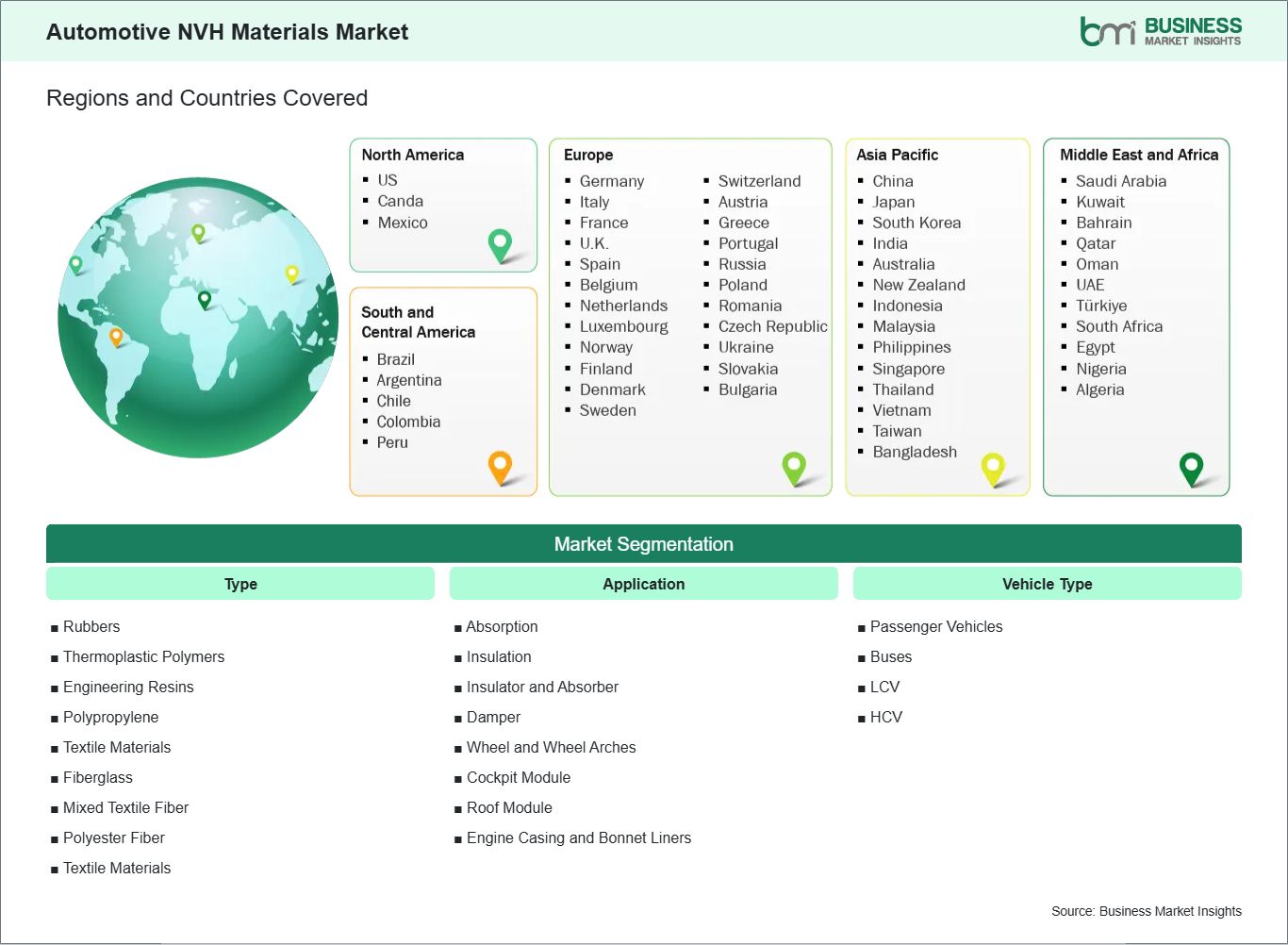
Key segments that contributed to the derivation of the Automotive NVH Materials market analysis are type, application, and vehicle type.
The primary driver for the Automotive NVH (Noise, Vibration, and Harshness) Materials Market is the accelerating global transition to Electric Vehicles (EVs). Unlike traditional internal combustion engines, which produce a consistent masking sound, electric powertrains are nearly silent. This silence makes secondary noise sources, such as high-frequency motor whine, road friction, and wind turbulence, far more perceptible and distracting to passengers. To address this, manufacturers are compelled to integrate advanced acoustic insulators and damping materials that can neutralize these specific frequencies. This demand is further amplified by rising consumer expectations for "premium" cabin comfort across all vehicle segments, not just luxury models.
Additionally, stringent government regulations regarding external pass-by noise and vehicle weight are driving the adoption of high-performance, lightweight NVH materials. As automakers strive to improve fuel efficiency and battery range, the need for materials that offer maximum sound absorption with minimum added mass has become a critical engineering priority.
A significant high-value opportunity lies in the development of sustainable and bio-based NVH solutions. As the automotive industry moves toward carbon neutrality, there is a burgeoning market for acoustic materials derived from recycled plastics, natural fibers, and renewable resins. These "green" materials allow OEMs to meet environmental, social, and governance (ESG) targets without compromising on noise reduction performance. Another major growth frontier is the integration of smart and active NVH technologies. Manufacturers are exploring the synergy between traditional passive materials and active noise cancellation (ANC) systems, creating "hybrid" environments where software and material science work in tandem to eliminate cabin noise.
Furthermore, the rise of autonomous driving presents a unique opportunity; as the steering wheel becomes secondary and the cabin evolves into a mobile living or office space, the demand for "holistic" acoustic management, including vibration-damping seats and noise-isolated glass, is expected to surge. Companies that pioneer miniaturized, multi-layer insulation systems tailored for compact EV architectures are positioned to lead the next generation of automotive design.
The Automotive NVH Materials market demonstrates steady growth, with size and share analysis revealing evolving trends and competitive positioning among key players. The report further examines subsegments categorized within type, application, and vehicle type, offering insights into their contribution to overall market performance.
For instance, based on the application segment, the Absorption subsegment is experiencing rapid adoption, particularly through the use of high-performance Fiberglass, Polyester Fiber, and Textile Materials. These materials are essential for Engine Casing and Bonnet Liners in ICE vehicles and for Wheel and Wheel Arches in both traditional and electric platforms to mitigate road-induced noise. In 2026, the market is seeing a surge in "mixed textile" solutions that combine recycled cotton and synthetic fibers to create porous barriers with enhanced air-flow resistance. This level of acoustic precision is critical for Buses and Heavy Commercial Vehicles (HCV), where reducing driver fatigue through improved cabin insulation has become a primary safety standard for long-haul transportation.

The Automotive NVH Materials market demonstrates steady growth, with size and share analysis revealing evolving trends and competitive positioning among key players. The report further examines subsegments categorized within type, application, and vehicle type, offering insights into their contribution to overall market performance.
For instance, based on the application segment, the Absorption subsegment is experiencing rapid adoption, particularly through the use of high-performance Fiberglass, Polyester Fiber, and Textile Materials. These materials are essential for Engine Casing and Bonnet Liners in ICE vehicles and for Wheel and Wheel Arches in both traditional and electric platforms to mitigate road-induced noise. In 2026, the market is seeing a surge in "mixed textile" solutions that combine recycled cotton and synthetic fibers to create porous barriers with enhanced air-flow resistance. This level of acoustic precision is critical for Buses and Heavy Commercial Vehicles (HCV), where reducing driver fatigue through improved cabin insulation has become a primary safety standard for long-haul transportation.
| Report Attribute | Details |
|---|---|
| Market size in 2025 | US$ 6.89 Billion |
| Market Size by 2033 | US$ 9.15 Billion |
| Global CAGR (2026 - 2033) | 3.61% |
| Historical Data | 2022-2024 |
| Forecast period | 2026-2033 |
| Segments Covered | By Type
|
|
Regions and Countries Covered
| |
| North America | US, Canada, Mexico |
| Europe | Belgium, Austria, Finland, Denmark, Greece, Poland, Romania, Russia, Ukraine, Czech Republic, Slovakia, Bulgaria, Italy, Luxembourg, Germany, Switzerland, France, Netherlands, Norway, Portugal, Spain, Sweden, United Kingdom |
| Asia-Pacific | Australia, China, India, Japan, South Korea, Indonesia, Malaysia, Philippines, Singapore, Thailand, Vietnam, Bangladesh, New Zealand, Taiwan |
| South and Central America | Brazil, Argentina, Peru, Chile, Colombia |
| Middle East and Africa | Bahrain, Kuwait, Oman, Qatar, Saudi Arabia, United Arab Emirates, Turkiye, South Africa, Egypt, Algeria, Nigeria |
| Market leaders and key company profiles |
|
The "Automotive NVH Materials Market Size and Forecast (2022 - 2033)" report provides a detailed analysis of the market covering below areas:
The geographical scope of the Automotive NVH Materials market report is divided into five regions: North America, Asia Pacific, Europe, Middle East &Africa, and South &Central America.
The Asia-Pacific Automotive NVH Materials Market is segmented into China, Japan, South Korea, India, Australia, New Zealand, Indonesia, Malaysia, the Philippines, Singapore, Thailand, Vietnam, Taiwan, Bangladesh, and the Rest of Asia. The market is primarily propelled by the region's status as the world's largest manufacturing hub for both traditional internal combustion engine (ICE) vehicles and new-energy vehicles. China is a significant regional contributor, supported by its high EV penetration and domestic demand for premium cabin comfort. India is emerging as a high-growth center, fueled by rising disposable income, urbanization, and a growing consumer preference for "premiumization" in the passenger vehicle and two-wheeler segments.
Growth is further bolstered by the global automotive industry's focus on lightweighting to improve fuel efficiency and battery range, driving the adoption of advanced thermoplastic polymers and composite foams. The integration of active noise cancellation (ANC) systems and the development of bio-based and recycled acoustic materials solidify Asia-Pacific as a critical hub for innovation and sustainable manufacturing in the automotive NVH materials landscape.

The Automotive NVH Materials market is evaluated by gathering qualitative and quantitative data post primary and secondary research, which includes important corporate publications, association data, and databases. A few of the key developments in the Automotive NVH Materials market are:
The Automotive NVH Materials Market is valued at US$ 6.89 Billion in 2025, it is projected to reach US$ 9.15 Billion by 2033.
As per our report Automotive NVH Materials Market, the market size is valued at US$ 6.89 Billion in 2025, projecting it to reach US$ 9.15 Billion by 2033. This translates to a CAGR of approximately 3.61% during the forecast period.
The Automotive NVH Materials Market report typically cover these key segments-
The historic period, base year, and forecast period can vary slightly depending on the specific market research report. However, for the Automotive NVH Materials Market report:
The Automotive NVH Materials Market is populated by several key players, each contributing to its growth and innovation. Some of the major players include:
The Automotive NVH Materials Market report is valuable for diverse stakeholders, including:
Essentially, anyone involved in or considering involvement in the Automotive NVH Materials Market value chain can benefit from the information contained in a comprehensive market report.
Please tell us your area of interest
(Market Segments/ Regions and Countries/ Companies)