Market Summary
Executive Summary and Global Market Analysis
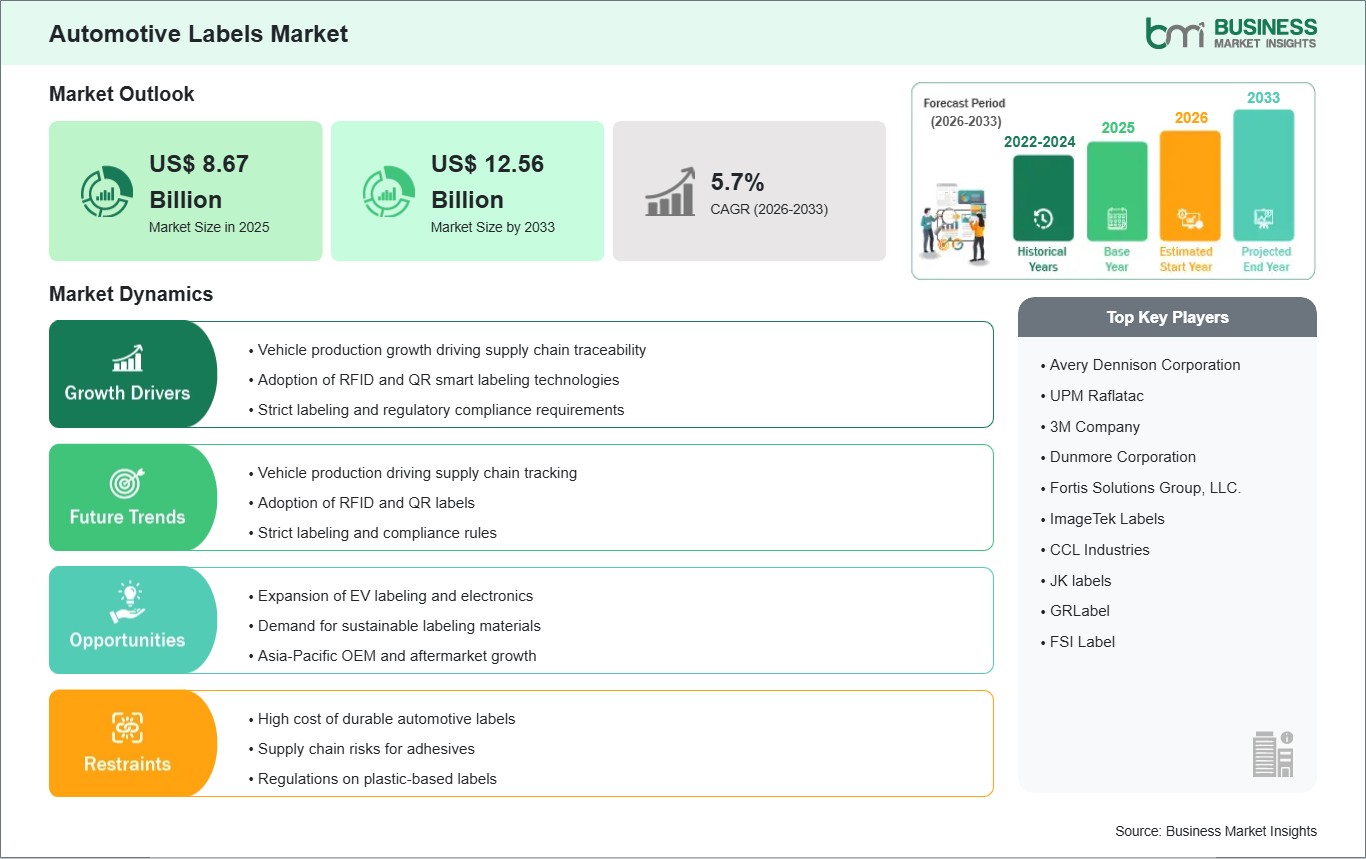
Automotive labels are crucial for modern vehicle manufacturing and safety. They provide essential identification, regulatory compliance, and traceability throughout a vehicle's lifecycle. These labels are widely used on interiors, exteriors, engine parts, tires, and batteries. They serve as tools for branding, tracking components, and informing consumers. Automotive labels can endure extreme temperatures, chemicals, and wear while remaining readable. They also help with serialization and prevent counterfeiting. The benefits include durability, strong adhesives, custom designs, and strict compliance with global safety and environmental standards. Market growth mainly comes from rising vehicle production, strict government regulations, the expansion of electric vehicles, and the growing use of smart labels with RFID and QR code technologies. Innovations in printable and heat-resistant materials also play an important role.
However, the automotive labels market faces challenges such as strict industry standards and certification requirements can create barriers, along with material performance issues in high-heat or outdoor settings. Cost pressures from automakers may restrict the use of premium labeling solutions. Achieving good adhesion and longevity also requires expertise in substrate compatibility and application methods. Despite these challenges, there are significant opportunities due to the demand for lightweight and sustainable materials, the integration of connected vehicle technologies, and the increasing desire for customized and brand-enhancing labels. Future market trends will depend on research into bio-based and recyclable label materials, changes in automotive safety standards, and the growing shift from mechanical parts to smart, data-embedded labeling systems.
Segment Analysis
Automotive Labels Market Segmentation
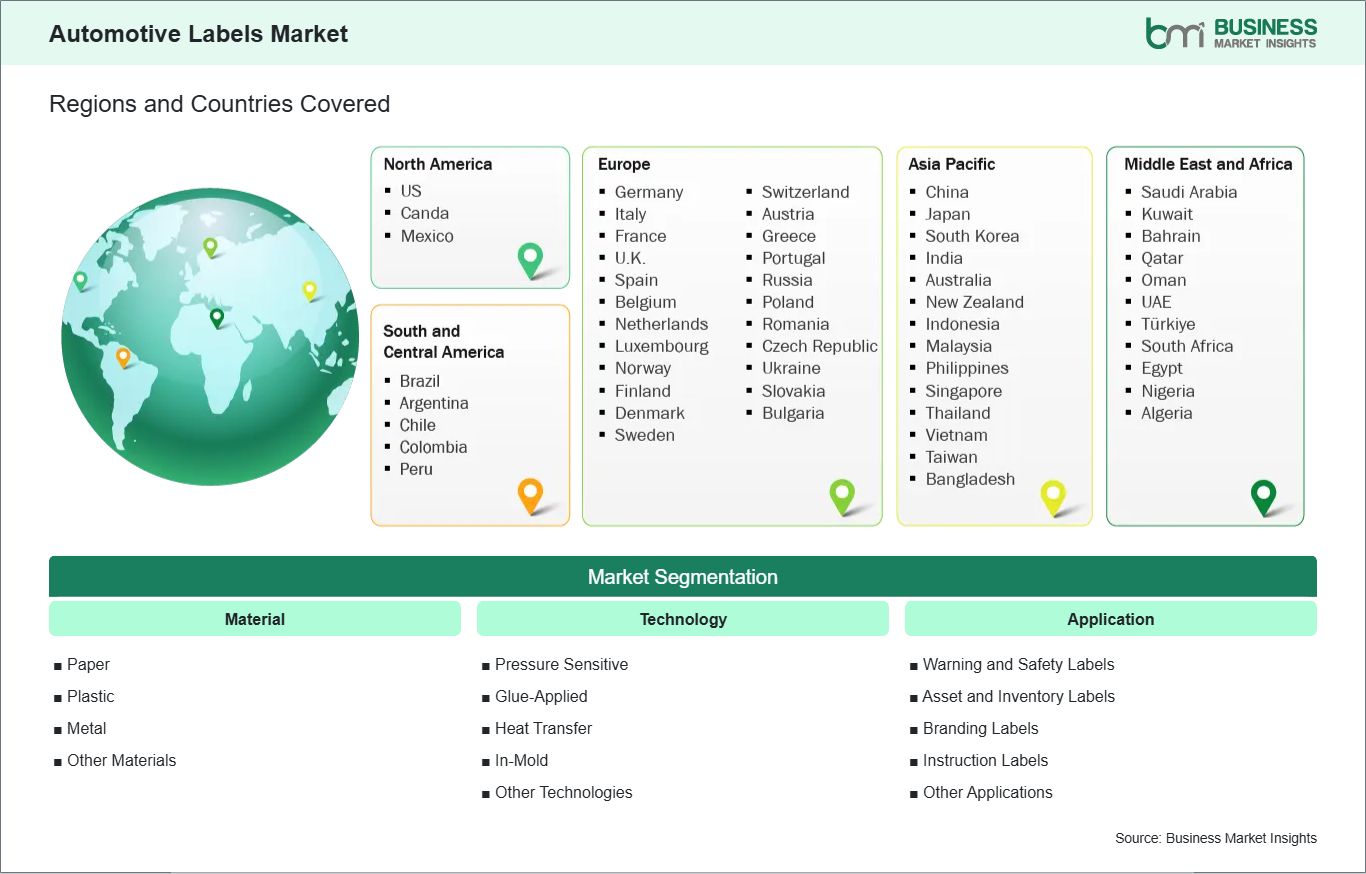
Key segments that contributed to the derivation of the automotive labels market analysis are material, technology, and application.
- By material, the automotive labels market is segmented into paper, plastic, metal, and other materials. The plastic segment dominated the market in 2025.
- By technology, the market is categorized into pressure-sensitive, glue-applied, heat transfer, in-mold, and other technologies. The pressure-sensitive segment dominated the market in 2025.
- By application, the market is categorized into warning and safety labels, asset and inventory labels, branding labels, instruction labels, and other applications. The warning and safety labels segment held the largest share of the market in 2025.
Market Forces
Automotive Labels Market Drivers and Opportunities
Rising Adoption of Electric and Autonomous Vehicles
Automakers are increasingly using labeling solutions to meet the specific needs of electric and autonomous vehicles. These labels must withstand high-voltage environments, support battery tracking, and provide clear safety warnings for maintenance and emergency responders. They offer a reliable way to ensure component identification, manage heat, and comply with changing EV safety standards without losing performance or durability. Their role in enabling secure data encoding, preventing tampering, and ensuring long-term readability is essential for modern vehicle platforms. The move toward electrification and smart mobility is speeding up innovation in automotive labeling, with the industry concentrating on materials that can handle tough underhood conditions, chemical exposure, and temperature changes. Regulatory requirements, OEM quality expectations, and the increase in EV production facilities further support growth. The demand for specialized functionality continues to accelerate the development of high-performance labels, keeping the market strong.
Shift Toward Sustainable and Circular Automotive Materials
There is a growing focus on recyclable, bio-based, and low-VOC labeling technologies. This shift shows an increased demand from automakers and consumers for environmentally friendly components. Products like solvent-free adhesives, monomaterial film labels, and easy-peel options make recycling end-of-life vehicles easier and support circular economy goals. These labeling solutions lower environmental harm by cutting down on hazardous waste, allowing for cleaner part recovery, and matching global sustainability promises. A rising interest in renewable raw materials and carbon-neutral production methods shows a dedication to combining performance with environmental care. Strict emissions regulations and industry-wide net-zero goals are speeding up the creation of green labeling options. The industry is focusing on innovations that maintain durability and compliance while reducing environmental impact. Striving for regulatory compliance, brand distinction, and long-term resource efficiency is driving the global adoption of sustainable automotive labels.
Size and Share Analysis
Automotive Labels Market Size and Share Analysis
The Automotive Labels market demonstrates steady growth, with size and share analysis revealing evolving trends and competitive positioning among key players. The report examines subsegments categorized within material, technology, and application, offering insights into their contribution to overall market performance.
Based on material, the plastic subsegment dominates the automotive labels market. Plastic labels are commonly used in the automotive industry because they are durable, flexible, and resistant to moisture, chemicals, and extreme temperatures. Materials like polypropylene (PP), polyethylene (PE), and polyvinyl chloride (PVC) offer strong adhesion and long-lasting performance. Their lightweight nature and low cost make plastic labels perfect for warning, branding, and instruction applications in vehicles.
Report Coverage
Automotive Labels Market Report Coverage and Deliverables
The " Automotive Labels Market Size and Forecast (2022–2033)" report provides a detailed analysis of the market covering below areas:
- Automotive Labels market size and forecast at global, regional, and country levels for all the key market segments covered under the scope
- Automotive Labels market trends, as well as market dynamics such as drivers, restraints, and key opportunities
- Automotive Labels market analysis covering key market trends, global and regional framework, major players, regulations, and recent market developments
- Industry landscape and competition analysis covering market concentration, heat map analysis, prominent players, and recent developments for the automotive labels market
- Detailed company profiles, including SWOT analysis
Geographic Insights
Automotive Labels Market Geographic Insights
The geographical scope of the Automotive Labels market report is divided into five regions: North America, Asia Pacific, Europe, the Middle East & Africa, and South & Central America. The Asia Pacific Automotive Labels Market is segmented into China, Japan, South Korea, India, Australia, New Zealand, Indonesia, Malaysia, the Philippines, Singapore, Thailand, Vietnam, Taiwan, Bangladesh, and the Rest of Asia Pacific. Asia Pacific's fast growth in the automotive industry, especially in passenger vehicle assembly, commercial vehicle manufacturing, electric mobility, and auto parts production, makes it a key region for market expansion.
The need for strict regulatory compliance, component traceability, anti-counterfeiting measures, and brand authentication solutions drives the market growth. There is also a significant demand for durable, heat-resistant, and high-performance labeling materials. The region's growing middle class, increasing vehicle ownership, and wider use of modern manufacturing and safety standards secure Asia Pacific's position as a leading producer and consumer of automotive labels globally.
Industry Activity
Recent Developments
The Automotive Labels market is evaluated by gathering qualitative and quantitative data post-primary and secondary research, which includes important corporate publications, association data, and databases. A few of the key developments in the automotive labels market are:
- In January 2026, DUST Identity partnered with Securikett to launch diamond-based labels that are impossible to copy, enhancing product authentication. This collaboration aims to integrate advanced security labeling with unique physical identities and digital verification to improve authentication systems that rely on strong physical identity.
- In January 2025, Giesecke+Devrient (G+D) launched the G+D Smart Label, an innovative tracking solution that turns any package into an IoT device. The ultra-thin Smart Label, developed alongside hardware partner Sensos, offers cost-effective and accurate location tracking for various applications, including parcel delivery, fleet management, and monitoring luxury goods movement.
Trust & Transparency
Research Methodology
The market analysis combines proprietary research with secondary data from government agencies, company disclosures, regulatory filings, industry databases and expert interviews. Market estimates are validated through data triangulation, cross-market benchmarking and analyst
review.
View Full Research Methodology
Key Sources Referred:
World Bank – Global Trade IndicatorsEuropean Chemicals AgencyInternational Council of Chemical AssociationsInternational Monetary Fund (IMF)World Trade Organization (WTO)International Trade Administration (ITA)Company WebsitesCompany Annual ReportsCompany Investor Presentations