Market Summary
Executive Summary and Global Market Analysis
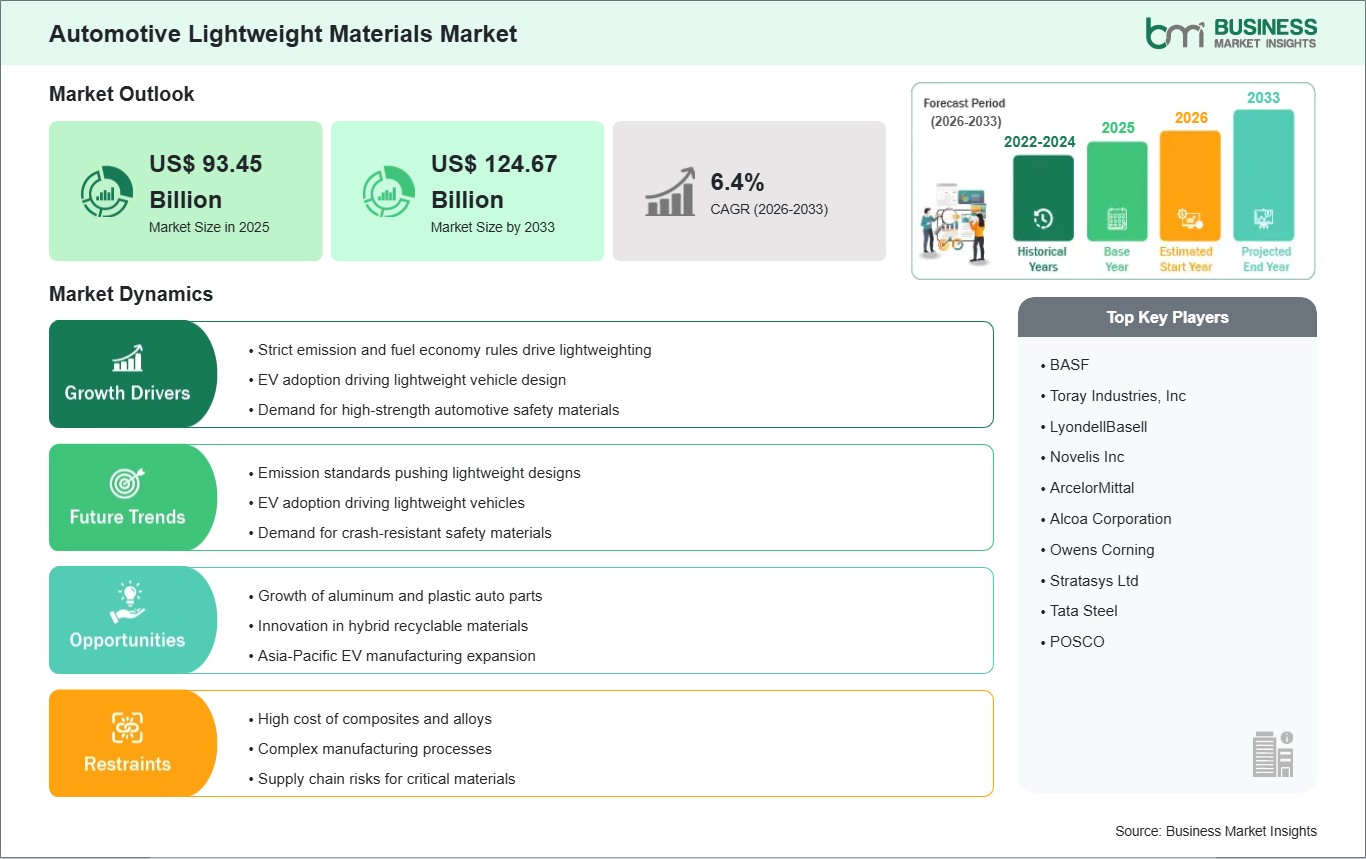
Automotive lightweight materials are essential for today's vehicle manufacturing. They help reduce weight, improve fuel efficiency, and lower emissions without sacrificing performance or safety. These materials are commonly used in body structures, chassis components, powertrains, and interiors. They effectively enhance vehicle dynamics, extend electric vehicle range, and meet strict regulatory standards. Automotive lightweight materials improve crash safety, provide design flexibility, and support electrification. They also promote resource efficiency and enable better manufacturing processes. The advantages include significant weight reduction, high strength-to-weight ratios, resistance to corrosion, and improved sustainability throughout the vehicle's life. Market growth mostly comes from global emissions regulations, the rapid rise of electric vehicles, and a move toward multi-material design strategies. Innovations in carbon fiber composites, advanced high-strength steels, and aluminum alloys are also crucial.
However, the automotive lightweight materials market has challenges, such as changing raw material prices can create issues, as can high production and recycling costs. Limited infrastructure for repairing advanced composites may slow down widespread use. Getting the best results also requires expertise in material selection, joining methods, and lifecycle assessment. Despite these hurdles, there are significant opportunities due to progress in material science, a strong focus on circular economy principles, and the increasing demand for high-performance, low-emission vehicles. Future market trends will rely on research into affordable and recyclable materials, supportive mobility policies, and the growing shift from traditional steel bodies to multi-material lightweight systems.
Segment Analysis
Automotive Lightweight Materials Market Segmentation
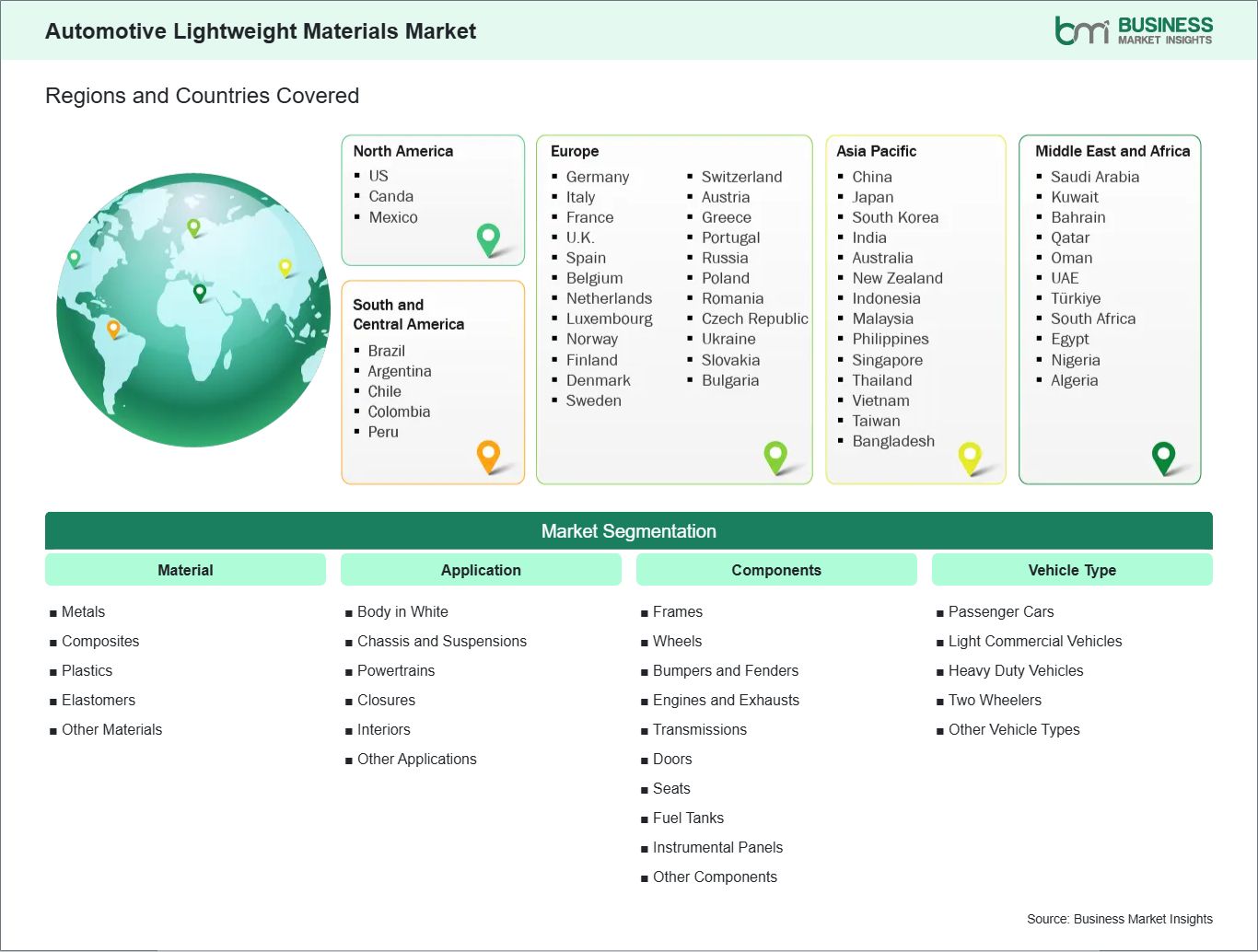
Key segments that contributed to the derivation of the automotive lightweight materials market analysis are material, application, components, and vehicle types.
- By material, the automotive lightweight materials market is segmented into metals, composites, plastics, elastomers, and other materials. The metals segment dominated the market in 2025.
- By application, the market is categorized into body in white, chassis and suspensions, powertrains, closures, interiors, and other applications. The body in white segment dominated the market in 2025.
- By components, the automotive lightweight materials market is segmented into frames, wheels, bumpers and fenders, engines and exhausts, transmissions, doors, seats, fuel tanks, instrumental panels, and other components. The frames segment dominated the market in 2025.
- By vehicle types, the market is categorized into passenger cars, light commercial vehicles, heavy-duty vehicles, two-wheelers, and other vehicle types. The passenger cars segment held the largest share of the market in 2025.
Market Forces
Automotive Lightweight Materials Market Drivers and Opportunities
Rising Emphasis on Fuel Efficiency and Emission Reduction
Automakers face constant pressure to reduce vehicle weight to comply with strict fuel economy and emission rules. Lightweight materials like aluminum, high-strength steel, magnesium alloys, and carbon fiber composites help lower vehicle mass without sacrificing structural strength or safety. Reducing weight directly improves fuel efficiency and cuts carbon dioxide emissions, making lightweighting a key strategy for meeting global environmental standards. Additionally, electric vehicle manufacturers rely on lightweight materials to increase battery range and boost performance. The rise in electric and hybrid vehicle production further emphasizes the need for effective lightweight solutions. Manufacturers are investing in new material engineering and design improvements to achieve better strength-to-weight ratios. Regulatory requirements, sustainability targets, and consumer demand for efficient vehicles all push the automotive lightweight materials market forward.
Expansion of Electric and Next-Generation Mobility Platforms
The rapid growth of electric vehicles, self-driving systems, and shared mobility platforms presents major opportunities for lightweight material suppliers. EV platforms need to reduce weight to balance heavy battery systems and improve driving range. This opens doors for new composites, mixed-material structures, and fresh bonding technologies. As car makers redesign vehicle structures for electrification, they are more willing to use new materials in their designs. Emerging markets are also investing in modern manufacturing plants that can produce lightweight parts on a large scale. Ongoing research in recyclable composites and cost-effective production methods is expanding the commercial potential. Cooperation between material producers and automotive manufacturers is speeding up the creation of custom solutions for next-generation vehicle needs. These changing mobility trends are creating long-term opportunities for innovation, diversification, and market growth.
Size and Share Analysis
Automotive Lightweight Materials Market Size and Share Analysis
The Automotive Lightweight Materials market demonstrates steady growth, with size and share analysis revealing evolving trends and competitive positioning among key players. The report further examines subsegments categorized within material, application, components, and vehicle types, offering insights into their contribution to overall market performance.
Based on material, the metal subsegment dominates the automotive lightweight materials market. Aluminum, high-strength steel, and magnesium are popular because they have strong mechanical properties and can reduce weight. Aluminum is often used in body structures and engine parts because it resists corrosion and can be recycled. High-strength steel provides safety while enabling thinner and lighter designs. These metals present a cost-effective option with proven manufacturing methods, making them a preferred choice for boosting fuel efficiency and meeting emission standards.
Report Coverage
Automotive Lightweight Materials Market Report Coverage and Deliverables
The " Automotive Lightweight Materials Market Size and Forecast (2022–2033)" report provides a detailed analysis of the market covering below areas:
- Automotive Lightweight Materials market size and forecast at global, regional, and country levels for all the key market segments covered under the scope
- Automotive Lightweight Materials market trends, as well as market dynamics such as drivers, restraints, and key opportunities
- Automotive Lightweight Materials market analysis covering key market trends, global and regional framework, major players, regulations, and recent market developments
- Industry landscape and competition analysis covering market concentration, heat map analysis, prominent players, and recent developments for the automotive lightweight materials market
- Detailed company profiles, including SWOT analysis
Geographic Insights
Automotive Lightweight Materials Market Geographic Insights
The geographical scope of the Automotive Lightweight Materials market report is divided into five regions: North America, Asia Pacific, Europe, the Middle East & Africa, and South & Central America. The Asia Pacific automotive lightweight materials Market is segmented into China, Japan, South Korea, India, Australia, New Zealand, Indonesia, Malaysia, the Philippines, Singapore, Thailand, Vietnam, Taiwan, Bangladesh, and the Rest of Asia Pacific. Asia Pacific is modernizing its automotive industry quickly. This is especially true in electric vehicle production, performance vehicle manufacturing, commercial transportation, and mobility infrastructure development. These factors make it a key area for market growth.
The rising demand for better vehicle efficiency, stricter emission standards, and improved driving range solutions boosts this market. There is also an increasing need for strong, lightweight materials that are affordable. The region's growing vehicle production, urbanization, and middle-class population, along with rising awareness of sustainable mobility and improved manufacturing technologies, solidify Asia Pacific's role as both a top producer and consumer of automotive lightweight materials globally.
Industry Activity
Recent Developments
The Automotive Lightweight Materials market is evaluated by gathering qualitative and quantitative data post-primary and secondary research, which includes important corporate publications, association data, and databases. A few of the key developments in the Automotive Lightweight Materials market are:
- In November 2025, CSP launched TCA Float, an ultra-lightweight sheet molding compound (SMC) that significantly decreases part weight by up to 25% while ensuring mechanical properties and a Class A surface finish. This new material boasts a sub-1.0 specific gravity (SpG) density, making it the first such product on the market that offers a truly paintable Class A surface, specifically designed for automotive body panel applications.
- In May 2025, Lyten Motorsports was established to provide the automotive racing sector with advanced 3D Graphene supermaterials that offer greater strength and lighter-weight components, contributing to improved speed and safety. Based in Indianapolis and in collaboration with INDYCAR Experience, Lyten Motorsports has spent over two years developing material designs, incorporating Lyten's proprietary 3D printing filaments and adhesive products into its designs.
Trust & Transparency
Research Methodology
The market analysis combines proprietary research with secondary data from government agencies, company disclosures, regulatory filings, industry databases and expert interviews. Market estimates are validated through data triangulation, cross-market benchmarking and analyst
review.
View Full Research Methodology
Key Sources Referred:
World Bank – Global Trade IndicatorsEuropean Chemicals AgencyInternational Council of Chemical AssociationsInternational Monetary Fund (IMF)World Trade Organization (WTO)International Trade Administration (ITA)Company WebsitesCompany Annual ReportsCompany Investor Presentations