Market Summary
Executive Summary and Global Market Analysis
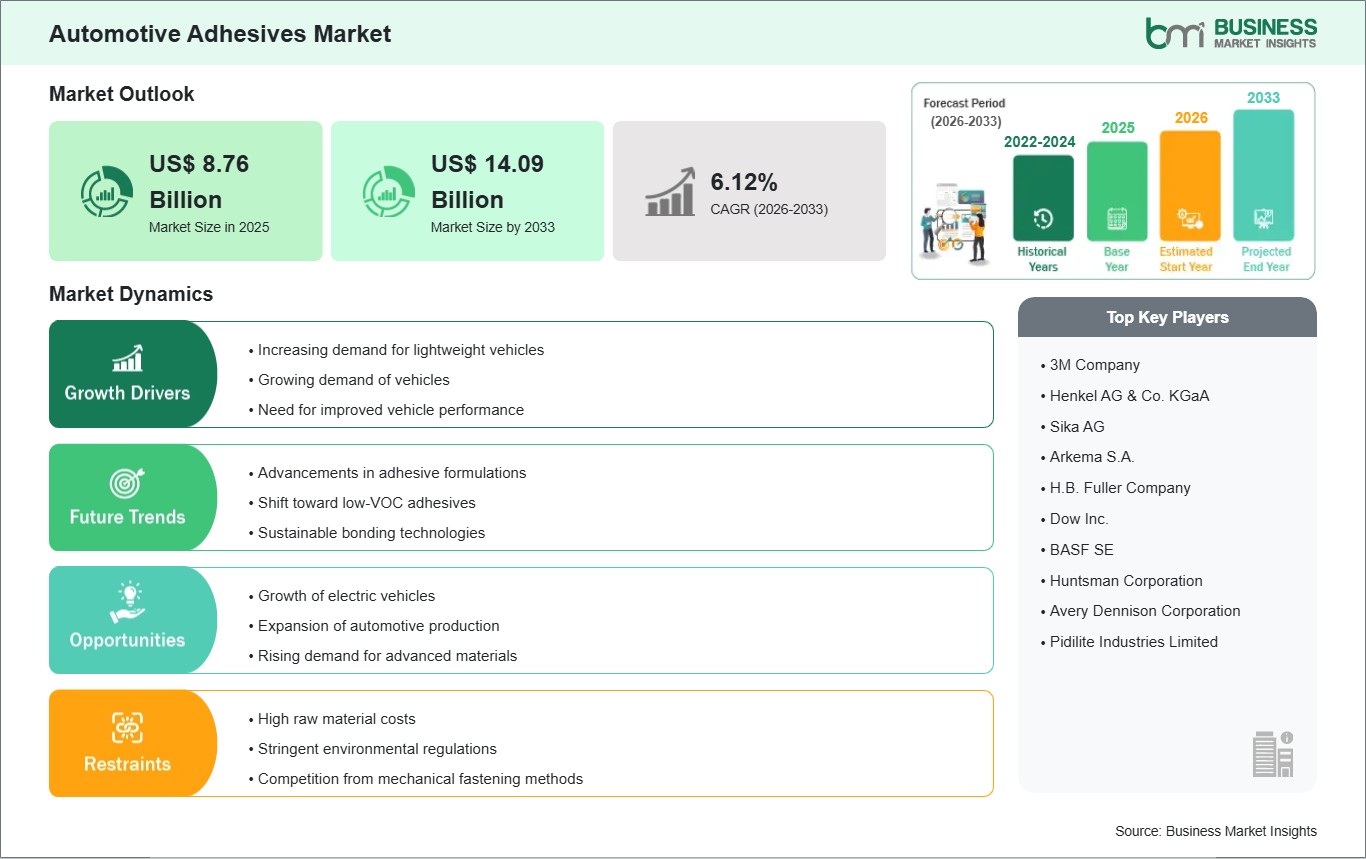
The global automotive adhesives market is defined by the increasing adoption of advanced bonding solutions in vehicle manufacturing to enhance structural integrity, reduce weight, and improve overall vehicle performance. Automotive adhesives are widely used as alternatives to traditional mechanical fastening methods such as welding and riveting, offering benefits such as uniform stress distribution, improved durability, and enhanced design flexibility.
The market is experiencing steady growth driven by the automotive industry’s focus on lightweighting and fuel efficiency. Adhesives enable the use of lightweight materials such as composites and plastics, which are increasingly replacing conventional metals in vehicle structures. Additionally, the growing adoption of electric vehicles is accelerating the demand for high-performance adhesives that provide thermal management, vibration resistance, and electrical insulation.
Competitive dynamics in the automotive adhesives market are centered on product innovation, regulatory compliance, and sustainability. Manufacturers are developing low-VOC and environmentally friendly adhesive solutions to meet stringent environmental regulations. Strategic collaborations with automotive OEMs are enabling customized adhesive formulations tailored to specific vehicle requirements. Continuous advancements in adhesive technologies are further strengthening market competitiveness.
Segment Analysis
Automotive Adhesives Market Segmentation
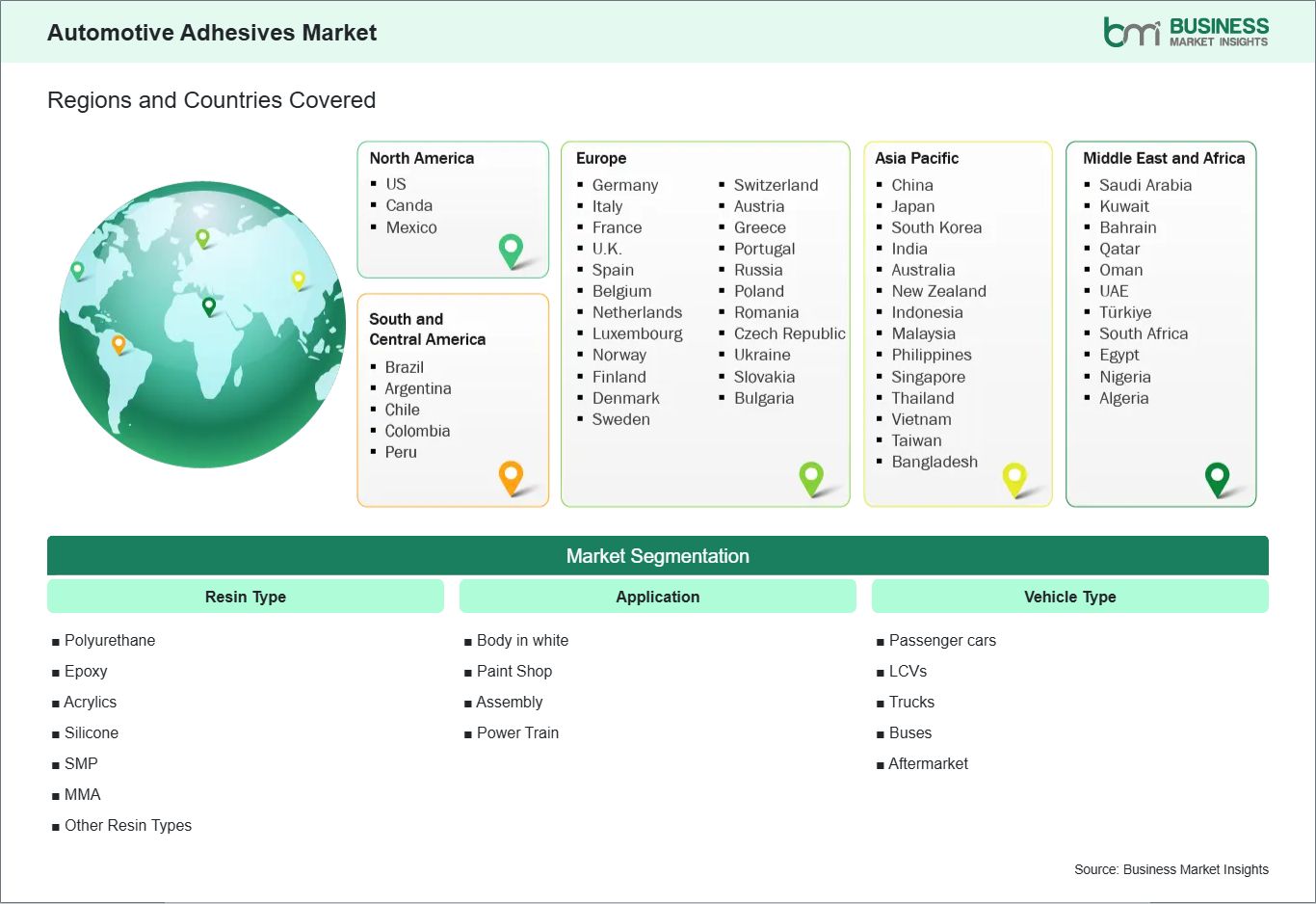
Key segments that contributed to the derivation of the automotive adhesives market analysis are resin type, application, and vehicle type.
- Based on the resin type, the automotive adhesives market is segmented into polyurethane, epoxy, acrylics, silicone, SMP, MMA, and other resin types. The polyurethane segment dominated the market in 2025.
- In terms of application, the automotive adhesives market is segmented into body in white, paint shop, assembly, and power train. The body in white segment dominated the market in 2025.
- Based on vehicle type, the automotive adhesives market is segmented into passenger cars, LCVs, trucks, buses, and aftermarket. The passenger cars segment dominated the market in 2025.
Market Forces
Automotive Adhesives Market Drivers and Opportunities
Increasing Demand for Lightweight Vehicles
The automotive adhesives industry is heavily influenced by the growing need for more lightweight automobiles. To decrease vehicle weight, meet strict emissions regulations and help with fuel efficiency, automotive manufacturers are incorporating more lightweight materials into their manufacture; these materials include aluminum and other composite products or advanced plastics. Adhesives provide the strong, long-lasting bond necessary to enable their use of these new lightweight materials while minimizing added weight, something that would not be possible using traditional joining methods. Using adhesives in body-in-white processes and assembly will provide increased structural integrity and improved crashworthiness by distributing stresses evenly across the entire surface of the bond, thus improving overall safety. In addition, due to their ability to dampen noise and vibration, adhesives will also help improve the overall passenger comfort level of the vehicle. Beyond the strength and reliability properties of adhesives used in the manufacturing process; the use of adhesives will also allow automotive manufacturers to create new, innovative designs that would not be achievable by using any of the traditional methods of joining. Technological advancements in adhesive formulations have provided new adhesives with superior thermal resistance to failure, enhanced durability and much shorter cure times. Due to the continued focus by automakers on fuel efficiency, performance and sustainability, the demand for advanced adhesive solutions continues to grow. This shift towards lightweight construction not only provides compliance with OEM and governmental regulations, but also meets the consumer desire for greater fuel efficiency.
Growth of Electric Vehicles
The rapid increase in electric vehicle (EV) adoption is leading to significant opportunities for automotive adhesives. In addition, EVs have unique bonding requirements for critical components such as battery packs, electrical systems, and lightweight structural components. Adhesives are also used to assemble battery modules and provide thermal management while ensuring electrical insulation; therefore, these adhesive qualities are critical for both the safety and performance of EVs operating in high-voltage environments. Adhesives are also used extensively to assemble vehicles' interiors and exteriors to help reduce weight, enhance durability, and increase overall efficiencies. The increasing integration of advanced electronic systems, such as infotainment and driver-assistance systems, will continue to fuel the need for high-performance, reliable adhesive products. The global transition to sustainable transportation is also driving the need for eco-friendly adhesive formulations that have a low environmental footprint while meeting stringent performance requirements. As a result, manufacturers are focused on producing recyclable and environmentally-friendly adhesive products to meet government regulations and provide consumers with the type of products they expect. With governments globally investing in EV infrastructure and providing incentives to adopt EVs, the EV market is poised for outstanding growth in the coming years; thus, this growth will create a significant increase in demand for innovative adhesives, which will help establish new markets for adhesive companies to succeed. The convergence of electrification, sustainability, and advanced materials will create new opportunities for adhesive manufacturers and their customers.
Size and Share Analysis
Automotive Adhesives Market Size and Share Analysis
The Automotive Adhesives Market demonstrates steady growth, with size and share analysis highlighting evolving trends and competitive dynamics among key players. The report examines subsegments categorized within resin type, application, and vehicle type, offering insights into their contribution to overall market performance.
By resin type, the polyurethane subsegment dominated the market in 2025, driven by its excellent bonding strength and flexibility across multiple substrates.
Based on application, the body in white subsegment dominated the market in 2025, driven by extensive use of adhesives in structural bonding and assembly processes.
By vehicle type, the passenger cars subsegment dominated the market in 2025, driven by high production volumes and increasing adoption of adhesive technologies.
Report Coverage
Automotive Adhesives Market Report Coverage and Deliverables
The "Automotive Adhesives Market Size and Forecast (2022 - 2033)" report provides a detailed analysis of the market covering below areas:
- Automotive Adhesives Market size and forecast at global, regional, and country levels for all the key market segments covered under the scope
- Automotive Adhesives Market trends, as well as drivers, restraints, and opportunities
- Automotive Adhesives Market analysis covering key trends, global and regional framework, major players, regulations, and recent developments
- Industry landscape and competition analysis covering market concentration, heat map analysis, prominent players, and recent developments for the Automotive Adhesives Market
- Detailed company profiles, including SWOT analysis
Geographic Insights
Automotive Adhesives Market Geographic Insights
The geographical scope of the Automotive Adhesives Market report is divided into North America, Asia Pacific, Europe, Middle East & Africa, and South & Central America. North America held the largest share in 2025.
The adoption and demand for automotive adhesives vary across regions, influenced by automotive production, technological advancements, and regulatory standards. In North America, the market is driven by strong automotive manufacturing capabilities and increasing adoption of lightweight materials to meet fuel efficiency and emission standards.
In Europe, stringent environmental regulations and a strong focus on sustainability are encouraging the use of low-VOC and eco-friendly adhesive solutions. The region is also witnessing significant growth in electric vehicle adoption, further boosting demand for advanced adhesive technologies.
Asia Pacific is the dominant and fastest-growing region, supported by large-scale automotive production and rising demand for passenger vehicles. Countries such as China, India, and Japan are key contributors to market growth due to expanding automotive industries and increasing investments in electric mobility.
The Middle East & Africa and South & Central America are experiencing moderate growth, driven by increasing vehicle demand and gradual industrial development. Across all regions, evolving automotive technologies and regulatory frameworks continue to shape market dynamics.
Industry Activity
Recent Developments
The Automotive Adhesives Market is evaluated by gathering qualitative and quantitative data post primary and secondary research, which includes important corporate publications, association data, and databases. A few of the key developments in the automotive adhesives market are:
- In August 2025, Henkel AG & Co. KGaA launched a new range of structural adhesives designed for electric vehicle battery systems, offering enhanced thermal conductivity and bonding strength.
- In May 2025, 3M Company introduced advanced acrylic adhesive solutions for automotive lightweighting applications, improving durability and reducing assembly time.
Trust & Transparency
Research Methodology
The market analysis combines proprietary research with secondary data from government agencies, company disclosures, regulatory filings, industry databases and expert interviews. Market estimates are validated through data triangulation, cross-market benchmarking and analyst
review.
View Full Research Methodology
Key Sources Referred:
International Organization for Standardization (ISO)U.S. Environmental Protection Agency (EPA)European Chemicals Agency (ECHA)American Chemistry Council (ACC)Bureau of Indian Standards (BIS)