Market Summary
Executive Summary and Global Market Analysis
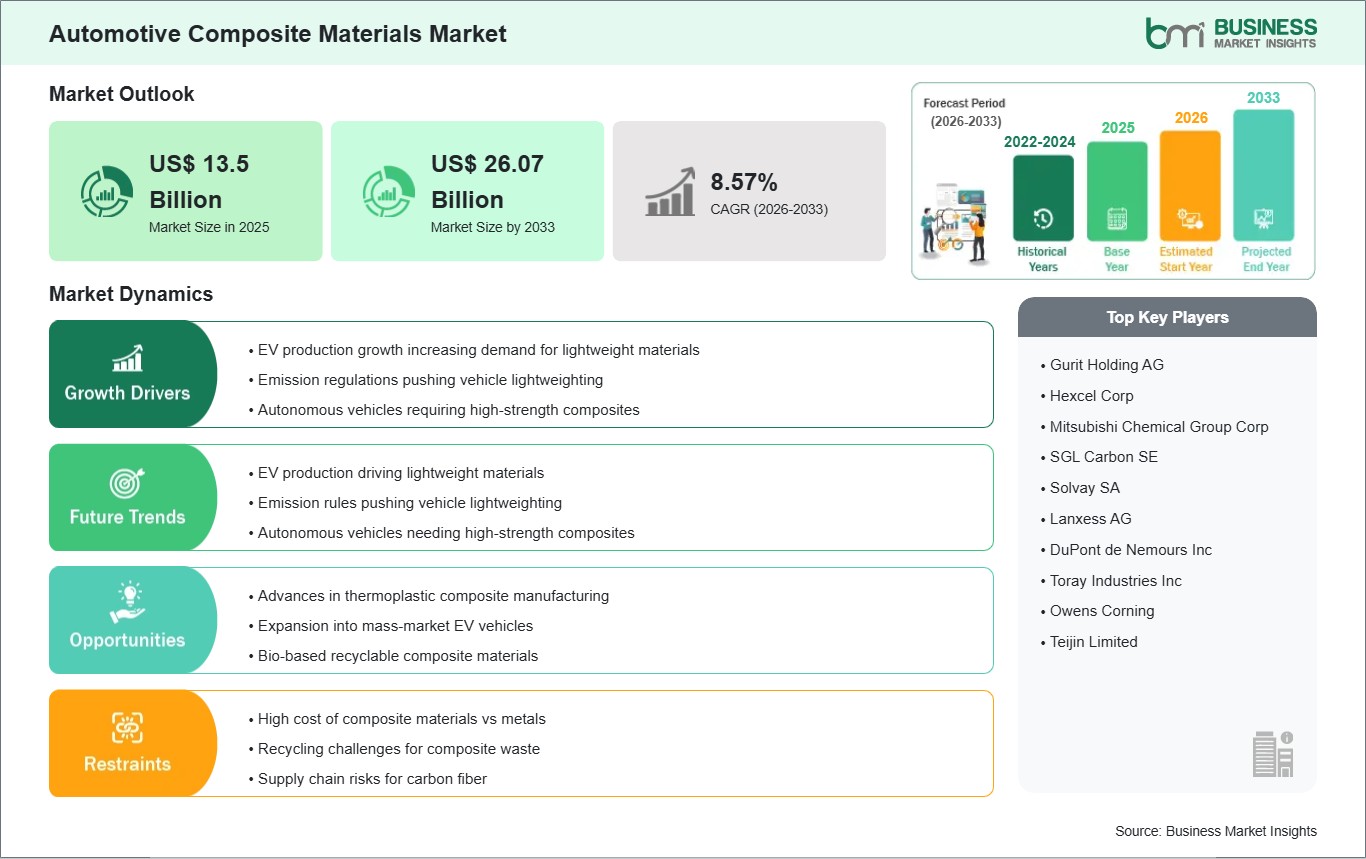
Automotive composite materials are engineered substances that typically combine reinforcing fibers like carbon or glass with polymer matrices. They play a crucial role in making vehicles lighter, which helps reduce overall vehicle weight. This reduction also boosts structural strength, durability, and design flexibility. Lightweight composites are central to automotive innovation and are key to improving fuel efficiency, battery range, and overall performance. The automotive composites market is growing quickly. The shift toward electric vehicles drives this growth, stricter emissions regulations that require weight reduction, and higher consumer demand for high-performance and premium vehicles. Ongoing improvements in material science, manufacturing processes like automated fiber placement and resin transfer molding, and recycling technologies are encouraging adoption. These advancements improve cost, speed, and sustainability. Therefore, these materials are now essential to efficient automotive engineering.
Despite this progress, the market faces significant challenges, such as the cost of raw materials is higher than traditional metals. Some composites are difficult to join, repair, or recycle at the end of their life. The established steel and aluminum industries, along with complicated supply chains and the need for industry-wide standards, create additional hurdles. Nevertheless, there are several opportunities for market expansion. Innovations in bio-based resins, recycled carbon fiber, and multi-material integration are helping create more sustainable, cost-effective, and custom material systems. These breakthroughs are enabling the use of advanced composites in battery enclosures, hydrogen tanks, and modular vehicle designs that fit within circular economy models. Ultimately, the future of the automotive composite materials market will be shaped by the industry's shift from metal-based structures to optimized solutions that balance performance, sustainability, and economic viability.
Segment Analysis
Automotive Composite Materials Market Segmentation
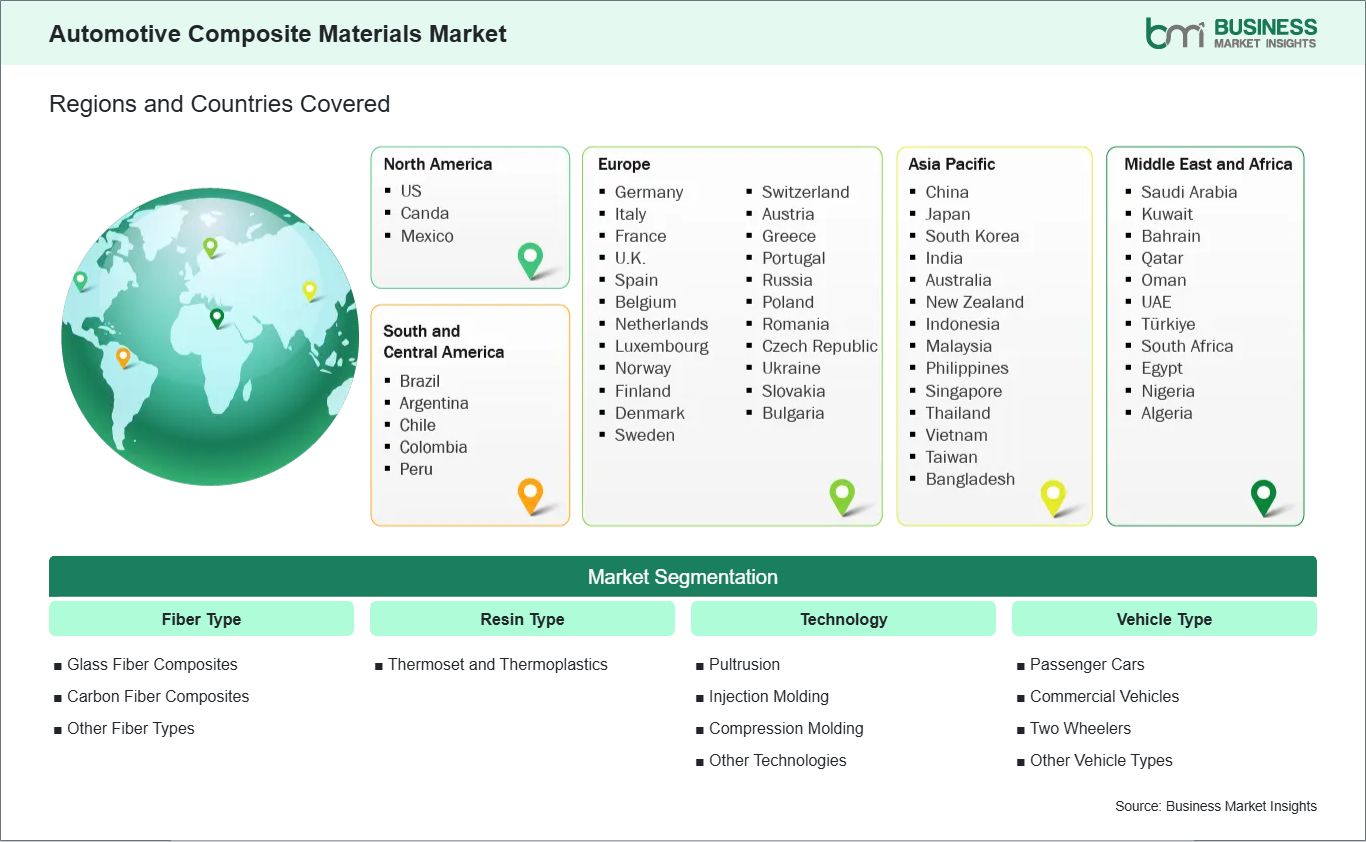
Key segments that contributed to the derivation of the automotive composite materials market analysis are fiber type, resin type, technology, vehicle type, and application.
- By fiber type, the automotive composite materials market is segmented into glass fiber composites, carbon fiber composites, and other fiber types. The glass fiber composites segment dominated the market in 2025.
- By resin type, the market is divided into thermoset and thermoplastics. The thermoset segment dominated the market in 2025.
- By technology, the automotive composite materials market is categorized into pultrusion, injection molding, compression molding, and other technologies. The injection molding segment held the largest share of the market in 2025.
- By vehicle type, the market is segmented into passenger cars, commercial vehicles, two-wheelers, and other vehicle types. The beer production segment dominated the market in 2025.
- By application, the market is segmented into structural assembly, powertrain component, interior, and exterior. The exterior segment dominated the market in 2025.
Market Forces
Automotive Composite Materials Market Drivers and Opportunities
Lightweighting Imperative for Electric Vehicles and Emission Reduction
The global push for vehicle electrification and deep decarbonization is significantly driving up the demand for composite materials in the automotive sector, especially for battery electric vehicles (BEVs). As governments set stricter emissions standards, corporate average fuel economy (CAFE) regulations, and zero-emission vehicle mandates, original equipment manufacturers (OEMs) increasingly depend on high-performance carbon fiber reinforced polymers (CFRP), glass fiber composites, and new hybrid material systems. These composite options help reduce vehicle weight, which directly increases the driving range of BEVs by lowering the energy needed for propulsion. They also balance the heavyweight of battery packs. At the same time, the demand for better aerodynamic efficiency and improved structural safety—particularly around battery enclosures and passenger cells—requires composites that offer strong strength-to-weight ratios, design flexibility, and resistance to corrosion. This combined pressure from regulatory requirements and the need for better EV performance is pushing manufacturers to use integrated composite solutions. These solutions allow for parts consolidation, lower assembly complexity, and enhance the overall vehicle design. By creating lighter, stronger, and more efficiently designed vehicles, these material advancements improve functionality and support the fast growth of the automotive composites market.
Innovation in Sustainable Materials and High-Volume Manufacturing Processes
Traditional composite applications often have problems with high raw material costs, slow cycle times, and difficulties in end-of-life recyclability. These issues can limit their widespread use in high-volume vehicle platforms. In response, significant progress in material science, process automation, and sustainable lifecycle management is changing what automotive composites can do. New developments in bio-derived resins, recycled carbon fiber, and thermoplastic composites are creating more eco-friendly material cycles without sacrificing performance. Additionally, innovations in manufacturing, like high-pressure resin transfer molding (HP-RTM), automated tape laying, and compression molding of sheet molding compound (SMC), are greatly improving production rates, consistency, and cost-effectiveness for structural and semi-structural parts.
Moreover, the growing focus on circular economy models in the automotive industry is creating new opportunities for composites designed for disassembly, reuse, and advanced chemical recycling. Companies that invest in these next-generation materials and closed-loop systems are positioned to meet strict sustainability regulations and reduce their lifecycle carbon footprint. They can also turn manufacturing waste into valuable materials for new components. This focus not only helps with long-term compliance and brand responsibility but also encourages the wider use of composites as important, sustainable foundations for future mobility solutions.
Size and Share Analysis
Automotive Composite Materials Market Size and Share Analysis
The automotive composite materials market demonstrates steady growth, with size and share analysis revealing evolving trends and competitive positioning among key players. The report examines subsegments categorized within fiber type, resin type, technology, vehicle type, and application, offering insights into their contribution to overall market performance.
Based on fiber type, the glass fiber composites segment dominates the automotive composite materials market. Glass fiber reinforcements offer a great mix of performance, cost, and versatility in manufacturing. This makes them important for creating various semi-structured components, interior parts, and under-the-hood applications. Their proven ability to be processed using high-volume methods like Sheet Molding Compound (SMC) compression molding and Resin Transfer Molding (RTM), along with a strong global supply chain, has made them the preferred choice for manufacturers in electric, mass-market, and commercial vehicle segments looking for a budget-friendly lightweight solution.
Report Coverage
Automotive Composite Materials Market Report Coverage and Deliverables
The " Automotive Composite Materials Market Size and Forecast (2022–2033)" report provides a detailed analysis of the market covering below areas:
- Automotive Composite Materials market size and forecast at global, regional, and country levels for all the key market segments covered under the scope
- Automotive Composite Materials market trends, as well as market dynamics such as drivers, restraints, and key opportunities
- Automotive Composite Materials market analysis covering key market trends, global and regional framework, major players, regulations, and recent market developments
- Industry landscape and competition analysis covering market concentration, heat map analysis, prominent players, and recent developments for the automotive composite materials market
- Detailed company profiles, including SWOT analysis
Geographic Insights
Automotive Composite Materials Market Geographic Insights
The geographical scope of the Automotive Composite Materials market report is divided into five regions: North America, Asia Pacific, Europe, the Middle East & Africa, and South & Central America. The Asia Pacific Automotive Composite Materials Market is segmented into China, Japan, South Korea, India, Australia, New Zealand, Indonesia, Malaysia, the Philippines, Singapore, Thailand, Vietnam, Taiwan, Bangladesh, and the Rest of Asia Pacific. Asia Pacific leads in both production and adoption of automotive composite materials worldwide. The region's strong position as the largest automotive manufacturing hub drives this success, along with government support for electric vehicle (EV) adoption and lightweighting. There are also significant investments in next-generation mobility solutions. The focus on scale, cost efficiency, and quick technological integration ensures a constant supply of quality, affordable composite components.
Moreover, a robust industrial base for both mass-market and premium vehicles, backed by national goals for reducing vehicle emissions and improving energy security, creates strong demand. The presence of major global manufacturers, tier-1 suppliers, and a close-knit network of material producers and process experts strengthens Asia Pacific's role as a key center for high-volume manufacturing and innovation. This setting sets global standards for affordability, scalability, and quick market entry in composite material integration.
Industry Activity
Recent Developments
The Automotive Composite Materials market is evaluated by gathering qualitative and quantitative data post-primary and secondary research, which includes important corporate publications, association data, and databases. A few of the key developments in the Automotive Composite Materials market are:
- In November 2025, CSP launched TCA Float, an ultra-lightweight sheet molding compound (SMC) designed for automotive body panels. This innovative material features a sub-1.0 specific gravity (SpG) density and is notable for being the first sub-1.0 product on the market that offers a paintable Class A surface.
- In May 2025, Tata AutoComp Systems Ltd. and Katcon Global formed a joint venture in Mexico aimed at manufacturing advanced composite materials. This partnership will concentrate on lightweight applications across various sectors, including passenger and commercial vehicles, agricultural tractors, off-road vehicles, and specialized non-automotive markets, with a primary focus on the North American region.
Trust & Transparency
Research Methodology
The market analysis combines proprietary research with secondary data from government agencies, company disclosures, regulatory filings, industry databases and expert interviews. Market estimates are validated through data triangulation, cross-market benchmarking and analyst
review.
View Full Research Methodology
Key Sources Referred:
World Bank – Global Trade IndicatorsEuropean Chemicals AgencyInternational Council of Chemical AssociationsInternational Monetary Fund (IMF)World Trade Organization (WTO)International Trade Administration (ITA)Company WebsitesCompany Annual ReportsCompany Investor Presentations