Market Summary
Executive Summary and Global Market Analysis
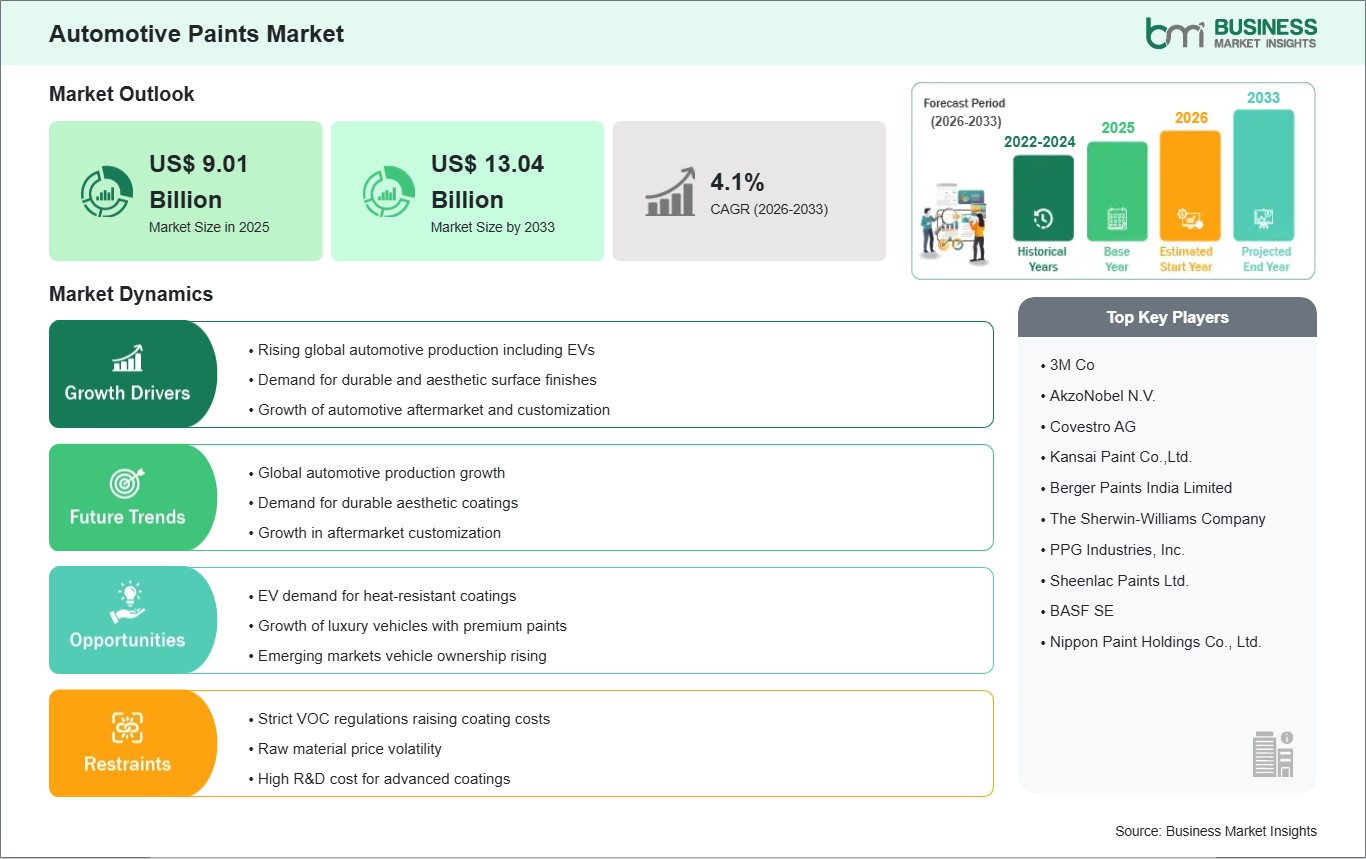
Automotive paints play a key role in protecting vehicles and enhancing their appearance. They improve the look of cars while creating a strong barrier against environmental harm. These coatings are common in passenger cars, commercial vehicles, and motorcycles. They act as protective layers against corrosion, UV rays, chemicals, and wear from use. Automotive paints boost surface durability, keep a shiny finish, and help maintain the vehicle's value over time. They also help establish brand identity through a variety of colors and quality finishes. The benefits include strong adhesion, resistance to weather, better scratch protection, and finishing options like metallic, pearlescent, and matte effects. Market growth mainly comes from increasing vehicle production, a rise in demand for attractive cars, and development in the automotive industries in developing countries. Advances in water-based coatings, powder coatings, and low-VOC formulations further aid market growth.
However, the automotive paint market faces a number of challenges, such as changes in raw material prices and strict environmental rules about VOC emissions can raise production costs. Keeping up with changing environmental standards requires constant innovation and investment. Additionally, shifts in car sales and supply chain issues might affect market stability. Despite these challenges, there are significant opportunities from the growing interest in electric vehicles, progress in eco-friendly coating technologies, and a rising focus on lightweight and high-performance materials. Future market trends are likely to focus on sustainable coating solutions, smart paints that can heal themselves and fight microbes, and ongoing research into durable and energy-efficient curing technologies.
Segment Analysis
Automotive Paints Market Segmentation
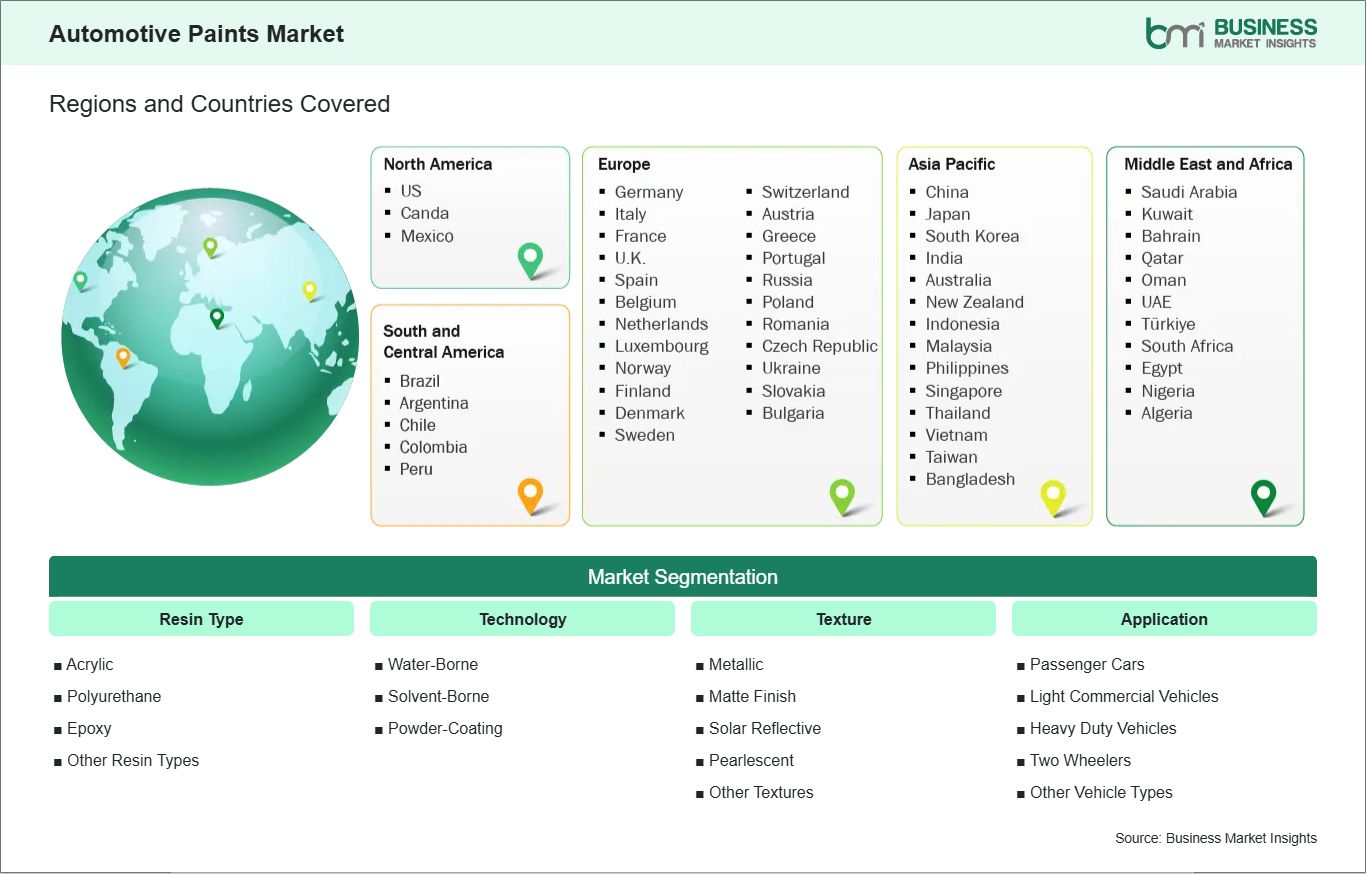
Key segments that contributed to the derivation of the Automotive Paints market analysis are resin type, technology, texture, and application.
- By resin type, the automotive paints market is segmented into acrylic, polyurethane, epoxy, and other resin types. The acrylic segment dominated the market in 2025.
- By technology, the market is categorized into water-borne, solvent-borne, and powder-coating. The solvent-borne segment dominated the market in 2025.
- By texture, the automotive paints market is segmented into metallic, matte finish, solar reflective, pearlescent, and other textures. The matte finish segment dominated the market in 2025.
- By application, the market is categorized into passenger cars, light commercial vehicles, heavy-duty vehicles, two-wheelers, and other vehicle types. The passenger cars segment held the largest share of the market in 2025.
Market Forces
Automotive Paints Market Drivers and Opportunities
Rising Demand for High-Performance and Advanced Coating Solutions
Automotive manufacturers are increasingly adopting new paint technologies to improve vehicle durability, appearance, and long-term protection. Modern automotive paints resist corrosion, UV radiation, chemicals, and mechanical wear while keeping high gloss and color stability. These coatings offer cost-effective solutions that enhance surface performance without needing major changes to production systems. They provide uniform finishes, faster drying times, and better adhesion, making them essential for both original equipment manufacturers and refinish applications. The rising popularity of premium vehicles, electric vehicles, and customized color options is pushing innovation in high-performance coatings. The industry is focusing on research and development to create smart paints with self-healing, anti-scratch, and anti-microbial features. Growth is also supported by increasing global vehicle production, expanding automotive manufacturing in emerging economies, and rising consumer expectations for long-lasting and attractive finishes. Ongoing advancements in resin chemistry and curing technologies are driving the development of next-generation automotive paints, ensuring continued market growth.
Shift Toward Sustainable and Low-Emission Coating Technologies
There is a strong and growing focus on environmentally friendly automotive paint solutions. The shift toward water-based, powder, and low-VOC coatings shows the industry's response to strict environmental rules and sustainability goals. These technologies help reduce harmful emissions, improve worker safety, and lower environmental impact without compromising performance. Automakers are increasingly prioritizing recyclable, energy-efficient, and eco-friendly coating systems to support global climate initiatives. The use of new curing methods, such as UV and low-temperature curing, encourages energy savings and better production efficiency. Regulatory pressures in regions like Europe and North America are speeding up the move away from traditional solvent-based systems.
Meanwhile, consumers are showing a greater preference for sustainable automotive products. The industry's focus on green chemistry, bio-based resins, and resource-efficient manufacturing shows a commitment to balancing high performance with environmental responsibility. This push for regulatory compliance, reduced carbon footprint, and long-term sustainability continues to shape the global automotive paints market.
Size and Share Analysis
Automotive Paints Market Size and Share Analysis
The Automotive Paints market demonstrates steady growth, with size and share analysis revealing evolving trends and competitive positioning among key players. The report further examines subsegments categorized within resin type, technology, texture, and application, offering insights into their contribution to overall market performance.
Based on resin type, the acrylic subsegment dominates the automotive paints market. Acrylic-based paints offer great color retention, strong UV resistance, and a glossy finish. They also provide good adhesion, weather durability, and a balanced cost-performance ratio. These coatings are commonly used in basecoats and clearcoats for passenger cars and commercial vehicles. Their ability to deliver vibrant colors, smooth application, and long-lasting surface protection makes them the top choice for automotive manufacturers and refinishing providers looking for reliable and visually appealing coating options.
Report Coverage
Automotive Paints Market Report Coverage and Deliverables
The " Automotive Paints Market Size and Forecast (2022–2033)" report provides a detailed analysis of the market covering below areas:
- Automotive Paints market size and forecast at global, regional, and country levels for all the key market segments covered under the scope
- Automotive Paints market trends, as well as market dynamics such as drivers, restraints, and key opportunities
- Automotive Paints market analysis covering key market trends, global and regional framework, major players, regulations, and recent market developments
- Industry landscape and competition analysis covering market concentration, heat map analysis, prominent players, and recent developments for the automotive paints market
- Detailed company profiles, including SWOT analysis
Geographic Insights
Automotive Paints Market Geographic Insights
The geographical scope of the Automotive Paints market report is divided into five regions: North America, Asia Pacific, Europe, the Middle East & Africa, and South & Central America. The Asia Pacific Automotive Paints Market is segmented into China, Japan, South Korea, India, Australia, New Zealand, Indonesia, Malaysia, the Philippines, Singapore, Thailand, Vietnam, Taiwan, Bangladesh, and the Rest of Asia Pacific. Asia Pacific's fast growth in automotive production, especially in passenger cars and electric vehicles, positions it as a key player in the automotive paints market. The region benefits from strong manufacturing capacity, rising vehicle ownership, and a growing demand for long-lasting, high-quality finishes.
This growth is also fueled by the need for coatings that resist corrosion, look good, and are environmentally friendly. With a large population, a growing middle class, and a strong export-focused automotive industry, the Asia Pacific continues to be a significant producer and consumer of automotive paints worldwide.
Industry Activity
Recent Developments
The Automotive Paints market is evaluated by gathering qualitative and quantitative data post-primary and secondary research, which includes important corporate publications, association data, and databases. A few of the key developments in the Automotive Paints market are:
- In Feb 2025, Yamaha Motor Co., Ltd. launched the CN1 carbon-neutral mass-production painting line at its Iwata Main Factory, marking the first all-electric product painting line in the motorcycle industry. This line began operations on February 20 and utilizes electricity for all processes that were previously reliant on fossil fuels, including pre-treatment, painting, baking, and drying.
- In November 2025, Covestro and Nippon Paint established a strategic partnership to enhance their automotive and industrial coatings portfolio. This collaboration aims to co-develop sustainable, efficient, and high-performance coatings to foster industry innovation and support transformation in various applications, including automotive OEM coatings, refinish paints, and coatings for coil steel, construction machinery, wind power, and photovoltaics.
Trust & Transparency
Research Methodology
The market analysis combines proprietary research with secondary data from government agencies, company disclosures, regulatory filings, industry databases and expert interviews. Market estimates are validated through data triangulation, cross-market benchmarking and analyst
review.
View Full Research Methodology
Key Sources Referred:
World Bank – Global Trade IndicatorsEuropean Chemicals AgencyInternational Council of Chemical AssociationsInternational Monetary Fund (IMF)World Trade Organization (WTO)International Trade Administration (ITA)Company WebsitesCompany Annual ReportsCompany Investor Presentations