Market Summary
Executive Summary and Global Market Analysis
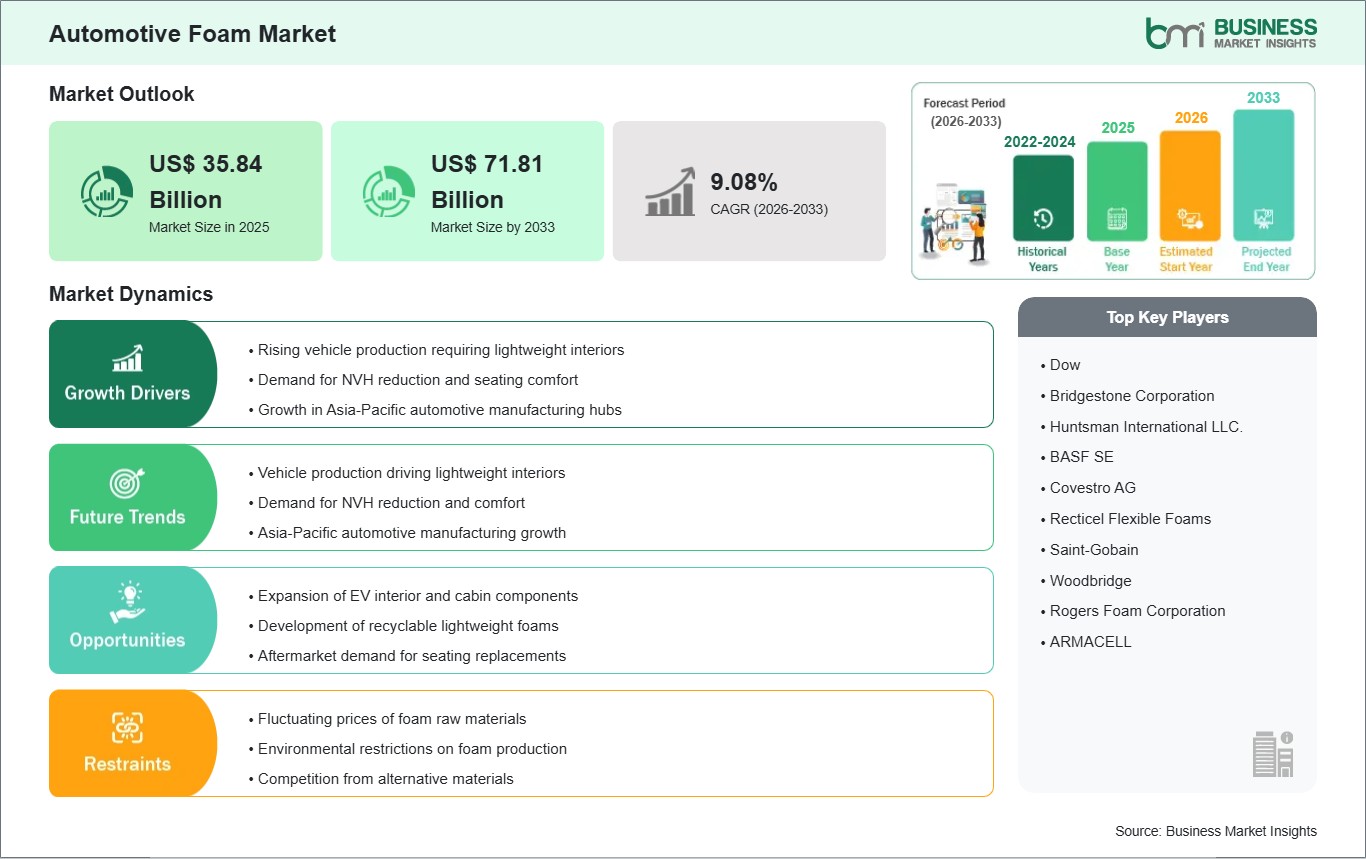
Automotive foam is essential for modern vehicles. It improves comfort, safety, and performance using lightweight, durable materials. These foams are found in seating, interior trim, acoustic insulation, and energy absorption. They help reduce noise, vibration, and harshness (NVH). They also enhance fuel efficiency and provide protection for passengers. Automotive foam offers ergonomic support, thermal insulation, and impact absorption. It helps in reducing weight and allows for more flexible designs. The benefits include better comfort, improved safety, lower emissions, and cost-effective manufacturing. The market is growing due to increased vehicle production, demand for electric vehicles (EVs), and strict regulations on fuel economy and safety. Innovations in bio-based, recyclable, and lightweight foam solutions are also important.
However, the market faces challenges. Fluctuating raw material prices, especially for petroleum-based inputs, can create problems, as can issues with recycling and disposal at the end of life. High costs may prevent small manufacturers from using advanced foams. Achieving optimal performance requires careful engineering and integration. Despite these challenges, there are significant opportunities owing to technological advances, a focus on sustainability and the circular economy, and efforts to lighten vehicles to extend EV range. Future trends will depend on research into smart foams, supportive environmental policies, and the move from traditional materials to new foam systems.
Segment Analysis
Automotive Foam Market Segmentation
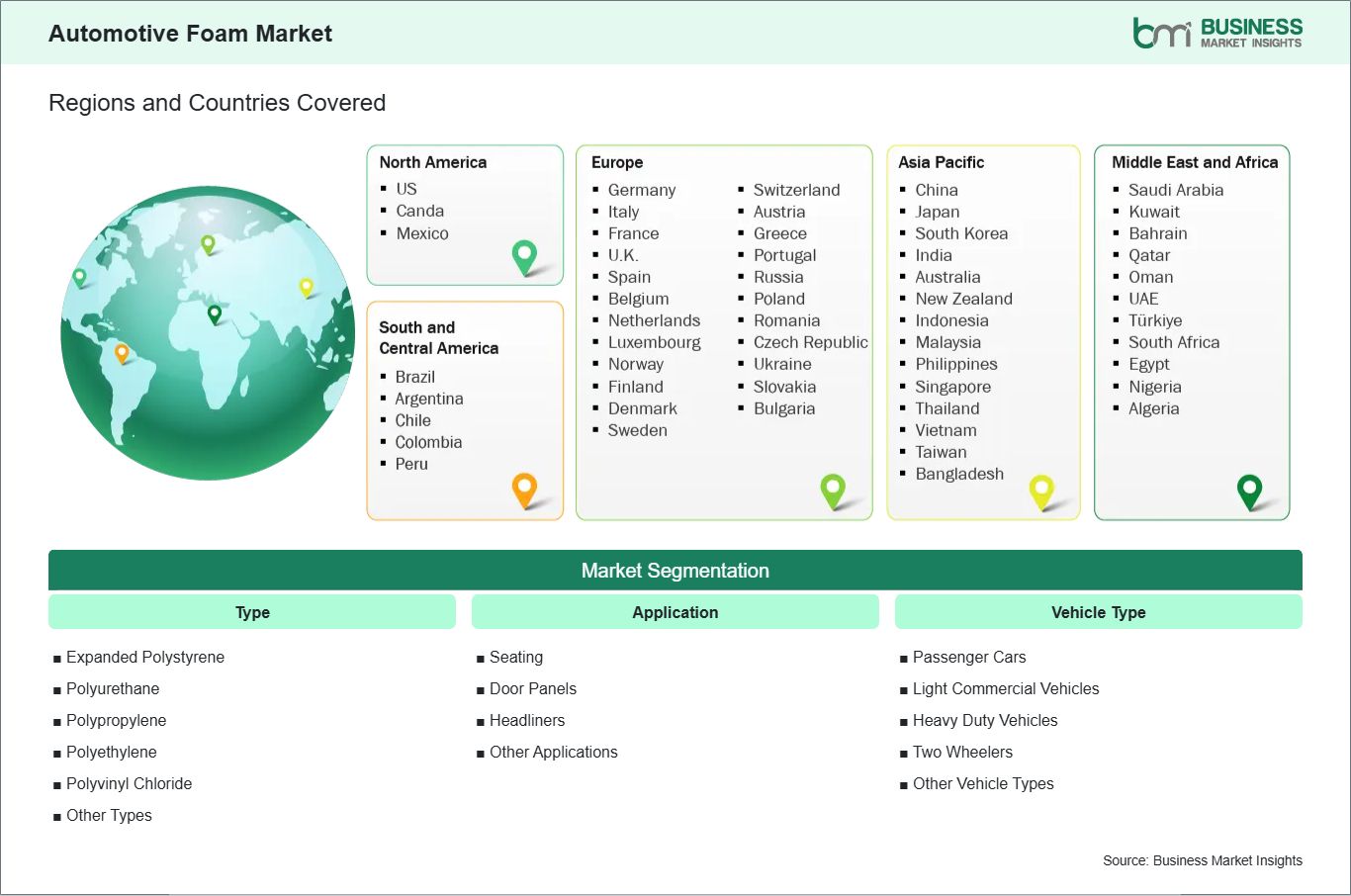
Key segments that contributed to the derivation of the automotive foam market analysis are type, application, and vehicle type.
- By type, the automotive foam market is segmented into expanded polystyrene (EPS), polyurethane, polypropylene, polyethylene, polyvinyl chloride, and other types. The polyurethane segment dominated the market in 2025.
- By application, the market is categorized into seating, door panels, headliners, and other applications. The seating segment dominated the market in 2025.
- By vehicle type, the automotive foam market is segmented into passenger cars, light commercial vehicles, heavy-duty vehicles, two-wheelers, and other vehicle types. The passenger cars segment dominated the market in 2025.
Market Forces
Automotive Foam Market Drivers and Opportunities
Growing Need for High-Performance and Lightweight Foam Solutions
Producers are increasingly using advanced automotive foams to improve passenger comfort, reduce vehicle weight, and boost safety and NVH performance. These foams provide a cost-effective way to deliver consistent cushioning, acoustic dampening, and impact absorption without adding significant weight or limiting design flexibility. They meet the modern need for quieter, safer, and more fuel-efficient vehicles by ensuring reliable quality and easier integration. Their role in EV battery protection and lightweight interiors is crucial for future mobility. The shift towards autonomous and connected vehicles is speeding up innovation in smart and multifunctional foams. The industry is focusing on material science and tailored formulations to meet changing OEM standards. The adoption of modular platforms, electrification goals, and the rise of premium vehicle segments also drive growth. The demand for specialized features continues to push the development of new foam chemistries, ensuring ongoing market growth.
Shift Toward Sustainable and Circular Automotive Materials
There is increasing attention on bio-based, recyclable, and low-VOC foam technologies. This change reflects a growing demand for eco-friendly interior solutions. Products like polyurethane foams with natural oil content reduce the use of fossil fuels and improve recyclability at the end of their life. This appeals to both automakers and regulators. These foams improve resource efficiency by using less material, allowing for easier disassembly, and lowering cabin emissions. They support global goals for carbon neutrality. Interest in renewable feedstocks and closed-loop production shows a commitment to high performance and environmental responsibility. Strict emission standards and global efforts to reduce pollution throughout the automotive lifecycle are speeding up the development of green foam systems. The industry is focusing on materials that sustainably improve efficiency while meeting safety and durability standards. The pursuit of long-term cost savings, meeting regulations, and minimizing the environmental impact is driving the global adoption of innovative automotive foams.
Size and Share Analysis
Automotive Foam Market Size and Share Analysis
The Automotive Foam market demonstrates steady growth, with size and share analysis revealing evolving trends and competitive positioning among key players. The report examines subsegments categorized within type, application, and vehicle type, offering insights into their contribution to overall market performance.
Based on type, the polyurethane subsegment dominates the automotive foam market. Polyurethane-based foams provide excellent comfort, durability, and lightweight properties. They also offer great sound absorption, vibration damping, and design flexibility. These materials are widely used in seating, headrests, armrests, interior trim, acoustic insulation, and EV battery encasements. Their reliable performance, moldability, and consistent quality make them the top choice for automakers and suppliers looking for cost-effective, high-performance solutions that improve passenger comfort, reduce weight, and enhance cabin acoustics.
Report Coverage
Automotive Foam Market Report Coverage and Deliverables
The " Automotive Foam Market Size and Forecast (2022–2033)" report provides a detailed analysis of the market covering below areas:
- Automotive Foam market size and forecast at global, regional, and country levels for all the key market segments covered under the scope
- Automotive Foam market trends, as well as market dynamics such as drivers, restraints, and key opportunities
- Automotive Foam market analysis covering key market trends, global and regional framework, major players, regulations, and recent market developments
- Industry landscape and competition analysis covering market concentration, heat map analysis, prominent players, and recent developments for the automotive foam market
- Detailed company profiles, including SWOT analysis
Geographic Insights
Automotive Foam Market Geographic Insights
The geographical scope of the Automotive Foam market report is divided into five regions: North America, Asia Pacific, Europe, the Middle East & Africa, and South & Central America. The Asia Pacific Automotive Foam Market is segmented into China, Japan, South Korea, India, Australia, New Zealand, Indonesia, Malaysia, the Philippines, Singapore, Thailand, Vietnam, Taiwan, Bangladesh, and the Rest of Asia Pacific. Asia Pacific's fast-growing automotive industry, particularly in passenger car production, commercial vehicle manufacturing, electric vehicle assembly, and parts sourcing, positions it as a crucial region for market growth.
This market growth also comes from the need for lighter materials, better cabin comfort, and safer and quieter vehicles. There is a strong demand for long-lasting, affordable, and resilient foam materials. The region's growing middle class, increasing vehicle ownership, and stricter fuel efficiency and emission standards highlight Asia Pacific's status as a leading producer and consumer of automotive foam globally.
Industry Activity
Recent Developments
The Automotive Foam market is evaluated by gathering qualitative and quantitative data post-primary and secondary research, which includes important corporate publications, association data, and databases. A few of the key developments in the automotive foam market are:
- In July 2025, Covestro introduced a new flame-retardant polyurethane foam technology aimed at improving battery safety in electric vehicles (EVs). This innovation addresses critical safety concerns as EV adoption rises globally. In response, China is implementing the national standard GB 38031-2025, which mandates that batteries must be designed to prevent fire or explosion during thermal runaway; this standard will be effective from July 2026. This regulation is anticipated to influence global safety standards for EVs.
- In September 2025, Dow and Gruppo Fiori created a new method for recycling automotive polyurethane foam, enabling the extraction of clean foam from car seats without needing to dismantle the vehicle. This innovative process allows recyclers to recover significant amounts of foam—typically around 22 to 33 pounds per vehicle—cost-effectively and efficiently, facilitating its transformation into new materials.
Trust & Transparency
Research Methodology
The market analysis combines proprietary research with secondary data from government agencies, company disclosures, regulatory filings, industry databases and expert interviews. Market estimates are validated through data triangulation, cross-market benchmarking and analyst
review.
View Full Research Methodology
Key Sources Referred:
World Bank – Global Trade IndicatorsEuropean Chemicals AgencyInternational Council of Chemical AssociationsInternational Monetary Fund (IMF)World Trade Organization (WTO)International Trade Administration (ITA)Company WebsitesCompany Annual ReportsCompany Investor Presentations