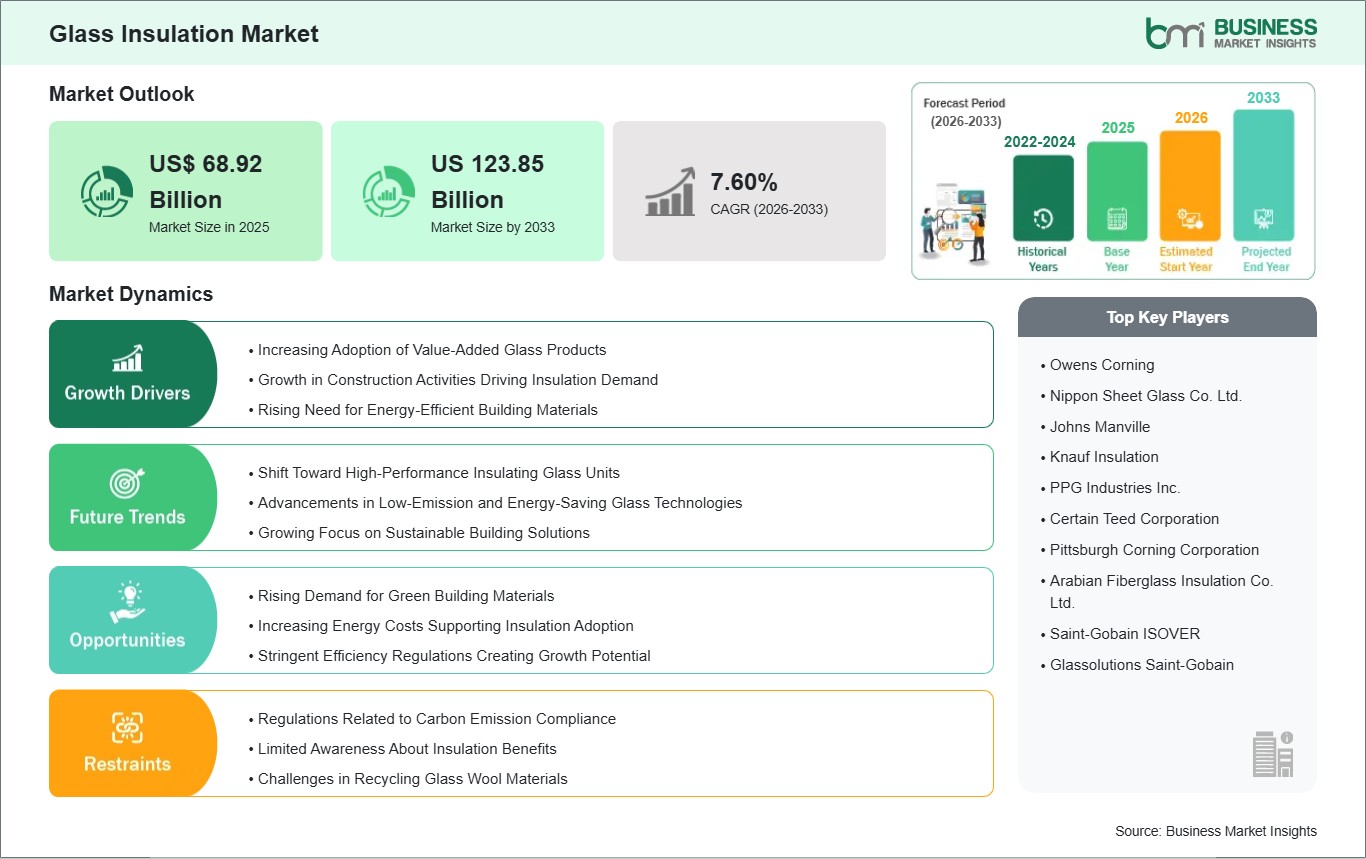
The Glass Insulation Market size is expected to reach US$ 123.85 Billion by 2033 from US$ 68.92 Billion in 2025. The market is estimated to record a CAGR of 7.60% from 2026 to 2033.
The global market for glass insulation has grown to become a significant contributor to energy-efficient construction and industrial practices due to the growing trend of performance-based building materials. Glass insulation, which is primarily made from recycled glass in a fibrous form, has become highly regarded for its ability to control temperatures, control sound, and provide fire safety in a variety of applications. It has become a common addition to building and industrial designs in which temperature control and comfort are essential. What has become so appealing about using glass insulation is its ability to provide reliable insulation without adding additional weight and complexity to the structure.
Market momentum is being driven by a marked shift towards smarter and more sustainable infrastructure, and this is helping to build a case for more efficient insulation products. Additionally, glass insulation is more in line with the principles of a more sustainable and circular economy, especially since many glass insulation products feature recycled materials and can help save energy in buildings. However, new developments in glass insulation manufacturing have made it easier for builders to handle this material, regardless of the type of project they are working on. Other insulation products that feature unique properties may also come into play for certain applications, and improper handling may also influence this type of insulation. However, glass insulation is still at a favorable position in the global market.

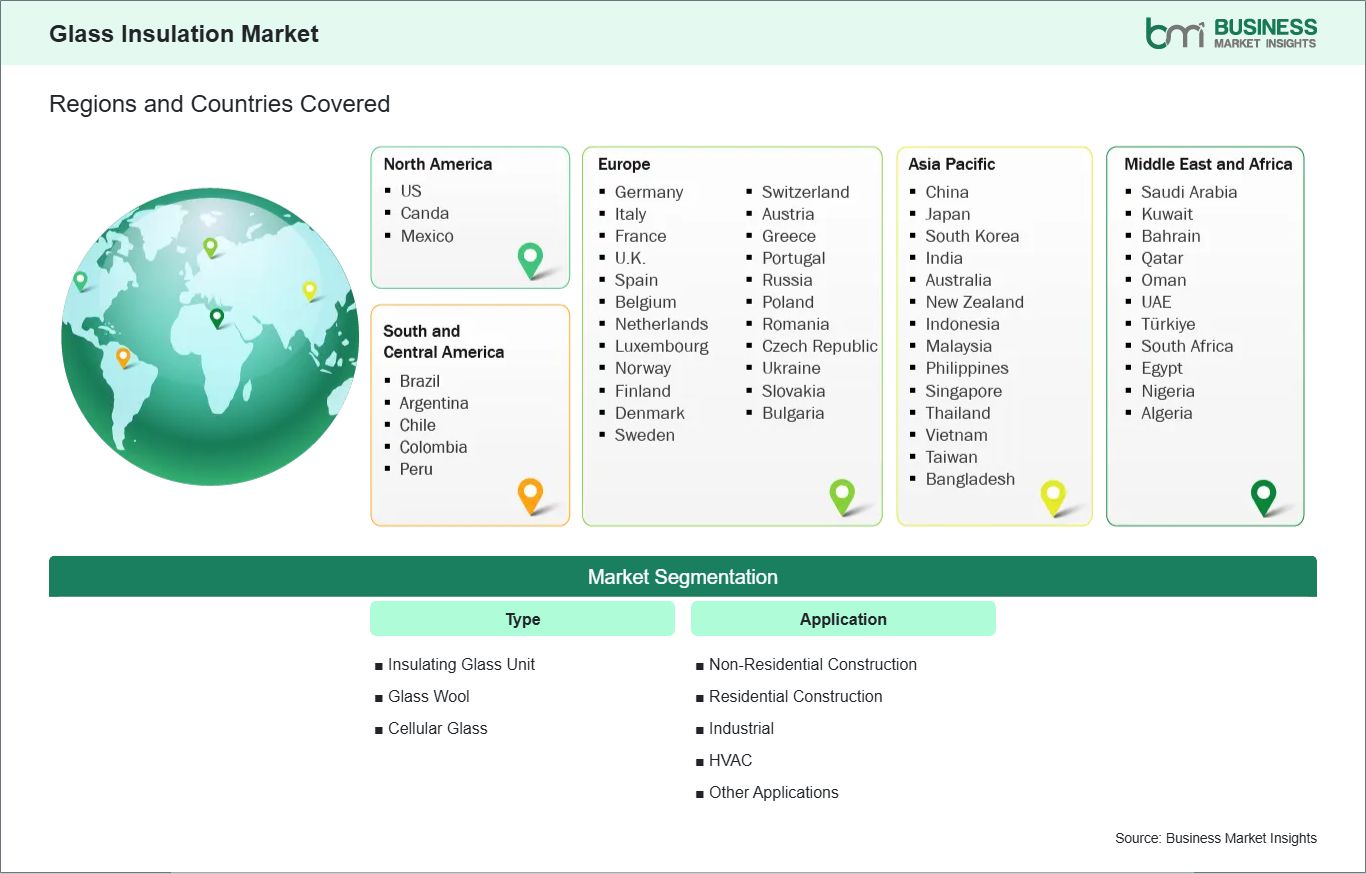
Key segments that contributed to the derivation of the glass insulation market analysis are type and application.
The growing adoption of value-added glass products is playing a significant role in shaping the global glass insulation market. As construction and industrial sectors evolve, there is a clear shift toward materials that offer more than basic insulation, including enhanced thermal efficiency, acoustic control, and durability. Glass insulation products, particularly those engineered with advanced formulations, are increasingly being used in applications where performance and long-term reliability are critical. This shift reflects a broader industry preference for materials that deliver multiple functional benefits within a single solution.
In developed construction markets, demand is being driven by the need for high-performance building materials that can support energy efficiency goals while maintaining design flexibility. Glass insulation is often integrated into wall systems, roofing structures, and HVAC applications to improve indoor comfort and reduce energy consumption. At the same time, industrial users are incorporating specialized glass insulation products in manufacturing facilities and process plants, where temperature control and safety are essential. These value-added applications highlight the expanding role of glass insulation beyond traditional building uses.
Emerging construction environments are also contributing to this trend, particularly where modern infrastructure projects are being designed with a focus on efficiency and longevity. Builders are increasingly selecting glass insulation products that combine lightweight characteristics with strong thermal and acoustic performance. As awareness grows around lifecycle costs and building efficiency, value-added glass insulation solutions are gaining traction as a practical investment. This evolution is positioning glass insulation as a key component in modern construction and industrial design strategies worldwide.
The rising demand for green building materials is a major factor driving growth in the glass insulation market. Sustainability has become a central consideration in construction, with developers and building owners seeking materials that reduce environmental impact while maintaining high performance. Glass insulation, often manufactured using recycled content and designed for energy efficiency, aligns well with these objectives. Its ability to minimize heat loss and improve overall building efficiency makes it an essential material in environmentally conscious construction projects.
In many regions, green building certifications and energy efficiency standards are influencing material selection in both new construction and renovation projects. Glass insulation contributes to these goals by supporting better thermal regulation, which reduces reliance on heating and cooling systems. This not only lowers energy consumption but also helps buildings meet increasingly stringent environmental requirements. As a result, architects and engineers are specifying glass insulation products more frequently in projects that prioritize sustainability and long-term operational efficiency.
Additionally, the focus on reducing carbon footprints across the construction lifecycle is encouraging wider adoption of recyclable and low-impact materials. Glass insulation stands out due to its durability, low maintenance needs, and ability to retain performance over time without significant degradation. These attributes make it a reliable choice for developers aiming to balance environmental responsibility with cost-effectiveness. As sustainable construction practices continue to gain momentum globally, the demand for glass insulation is expected to grow, reinforcing its role as a key material in the transition toward greener and more energy-efficient buildings.

The glass insulation market is experiencing steady growth, with market size and share analysis reflecting evolving treatment preferences and competitive dynamics among key players. The report evaluates important subsegments categorized within type and application, highlighting their respective contributions to overall market performance.
By type, the insulating glass unit subsegment dominated the glass insulation market in 2025. Insulating glass units provide superior thermal insulation and energy efficiency, making them highly suitable for modern construction requirements, which drives their widespread adoption.
Based on application, the non-residential construction subsegment dominated the glass insulation market in 2025. Non-residential construction projects require energy-efficient and durable insulation solutions for large-scale buildings, making this segment highly suitable for commercial and institutional infrastructure, which drives its widespread adoption.
| Report Attribute | Details |
|---|---|
| Market size in 2025 | US$ 68.92 Billion |
| Market Size by 2033 | US 123.85 Billion |
| Global CAGR (2026 - 2033) | 7.60% |
| Historical Data | 2022-2024 |
| Forecast period | 2026-2033 |
| Segments Covered | By Type
|
|
Regions and Countries Covered
| |
| North America | US, Canada, Mexico |
| Europe | Belgium, Austria, Finland, Denmark, Greece, Poland, Romania, Russia, Ukraine, Czech Republic, Slovakia, Bulgaria, Italy, Luxembourg, Germany, Switzerland, France, Netherlands, Norway, Portugal, Spain, Sweden, United Kingdom |
| Asia-Pacific | Australia, China, India, Japan, South Korea, Indonesia, Malaysia, Philippines, Singapore, Thailand, Vietnam, Bangladesh, New Zealand, Taiwan |
| South and Central America | Brazil, Argentina, Peru, Chile, Colombia |
| Middle East and Africa | Bahrain, Kuwait, Oman, Qatar, Saudi Arabia, United Arab Emirates, Turkiye, South Africa, Egypt, Algeria, Nigeria |
| Market leaders and key company profiles |
|
The "Glass Insulation Market Size and Forecast (2022 - 2033)" report provides a detailed analysis of the market covering below areas:
The geographical scope of the Glass Insulation market report is divided into five regions: North America, Asia Pacific, Europe, Middle East & Africa, and South & Central America. The Glass Insulation market in North America is expected to grow during the forecast period.
North America remains the leading region in the global glass insulation market, shaped by a combination of regulatory discipline, construction maturity, and a strong culture of building performance optimization. In this region, insulation is not treated as an afterthought but as a core component of building design, influencing everything from energy usage to indoor comfort. Glass insulation is widely specified in both new construction and retrofit projects, particularly where consistent thermal control and noise reduction are important considerations. Its adaptability makes it suitable for residential housing, large commercial developments, and specialized industrial facilities alike. One of the major characteristics of the North American market is its consistent focus on improving existing infrastructure. Such projects provide a consistent level of demand for insulation materials that can be implemented with minimal disruption, while at the same time offering a level of performance enhancement that is readily apparent.
The role of glass insulation within this narrative is clear, as it offers a level of familiarity and consistency that can be readily utilized by project managers and other relevant professionals. The region also offers a high level of consistency in its supply chain, which, combined with its experienced workforce, can readily implement insulation materials with a consistent level of quality. While other materials are gaining prominence in the region, the level of trust associated with glass insulation materials remains high, thanks to their consistency of performance and ease of use. The region’s consistent emphasis on performance-based building and infrastructure is a major reason for its status as a leader in the industry.

The glass insulation market is evaluated by gathering qualitative and quantitative data post primary and secondary research, which includes important corporate publications, association data, and databases. A few of the key developments in the glass insulation market are:
The Glass Insulation Market is valued at US$ 68.92 Billion in 2025, it is projected to reach US 123.85 Billion by 2033.
As per our report Glass Insulation Market, the market size is valued at US$ 68.92 Billion in 2025, projecting it to reach US 123.85 Billion by 2033. This translates to a CAGR of approximately 7.60% during the forecast period.
The Glass Insulation Market report typically cover these key segments-
The historic period, base year, and forecast period can vary slightly depending on the specific market research report. However, for the Glass Insulation Market report:
The Glass Insulation Market is populated by several key players, each contributing to its growth and innovation. Some of the major players include:
The Glass Insulation Market report is valuable for diverse stakeholders, including:
Essentially, anyone involved in or considering involvement in the Glass Insulation Market value chain can benefit from the information contained in a comprehensive market report.
Please tell us your area of interest
(Market Segments/ Regions and Countries/ Companies)