Market Summary
Executive Summary and Global Market Analysis
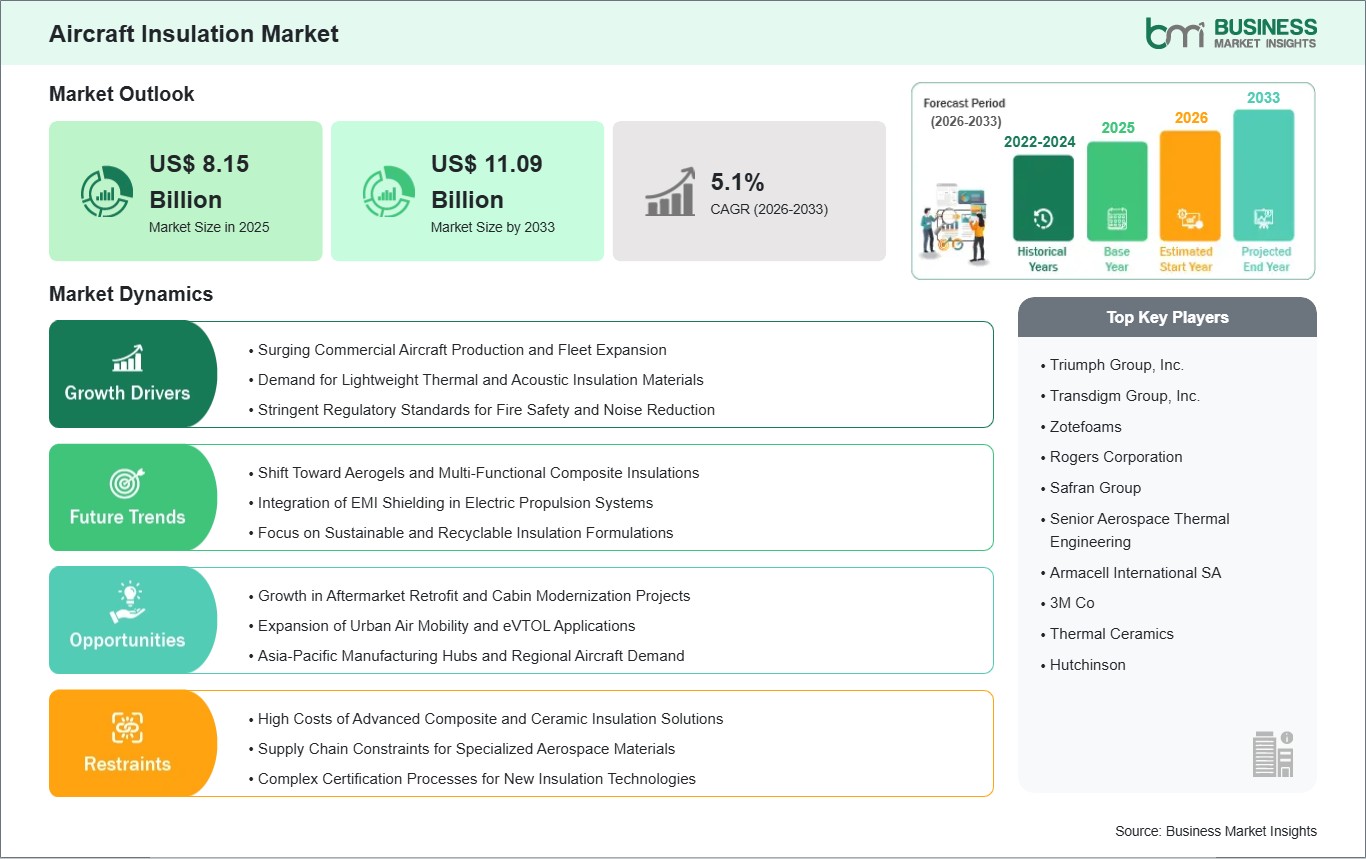
Aircraft insulation is essential for modern aviation, as it acts as a system for thermal regulation, sound control, fire safety, and condensation management. Its performance affects aircraft safety, operational efficiency, and passenger comfort. The market grows due to rising global aircraft production, strict international safety and noise regulations, and the industry's ongoing quest for better fuel efficiency through lightweight materials. Innovations in high-performance products, such as aerogels and multifunctional blankets, along with increased demand from aftermarket maintenance and retrofitting, are driving industry growth.
Despite strong drivers, the market faces challenges like high certification and material costs, fluctuations in raw material supply chains, and the complexity of installation. Still, there are significant opportunities in developing sustainable and recyclable insulation materials. The rise of electric and hybrid-electric aircraft also presents new possibilities, as does the expansion into new platforms like urban air mobility vehicles and advanced UAVs. The market's future will depend on ongoing material science innovations and the aviation industry's shift toward more efficient and environmentally friendly aircraft.
Segment Analysis
Aircraft Insulation Market Segmentation
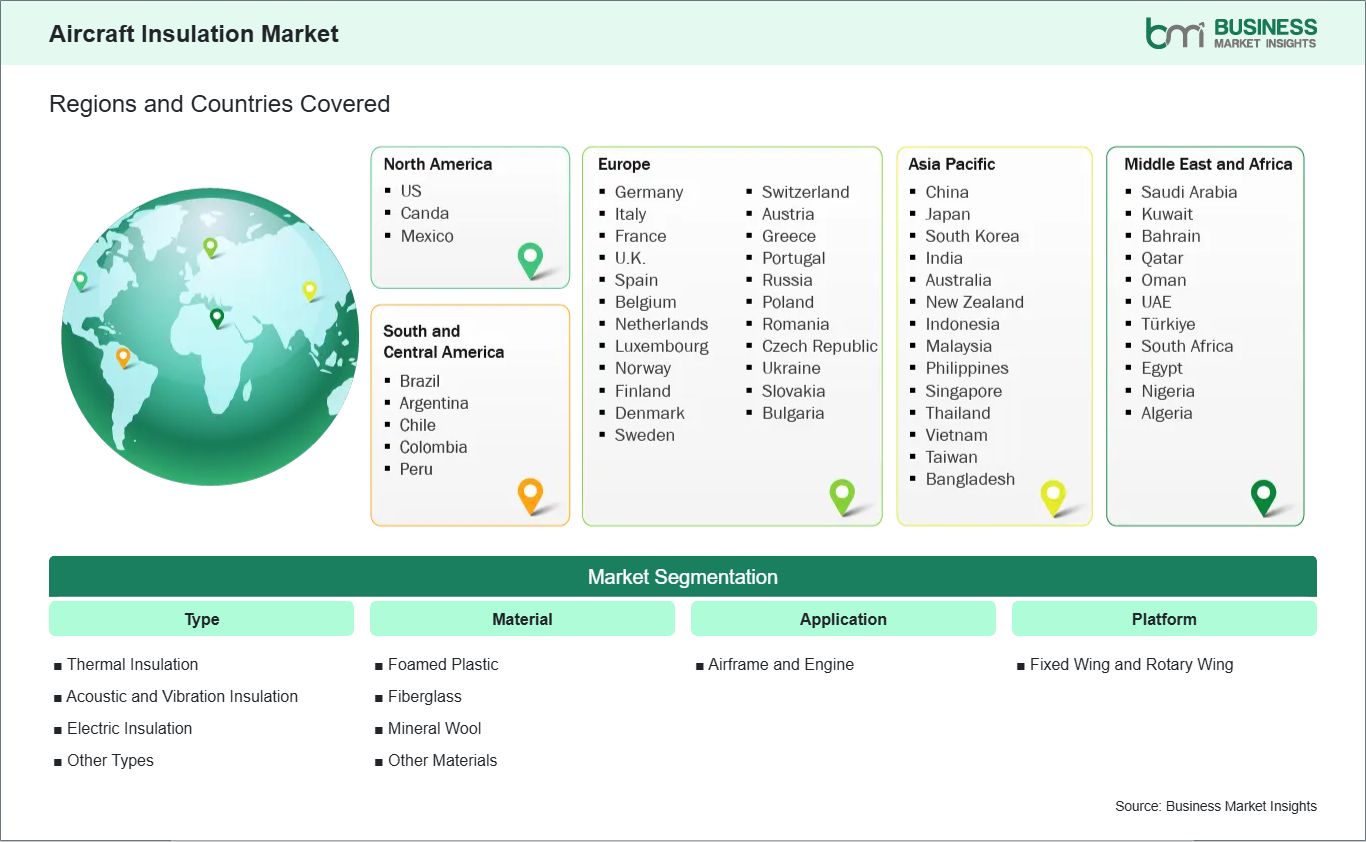
Key segments that contributed to the derivation of the aircraft insulation market analysis are type, material, application, platform, and solution.
- By type, the aircraft insulation market is segmented into thermal insulation, acoustic and vibration insulation, electric insulation, and other types. The thermal insulation segment dominated the market in 2025.
- By material, the market is segmented into foamed plastic, fiberglass, mineral wool, and other materials. The foamed plastic segment dominated the market in 2025.
- By application, the aircraft insulation market is divided into airframe and engine. The airframe segment held a larger share of the market in 2025.
- By platform, the market is bifurcated into fixed-wing and rotary-wing. The fixed-wing segment dominated the market in 2025.
- By solution, the aircraft insulation market is segmented into encapsulated insulation systems, heat shields, and other solutions. The encapsulated insulation systems segment held the largest share of the market in 2025.
Market Forces
Aircraft Insulation Market Drivers and Opportunities
Stringent Regulatory Standards and Demand for Fuel-Efficient, Quieter Aircraft
The commercial aviation industry relies on two main factors: following regulations and improving efficiency. Strict international safety standards for fire protection, cabin noise, and emissions require the use of better insulation materials that resist fire, produce less smoke, and dampen noise effectively. At the same time, the ongoing need for fuel efficiency and a smaller carbon footprint is speeding up the use of lighter insulation solutions. By switching from heavier traditional materials, modern insulation systems help reduce weight, which results in significant fuel savings and lower emissions throughout an aircraft's life. This is crucial as production rates for new, fuel-efficient aircraft increase. Moreover, rising passenger demands for comfort in the cabin are driving airlines to seek better thermal and noise management. High-performance insulation has become essential in aircraft interiors and a major factor in both the original equipment manufacturer and aftermarket markets.
Development and Integration of Sustainable and Multifunctional Advanced Materials
Traditional aircraft insulation is effective but faces growing scrutiny about its impact on the environment throughout its lifecycle, from production to disposal. This challenge offers a major chance for innovation. The market is shifting toward sustainable materials, such as recyclable polymer-based felts, bio-derived fibers, and solutions made for easier disassembly and recycling. This shift supports the aviation industry's larger goals of a circular economy. Additionally, the use of multifunctional materials represents a significant area for growth. Innovations like aerogels and microporous materials provide excellent thermal performance while being lightweight and thin. Developing "smart" insulation with built-in sensors for health monitoring or materials that combine thermal, acoustic, and fire-blocking features into single-layer systems can simplify installation and reduce complexity. These valuable solutions are especially appealing for new platforms like electric and hybrid-electric aircraft, UAVs, and Urban Air Mobility vehicles, which have specific thermal management needs. Companies investing in research and development for these next-generation materials, and building partnerships with aerospace manufacturers, are set to seize profitable opportunities and secure a lasting competitive edge in a market increasingly focused on sustainability and technology.
Size and Share Analysis
Aircraft Insulation Market Size and Share Analysis
The Aircraft Insulation market demonstrates steady growth, with size and share analysis revealing evolving trends and competitive positioning among key players. The report further examines subsegments categorized within type, material, application, platform, and solution, offering insights into their contribution to overall market performance.
Based on type, the thermal insulation subsegment dominates the aircraft insulation market. Materials such as ceramic fabrics, fiberglass, and silica‑based blankets play a critical role in maintaining stable cabin temperatures, protecting airframe structures from extreme external conditions, and enhancing overall aircraft safety. Their use is driven not only by the need to improve passenger comfort but also by stringent aviation safety standards that regulate fire resistance, temperature management, and system reliability. The demand for advanced thermal insulation is further strengthened by the industry’s ongoing focus on lightweight, fuel‑efficient aircraft. As manufacturers work to reduce fuel consumption and emissions, insulation materials that offer high thermal performance at lower weight are becoming increasingly important. Additionally, the steady rise in new aircraft production, along with continuous maintenance, repair, and overhaul (MRO) activities, ensures consistent demand for durable and efficient thermal insulation solutions. Together, these factors secure thermal insulation’s position as a critical and leading segment within the broader aircraft insulation market.
Report Coverage
Aircraft Insulation Market Report Coverage and Deliverables
The " Aircraft Insulation Market Size and Forecast (2022–2033)" report provides a detailed analysis of the market covering below areas:
- Aircraft Insulation market size and forecast at global, regional, and country levels for all the key market segments covered under the scope
- Aircraft Insulation market trends, as well as market dynamics such as drivers, restraints, and key opportunities
- Aircraft Insulation market analysis covering key market trends, global and regional framework, major players, regulations, and recent market developments
- Industry landscape and competition analysis covering market concentration, heat map analysis, prominent players, and recent developments for the aircraft insulation market
- Detailed company profiles, including SWOT analysis
Geographic Insights
Aircraft Insulation Market Geographic Insights
The geographical scope of the Aircraft Insulation market report is divided into five regions: North America, Asia Pacific, Europe, the Middle East & Africa, and South & Central America. The North America Aircraft Insulation Market is segmented into the US, Canada, and Mexico. North America is the main hub and largest market for aircraft insulation. This is due to the presence of major aerospace manufacturers like Boeing and Airbus in the region, strict regulatory standards from the FAA and NASA, and the largest Maintenance, Repair, and Overhaul (MRO) sector in the world.
The region's leadership is also supported by high spending on defense and research and development, which speeds up the use of new insulation technologies for next-generation commercial, military, and space platforms. Ongoing fleet modernization, along with strong aftermarket demand and a focus on lightweighting and sustainability in aircraft design, reinforces North America's role as the leading and most advanced region in the global aircraft insulation market.
Industry Activity
Recent Developments
The Aircraft Insulation market is evaluated by gathering qualitative and quantitative data post-primary and secondary research, which includes important corporate publications, association data, and databases. A few of the key developments in the aircraft insulation market are:
- In May 2025, a New HCN report highlighted the UK's materials testing capabilities for liquid hydrogen in aviation. Identifying key research areas in materials, thermofluids, and health and safety, the report emphasizes the importance of developing test infrastructure and skills for hydrogen-powered aircraft. While the UK excels in various aspects of liquid-hydrogen technology, it notes deficiencies in on-aircraft cryogenic hydrogen fuel storage and distribution systems.
- In January 2024, Chinese researchers from Guangzhou University developed a new high-strength, porous ceramic with excellent thermal insulation properties, potentially transformative for hypersonic aircraft as well as aerospace, energy, and chemical engineering applications.
Trust & Transparency
Research Methodology
The market analysis combines proprietary research with secondary data from government agencies, company disclosures, regulatory filings, industry databases and expert interviews. Market estimates are validated through data triangulation, cross-market benchmarking and analyst
review.
View Full Research Methodology
Key Sources Referred:
World Bank – Global Trade Indicators European Chemicals Agency International Council of Chemical Associations International Monetary Fund (IMF) World Trade Organization (WTO) International Trade Administration (ITA) Company Websites Company Annual Reports Company Investor Presentations