Market Summary
Executive Summary and Global Market Analysis
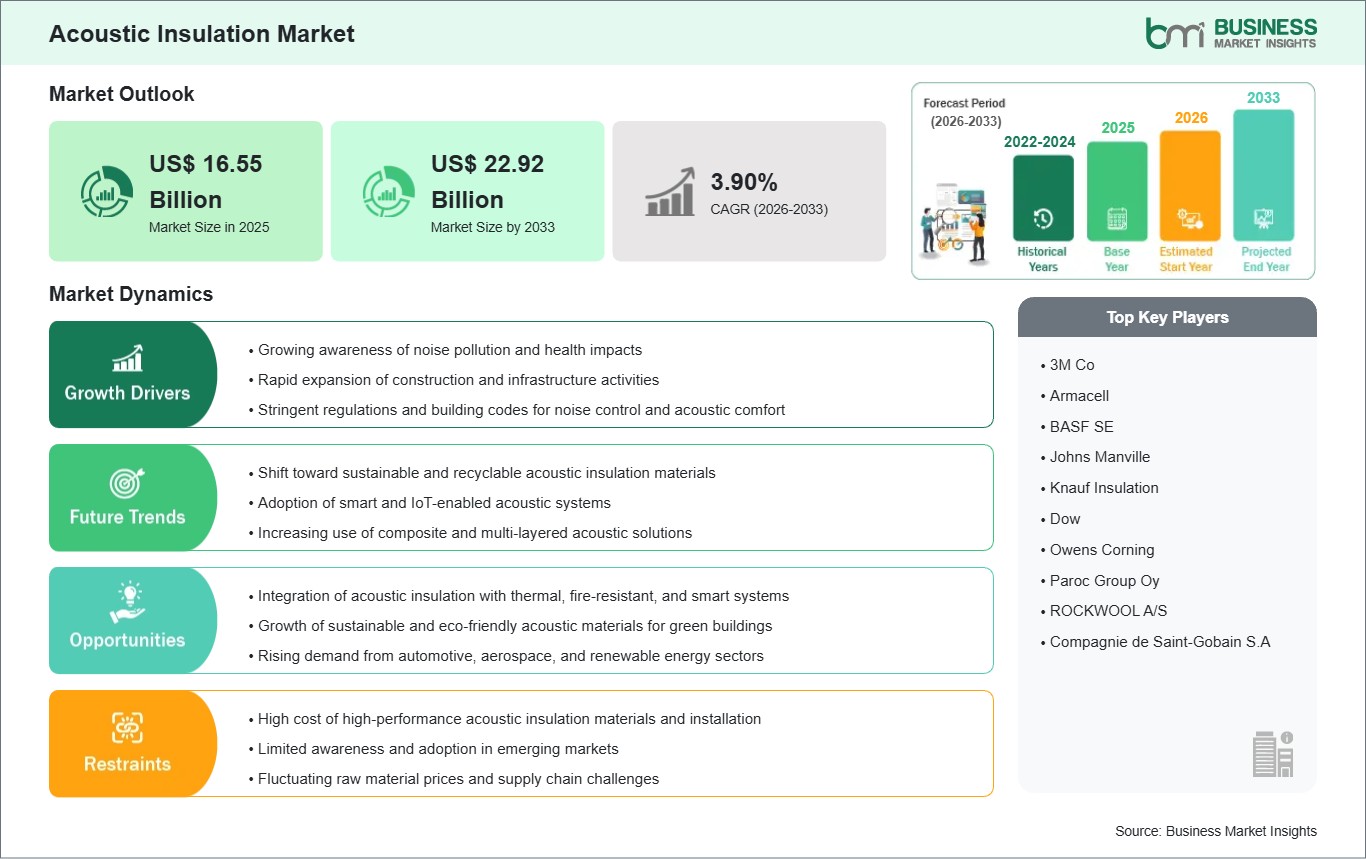
The acoustic insulation market is fueled by a growing need for noise reduction and soundproofing in residential, commercial, and industrial sectors. Rapid urbanization and population growth have increased noise pollution in cities. This has led to stricter building regulations and standards for sound control. In construction, more investment in residential and commercial infrastructure, such as offices, hotels, hospitals, and educational facilities, drives the use of acoustic insulation materials like mineral wool, fiberglass, foam, and recycled composites. Industrial settings, including manufacturing plants and power generation facilities, also need effective noise reduction to meet health and safety rules.
Additionally, the growth of the transportation sector, especially in automotive, aerospace, and rail, raises the need for acoustic insulation solutions that improve passenger comfort and cut down on operational noise. Advances in insulation materials, which include lightweight, eco-friendly, and high-performance options, also support market growth. Increased awareness among consumers about the health effects of noise pollution, along with a greater focus on energy-efficient and sustainable building designs, helps drive continued growth in the global acoustic insulation market.
Segment Analysis
Acoustic Insulation Market Segmentation
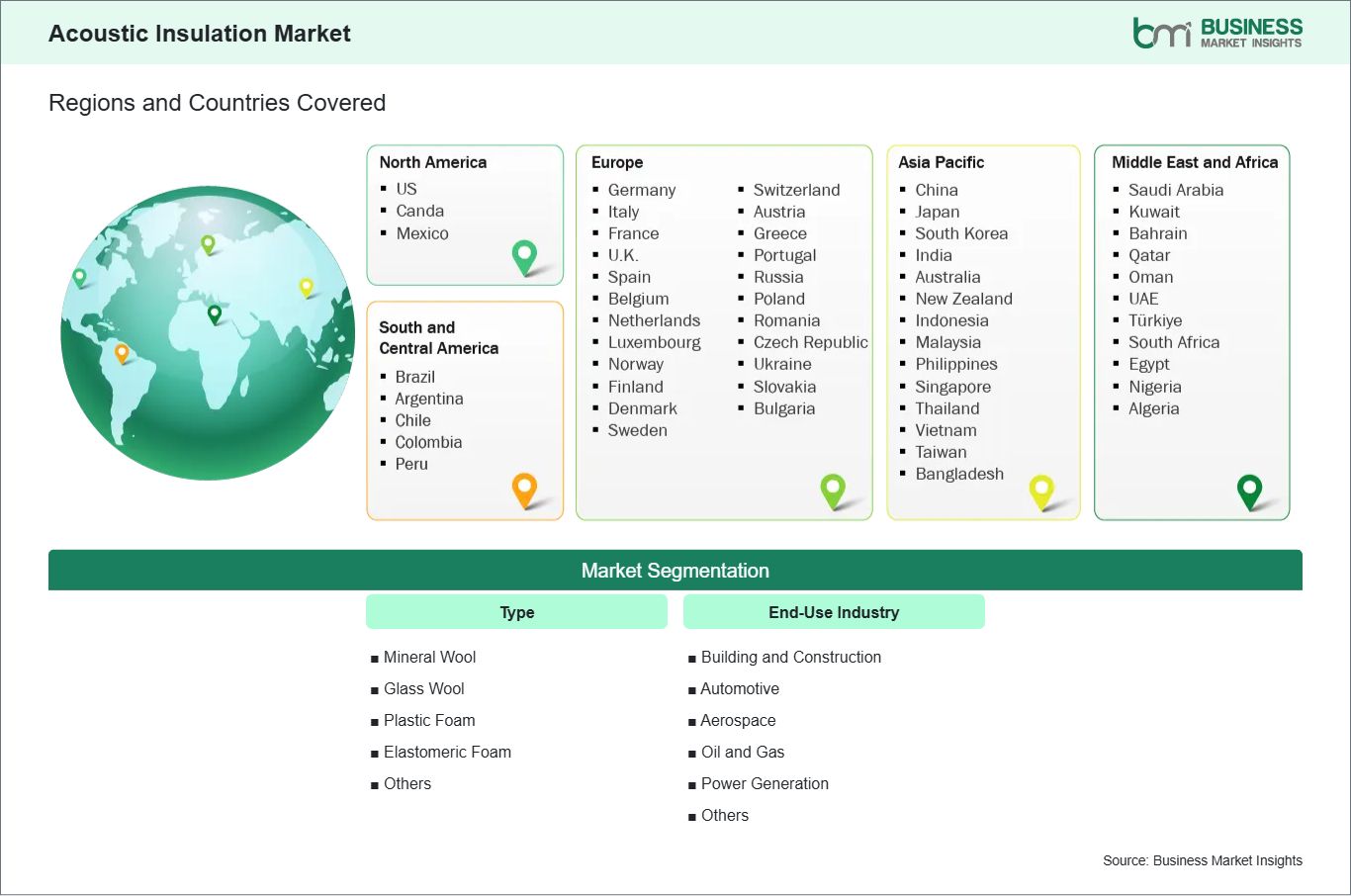
Key segments that contributed to the derivation of the acoustic insulation market analysis are type and end-use industry.
- By type, the market is divided into mineral wool, glass wool, plastic foam, elastomeric foam, and others. The mineral wool segment held the largest market share in 2025.
- By end-use industry, the market is categorized into building and construction, automotive, aerospace, oil and gas, power generation, and others. The building and construction segment accounted for the largest share in 2025.
Market Forces
Acoustic Insulation Market Drivers and Opportunities
Increasing Urbanization and Noise Pollution
Growing urbanization and population increase in cities have led to higher noise pollution in residential, commercial, and industrial areas. The rapid growth of infrastructure, like high-rise buildings, transportation networks, airports, and industrial facilities, has increased the need for effective soundproofing solutions. Stricter government regulations and building codes about allowable noise levels in urban areas push developers and facility managers to include acoustic insulation in their projects.
In the automotive and aerospace industries, manufacturers are increasingly using sound-absorbing materials to improve passenger comfort and meet noise emission standards. Also, consumer awareness of the harmful health effects from extended exposure to high noise levels, like stress, sleep problems, and hearing issues, boosts the demand for high-performance acoustic insulation products. Developments in insulation materials, such as lightweight, eco-friendly, and fire-resistant options, have also helped the market grow by providing versatile solutions for various applications. All these factors encourage the consistent use of acoustic insulation across multiple industries worldwide.
Adoption of Eco-Friendly and Sustainable Insulation Materials
Governments and industries around the world are focusing on green construction and energy-efficient building practices. They aim to reduce carbon footprints and meet sustainability goals. This trend has pushed manufacturers to create insulation solutions using recycled, biodegradable, or low-emission materials while maintaining acoustic and thermal performance. For instance, mineral wool and recycled cellulose-based products are becoming popular as sustainable alternatives to traditional foams and synthetic materials.
The rising consumer preference for environmentally friendly building products, along with incentives and regulations that support green construction, creates a promising path for market expansion. Additionally, combining acoustic insulation with thermal insulation and fire-resistant features results in multifunctional solutions that meet modern building needs, boosting their adoption. As the construction, automotive, and industrial sectors increasingly focus on sustainability, manufacturers who invest in eco-friendly acoustic materials are well-positioned to seize long-term growth opportunities in the global market.
Size and Share Analysis
Acoustic Insulation Market Size and Share Analysis
The acoustic insulation market demonstrates steady growth, with size and share analysis revealing evolving trends and competitive positioning among key players. The report further examines subsegments categorized within type and end-use industry, offering insights into their contribution to overall market performance. By type, the mineral wool segment held the largest market share in 2025 due to its excellent thermal and acoustic insulation properties, fire resistance, and durability, making it highly suitable for building, industrial, and automotive applications. In terms of end-use industry, the building and construction segment accounted for the largest share in 2025, driven by rapid urbanization, increased infrastructure development, and stricter regulations for noise control and energy efficiency in residential and commercial buildings.
Report Coverage
Acoustic Insulation Market Report Coverage and Deliverables
The " Acoustic Insulation Market Size and Forecast (2022–2033)" report provides a detailed analysis of the market covering below areas:
- Acoustic insulation market size and forecast at global, regional, and country levels for all the key market segments covered under the scope
- Acoustic insulation market trends, as well as market dynamics such as drivers, restraints, and key opportunities
- acoustic insulation market analysis covering key market trends, global and regional framework, major players, regulations, and recent market developments
- Industry landscape and competition analysis covering market concentration, heat map analysis, prominent players, and recent developments for the acoustic insulation market
- Detailed company profiles, including SWOT analysis
Geographic Insights
Acoustic Insulation Market Geographic Insights
The geographical scope of the acoustic insulation market report is divided into five regions: North America, Asia Pacific, Europe, the Middle East & Africa, and South & Central America. The acoustic insulation market in Asia Pacific is expected to grow significantly during the forecast period.
Asia Pacific led the acoustic insulation market in 2025 due to rapid urbanization, industrial growth, and expanding infrastructure development. Countries like China, India, and Japan are seeing major investments in residential, commercial, and industrial construction. This includes high-rise buildings, airports, rail networks, and manufacturing facilities, all of which need effective acoustic insulation to meet noise control rules. The growing automotive and aerospace industries in the region also add to market demand, as manufacturers use sound-absorbing materials to improve passenger comfort and meet strict noise emission limits.
Increased awareness of the negative health effects of noise pollution, such as stress, sleep problems, and hearing loss, has pushed demand for soundproofing solutions in homes, offices, and public spaces. Additionally, Asia Pacific has cost-effective manufacturing, plenty of raw materials, and a robust supply chain, which support large-scale production and distribution of insulation materials. Government programs promoting green building practices and energy-efficient designs, along with advancements in lightweight, fire-resistant, and eco-friendly acoustic materials, have solidified the region's leading position, allowing Asia Pacific to hold the largest share of the global acoustic insulation market.
Industry Activity
Recent Developments
The acoustic insulation market is evaluated by gathering qualitative and quantitative data post-primary and secondary research, which includes important corporate publications, association data, and databases. A few of the key developments in the acoustic insulation market are:
- In March 2025, Knauf Insulation APAC joined forces with Mineral Wool (Thailand) to launch the Earthwool Metal Roofing Roll range in Thailand. This high-quality acoustic and thermal insulation uses bio-based binders instead of petroleum-based ones. This change greatly reduces embodied carbon while keeping fire safety and sound comfort intact.
- In February 2025, BASF introduced a new line of bio-based acoustic insulation materials. These products aim to meet strict environmental rules while offering excellent sound absorption. This launch shows the industry's increasing attention to sustainable acoustic solutions.
Trust & Transparency
Research Methodology
The market analysis combines proprietary research with secondary data from government agencies, company disclosures, regulatory filings, industry databases and expert interviews. Market estimates are validated through data triangulation, cross-market benchmarking and analyst
review.
View Full Research Methodology
Key Sources Referred:
World Bank – Global Trade IndicatorsWorld Trade Organization (WTO)International Monetary Fund (IMF)International Trade Administration (ITA)Company WebsitesCompany Annual ReportsCompany Investor PresentationsRockwool Technical Association (RTA)Insulation Manufacturers Association (IMA)European Insulation Manufacturers Association (EURIMA)American Society for Testing and Materials (ASTM International)