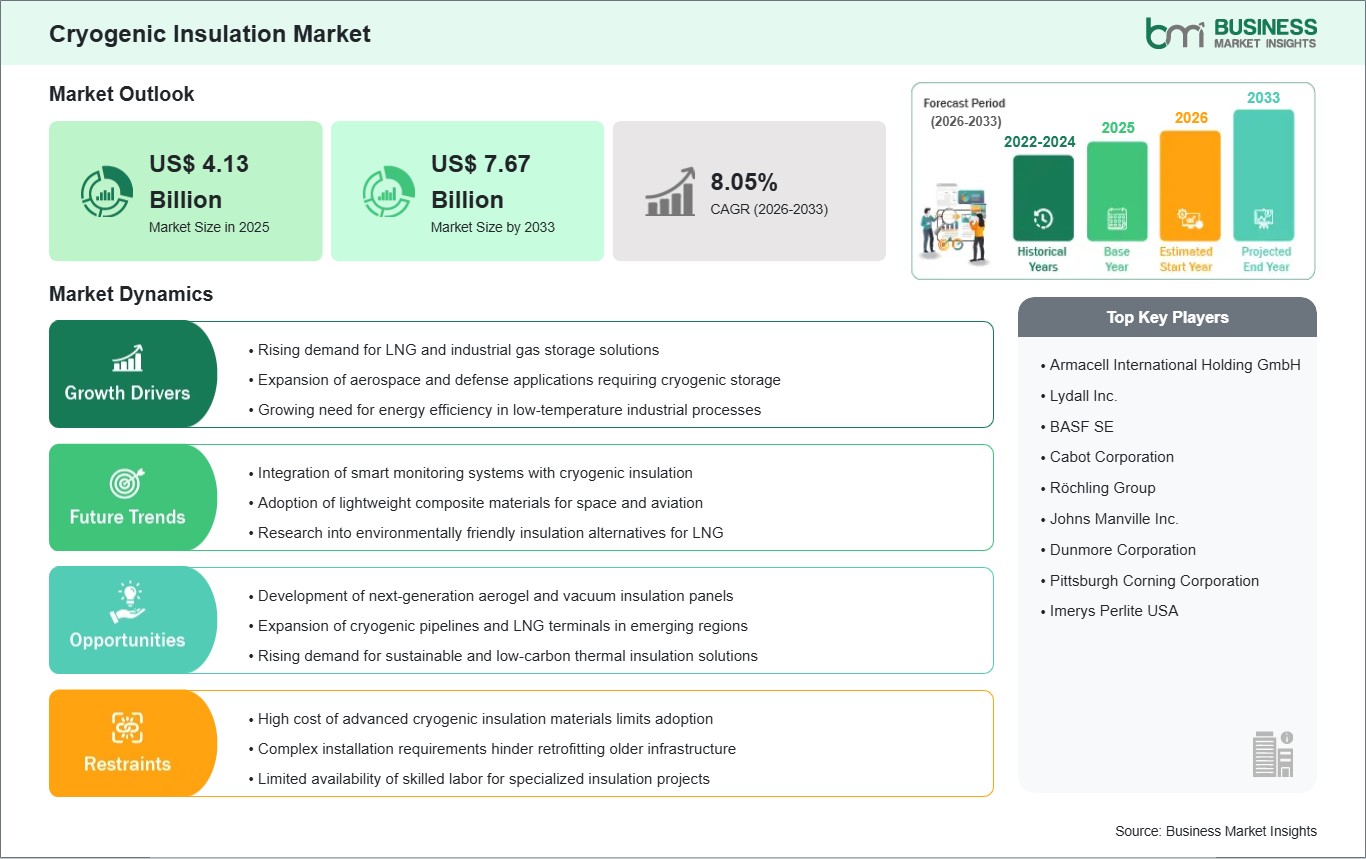
The Cryogenic Insulation Market size is expected to reach US$ 7.67 Billion by 2033 from US$ 4.13 Billion in 2025. The market is estimated to record a CAGR of 8.05% from 2026 to 2033.
The global cryogenic insulation market operates through specialized materials and systems that function to stop heat movement in applications that involve extremely low temperatures. Industries that require temperature control below freezing point use cryogenic insulation for liquefied natural gas (LNG) storage and transportation and industrial gas processing, aerospace and defense operations and medical and research facilities that work with cryogenic fluids, including liquid nitrogen, oxygen and helium. Through its effective cryogenic insulation system, the organization achieves higher operational safety while reducing energy waste and enhancing process dependability and achieves cost savings through lower evaporation waste and exact temperature control, which lasts for long durations. The global cryogenic insulation market develops because energy infrastructure needs require dependable temperature control solutions, which are essential for LNG value chain operations. As liquefied gases become increasingly central to the global energy mix, the need for advanced insulation systems to protect storage tanks, marine carriers and distribution pipelines continues to rise. Industrial gas applications require high‑performance insulation to maintain system integrity while implementing safety and performance standards that govern high‑purity oxygen and nitrogen delivery. The aerospace and defense sectors drive market growth because cryogenic insulation is essential for rocket fuel storage and propulsion systems and space vehicle thermal management. The market experiences restrictions because of material costs and technical difficulties, which both need to be overcome. The production of cryogenic insulation solutions needs advanced materials, which include multilayer vacuum insulation panels, aerogels, foamed polymers and perlite-based systems. The existing infrastructure needs insulation systems, which create operational difficulties during retrofitting because it requires detailed execution and specialized personnel. The market operation gets affected by environmental factors and regulatory requirements. The energy efficiency and safety regulations that apply to industrial sectors create an incentive for companies to adopt better insulation materials while requiring them to spend money on necessary compliance measures. The manufacturing process and usage of insulation products are affected by two factors, including supply chain interruptions and environmental worries about specific insulation foams and chemical blowing agents. The global demand for the cryogenic insulation market continues to grow because of three factors, which include energy transitions, industrial gas consumption and aerospace innovation. The market for insulation products will maintain its stability and growth because companies will continue to develop performance, safety and energy efficiency features that support insulation technology development.

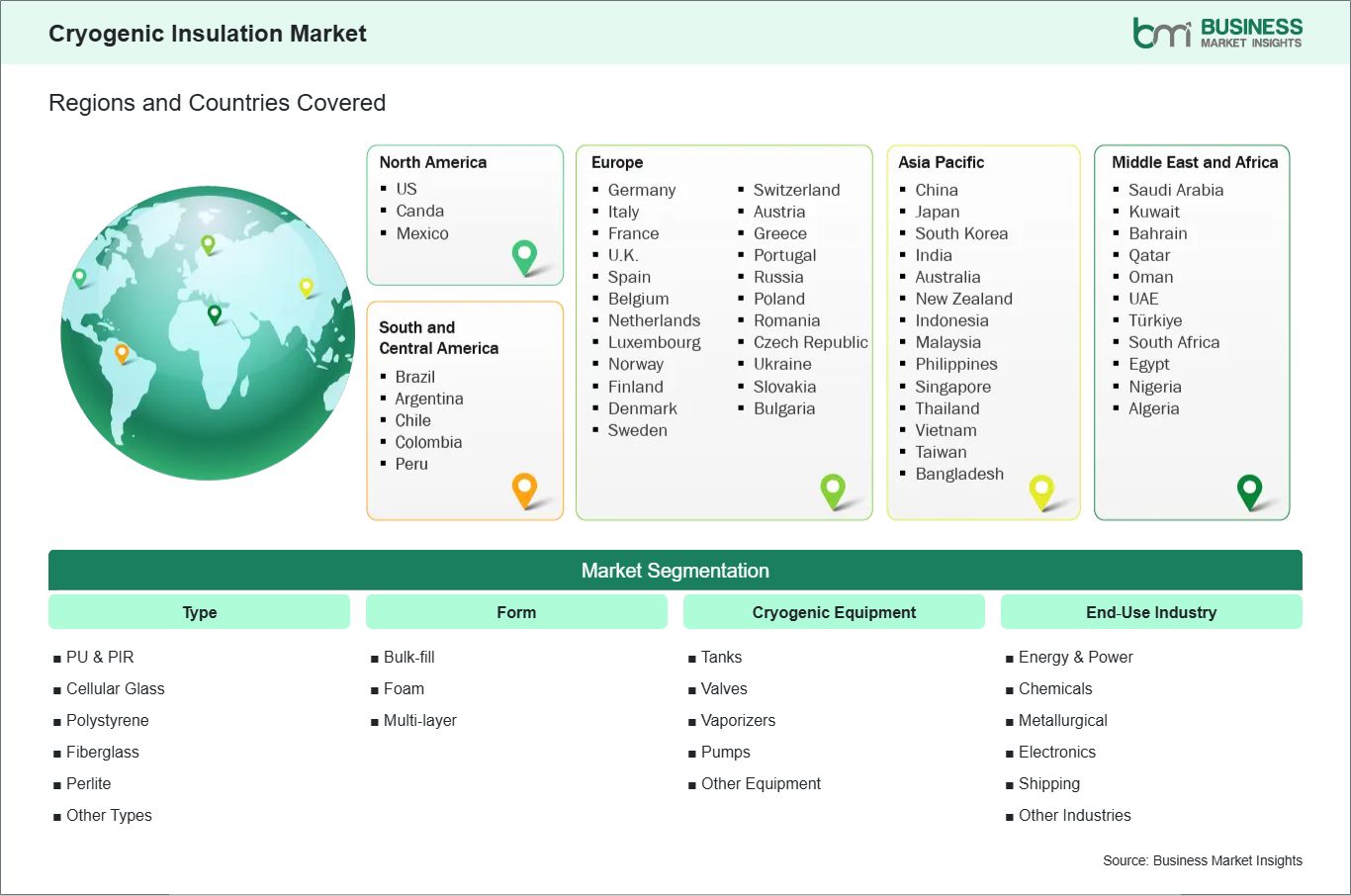
Key segments that contributed to the derivation of the cryogenic insulation market analysis are type, form, cryogenic equipment and end-use industry.
The global cryogenic insulation market is significantly driven by the rising demand for liquefied natural gas (LNG) and industrial gas storage solutions. LNG has emerged as a key transitional fuel and strategic energy resource that meets the energy consumption needs of multiple regions. The world has established new LNG terminals, storage facilities and transportation infrastructure, which now exists throughout various regions. Cryogenic insulation systems enable LNG storage and transportation operations to maintain ultra-low temperature requirements while also reducing boiling gas emissions and gas loss during long-term storage and marine transportation.
Cryogenic insulation proves essential for industrial applications that require liquid oxygen, nitrogen, and argon as medical gases, metallurgical gases and chemical processing gases because it maintains specific temperatures and safe operations throughout various applications. Medical facilities require cryogenically stored oxygen to provide critical care, while the metal fabrication and welding industries depend on liquid nitrogen and argon for their insulation needs, which protects against both shielding and cooling requirements.
European and North American regions require better insulation performance for their ongoing upgrades to gas storage facilities and distribution networks. The increasing industrial gas consumption in the Asia Pacific, together with its fast infrastructure growth, leads to higher adoption rates of cryogenic insulation technology. The rising global demand for advanced thermal solutions demonstrates their vital role in maintaining operational systems while reducing energy losses across both the energy sector and industrial gas industry.
A key opportunity in the global cryogenic insulation market lies in the development of next‑generation aerogel and vacuum insulation panel (VIP) technologies. Traditional insulation materials such as polyurethane foams and perlite have served well in many applications, but increasingly complex industrial and energy storage requirements are pushing manufacturers and researchers to innovate higher‑performance alternatives. Aerogels, which offer extremely low thermal conductivity, enable improved temperature retention with thinner material thickness, making them attractive for space‑constrained installations and advanced LNG carriers.
Vacuum insulation panels complement this trend by providing excellent thermal resistance through evacuated core structures that significantly reduce convective and conductive heat transfer. These materials are finding greater acceptance in high‑end industrial and aerospace applications, where reliability, energy efficiency, and durability are paramount. For example, space agencies and private aerospace firms incorporate advanced insulation panels in cryogenic rocket fuel tanks and launch systems to preserve propellant at ultra‑low temperatures amid harsh environmental conditions.
In emerging economies, increased interest in these advanced materials reflects a broader push to modernize energy storage infrastructure and reduce overall lifecycle costs. As awareness of energy efficiency and sustainability grows, manufacturers have greater incentive to invest in research and commercialization of aerogel and VIP solutions, positioning these technologies as strategic differentiators in the global cryogenic insulation landscape.

The cryogenic insulation market demonstrates steady growth, with size and share analysis highlighting evolving trends and competitive dynamics among key players. The report examines subsegments categorized within type, form, cryogenic equipment and end-use industry, offering insights into their contribution to overall market performance.
By type, the PU & PIR subsegment dominated the market in 2025, driven by its lightweight structure, low thermal conductivity, and excellent moisture and fire resistance.
Based on form, the multi‑layer subsegment dominated the market in 2025, driven by superior insulation efficiency and performance under extreme low-temperature conditions.
On the basis of cryogenic equipment, the tanks subsegment dominated the market in 2025, driven by extensive use in storage and transportation of liquefied gases requiring robust cryogenic insulation.
In terms of end-use industry, the energy & power subsegment dominated the market in 2025, driven by high deployment of cryogenic systems in LNG infrastructure and power generation applications.
| Report Attribute | Details |
|---|---|
| Market size in 2025 | US$ 4.13 Billion |
| Market Size by 2033 | US$ 7.67 Billion |
| Global CAGR (2026 - 2033) | 8.05% |
| Historical Data | 2022-2024 |
| Forecast period | 2026-2033 |
| Segments Covered | By Type
|
|
Regions and Countries Covered
| |
| North America | US, Canada, Mexico |
| Europe | Belgium, Austria, Finland, Denmark, Greece, Poland, Romania, Russia, Ukraine, Czech Republic, Slovakia, Bulgaria, Italy, Luxembourg, Germany, Switzerland, France, Netherlands, Norway, Portugal, Spain, Sweden, United Kingdom |
| Asia-Pacific | Australia, China, India, Japan, South Korea, Indonesia, Malaysia, Philippines, Singapore, Thailand, Vietnam, Bangladesh, New Zealand, Taiwan |
| South and Central America | Brazil, Argentina, Peru, Chile, Colombia |
| Middle East and Africa | Bahrain, Kuwait, Oman, Qatar, Saudi Arabia, United Arab Emirates, Turkiye, South Africa, Egypt, Algeria, Nigeria |
| Market leaders and key company profiles |
|
The "Cryogenic Insulation Market Size and Forecast (2022 - 2033)" report provides a detailed analysis of the market covering below areas:
The geographical scope of the Cryogenic Insulation Market report is divided into North America, Asia Pacific, Europe, Middle East & Africa, and South & Central America. North America held the largest share in 2025.
North America leads the worldwide cryogenic insulation industry because of its modern industrial systems, its large LNG storage and distribution facilities and its substantial aerospace and defense industry. The United States leads because it operates multiple LNG import and export terminals that stretch across both the Gulf and East Coasts, and its industrial gas production plants and sectors that need accurate temperature control for uses like medical cryogenic storage and space exploration. The industry uses high-performance multilayer vacuum panels, aerogels and advanced foam insulation materials because safety and energy efficiency regulations require proper thermal management to minimize boil-off losses. The market in Asia Pacific experiences strong expansion because LNG import facilities are increasing, industrialization is progressing, and infrastructure development is rising in China, Japan and India. The aviation industry in the region expands because it requires cryogenic insulation materials that are both lightweight and durable and provide high performance for satellite deployment and space launch operations. Europe shows consistent market demand because its established energy infrastructure, strict environmental and safety regulations and its major industrial gas companies in Germany, France and the U.K. drive market needs. The European renewable energy storage push, together with LNG distribution network development, has created a necessity, which drives the market demand for advanced insulation solutions that include high-performance vacuum panels together with nanoporous composite materials. The Middle East and Africa region experiences growing demand because of its numerous LNG export terminals, petrochemical plants and important industrial gas facilities, which Qatar, Saudi Arabia, and the UAE develop through their extensive infrastructure projects that need dependable cryogenic storage systems built to endure extreme weather conditions. The region of South America and Central America presents new business possibilities through the development of LNG import terminals together with industrial gas facilities and expanding energy systems, which Brazil and Argentina use to improve their fuel distribution networks and industrial activities and research projects through efficient cryogenic insulation. All regions face multiple challenges, which include expensive materials together with installation expenses and the requirement for trained personnel and issues related to supply networks, yet the combination of energy transition initiatives, industrial expansion and aerospace growth creates circumstances that drive worldwide adoption and development of cryogenic insulation systems.

The Cryogenic Insulation Market is evaluated by gathering qualitative and quantitative data post primary and secondary research, which includes important corporate publications, association data, and databases. A few of the key developments in the cryogenic insulation market are:
The Cryogenic Insulation Market is valued at US$ 4.13 Billion in 2025, it is projected to reach US$ 7.67 Billion by 2033.
As per our report Cryogenic Insulation Market, the market size is valued at US$ 4.13 Billion in 2025, projecting it to reach US$ 7.67 Billion by 2033. This translates to a CAGR of approximately 8.05% during the forecast period.
The Cryogenic Insulation Market report typically cover these key segments-
The historic period, base year, and forecast period can vary slightly depending on the specific market research report. However, for the Cryogenic Insulation Market report:
The Cryogenic Insulation Market is populated by several key players, each contributing to its growth and innovation. Some of the major players include:
The Cryogenic Insulation Market report is valuable for diverse stakeholders, including:
Essentially, anyone involved in or considering involvement in the Cryogenic Insulation Market value chain can benefit from the information contained in a comprehensive market report.
Please tell us your area of interest
(Market Segments/ Regions and Countries/ Companies)