Market Summary
Executive Summary and Global Market Analysis
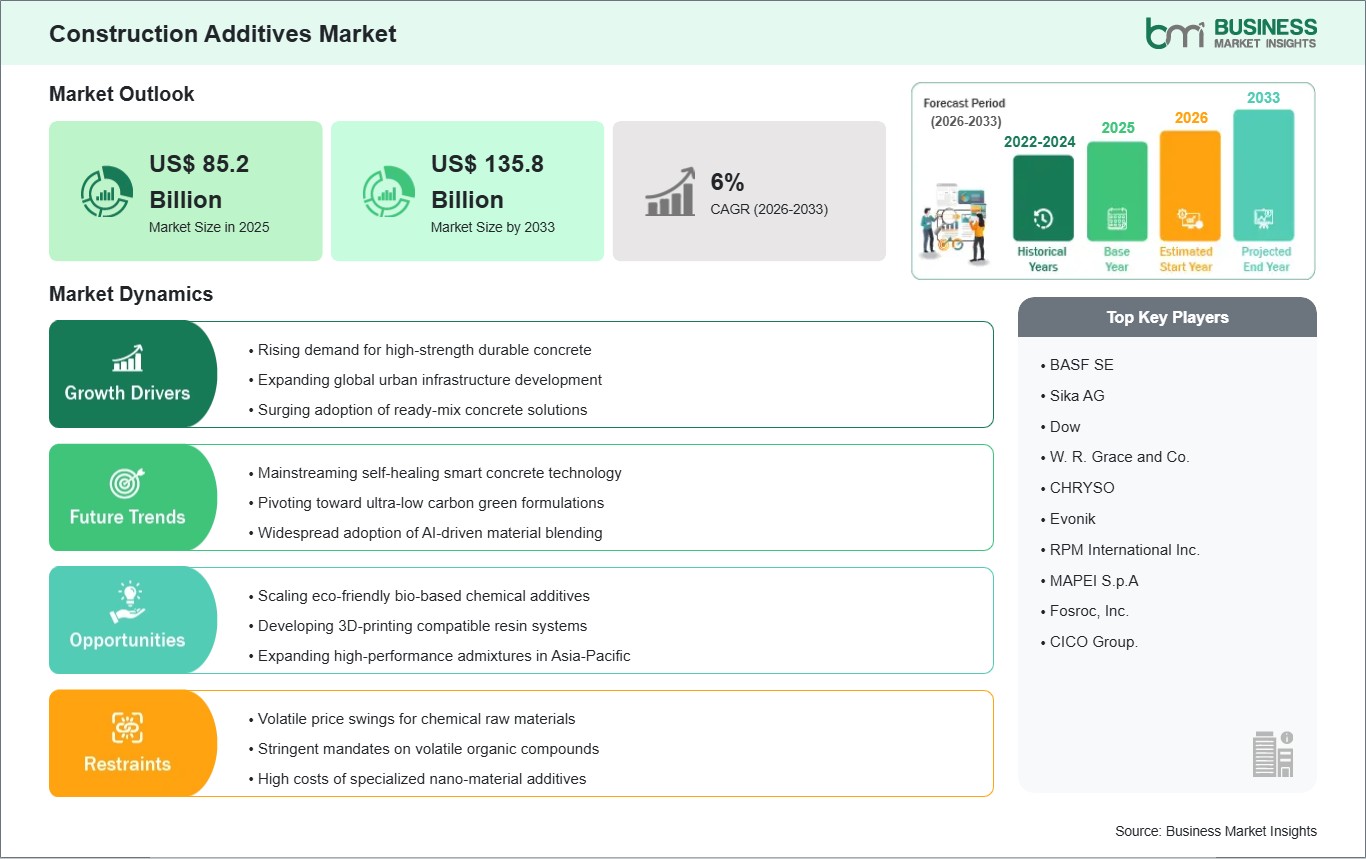
Construction additives are specialty chemicals or mineral formulations mixed into building materials such as concrete and mortar to change their physical and chemical properties. They are used in small, precise amounts to improve qualities such as workability, durability, setting time, and resistance to environmental stress. The construction additives market covers chemical admixtures, mineral additives, and fiber reinforcements, all of which help create high-performance infrastructure. Tultra-high-strength concrete uses less water and increases the lifespan of structures. The market is growing due to large infrastructure projects worldwide, more use of ready-mix concrete (RMC), and a need for materials that can withstand disasters. The move toward "Green Chemistry" is also making the industry more sustainable.
However, several challenges can restrain market growth: the high initial capital expenditure and complexity associated with the precise dosing and testing required for advanced, nano-enhanced additives can be substantial for smaller contractors. Extreme price volatility of petrochemical-based raw materials, such as vinyl acetate and ethylene derivatives, poses a constant margin and supply chain hurdle for manufacturers. Furthermore, the industry faces constraints due to stringent and varied regional regulatory standards and a persistent technical knowledge gap among end users regarding the optimal application of specialized chemical formulations. Despite these hurdles, the market presents immense opportunities due to the universal mandate for low-carbon and net-zero construction, the accelerating deployment of 3D concrete printing, which requires highly specialised rheology-modifying additives, and the increasing reliance on nanotechnology (nano-silica and carbon nanotubes) for self-healing concrete capabilities. The shift to digital mixing workflows and AI-driven dosage optimization is expected to create significant opportunities for market growth.
Segment Analysis
Construction Additives Market Segmentation
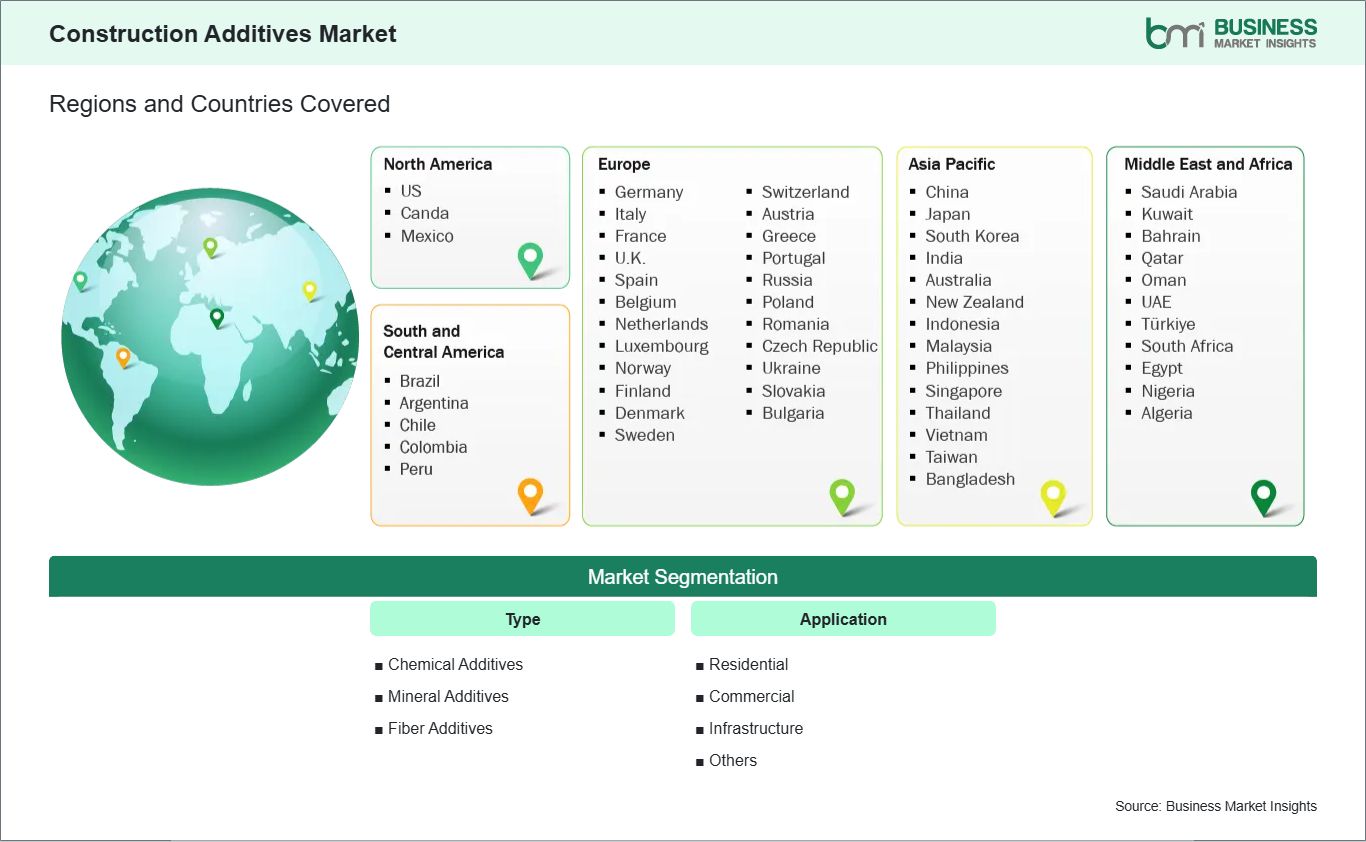
Key segments that contributed to the derivation of the Construction Additives market analysis are type and application.
- By Type, the market is segmented into Chemical Additives (Plasticizers, Retarding Agents, Waterproofing Chemicals, Concrete Admixtures, Accelerating Agents, and Others), Mineral Additives, and Fiber Additives.
- By Application, the market is segmented into Residential, Commercial, Infrastructure, and Others.
Market Forces
Construction Additives Market Drivers and Opportunities
Rising Demand for High-Performance Infrastructure
The primary driver for the Construction Additives market is the global surge in large-scale infrastructure projects that require enhanced material longevity and structural integrity. As emerging economies, particularly in the Asia-Pacific region, invest heavily in "mega-projects" such as high-speed railways, deep-sea ports, and smart cities, there is a critical need for additives that go beyond standard performance. Chemicals like superplasticizers and accelerators are essential for creating high-strength concrete that remains workable under tight construction schedules and resistant to harsh environmental stressors. This demand is further amplified by the global trend of rehabilitating aging urban infrastructure in developed nations, where specialized repair additives are used to extend the lifecycle of existing bridges and buildings, thereby reducing long-term maintenance costs.
Sustainability Initiatives and Green Building Transitions
A significant and high-value opportunity lies in the development of eco-friendly, low-carbon construction additives that support global net-zero goals and green building standards such as LEED. The industry is moving away from traditional, carbon-heavy formulas and turning to bio-based and mineral additives that help lower cement use, which is the main source of carbon emissions in concrete. New products like self-healing concrete additives, which use bacteria or minerals to repair cracks on their own, are opening up new possibilities for sustainable building. Furthermore, the push for circular economy practices is opening markets for additives derived from industrial by-products (such as fly ash or slag) and recycled materials. Manufacturers who can deliver high-performance solutions that simultaneously lower the environmental footprint of building materials are positioned to capture the rapidly growing green construction segment.
Size and Share Analysis
Construction Additives Market Size and Share Analysis
The Construction Additives market demonstrates steady growth, with size and share analysis revealing evolving trends and competitive positioning among key players. The report further examines subsegments categorized within type and application, offering insights into their contribution to overall market performance.
For instance, the Chemical Additives segment, which includes Plasticizers, Concrete Admixtures, and Waterproofing Chemicals, is a significant component of the Infrastructure sector. These chemicals are essential for large-scale projects like bridges, highways, and tunnels, where they enhance the durability and workability of concrete. The use of high-range water reducers (superplasticizers) is a notable trend in this segment, as they allow for the creation of high-strength concrete with lower water content, ensuring the structural integrity of critical public works.
Report Coverage
Construction Additives Market Report Coverage and Deliverables
The "Construction Additives Market Size and Forecast (2022 - 2033)" report provides a detailed analysis of the market covering below areas:
- Construction Additives market size and forecast at global, regional, and country levels for all the key market segments covered under the scope
- Construction Additives market trends, as well as market dynamics such as drivers, restraints, and key opportunities
- Construction Additives market analysis covering key market trends, global and regional framework, major players, regulations, and recent market developments
- Industry landscape and competition analysis covering market concentration, heat map analysis, prominent players, and recent developments for the Construction Additives market
- Detailed company profiles, including SWOT analysis
Geographic Insights
Construction Additives Market Geographic Insights
The geographical scope of the Construction Additives market report is divided into five regions: North America, Asia Pacific, Europe, Middle East & Africa, and South & Central America.
The Asia-Pacific Construction Additives Market is segmented into China, Japan, South Korea, India, Australia, New Zealand, Indonesia, Malaysia, the Philippines, Singapore, Thailand, Vietnam, Taiwan, Bangladesh, and the Rest of Asia. The market is primarily driven by the region's unprecedented urbanization and massive infrastructure pipelines.
Growth is further bolstered by a rising demand for high-performance concrete admixtures and waterproofing agents to improve the durability of structures in diverse climates. The shift toward green building standards and the adoption of nanotechnology-based additives for high-strength, low-carbon construction solidifies Asia-Pacific as the primary global hub for construction additive innovation and consumption.
Industry Activity
Recent Developments
The Construction Additives market is evaluated by gathering qualitative and quantitative data post primary and secondary research, which includes important corporate publications, association data, and databases. A few of the key developments in the Construction Additives market are:
- In November 2025, BirlaNu, part of the C K A Birla Group, will acquire Mumbai-based Clean Coats Private Limited for Rs 120 crore. BirlaNu, said that the acquisition was a strategic step towards strengthening the company’s portfolio and would give it scale in the construction chemicals business.
- In June 2025, Sika acquired Gulf Additive Factory LLC in the State of Qatar. The company manufactures a wide range of construction chemical products and has a strong standing in the fast-growing Qatar construction market. The acquisition strengthens Sika’s foothold in the country and provides exciting opportunities for further expansion.
Trust & Transparency
Research Methodology
The market analysis combines proprietary research with secondary data from government agencies, company disclosures, regulatory filings, industry databases and expert interviews. Market estimates are validated through data triangulation, cross-market benchmarking and analyst
review.
View Full Research Methodology
Key Sources Referred:
World Bank - Global Trade IndicatorsWorld Trade Organization (WTO)International Monetary Fund (IMF)International Trade Administration (ITA)Company WebsitesCompany Annual ReportsCompany Investor Presentations