Construction Plastics Market Outlook (2022-2033)

Historic Data: 2022-2024   |   Base Year: 2025   |   Forecast Period: 2026-2033
Report Content: Market Scope, Market Segmentation, Market Dynamics, and Competitive Analysis

Report Coverage:
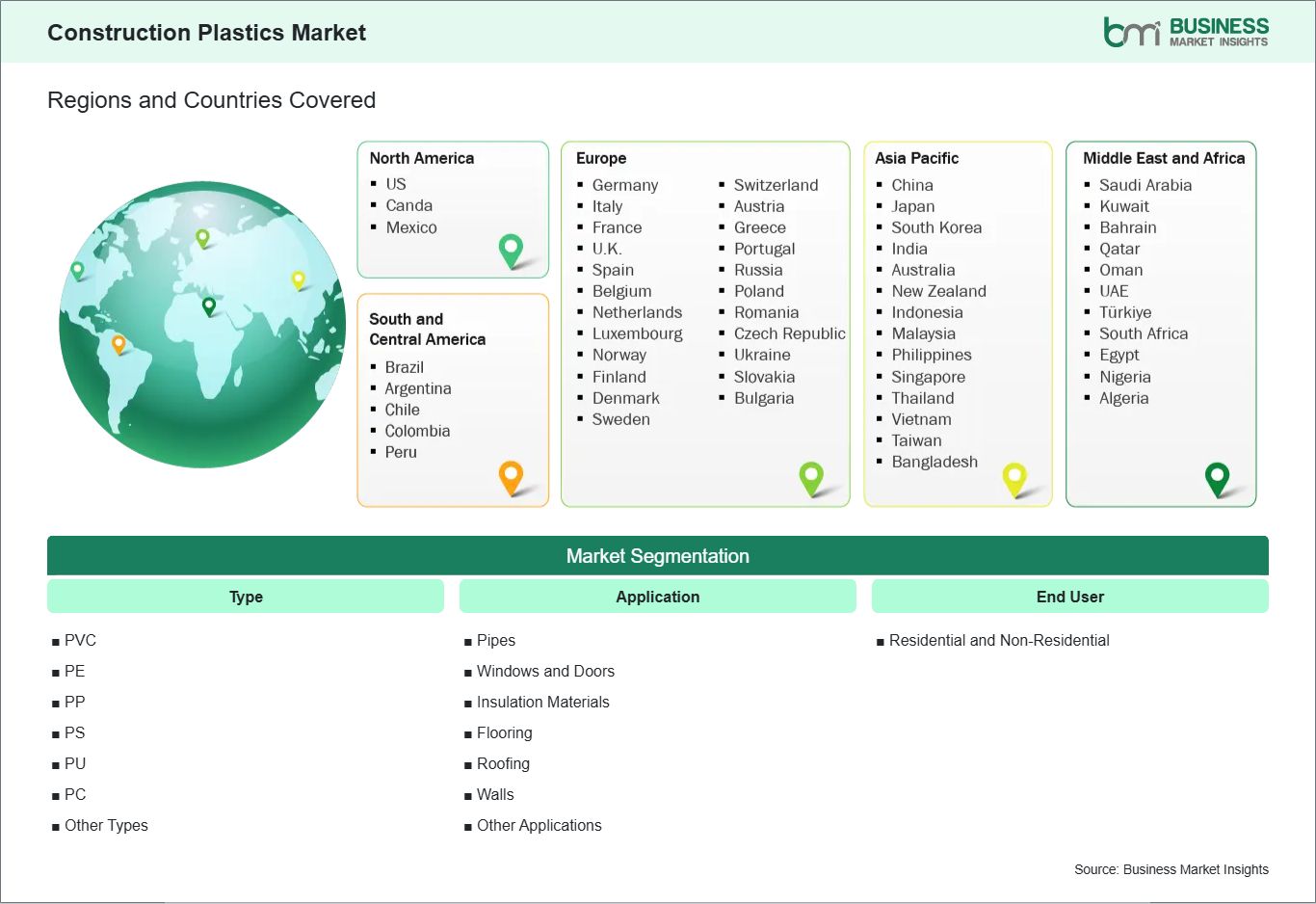
  • Type (PVC, PE, PP, PS, PU, PC, and Other Types)
  • Application (Pipes, Windows and Doors, Insulation Materials, Flooring, Roofing, Walls, and Other Applications)
  • End User (Residential and Non-Residential)

No. of Pages: 426
Report Code: BMIPUB00033860
Category: Chemicals and Materials
Construction Plastics Market

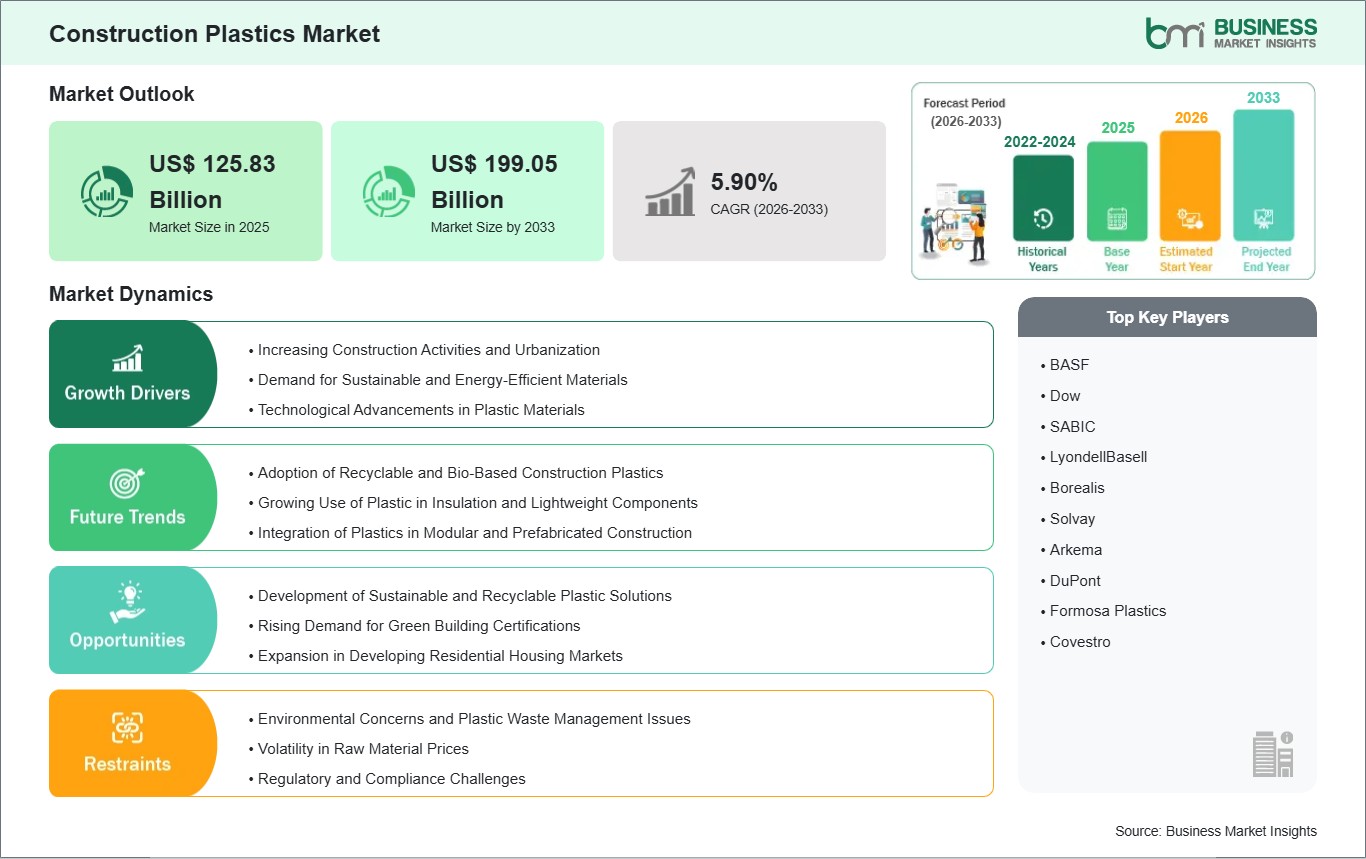
The Construction Plastics Market size is expected to reach US$ 199.05 Billion by 2033 from US$ 125.83 Billion in 2025. The market is estimated to record a CAGR of 5.90% from 2026 to 2033.

Executive Summary and Global Market Analysis:

The global construction plastics market is an important part of the larger construction and materials industry. It plays a key role in building modern infrastructure and promoting sustainable building practices. Construction plastics are a wide range of polymer-based materials used in residential, commercial, and industrial construction because they are versatile, durable, lightweight, and cost-effective. These materials include products like PVC, polyethylene, polypropylene, polystyrene, and engineering plastics. They are commonly used in pipes, insulation, flooring, roofing membranes, windows, doors, and structural components. The market covers the production, processing, and application of both standard and high-performance plastics designed for various construction needs. Manufacturing construction plastics involves processes such as polymerization, compounding, extrusion, molding, and fabrication. These methods allow producers to improve properties like strength, flexibility, weather resistance, thermal insulation, and fire retardancy. Manufacturers often add additives and reinforcements to enhance UV stability, impact resistance, and longevity. This ensures that materials meet strict building codes and safety standards. Modern processing technologies enable the creation of tailored plastic solutions for specific environmental conditions and structural requirements. Construction plastics are popular for their excellent insulation and moisture resistance, which are vital for energy-efficient buildings. In piping systems, plastic materials resist corrosion, are easy to install, and last longer compared to traditional materials like metal or concrete. For insulation, plastic foams such as expanded polystyrene (EPS) and polyurethane significantly reduce energy consumption by improving thermal efficiency in buildings. Furthermore, plastic-based composites are increasingly used in structural and façade applications, offering lightweight options without sacrificing strength or durability. The market is growing steadily due to urbanization, population growth, and the rising need for affordable housing and infrastructure development. Government investments in smart cities, green buildings, and large infrastructure projects also boost the demand for construction plastics. The global focus on energy efficiency and sustainable building practices encourages the use of innovative plastic materials that improve building performance while lowering lifecycle costs. In emerging economies, rapid industrialization and the modernization of construction methods are key factors in market growth. However, the market faces challenges, such as concerns about plastic waste, environmental regulations, and fluctuations in raw material prices tied to petrochemicals. Public attitudes toward plastic use and increasing rules against single-use plastics might affect some market segments. Moreover, the high initial costs of advanced plastic materials and the need to comply with strict building regulations can create obstacles for manufacturers and end-users. In summary, the global construction plastics market shows strong growth potential, fueled by the demand for durable, energy-efficient, and cost-effective building materials. With ongoing advancements in material innovation, manufacturing methods, and sustainable practices, construction plastics are set to play a more significant role in modern construction. As the industry adapts to meet environmental and performance needs, the market is well-equipped to support global infrastructure development and the shift toward more sustainable and resilient built environments.

Construction Plastics Market - Strategic Insights:

global-market-strategic-framework
Get more information on this report

Construction Plastics Market Segmentation Analysis:

Key segments that contributed to the derivation of the Construction Plastics market analysis are type, application, and end user.

  • By type, the Construction Plastics market is segmented into PVC, PE, PP, PS, PU, PC, and others. The PP segment dominated the market in 2025.
  • By application, the Construction Plastics market is segmented into pipes, windows and doors, insulation materials, flooring, roofing, walls, and others. The roofing segment dominated the market in 2025.
  • By end user, the Construction Plastics market is segmented into residential and non-residential. The residential segment dominated the market in 2025.

Construction Plastics Market Drivers and Opportunities:

Rising Demand from Urbanization, Infrastructure Development, and Energy-Efficient Construction

The global construction plastics market is growing steadily. This growth results from rapid urbanization, population increases, and more infrastructure development in both emerging and developed countries. Governments and private sectors are investing significantly in residential housing, commercial buildings, transportation systems, and smart city projects. This trend is driving the need for durable and affordable construction materials. Construction plastics are commonly used for piping systems, insulation, roofing membranes, and window profiles. Their lightweight nature, corrosion resistance, and long lifespan make them ideal choices. Meanwhile, the increasing focus on energy-efficient buildings is boosting the use of plastic-based insulation materials, like polyurethane and polystyrene foams. These materials help lower energy use and improve thermal performance. The rise of green building standards and rules aimed at cutting carbon emissions is further encouraging the adoption of plastic materials that improve building efficiency. Additionally, the growing interest in prefabricated and modular construction methods is benefiting market growth. Plastics facilitate faster installation, design flexibility, and lower labor costs. As construction activities rise globally and sustainability becomes a priority, the demand for high-performance construction plastics is expected to grow consistently.

Technological Advancements and Sustainability-Driven Material Innovation

Technological progress is crucial in shaping the global construction plastics market. Continuous innovations are enhancing material performance, durability, and environmental impact. Advances in polymer engineering, compounding technologies, and processing methods like extrusion and injection molding are leading to the creation of high-performance plastics with improved strength, fire resistance, UV stability, and weather durability. These advancements allow construction plastics to meet strict safety standards and expand their applications in structural and exterior uses. The integration of automation and digital manufacturing technologies is helping manufacturers boost production efficiency, maintain product quality, and cut down on material waste. Sustainability is a central focus, with growing efforts to create recyclable, bio-based, and low-carbon plastic materials that support global environmental goals. Manufacturers are also investing in circular economy initiatives, including recycling systems and eco-friendly product designs, to lessen the environmental impact of plastic use in construction. As regulatory pressures increase and the industry moves toward greener practices, ongoing innovation in materials and manufacturing processes is likely to drive long-term growth and changes in the construction plastics market.

Construction Plastics Market Size and Share Analysis:

The polypropylene (PP) segment leads the market because of its strong balance of strength, flexibility, and chemical resistance. This makes it ideal for many construction applications. Its lightweight nature and low cost support its wide use in piping systems, insulation materials, and structural applications. Additionally, PP’s recyclability and durability fit well with the growing focus on sustainable construction materials.

The roofing segment dominates the market due to the rising need for durable, weather-resistant, and energy-efficient roofing solutions. Plastic materials like PVC and TPO are popular for their excellent waterproofing, UV resistance, and long lifespan. The increasing popularity of green buildings and cool roofing systems is further boosting the use of plastics in roofing.

The residential segment holds the largest share thanks to rapid urbanization, population growth, and the rising need for affordable housing. Construction plastics are commonly used in residential buildings for things like pipes, insulation, windows, and flooring. They are favored because they are cost-effective and easy to install. Government housing programs and the growth of smart housing projects also drive demand in this segment.

Construction Plastics Market Report Highlights:

Report Attribute Details
Market size in 2025 US$ 125.83 Billion
Market Size by 2033 US$ 199.05 Billion
Global CAGR (2026 - 2033)5.90%
Historical Data 2022-2024
Forecast period 2026-2033
Segments Covered By Type
  • PVC
  • PE
  • PP
  • PS
  • PU
  • PC
  • Other Types
By Application
  • Pipes
  • Windows and Doors
  • Insulation Materials
  • Flooring
  • Roofing
  • Walls
  • Other Applications
By End User
  • Residential and Non-Residential
Regions and Countries Covered
North America US, Canada, Mexico
Europe Belgium, Austria, Finland, Denmark, Greece, Poland, Romania, Russia, Ukraine, Czech Republic, Slovakia, Bulgaria, Italy, Luxembourg, Germany, Switzerland, France, Netherlands, Norway, Portugal, Spain, Sweden, United Kingdom
Asia-Pacific Australia, China, India, Japan, South Korea, Indonesia, Malaysia, Philippines, Singapore, Thailand, Vietnam, Bangladesh, New Zealand, Taiwan
South and Central America Brazil, Argentina, Peru, Chile, Colombia
Middle East and Africa Bahrain, Kuwait, Oman, Qatar, Saudi Arabia, United Arab Emirates, Turkiye, South Africa, Egypt, Algeria, Nigeria
Market leaders and key company profiles
  • BASF
  • Dow
  • SABIC
  • LyondellBasell
  • Borealis
  • Solvay
  • Arkema
  • DuPont
  • Formosa Plastics
  • Covestro
Get more information on this report

Construction Plastics Market Report Coverage and Deliverables:

The "Construction Plastics Market Size and Forecast (2022 - 2033)" report provides a detailed analysis of the market covering below areas:

  • Construction Plastics market size and forecast at global, regional, and country levels for all the key market segments covered under the scope
  • Construction Plastics market trends, as well as market dynamics such as drivers, restraints, and key opportunities
  • Construction Plastics market analysis covering key market trends, global and regional framework, major players, regulations, and recent market developments
  • Industry landscape and competition analysis covering market concentration, heat map analysis, prominent players, and recent developments for the Construction Plastics market
  • Detailed company profiles, including SWOT analysis

Construction Plastics Market Geographic Insights:

The geographical scope of the Construction Plastics market report is divided into five regions: North America, Asia Pacific, Europe, Middle East & Africa, and South & Central America. The Construction Plastics market in the Asia Pacific is expected to grow significantly during the forecast period.

The Asia-Pacific Construction Plastics market is segmented into China, Japan, South Korea, India, Australia, New Zealand, Indonesia, Malaysia, the Philippines, Singapore, Thailand, Vietnam, Taiwan, Bangladesh, and the Rest of Asia.

The Asia-Pacific region is becoming one of the fastest-growing markets for construction plastics. This growth is fueled by rapid urbanization, expanding infrastructure projects, and strong economic progress. Countries like China, India, Japan, and South Korea are seeing significant investments in residential housing, commercial construction, transportation networks, and smart city initiatives. This increase in construction activity is raising the demand for high-performance plastic materials used in piping systems, insulation, roofing, flooring, and structural components. The region’s growing population and rising middle-class incomes are speeding up the need for affordable and energy-efficient housing solutions. Construction plastics are crucial here due to their cost-effectiveness, durability, and ease of installation. The growing use of modern construction techniques, such as prefabrication and modular building systems, is also supporting the use of lightweight and flexible plastic materials. The push for sustainable construction and energy efficiency is another key factor driving the construction plastics market in Asia-Pacific. Governments in the region are enforcing stricter building regulations and promoting green building standards to cut down carbon emissions and energy use. This is increasing the demand for advanced plastic insulation materials like expanded polystyrene and polyurethane, which improve thermal efficiency and lower operational costs in buildings. Additionally, the region has a robust manufacturing base and access to raw materials, which allows for large-scale production of construction plastics at competitive prices, making it a global hub for production and consumption. More investments in research and development, combined with advancements in polymer processing and recycling, are improving product performance and sustainability. With ongoing infrastructure expansion, supportive government policies, and a heightened focus on eco-friendly construction practices, Asia-Pacific is playing a vital role in driving innovation, supply chain development, and overall growth in the global construction plastics market.

global-market-geography
Get more information on this report

Construction Plastics Market Research Report Guidance:

  • The report includes qualitative and quantitative data in the Construction Plastics market across type, application, end user, and geography.
  • The report starts with the key takeaways (chapter 2), highlighting the key trends and outlook of the Construction Plastics market.
  • Chapter 3 includes the research methodology of the study.
  • Chapter 4 further includes ecosystem analysis.
  • Chapter 5 highlights the major industry dynamics in the Construction Plastics market, including factors that are driving the market, prevailing deterrents, potential opportunities, as well as future trends. Impact analysis of these drivers and restraints is also covered in this section.
  • Chapter 6 discusses the Construction Plastics market scenario, in terms of historical market revenues, and forecast till the year 2031.
  • Chapters 7 to 10 cover Construction Plastics market segments by type, application, and end user across North America, Europe, Asia Pacific, Middle East and Africa, and South and Central America. They cover the market revenue and forecast and factors driving the market.
  • Chapter 11 describes the competitive analysis along with the heat map analysis for the key players operating in the market.
  • Chapter 12 describes the industry landscape analysis. It provides detailed descriptions of business activities such as market initiatives, new developments, mergers, and joint ventures globally, along with a competitive landscape.
  • Chapter 13 provides detailed profiles of the major companies operating in the Construction Plastics market. Companies have been profiled on the basis of their key facts, business descriptions, products and services, financial overview, SWOT analysis, and key developments.
  • Chapter 14, i.e., the appendix is inclusive of a brief overview of the company, a list of abbreviations, and a disclaimer.

Construction Plastics Market News and Key Development:

The Construction Plastics market is evaluated by gathering qualitative and quantitative data post primary and secondary research, which includes important corporate publications, association data, and databases. A few of the key developments in the Construction Plastics market are:

  • In March 2026, Charlotte, N.C.-based Charlotte Pipe and Foundry Co. has realigned its corporate structure, transitioning Neenah Foundry from a wholly owned subsidiary to a product-line brand.
  • In March 2026, Neste successfully commissioned a new upgrading facility for liquefied waste plastic at its refinery in Porvoo, Finland - expecting to reach an annual capacity of up to 150,000 tons of feedstock for the plastics and chemical industries.

Key Sources Referred:

  • World Bank - Global Trade Indicators
  • World Trade Organization (WTO)
  • International Trade Administration (ITA)
  • Company website
  • Company annual reports
  • Company investor presentations
The List of Companies - Construction Plastics Market
  • BASF
  • Dow
  • SABIC
  • LyondellBasell
  • Borealis
  • Solvay
  • Arkema
  • DuPont
  • Formosa Plastics
  • Covestro
Frequently Asked Questions
How big is the Construction Plastics Market?

The Construction Plastics Market is valued at US$ 125.83 Billion in 2025, it is projected to reach US$ 199.05 Billion by 2033.

What is the CAGR for Construction Plastics Market by (2026 - 2033)?

As per our report Construction Plastics Market, the market size is valued at US$ 125.83 Billion in 2025, projecting it to reach US$ 199.05 Billion by 2033. This translates to a CAGR of approximately 5.90% during the forecast period.

What segments are covered in this report?

The Construction Plastics Market report typically cover these key segments-

  • Type (PVC, PE, PP, PS, PU, PC, and Other Types)
  • Application (Pipes, Windows and Doors, Insulation Materials, Flooring, Roofing, Walls, and Other Applications)
  • End User (Residential and Non-Residential)

What is the historic period, base year, and forecast period taken for Construction Plastics Market?

The historic period, base year, and forecast period can vary slightly depending on the specific market research report. However, for the Construction Plastics Market report:

  • Historic Period : 2022-2024
  • Base Year : 2025
  • Forecast Period : 2026-2033
  • Who are the major players in Construction Plastics Market?

    The Construction Plastics Market is populated by several key players, each contributing to its growth and innovation. Some of the major players include:

  • BASF
  • Dow
  • SABIC
  • LyondellBasell
  • Borealis
  • Solvay
  • Arkema
  • DuPont
  • Formosa Plastics
  • Covestro
  • Who should buy this report?

    The Construction Plastics Market report is valuable for diverse stakeholders, including:

    • Investors: Provides insights for investment decisions pertaining to market growth, companies, or industry insights. Helps assess market attractiveness and potential returns.
    • Industry Players: Offers competitive intelligence, market sizing, and trend analysis to inform strategic planning, product development, and sales strategies.
    • Suppliers and Manufacturers: Helps understand market demand for components, materials, and services related to concerned industry.
    • Researchers and Consultants: Provides data and analysis for academic research, consulting projects, and market studies.
    • Financial Institutions: Helps assess risks and opportunities associated with financing or investing in the concerned market.

    Essentially, anyone involved in or considering involvement in the Construction Plastics Market value chain can benefit from the information contained in a comprehensive market report.

    Available Report Formats

    pdf-format excel-format pptx-format
    Buy Now
    Sales Assistance
    +1 646 791 7070 (US & UK)
    Customization Form

    Please tell us your area of interest
    (Market Segments/ Regions and Countries/ Companies)