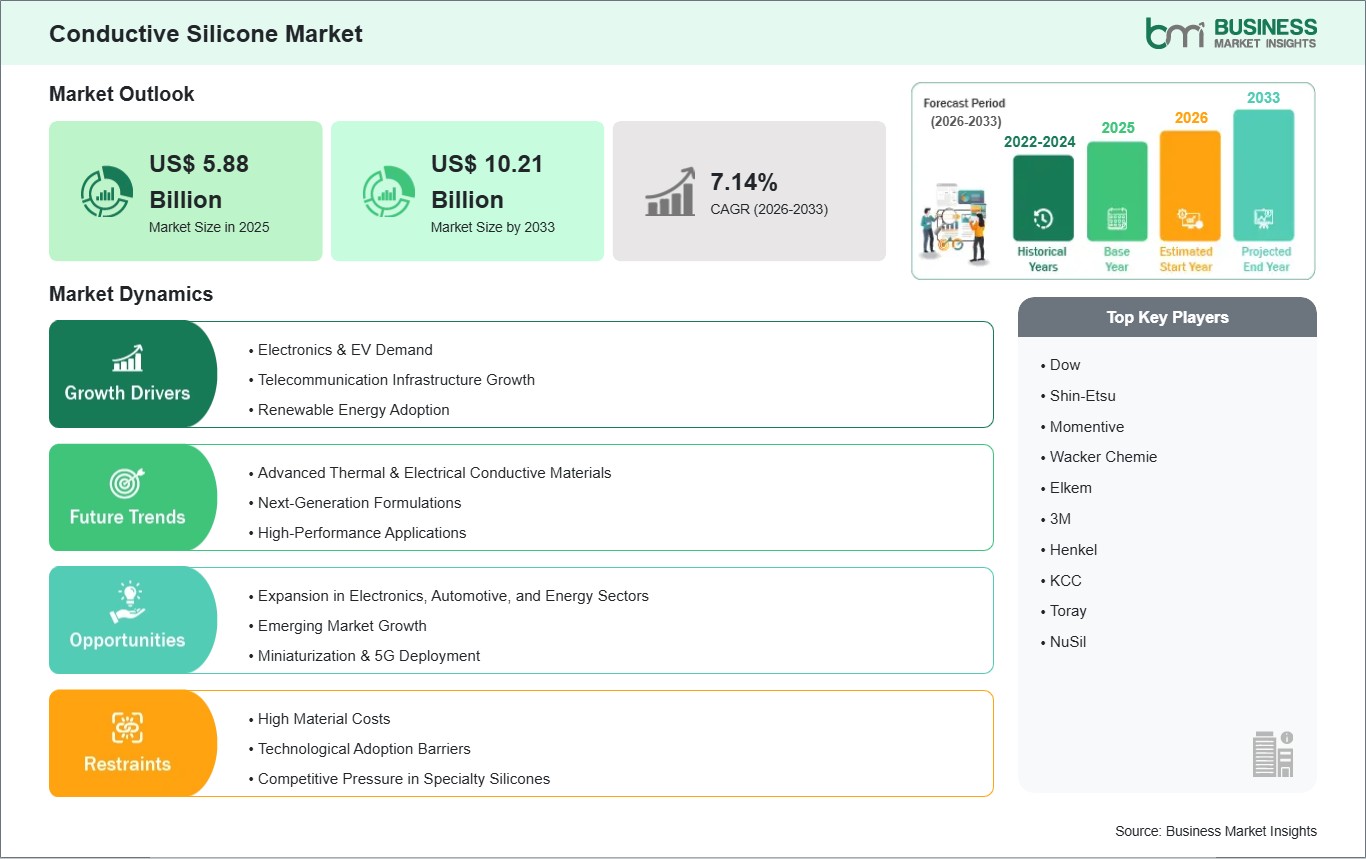
The Conductive Silicone Market size is expected to reach US$ 10.21 Billion by 2033 from US$ 5.88 Billion in 2025. The market is estimated to record a CAGR of 7.14% from 2026 to 2033.
The global conductive silicone market is experiencing strong growth due to increasing demand for advanced materials that offer both electrical conductivity and thermal stability across high-performance applications. Conductive silicone materials are widely used in electronics, automotive systems, telecommunications infrastructure, and renewable energy applications, owing to their unique combination of flexibility, durability, and conductivity. These materials are typically infused with conductive fillers such as carbon, silver, or other metals, enabling them to perform efficiently in environments requiring electromagnetic interference (EMI) shielding, electrostatic discharge (ESD) protection, and heat dissipation.
One of the primary growth drivers of the market is the rapid expansion of the electronics industry. The increasing adoption of smartphones, wearable devices, and high-performance computing systems has created significant demand for materials that can manage heat and ensure reliable electrical performance. Conductive silicones are widely used in thermal interface materials, adhesives, and encapsulants to enhance device reliability and longevity. Additionally, the ongoing deployment of 5G infrastructure is further boosting demand, as these systems require advanced materials for signal integrity and thermal management.
The automotive industry is another key contributor to market growth, particularly with the rising adoption of electric vehicles (EVs). Conductive silicones are used in battery systems, sensors, and power electronics to ensure efficient heat dissipation and electrical performance. Their ability to maintain conductivity under extreme temperatures and environmental conditions makes them highly suitable for automotive applications.
Furthermore, the increasing focus on renewable energy systems, including solar and wind power, is creating additional demand for conductive silicone materials. These materials are used in photovoltaic modules and power distribution systems to improve efficiency and durability. Continuous innovation in material formulations and manufacturing processes is expanding application possibilities, making conductive silicone a critical component in modern industrial and electronic systems.
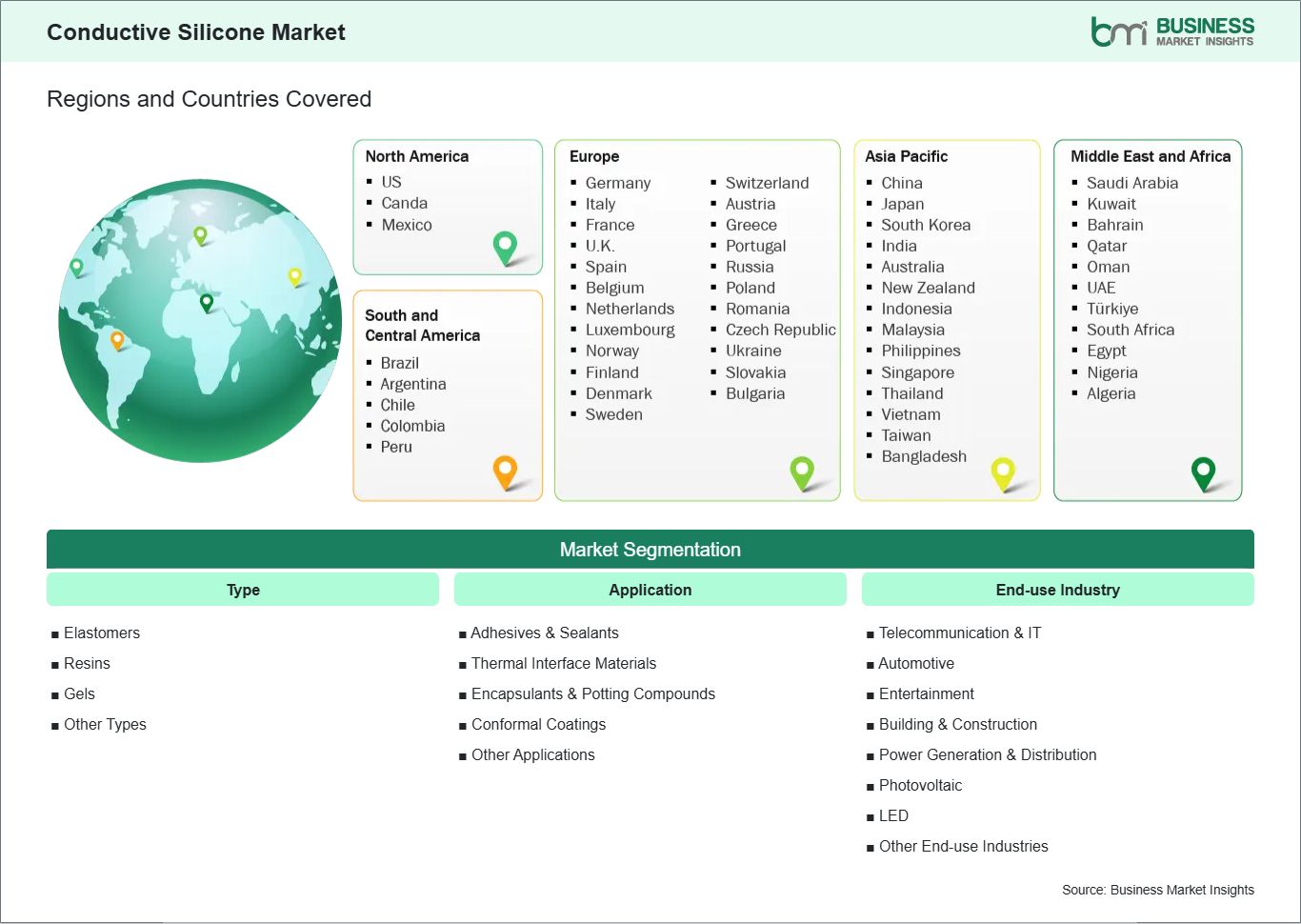
Key segments that contributed to the derivation of the conductive silicone market analysis are type, application, and end-use industry.
The global trend of using more advanced electronic devices and electric vehicles has driven growth of conductive silicone demand. Driving this demand, miniaturization is taking place as component size shrinks and the generation of more heat is being produced by the electronic devices that are miniaturizing. Conductive silicones are widely utilized in thermal interface materials, adhesives, and coatings for dissipating heat and ensuring that the devices operate properly. Conductive silicones are essential to modern electronics due to their ability to provide the necessary electrical conductivity while also insulating electrically to protect devices from electrical failure.
The expansion of 5G networks and telecommunications infrastructure is directly contributing to the growth of conductive silicone materials. Conductive silicones are key materials used to ensure signal integrity when combined with antennas, base stations, and other communications devices, as well as to help shield against electromagnetic interference. As the world continues to become more connected, the demand for reliable and high-level quality conductive silicone materials will expand significantly.
In the automotive market, there is also a significant growth opportunity for conductive silicones. As the automotive market transitions to electric and hybrid vehicles, conductive silicones are increasingly being used in areas such as battery packs, sensors, and electronic control units to improve performance and enhance safety. Additionally, conductive silicones are well suited for automotive applications due to their resistance to extreme temperatures, moisture, and environmental wear and tear. The increased use of advanced driving assistance systems (ADAS) and other electronics in automobiles also supports the growth of the conductive silicone market.
An increased focus on sustainable technologies and renewable energy is creating new possibilities for conductive silicones. Conductive silicone has many applications in photovoltaic systems, wind turbines, and power distribution networks. These materials increase efficiency by improving the performance of the device while providing long-lasting performance when exposed to harsh environments.
With advancements in material science, the development of next-generation conductive silicones provides enhanced thermal conductivity, flexibility, and mechanical integrity, thus expanding applications into new areas such as wearable electronics, biomedical devices, and smart infrastructure systems.
The demand for high-performance materials across multiple industries (aerospace, defense, and industrial manufacturing) will continue to drive the growth of the conductive silicone industry. Conductive silicones are now commonly used in conformal coatings, encapsulants, and potting compounds to protect sensitive components from environmental degradation. Emerging markets in the Asia Pacific and Latin America represent large potential growth opportunities as they rapidly industrialize, continue to invest heavily in electronics manufacturing, and are expanding their investments in renewable energy projects.

The Conductive Silicone Market demonstrates steady growth, with size and share analysis highlighting evolving trends and competitive dynamics among key players. The report examines subsegments categorized type, application, and end-use industry, offering insights into their contribution to overall market performance.
By product, the elastomers subsegment dominated the market in 2025, driven by their superior flexibility, electrical conductivity, and widespread use in electronic and automotive applications.
In terms of application, the adhesives & sealants subsegment dominated the market in 2025, driven by their critical role in bonding and protecting electronic components while maintaining conductivity.
By end-use industry, the telecommunication & IT subsegment dominated the market in 2025, driven by rapid expansion of communication infrastructure and increasing demand for advanced electronic systems.
| Report Attribute | Details |
|---|---|
| Market size in 2025 | US$ 5.88 Billion |
| Market Size by 2033 | US$ 10.21 Billion |
| Global CAGR (2026 - 2033) | 7.14% |
| Historical Data | 2022-2024 |
| Forecast period | 2026-2033 |
| Segments Covered | By Type
|
|
Regions and Countries Covered
| |
| North America | US, Canada, Mexico |
| Europe | Belgium, Austria, Finland, Denmark, Greece, Poland, Romania, Russia, Ukraine, Czech Republic, Slovakia, Bulgaria, Italy, Luxembourg, Germany, Switzerland, France, Netherlands, Norway, Portugal, Spain, Sweden, United Kingdom |
| Asia-Pacific | Australia, China, India, Japan, South Korea, Indonesia, Malaysia, Philippines, Singapore, Thailand, Vietnam, Bangladesh, New Zealand, Taiwan |
| South and Central America | Brazil, Argentina, Peru, Chile, Colombia |
| Middle East and Africa | Bahrain, Kuwait, Oman, Qatar, Saudi Arabia, United Arab Emirates, Turkiye, South Africa, Egypt, Algeria, Nigeria |
| Market leaders and key company profiles |
|
The "Conductive Silicone Market Size and Forecast (2022 - 2033)" report provides a detailed analysis of the market covering below areas:
The geographical scope of the Conductive Silicone Market report is divided into North America, Asia Pacific, Europe, Middle East & Africa, and South & Central America. North America held the largest share in 2025.
North America dominates the global conductive silicone market, supported by strong demand from advanced industries such as electronics, automotive, aerospace, and telecommunications. The United States is a major contributor, with significant investments in research and development, as well as widespread adoption of advanced materials in high-performance applications. The presence of leading technology companies and semiconductor manufacturers further strengthens market growth in the region.
The region’s focus on innovation and technological advancement is driving the adoption of conductive silicone materials in applications such as 5G infrastructure, electric vehicles, and renewable energy systems. Additionally, stringent regulations regarding product performance and safety are encouraging the use of high-quality materials, further boosting market demand.
Europe represents a significant market, characterized by strong emphasis on sustainability and advanced manufacturing technologies. Countries such as Germany, France, and the UK are investing in electric vehicles and renewable energy systems, driving demand for conductive silicone materials.
Asia Pacific is the fastest-growing region, driven by rapid industrialization, expanding electronics manufacturing, and increasing adoption of electric vehicles. Countries such as China, Japan, and South Korea are major contributors, with strong demand from consumer electronics and automotive industries.
The Middle East & Africa and South & Central America are emerging markets, supported by growing investments in infrastructure and energy projects. While these regions offer significant growth potential, challenges such as cost sensitivity and limited technological adoption may impact market expansion. Overall, increasing demand for advanced materials and ongoing technological innovation will continue to drive regional growth.
The Conductive Silicone Market is evaluated by gathering qualitative and quantitative data post primary and secondary research, which includes important corporate publications, association data, and databases. A few of the key developments in the conductive silicone market are:
The Conductive Silicone Market is valued at US$ 5.88 Billion in 2025, it is projected to reach US$ 10.21 Billion by 2033.
As per our report Conductive Silicone Market, the market size is valued at US$ 5.88 Billion in 2025, projecting it to reach US$ 10.21 Billion by 2033. This translates to a CAGR of approximately 7.14% during the forecast period.
The Conductive Silicone Market report typically cover these key segments-
The historic period, base year, and forecast period can vary slightly depending on the specific market research report. However, for the Conductive Silicone Market report:
The Conductive Silicone Market is populated by several key players, each contributing to its growth and innovation. Some of the major players include:
The Conductive Silicone Market report is valuable for diverse stakeholders, including:
Essentially, anyone involved in or considering involvement in the Conductive Silicone Market value chain can benefit from the information contained in a comprehensive market report.
Please tell us your area of interest
(Market Segments/ Regions and Countries/ Companies)