Elastomeric Foam Market Outlook (2022-2033)

Historic Data: 2022-2024   |   Base Year: 2025   |   Forecast Period: 2026-2033
Report Content: Market Scope, Market Segmentation, Market Dynamics, and Competitive Analysis

Report Coverage:
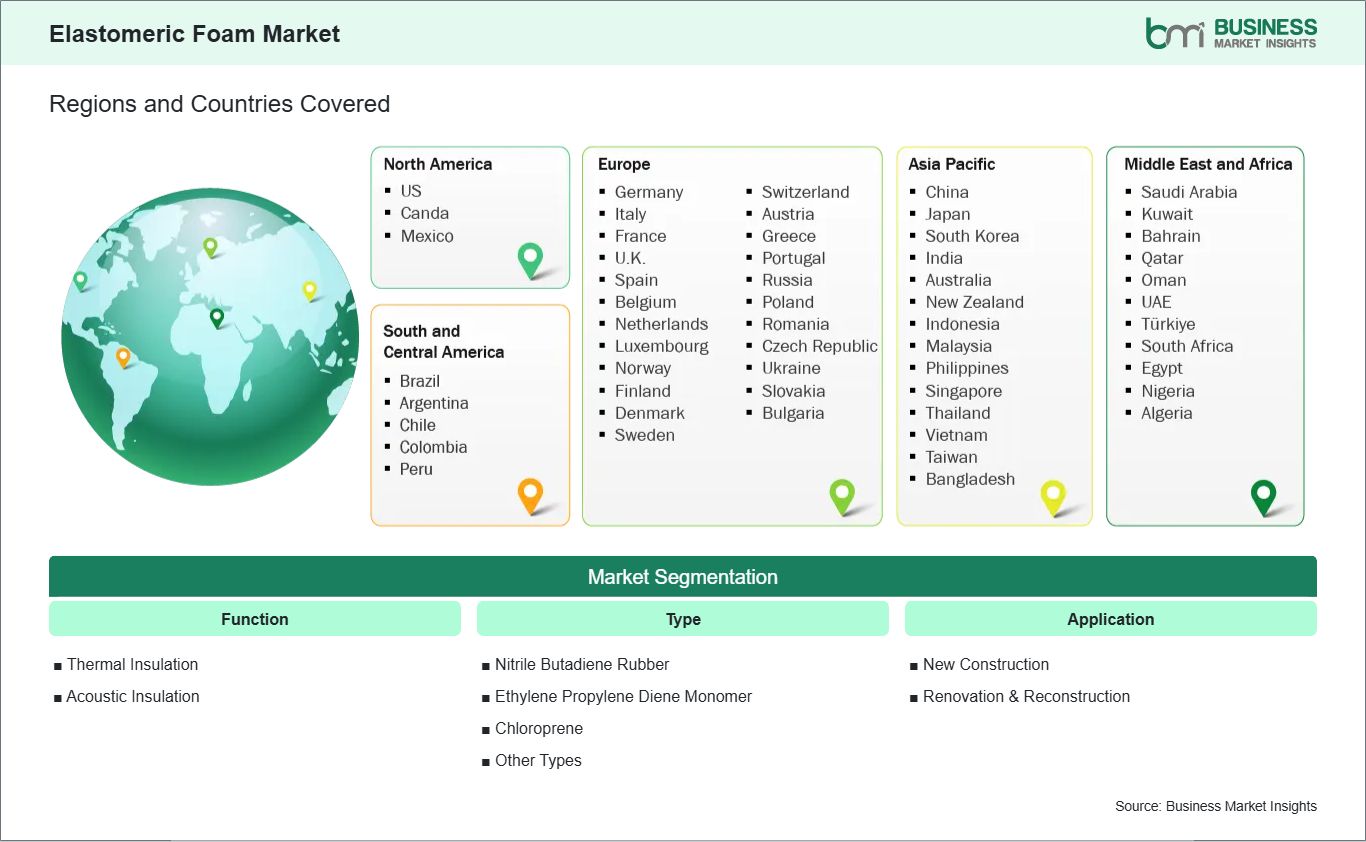
  • Function (Thermal Insulation, Acoustic Insulation)
  • Type (Nitrile Butadiene Rubber (NBR), Ethylene Propylene Diene Monomer (EPDM), Chloroprene (CR), Other Types)
  • Application (New Construction, Renovation & Reconstruction)

No. of Pages: 429
Report Code: BMIPUB00033904
Category: Chemicals and Materials
Elastomeric Foam Market

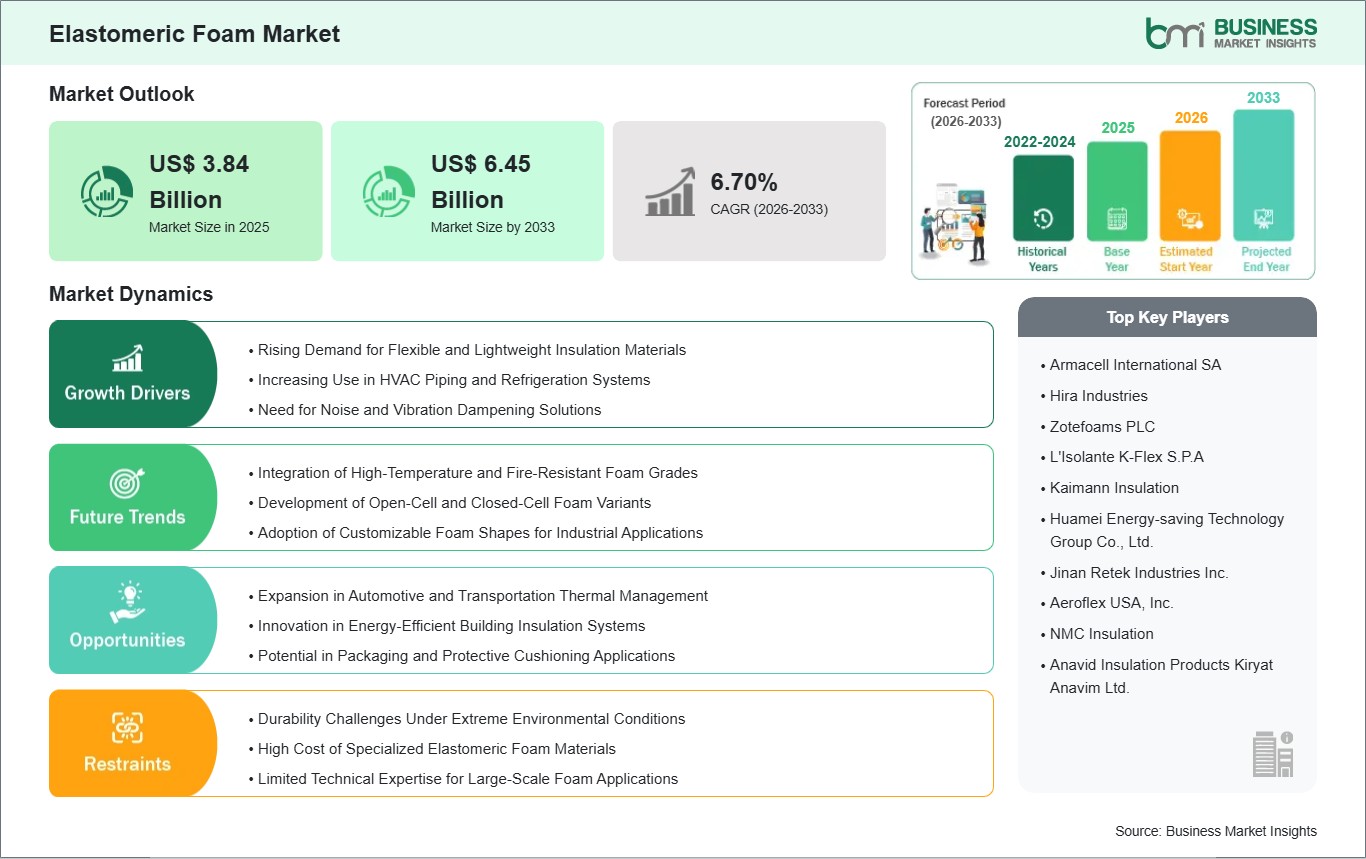
The Elastomeric Foam Market size is expected to reach US$ 6.45 Billion by 2033 from US$ 3.84 Billion in 2025. The market is estimated to record a CAGR of 6.70% from 2026 to 2033.

Executive Summary and Global Market Analysis:

The elastomeric foam market, at the global level, has attained higher importance as industries are looking towards the development of lightweight, elastic, and thermally efficient products. These types of foams are highly preferred as they are flexible, compressible, and offer good resistance towards moisture, temperature, and chemical exposure. These foams are used in HVAC, automobile, industrial, and construction sectors. The elastomeric foam market is driven by the rising need for efficient building products, regulatory pressures on building insulation, and the development of lightweight products, which enhance the efficiency of vehicles. Another factor that is contributing to market growth is sustainability. This is because foam manufacturers are looking for alternative elastomers that are recyclable and sustainable in order to reduce carbon emissions. Furthermore, developments in closed-cell and open-cell foam structures enable customization for particular thermal, acoustic, and mechanical requirements, thus opening new markets for elastomeric foams. However, some limitations are hindering the market growth. For instance, high-performance elastomeric foams require equipment and processing conditions, which may result in high production costs. In addition, incompatibility with adhesives and coatings in composite parts and a lack of awareness in emerging markets are other limitations hindering market growth. However, continued research in polymer science and increased emphasis on energy efficiency and comfort are propelling the elastomeric foam market forward.

Elastomeric Foam Market - Strategic Insights:

global-market-strategic-framework
Get more information on this report

Elastomeric Foam Market Segmentation Analysis:

Key segments that contributed to the derivation of the elastomeric foam market analysis are function, type, and end‑use industry.

  • By function, the elastomeric foam market is segmented into thermal insulation and acoustic insulation. The thermal insulation subsegment dominated the market in 2025.
  • Based on type, the elastomeric foam market is categorized into nitrile butadiene rubber (NBR), ethylene propylene diene monomer (EPDM), chloroprene (CR), and other types. The nitrile butadiene rubber (NBR) subsegment dominated the market in 2025.
  • In terms of end‑use industry, the elastomeric foam market is divided into HVAC, heating & plumbing, refrigeration, transportation, and other end‑use industries. The HVAC subsegment dominated the market in 2025.

Elastomeric Foam Market Drivers and Opportunities:

Rising Demand for Flexible and Lightweight Insulation Materials

Elastomeric foam is increasingly sought after as a flexible and lightweight insulation material across multiple industries. Its unique cellular structure allows it to provide excellent thermal and acoustic insulation while remaining easy to handle and install. This flexibility makes it ideal for applications in buildings, piping, HVAC systems, and refrigeration units, where efficiency, safety, and weight reduction are critical.

The increasing focus on energy efficiency in building and constructing is thus driving this need. The capacity of elastomeric foam to prevent heat loss and condensation makes it a popular choice. The material is also popular with builders and engineers, as it can be molded to fit complex and uneven surfaces, thus ensuring complete coverage without interruptions or joints.

The material also boasts long-term durability and flexibility. The material does not lose its insulating capabilities over time and does not succumb to moisture, molds, or vibrations. These characteristics make elastomeric foam a popular choice for building and constructing, especially in countries around the world.

Expansion in Automotive and Transportation Thermal Management

The automotive and transportation sectors are opening new growth avenues for elastomeric foam. Vehicles, trains, and commercial aircraft require materials that are lightweight yet effective in managing heat, vibration, and sound. Elastomeric foam meets these needs, providing insulation for engine compartments, HVAC ducts, and interior panels while contributing to fuel efficiency through weight reduction.

Increasing adoption in electric and hybrid vehicles presents a particularly compelling opportunity. Battery packs, power electronics, and charging components generate heat that must be carefully managed to maintain performance and safety. Elastomeric foam`s thermal stability and adaptability allow manufacturers to design lightweight thermal management solutions without compromising vehicle efficiency or passenger comfort.

Beyond energy efficiency, the opportunity extends to passenger comfort and noise reduction. Foam products can reduce vibrations and acoustic disturbances, improving the overall travel experience. As transportation industries continue to innovate and prioritize lightweight, multifunctional materials, elastomeric foam is well-positioned to capture demand across both conventional and emerging mobility applications worldwide.

Elastomeric Foam Market Size and Share Analysis:

The elastomeric foam market is experiencing steady growth, with market size and share analysis reflecting evolving treatment preferences and competitive dynamics among key players. The report evaluates important subsegments categorized within function, type, and end‑use industry, highlighting their respective contributions to overall market performance.

By function, the Thermal Insulation subsegment dominated the Elastomeric Foam market in 2025. Thermal insulation foams provide excellent temperature resistance, energy efficiency, and durability, making them highly suitable for building and industrial applications, which drives their widespread adoption.

Based on type, the Nitrile Butadiene Rubber (NBR) subsegment dominated the Elastomeric Foam market in 2025. NBR foams offer superior resistance to heat, oils, and chemicals, making them ideal for demanding insulation and sealing applications, supporting strong market demand.

In terms of end‑use industry, the HVAC subsegment dominated the Elastomeric Foam market in 2025. HVAC applications benefit from elastomeric foam`s high thermal performance, flexibility, and energy efficiency, reinforcing the dominance of this segment.

Elastomeric Foam Market Report Highlights:

Report Attribute Details
Market size in 2025 US$ 3.84 Billion
Market Size by 2033 US$ 6.45 Billion
Global CAGR (2026 - 2033)6.70%
Historical Data 2022-2024
Forecast period 2026-2033
Segments Covered By Function
  • Thermal Insulation
  • Acoustic Insulation
By Type
  • Nitrile Butadiene Rubber
  • Ethylene Propylene Diene Monomer
  • Chloroprene
  • Other Types
By Application
  • New Construction
  • Renovation & Reconstruction
Regions and Countries Covered
North America US, Canada, Mexico
Europe Belgium, Austria, Finland, Denmark, Greece, Poland, Romania, Russia, Ukraine, Czech Republic, Slovakia, Bulgaria, Italy, Luxembourg, Germany, Switzerland, France, Netherlands, Norway, Portugal, Spain, Sweden, United Kingdom
Asia-Pacific Australia, China, India, Japan, South Korea, Indonesia, Malaysia, Philippines, Singapore, Thailand, Vietnam, Bangladesh, New Zealand, Taiwan
South and Central America Brazil, Argentina, Peru, Chile, Colombia
Middle East and Africa Bahrain, Kuwait, Oman, Qatar, Saudi Arabia, United Arab Emirates, Turkiye, South Africa, Egypt, Algeria, Nigeria
Market leaders and key company profiles
  • Armacell International SA
  • Hira Industries
  • Zotefoams PLC
  • L'Isolante K-Flex S.P.A
  • Kaimann Insulation
  • Huamei Energy-saving Technology Group Co., Ltd.
  • Jinan Retek Industries Inc.
  • Aeroflex USA, Inc.
  • NMC Insulation
  • Anavid Insulation Products Kiryat Anavim Ltd.
Get more information on this report

Elastomeric Foam Market Report Coverage and Deliverables:

The "Elastomeric Foam Market Size and Forecast (2022 - 2033)" report provides a detailed analysis of the market covering below areas:

  • Elastomeric Foam market size and forecast at global, regional, and country levels for all the key market segments covered under the scope
  • Elastomeric Foam market trends, as well as drivers, restraints, and opportunities
  • Elastomeric Foam market analysis covering key trends, regional framework, major players, regulations, and recent developments
  • Industry landscape and competition analysis covering market concentration, heat map analysis, prominent players, and recent developments for the Elastomeric Foam market
  • Detailed company profiles, including SWOT analysis

Elastomeric Foam Market Geographic Insights:

The geographical scope of the Elastomeric Foam market report is divided into five regions: North America, Asia Pacific, Europe, Middle East & Africa, and South & Central America. The Elastomeric Foam market in North America is expected to grow during the forecast period.

North America dominates the global elastomeric foam market, fueled by a combination of industrial sophistication, advanced construction practices, and a strong automotive sector. In the construction industry, elastomeric foams are widely used in HVAC insulation, pipe coverings, roofing systems, and building envelopes to enhance thermal efficiency and minimize energy loss. Their flexibility and moisture resistance make them particularly suitable for variable climates, where expansion and contraction or condensation could compromise rigid insulation materials. Another region that plays an important role in the demand for elastomeric foams is the automotive and industrial sectors. The foams find applications as seat materials, vibration dampeners, gaskets, and protective coverings. The region of North America is able to enjoy high-end infrastructure for manufacturing and processing, as well as a strong distribution network and a focus on building and automotive standards that emphasize high-performance insulation materials. Even as the cost of processing and handling poses a problem for the region, the focus on sustainability and efficiency ensures that North America continues to hold its position as the leader in the global elastomeric foams market.

global-market-geography
Get more information on this report

Elastomeric Foam Market Research Report Guidance:

  • The report includes qualitative and quantitative data in the Elastomeric Foam market across function, type, end‑use industry, and geography.
  • The report starts with the key takeaways (chapter 2), highlighting the key trends and outlook of the Elastomeric Foam market.
  • Chapter 3 focuses on the research methodology of the study.
  • Chapter 4 includes ecosystem analysis.
  • Chapter 5 highlights the major industry dynamics in the Elastomeric Foam market, including factors that are driving the market, prevailing deterrents, potential opportunities, as well as future trends. Impact analysis of these drivers and restraints is also covered in this section.
  • Chapter 6 discusses the Elastomeric Foam market scenario, in terms of historical market revenues, and forecast till the year 2033.
  • Chapters 7 to 10 cover the Elastomeric Foam market segments by function, type, end‑use industry, and geography across North America, Europe, Asia Pacific, Middle East and Africa, and South and Central America. They cover the market volume, revenue forecast, and factors driving the market.
  • Chapter 11 describes the competitive analysis with the heat map analysis for the key players operating in the market.
  • Chapter 12 describes the industry landscape analysis. It provides detailed descriptions of business activities such as market initiatives, new developments, mergers, and joint ventures globally, along with a competitive landscape.
  • Chapter 13 provides detailed profiles of the major companies operating in the Elastomeric Foam market. Companies have been profiled on the basis of their key facts, business descriptions, products, financial overview, SWOT analysis, and key developments.
  • Chapter 14, i.e., the appendix, is inclusive of a brief overview of the company, list of abbreviations, and disclaimer.

Elastomeric Foam Market News and Key Development:

The elastomeric foam market is evaluated by gathering qualitative and quantitative data post primary and secondary research, which includes important corporate publications, association data, and databases. A few of the key developments in the elastomeric foam market are:

  • In March 2026, Armacell International S.A. announced that its ArmaFlex Ultima elastomeric foam insulation received NK Type Approval from Nippon Kaiji Kyokai (Class NK), verifying compliance with stringent marine safety standards for use in ships and offshore structures. This certification supports broader adoption of the product in marine and offshore markets under recognized international safety criteria.
  • In April 2025, Armacell International S.A. announced that it introduced ArmaGel XGC, a next‑generation cryogenic and dual‑temperature elastomeric aerogel insulation blanket designed for extreme industrial environments (down to −196 °C). Manufacturing for this product now includes its new facility in India, strengthening the company`s global supply chain and production footprint for high‑performance insulation solutions serving energy, industrial, and process markets worldwide.

Key Sources Referred:

  • International Organization for Standardization (ISO)
  • American Society for Testing and Materials (ASTM International)
  • Bureau of Indian Standards (BIS)
  • Environmental Protection Agency (EPA), USA
  • European Chemicals Agency (ECHA)
  • Central Pollution Control Board (CPCB), India
  • Ministry of Chemicals and Fertilizers, India
  • American Chemistry Council (ACC)
  • Indian Chemical Council (ICC)
  • European Chemical Industry Council (Cefic)
  • Specialty Chemical Association of India (SCAI)
  • Company Websites
  • Company Annual Reports
  • Company Investor Presentations
  • The List of Companies - Elastomeric Foam Market
    • Armacell International SA
    • Hira Industries
    • Zotefoams PLC
    • L'Isolante K-Flex S.P.A
    • Kaimann Insulation
    • Huamei Energy-saving Technology Group Co., Ltd.
    • Jinan Retek Industries Inc.
    • Aeroflex USA, Inc.
    • NMC Insulation
    • Anavid Insulation Products Kiryat Anavim Ltd.
    Frequently Asked Questions
    How big is the Elastomeric Foam Market?

    The Elastomeric Foam Market is valued at US$ 3.84 Billion in 2025, it is projected to reach US$ 6.45 Billion by 2033.

    What is the CAGR for Elastomeric Foam Market by (2026 - 2033)?

    As per our report Elastomeric Foam Market, the market size is valued at US$ 3.84 Billion in 2025, projecting it to reach US$ 6.45 Billion by 2033. This translates to a CAGR of approximately 6.70% during the forecast period.

    What segments are covered in this report?

    The Elastomeric Foam Market report typically cover these key segments-

    • Function (Thermal Insulation, Acoustic Insulation)
    • Type (Nitrile Butadiene Rubber (NBR), Ethylene Propylene Diene Monomer (EPDM), Chloroprene (CR), Other Types)
    • Application (New Construction, Renovation & Reconstruction)

    What is the historic period, base year, and forecast period taken for Elastomeric Foam Market?

    The historic period, base year, and forecast period can vary slightly depending on the specific market research report. However, for the Elastomeric Foam Market report:

  • Historic Period : 2022-2024
  • Base Year : 2025
  • Forecast Period : 2026-2033
  • Who are the major players in Elastomeric Foam Market?

    The Elastomeric Foam Market is populated by several key players, each contributing to its growth and innovation. Some of the major players include:

  • Armacell International SA
  • Hira Industries
  • Zotefoams PLC
  • L'Isolante K-Flex S.P.A
  • Kaimann Insulation
  • Huamei Energy-saving Technology Group Co., Ltd.
  • Jinan Retek Industries Inc.
  • Aeroflex USA, Inc.
  • NMC Insulation
  • Anavid Insulation Products Kiryat Anavim Ltd.
  • Who should buy this report?

    The Elastomeric Foam Market report is valuable for diverse stakeholders, including:

    • Investors: Provides insights for investment decisions pertaining to market growth, companies, or industry insights. Helps assess market attractiveness and potential returns.
    • Industry Players: Offers competitive intelligence, market sizing, and trend analysis to inform strategic planning, product development, and sales strategies.
    • Suppliers and Manufacturers: Helps understand market demand for components, materials, and services related to concerned industry.
    • Researchers and Consultants: Provides data and analysis for academic research, consulting projects, and market studies.
    • Financial Institutions: Helps assess risks and opportunities associated with financing or investing in the concerned market.

    Essentially, anyone involved in or considering involvement in the Elastomeric Foam Market value chain can benefit from the information contained in a comprehensive market report.

    Available Report Formats

    pdf-format excel-format pptx-format
    Buy Now
    Sales Assistance
    +1 646 791 7070 (US & UK)
    Customization Form

    Please tell us your area of interest
    (Market Segments/ Regions and Countries/ Companies)