Market Summary
Executive Summary and Global Market Analysis
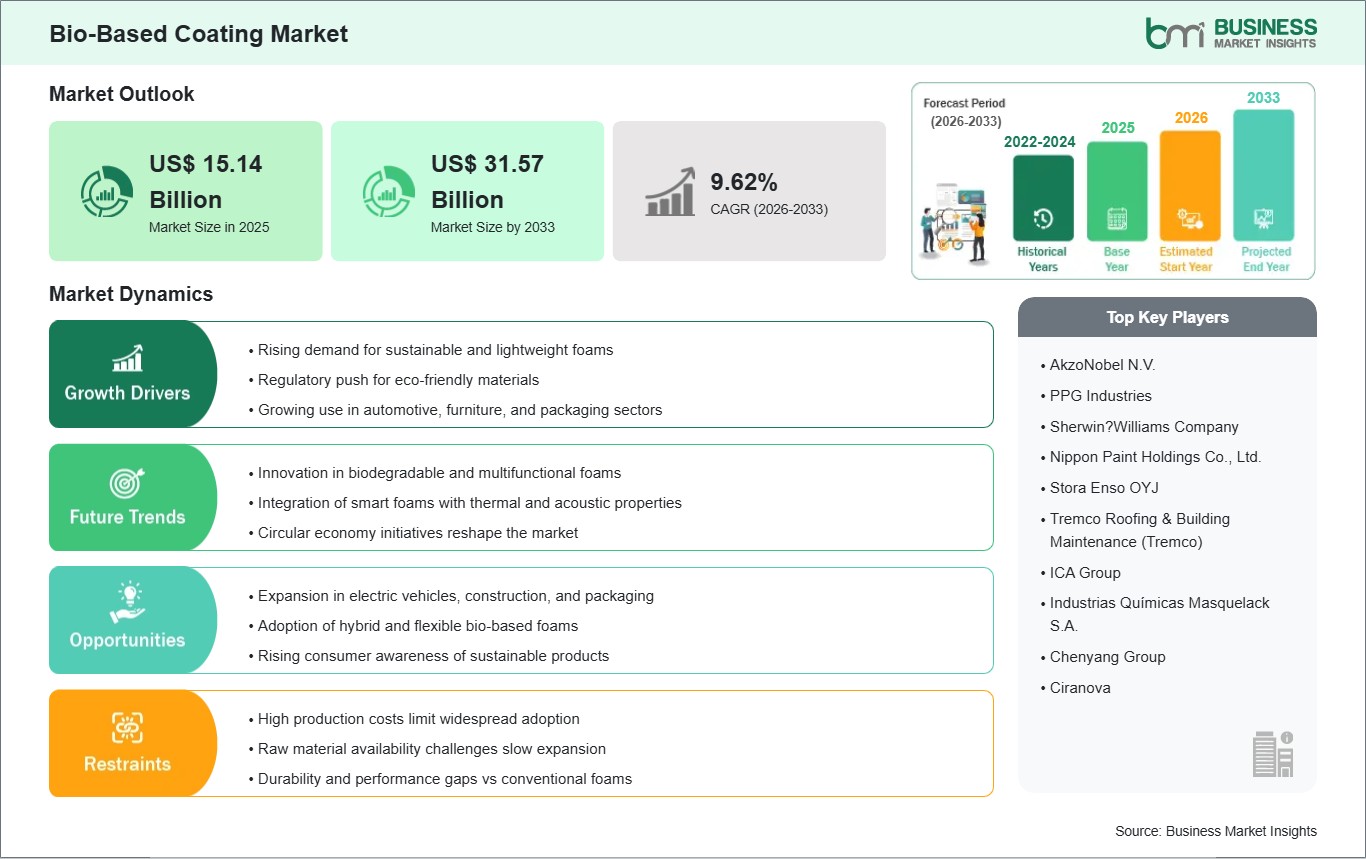
Bio-based coatings are sustainable surface treatments formulated with resins, binders, and solvents derived from renewable biological resources such as plant oils, starches, lignocellulose, and agricultural by-products, covering key product categories such as bio-polyurethanes, alkyd resins, polylactic acid (PLA) coatings, and bio-epoxies. These technologies offer strong clinical and economic benefits. They help lower Volatile Organic Compound (VOC) emissions, which improves indoor air quality. They also provide renewable options for food-safe packaging and support long-term structural protection with less embodied carbon. The market is expanding as a result of higher global demand for green building materials, stricter government rules such as the EU's VOC limits and dual-carbon strategies, and more consumers choosing non-toxic finishes.
However, several challenges can restrain market growth: high initial procurement and production costs, often 20% to 50% higher than petroleum-based counterparts due to complex extraction processes, can limit adoption in price-sensitive markets. Strict regulations, including requirements for detailed life-cycle assessments (LCA) and third-party eco-label certifications, make it harder to launch new products quickly and increase development costs. Furthermore, the industry struggles with technical performance and keeping raw materials consistent. Early bio-coatings often do not offer the durability or chemical resistance needed for heavy industrial and marine applications.
Despite these hurdles, the market holds immense opportunities in the universal mandate for decarbonized construction and the accelerating deployment of smart, bio-based barrier coatings for plastic-free paper packaging. The expansion of maritime bio-coatings for zero-emission shipping and the development of next-generation nanocellulose-reinforced resins that offer superior hardness are expected to create significant opportunities for market growth.
Segment Analysis
Bio-Based Coating Market Segmentation
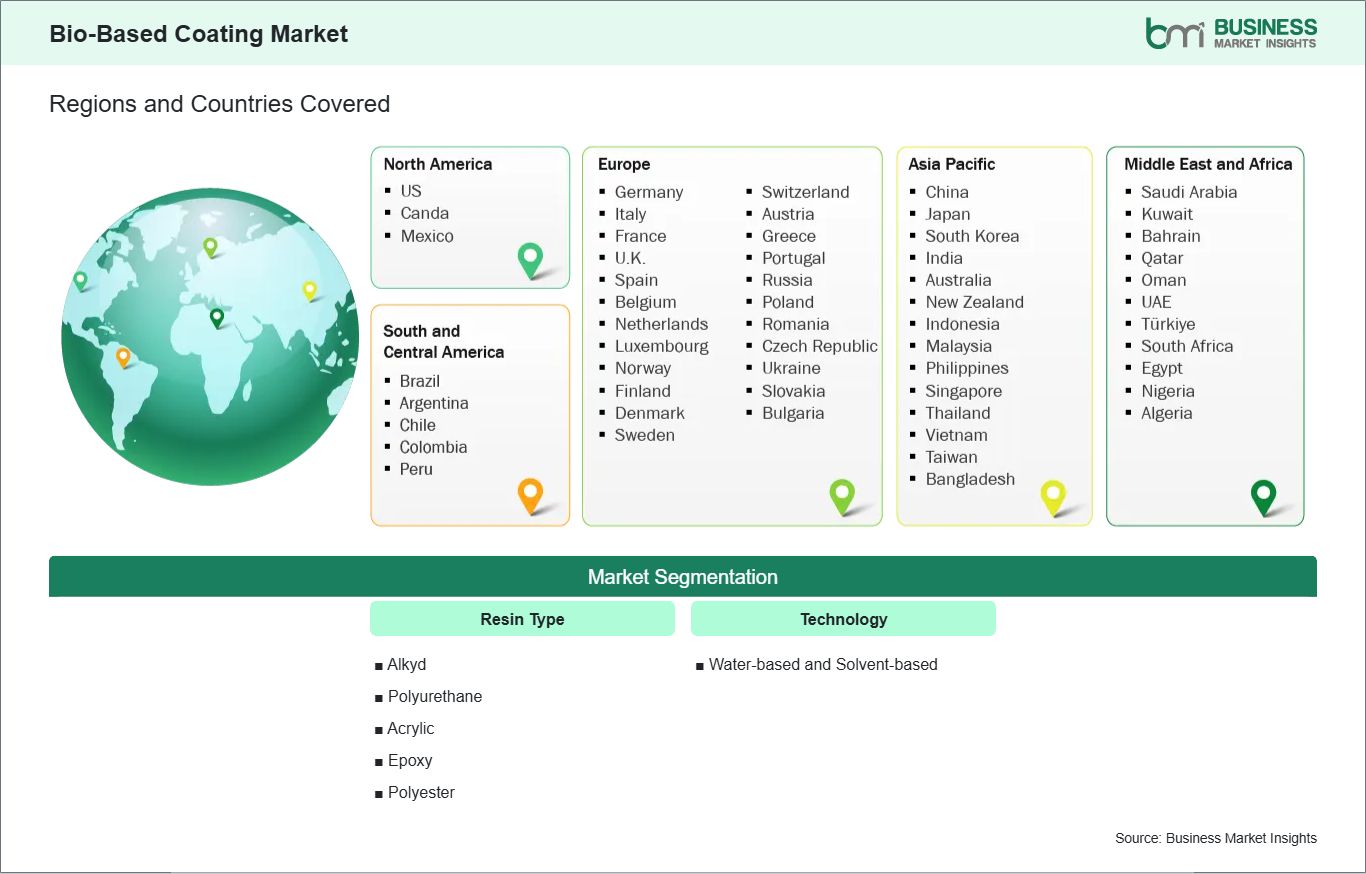
Key segments that contributed to the derivation of the Bio-Based Coating market analysis are resin type and technology.
- By Resin Type, the market is segmented into Alkyd, Polyurethane, Acrylic, Epoxy, and Polyester.
- By Technology, the market is divided into Water-based and Solvent-based.
Market Forces
Bio-Based Coating Market Drivers and Opportunities
Decarbonization Mandates and the Phase-out of Fossil-Based Solvents
The primary driver for the Bio-Based Coating Market is the intensifying global regulatory pressure to reduce Volatile Organic Compound (VOC) emissions and decouple industrial production from fossil fuels. Governments, particularly in the European Union and North America, are implementing stringent air quality standards and "Green Deal" initiatives that mandate a transition toward low-carbon, renewable materials. This legislative environment is compelling manufacturers in the architectural, automotive, and packaging sectors to replace traditional petroleum-based resins and solvents with bio-derived alternatives.
Furthermore, the market is propelled by a profound shift in "conscious consumerism," where end-users and corporate stakeholders prioritize eco-friendly, non-toxic formulations for indoor air quality and environmental safety. As major industries commit to net-zero targets and sustainable procurement policies, the demand for coatings derived from renewable biomass, such as plant oils, starches, and lignin, has transitioned from a niche "green" preference to a critical operational requirement for global supply chains.
High-Performance Resins and Circular Economy Integration
A significant high-value opportunity lies in the technical advancement of next-generation bio-based resins, such as bio-polyurethanes and bio-epoxies, which are increasingly achieving performance parity with their synthetic counterparts. These innovations allow for the expansion of bio-based coatings into demanding, "high-stakes" environments like marine anti-fouling, aerospace, and heavy-duty industrial infrastructure, where durability and corrosion resistance are paramount. There is also a major growth frontier in the circular economy, specifically the upcycling of agricultural and industrial by-products into functional coating ingredients. Utilizing waste streams like cashew nut shell liquid (CNSL), orange peels, or recycled cellulose not only lowers raw material costs but also enhances the sustainability profile of the end product.
Additionally, the integration of AI-driven lab automation presents an opportunity to accelerate the discovery of bespoke, bio-based formulations tailored for specific substrates like wood or recycled plastics. Manufacturers who focus on "drop-in" solutions, which can be used in existing application machinery without modification, and those leading in certified home-compostable barrier coatings for packaging are positioned to capture the highest-margin segments of the market.
Size and Share Analysis
Bio-Based Coating Market Size and Share Analysis
The Bio-Based Coating market demonstrates steady growth, with size and share analysis revealing evolving trends and competitive positioning among key players. The report further examines subsegments categorized within resin type and technology, offering insights into their contribution to overall market performance.
For instance, the Water-based subsegment is the fastest-growing technology segment. Water-based systems are essential for modern indoor applications because they utilize water as a primary carrier, significantly reducing VOC emissions and eliminating the foul odors associated with traditional coatings. In 2026, the market is seeing a surge in "bio-based polyurethane dispersions" (PUDs) within this category, which offer the durability and chemical resistance required for high-traffic environments like hospitals and schools. This shift is critical for compliance with the latest environmental safety mandates, providing a data-driven path for facility managers to improve indoor air quality while maintaining a high-performance finish.
Report Coverage
Bio-Based Coating Market Report Coverage and Deliverables
The "Bio-Based Coating Market Size and Forecast (2022 - 2033)" report provides a detailed analysis of the market covering below areas:
- Bio-Based Coating market size and forecast at global, regional, and country levels for all the key market segments covered under the scope
- Bio-Based Coating market trends, as well as market dynamics such as drivers, restraints, and key opportunities
- Bio-Based Coating market analysis covering key market trends, global and regional framework, major players, regulations, and recent market developments
- Industry landscape and competition analysis covering market concentration, heat map analysis, prominent players, and recent developments for the Bio-Based Coating market
- Detailed company profiles, including SWOT analysis
Geographic Insights
Bio-Based Coating Market Geographic Insights
The geographical scope of the Bio-Based Coating market report is divided into five regions: North America, Asia Pacific, Europe, Middle East &Africa, and South &Central America.
The Asia-Pacific Bio-Based Coating Market is segmented into China, Japan, South Korea, India, Australia, New Zealand, Indonesia, Malaysia, the Philippines, Singapore, Thailand, Vietnam, Taiwan, Bangladesh, and the Rest of Asia. The market is primarily propelled by massive infrastructure projects and the region's status as a global automotive and electronics manufacturing hub. China holds regional revenue due to its "dual-carbon" strategy and vast production capacity, while India is the fastest-growing country market, fueled by rapid urbanization and the government's push for "green" smart cities. Japan and South Korea are also significant contributors, focusing on high-performance bio-based epoxy and polyurethane resins for the maritime and high-tech sectors.
Growth is further bolstered by the increasing availability of renewable feedstocks like soybean, corn, and castor oil across the region. The shift toward waterborne and powder-based bio-coatings to meet tighter VOC (Volatile Organic Compound) limits, combined with the rise of circular economy practices using agricultural waste, solidifies Asia-Pacific as the primary driver of innovation and sustainable consumption in the global bio-based coating landscape.
Industry Activity
Recent Developments
The Bio-Based Coating market is evaluated by gathering qualitative and quantitative data post primary and secondary research, which includes important corporate publications, association data, and databases. A few of the key developments in the Bio-Based Coating market are:
- In June 2025, Kemira and Bluepha announced an exclusive partnership to commercialize fully biobased barrier coatings in APAC for paper, board and molded fiber, contributing to a move towards sustainable packaging and the elimination of plastic waste. The PHA-based coatings offer biodegradable, recyclable, and PFAS-free alternatives, supporting a circular and environmentally friendly packaging ecosystem
- In January 2025, Cortec® announced a major step forward in the development of biobased anticorrosion coatings for metal with the release of EcoLine® 3860, Cortec's first water-based acrylic coating to incorporate renewably-sourced resins. EcoLine® 3860 contains 27% USDA certified biobased content and is designed for industrial users who want to increase their use of renewable content. It is an important move toward expanding sustainable options in the specialty field of corrosion inhibiting paints.
Trust & Transparency
Research Methodology
The market analysis combines proprietary research with secondary data from government agencies, company disclosures, regulatory filings, industry databases and expert interviews. Market estimates are validated through data triangulation, cross-market benchmarking and analyst
review.
View Full Research Methodology
Key Sources Referred:
Society for Science World Bank – Global Trade Indicators World Trade Organization (WTO) National Science Foundation ACM SIGBED International Trade Administration (ITA) Company website Company annual reports Company investor presentations