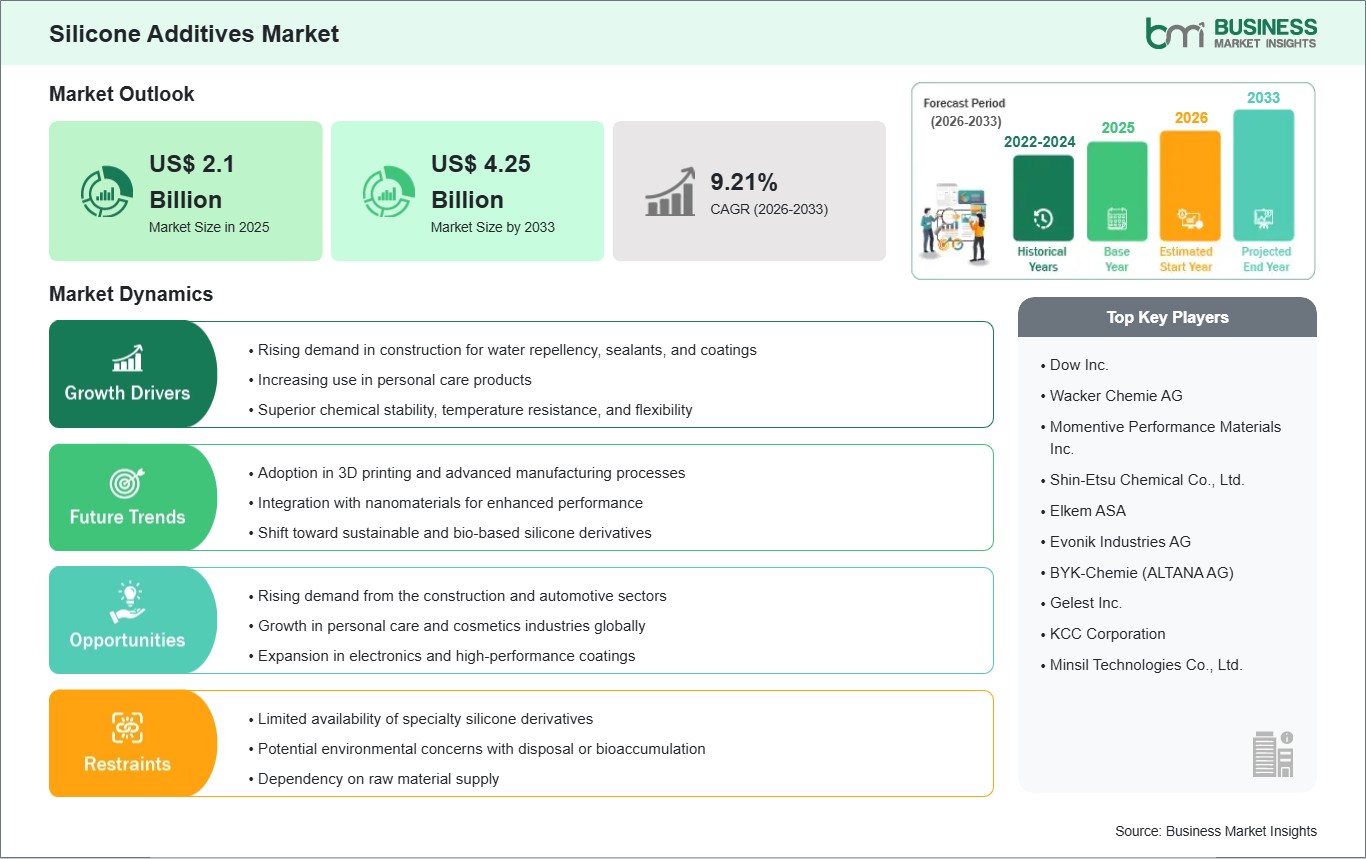
The Silicone Additives Market size is expected to reach US$ 4.25 billion by 2033 from US$ 2.1 billion in 2025. The market is estimated to record a CAGR of 9.21% from 2026 to 2033.
The global silicone additives market is a pivotal segment within the broader specialty chemicals industry, providing functional enhancements to a wide array of applications across coatings, adhesives, sealants, elastomers, personal care, textiles, and plastics. Silicone additives, including silanes, siloxanes, and silicone oils, improve product properties such as thermal stability, water repellency, slip, anti-foaming, and durability.
The market is primarily driven by the growing demand for high-performance materials in industrial and consumer applications, where enhanced performance and longevity are critical. Increasing adoption of silicone additives in coatings and sealants for automotive, construction, and electronics applications is boosting growth, as manufacturers seek materials that can withstand extreme temperatures, UV exposure, and chemical attack. Additionally, the cosmetics and personal care sectors are leveraging silicone additives for improved texture, smoothness, and moisture retention, further expanding market scope. However, the market faces certain restraints, including rising raw material costs and regulatory scrutiny around environmental impact and VOC emissions. Moreover, specialty knowledge is required to formulate and incorporate silicone additives effectively into complex matrices, which can limit adoption among smaller manufacturers or in cost-sensitive applications.
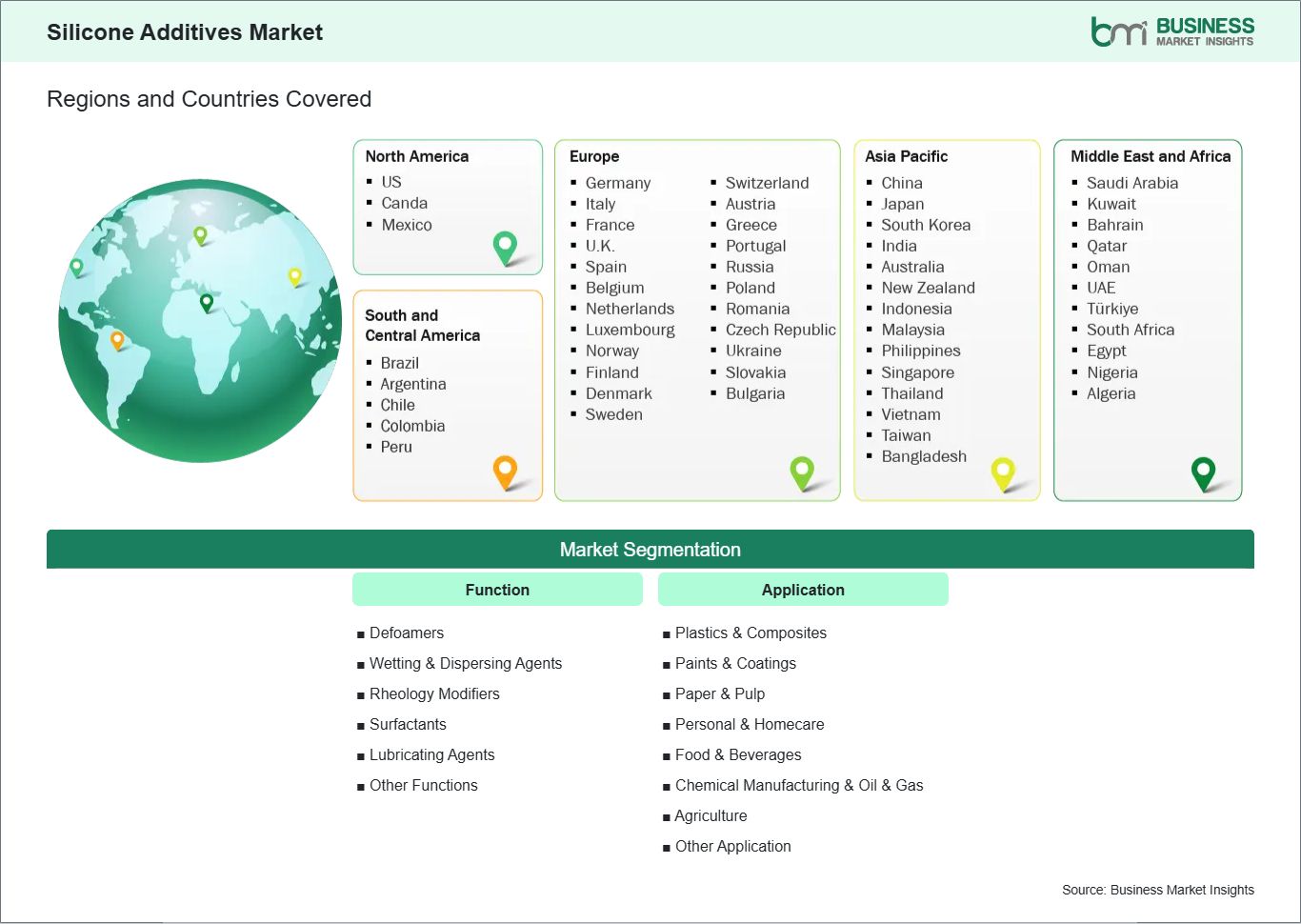
Key segments that contributed to the derivation of the silicone additives market analysis are function and application.
The Western Europe silicone additives market is being driven by the increasing trend of using silicones in personal care products. Countries like France, Germany, and Italy are at the forefront in developing personal care products in terms of cosmetics and skin care, and consumers are demanding smooth textures, longer-lasting effects, and sensory experiences in these products. Silicones like dimethicone, cyclopentasiloxane, and amodimethicone are being used in hair care, skin care, and color cosmetics as they offer excellent emollience, spreadability, and water resistance, thus becoming a necessity in these products.
European manufacturers are leveraging silicone additives to create premium products that align with consumer demand for quality and efficacy. In hair care, silicones help improve manageability, shine, and protection against thermal and environmental stress. In skincare, they form a breathable barrier that locks in moisture while enhancing the feel of creams and lotions. This growing focus on product functionality and sensory appeal drives demand for specialized silicone chemistries that meet strict European regulatory standards for safety, biodegradability, and hypoallergenic performance.
Innovation in product formats further fuels market adoption. From lightweight serums and leave-in hair treatments to long-lasting foundations and sunscreens, silicones are critical in achieving the desired performance characteristics. European R&D centers are actively developing advanced silicone derivatives that improve texture, stability, and compatibility with natural and bio-based ingredients, reinforcing the role of silicone additives as a key enabler of premium personal care formulations across the region.
The growth of personal care and cosmetics in Western Europe will continue to support demand for silicone additives. France, with its luxury cosmetics, and Italy, with its luxury cosmetics, along with Germany, with its leading skincare and hair care brands, are adding new products to their portfolios to meet both domestic and international demand. Silicones are critical in achieving consistency, look, and durability, which are ever-important in a competitive European and worldwide marketplace.
Consumer demand for multiple functional and high-performance products is driving the development of new formulations for shampoos and conditioners, moisturizers, and cosmetics. The use of silicone additive materials provides key product benefits such as smooth application, non-greasy feel, water resistance, and long-lasting color. These are important product attributes for discerning European consumers. The product benefits also contribute to the overall international competitiveness of European personal care and cosmetics products for export to Asia, the Americas, and the Middle East, where the demand for high-quality personal care and cosmetics products continues to grow.
Sustainability and clean beauty are also driving the use of silicone additive materials. Manufacturers are working on new and innovative formulations that use silicones and biodegradable materials. The use of these materials is environmentally friendly and also ensures that the product is safe for use by consumers. The combination of new product development for high-performance products, export markets, and sustainability and clean beauty is driving the demand for silicone additive materials in Western Europe for use in the global personal care and cosmetics industries.

The silicone additives market is experiencing steady growth, with market size and share analysis reflecting evolving treatment preferences and competitive dynamics among key players. The report evaluates important subsegments categorized within function and application, highlighting their respective contributions to overall market performance.
By function, the wetting and dispersing agents subsegment dominated the Silicone additives market in 2025 because they enhance uniform distribution of fillers and pigments in formulations such as paints, coatings, plastics, and composites. Their ability to improve flow, reduce defects, and ensure consistent performance across diverse substrates makes them widely adopted across multiple industries.
Based on application, the paints & coatings subsegment dominated the silicone additives market in 2025 because silicone additives significantly improve scratch resistance, leveling, weatherability, and anti‑foaming properties in architectural, automotive, and industrial coatings. With ongoing infrastructure development and stricter performance expectations for coatings, this segment absorbs the greatest volume of silicone additives relative to other end uses.
| Report Attribute | Details |
|---|---|
| Market size in 2025 | US$ 2.1 Billion |
| Market Size by 2033 | US$ 4.25 Billion |
| Global CAGR (2026 - 2033) | 9.21% |
| Historical Data | 2022-2024 |
| Forecast period | 2026-2033 |
| Segments Covered | By Function
|
|
Regions and Countries Covered
| |
| North America | US, Canada, Mexico |
| Europe | Belgium, Austria, Finland, Denmark, Greece, Poland, Romania, Russia, Ukraine, Czech Republic, Slovakia, Bulgaria, Italy, Luxembourg, Germany, Switzerland, France, Netherlands, Norway, Portugal, Spain, Sweden, United Kingdom |
| Asia-Pacific | Australia, China, India, Japan, South Korea, Indonesia, Malaysia, Philippines, Singapore, Thailand, Vietnam, Bangladesh, New Zealand, Taiwan |
| South and Central America | Brazil, Argentina, Peru, Chile, Colombia |
| Middle East and Africa | Bahrain, Kuwait, Oman, Qatar, Saudi Arabia, United Arab Emirates, Turkiye, South Africa, Egypt, Algeria, Nigeria |
| Market leaders and key company profiles |
|
The "Silicone Additives Market Size and Forecast (2022 - 2033)" report provides a detailed analysis of the market covering below areas:
The geographical scope of the Silicone additives market report is divided into five regions: North America, Asia Pacific, Europe, Middle East & Africa, and South & Central America. The Silicone additives market in North America is expected to grow during the forecast period.
North America dominates the silicone additives market, driven by a mature specialty chemicals industry, strong R&D infrastructure, and high demand from end-use industries such as automotive, electronics, construction, and personal care. The region benefits from a robust presence of leading silicone additive manufacturers, which enables innovation in functional additives tailored to meet the performance and regulatory requirements of high-value applications. North American industries are increasingly focused on sustainability, promoting the development of low-VOC, eco-friendly silicone additives that enhance product durability while minimizing environmental impact.
The automotive and aerospace sectors in particular drive demand for silicone-based coatings, sealants, and lubricants capable of enduring extreme thermal and mechanical stress. In personal care and cosmetics, silicone additives are highly valued for improving product aesthetics, stability, and skin compatibility. Despite North America’s dominance, challenges such as high raw material costs, stringent environmental regulations, and the technical complexity of integrating silicone additives into formulations persist. These factors encourage manufacturers to focus on advanced product development, strategic partnerships, and customized solutions to maintain market leadership and support diverse regional industrial requirements.
The silicone additives market is evaluated by gathering qualitative and quantitative data post primary and secondary research, which includes important corporate publications, association data, and databases. A few of the key developments in the silicone additives market are:
The Silicone Additives Market is valued at US$ 2.1 Billion in 2025, it is projected to reach US$ 4.25 Billion by 2033.
As per our report Silicone Additives Market, the market size is valued at US$ 2.1 Billion in 2025, projecting it to reach US$ 4.25 Billion by 2033. This translates to a CAGR of approximately 9.21% during the forecast period.
The Silicone Additives Market report typically cover these key segments-
The historic period, base year, and forecast period can vary slightly depending on the specific market research report. However, for the Silicone Additives Market report:
The Silicone Additives Market is populated by several key players, each contributing to its growth and innovation. Some of the major players include:
The Silicone Additives Market report is valuable for diverse stakeholders, including:
Essentially, anyone involved in or considering involvement in the Silicone Additives Market value chain can benefit from the information contained in a comprehensive market report.
Please tell us your area of interest
(Market Segments/ Regions and Countries/ Companies)