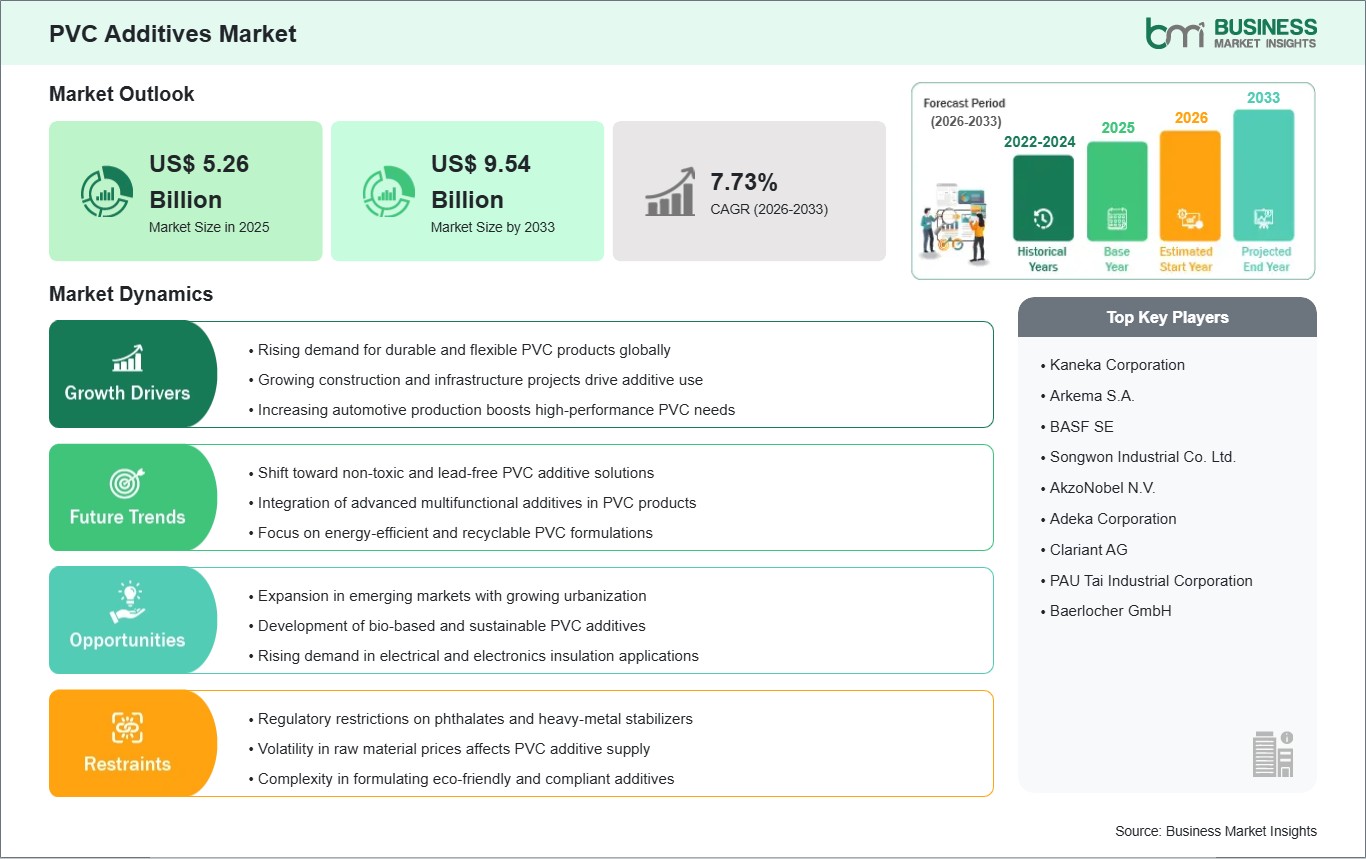
The PVC Additives Market size is expected to reach US$ 9.54 billion by 2033 from US$ 5.26 billion in 2025. The market is estimated to record a CAGR of 7.73% from 2026 to 2033.
The global PVC additives market is experiencing robust growth driven by the ongoing evolution of the PVC (polyvinyl chloride) value chain and the expanding application landscape of PVC‑based products. PVC additives, which include stabilizers, plasticizers, impact modifiers, lubricants and flame retardants, enhance performance attributes that include flexibility and durability, heat resistance, weatherability and processability. The additives enable PVC to achieve the strict performance standards required for construction, automotive, electrical, electronics, packaging and consumer goods applications. The demand for special additive solutions keeps growing as industries require better performance results and need to follow safety regulations.
The global market reaches its highest point because the construction and infrastructure sectors experience rapid development throughout the world. The cost‑effective, corrosion-resistant and long-lasting properties of PVC materials make them suitable for use in pipes and window profiles, flooring and roofing membranes and cable jacketing. The use of heat stabilizers and impact modifiers as additives becomes necessary because they help PVC products keep their structural strength when exposed to high temperatures and extended UV radiation.
The automotive industry requires manufacturers to create lightweight vehicles and energy-efficient automobiles, which drives the demand for flexible PVC parts that contain advanced plasticizers and processing additives because these materials let manufacturers achieve their performance goals while maintaining safe product life spans. The electrical and electronics industry uses PVC because its insulation capabilities become stronger when specific additives are applied to enhance its fire resistance and heat protection qualities.
The increasing demand for secure and dependable wiring systems, cable insulation materials and electronic device packaging solutions establishes a market requirement that particularly affects emerging economies, which are developing their electricity networks and intelligent system infrastructure. The development of biodegradable and low‑toxicity additive solutions has become more popular because environmental sustainability has become a vital concern that affects the way companies create products throughout different areas of the world. The market encounters essential limitations, although it possesses strong market drivers. The industry has moved toward new eco-friendly materials because regulations about specific additives, which include traditional phthalate plasticizers and heavy-metal-based stabilizers, have forced manufacturers to stop using old chemical formulas for product development.
The manufacturing process is now more difficult because these new eco-friendly materials require companies to develop new production methods, which also increase their operational expenses. The global supply chain of raw materials operates under conditions that connect petrochemical feedstock markets with supply chain possibilities, which creates pricing difficulties that impact PVC compounders who operate in the downstream market. The worldwide PVC additives industry continues to grow because various industrial sectors require more products while companies create new additive products that meet upcoming performance and environmental standards in their respective markets.

Key segments that contributed to the derivation of the PVC additives market analysis are type, fabrication process, and application.
The global PVC additives market is strongly affected by the increasing need for long-lasting and adaptable PVC products, which multiple industries require. The construction industry serves as the main end-use sector, which depends on PVC pipes and window profiles and flooring materials that need stabilizers and impact modifiers to handle temperature changes, ultraviolet radiation and physical weight. The additives in these products enhance their durability and dependable performance, which enables them to fulfill both regulatory requirements and performance expectations needed for global residential and commercial construction.
Lightweight and flexible PVC materials have gained popularity for use in automotive and transportation applications, which require these materials to build interior components, dashboards and wiring insulation. The combination of plasticizers and heat stabilizers enables materials to achieve both flexible properties and heat resistance capabilities, which helps manufacturers develop vehicles with improved fuel efficiency, reduced weight and enhanced passenger safety. North America and Europe particularly emphasize performance standards, while the Asia Pacific is rapidly adopting such solutions due to industrial expansion.
The worldwide demand for high-performance PVC products receives a boost from electrical and electronics applications. The production of cable insulation and protective sheathing and electronic component housings requires flame retardants, lubricants and dielectric additives. The emerging markets in the Asia Pacific are experiencing increased electrification, which creates a demand for flexible and durable PVC products that contain specialized additives. The global market relies on durable and flexible PVC materials, which use additive technologies for construction, automotive and electrical applications.
Emerging markets are a key driver for global PVC additives growth, fueled by rapid urbanization and industrialization. Countries such as India, China, Brazil, and Mexico are experiencing large-scale construction projects, including residential complexes, commercial infrastructure, and transportation networks, all of which require high-quality PVC products enhanced with stabilizers, impact modifiers, and plasticizers. This expansion provides significant opportunities for additive manufacturers to serve growing construction demands.
Urbanization also boosts demand in the automotive and electrical sectors, as rising populations increase vehicle ownership and electrification efforts. Flexible PVC materials enhanced with advanced additives are essential for wiring, insulation, and interior components, allowing manufacturers to meet regulatory standards while addressing the performance expectations of end-users. Local production capacities in Asia Pacific are expanding to support these demands, while international suppliers are strengthening distribution networks to ensure timely availability of specialty additives.
Furthermore, sustainability and environmental awareness are influencing additive development in emerging markets. Bio-based and non-phthalate plasticizers, lead-free stabilizers, and energy-efficient formulations are gaining traction, enabling compliance with evolving regulations and consumer preferences. The growing urban population, coupled with industrial and infrastructural growth, positions emerging markets as a pivotal opportunity for the global PVC additives industry, driving innovation and adoption of high-performance, environmentally responsible additive solutions.

The PVC additives market demonstrates steady growth, with size and share analysis highlighting evolving trends and competitive dynamics among key players. The report examines subsegments categorized within type, fabrication process, and application, offering insights into their contribution to overall market performance.
By type, the stabilizers subsegment dominated the market in 2025, driven by its crucial role in enhancing PVC thermal stability and longevity across diverse applications.
Based on fabrication process, the extrusion subsegment dominated the market in 2025, driven by its cost‑efficient, high‑volume production capability and widespread use in PVC manufacturing.
In terms of application, the pipes & fittings subsegment dominated the market in 2025, driven by growing infrastructure demand and replacement of traditional materials with PVC in construction projects.
| Report Attribute | Details |
|---|---|
| Market size in 2025 | US$ 5.26 Billion |
| Market Size by 2033 | US$ 9.54 Billion |
| Global CAGR (2026 - 2033) | 7.73% |
| Historical Data | 2022-2024 |
| Forecast period | 2026-2033 |
| Segments Covered | By Type
|
|
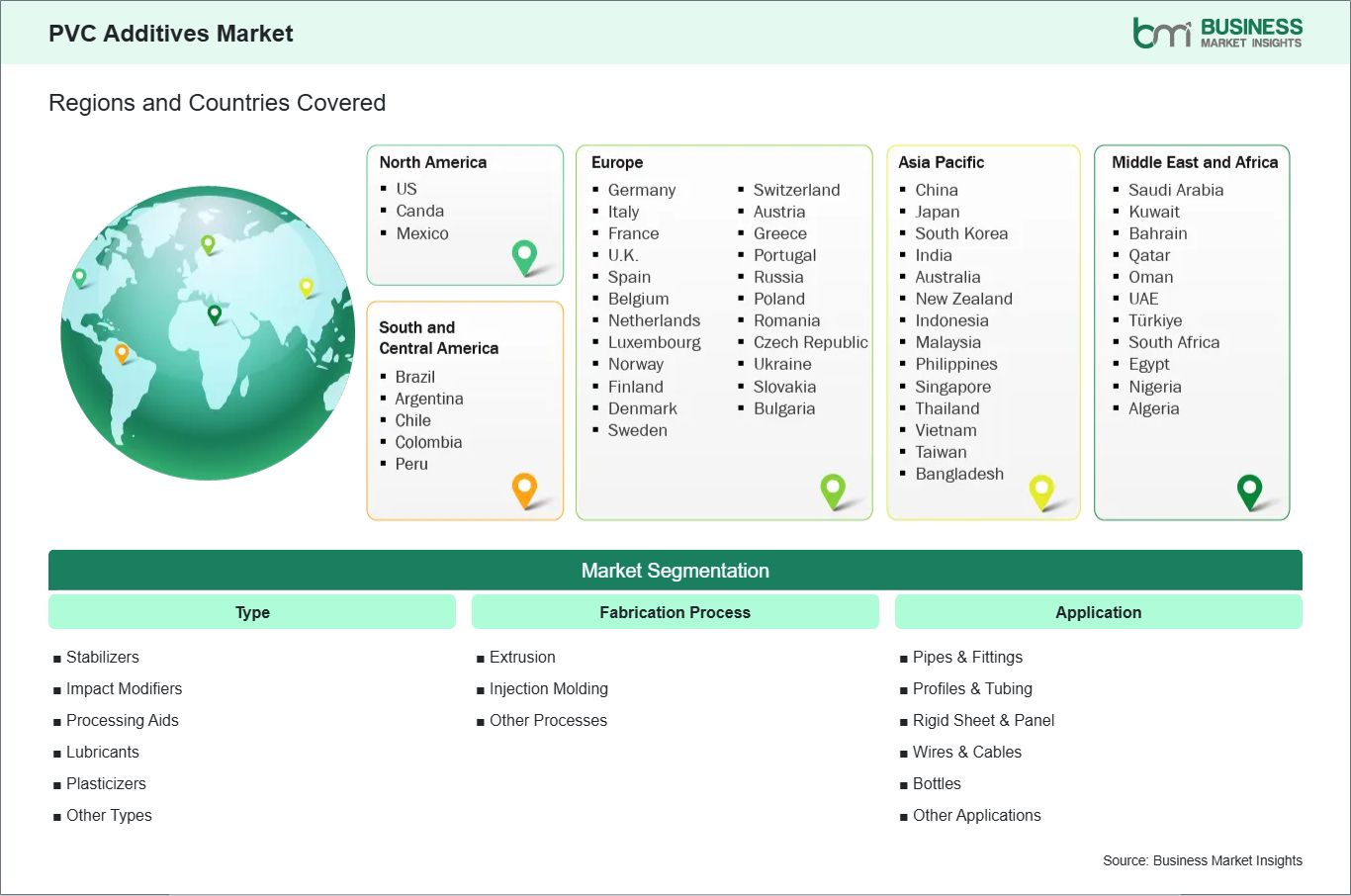
Regions and Countries Covered
| |
| North America | US, Canada, Mexico |
| Europe | Belgium, Austria, Finland, Denmark, Greece, Poland, Romania, Russia, Ukraine, Czech Republic, Slovakia, Bulgaria, Italy, Luxembourg, Germany, Switzerland, France, Netherlands, Norway, Portugal, Spain, Sweden, United Kingdom |
| Asia-Pacific | Australia, China, India, Japan, South Korea, Indonesia, Malaysia, Philippines, Singapore, Thailand, Vietnam, Bangladesh, New Zealand, Taiwan |
| South and Central America | Brazil, Argentina, Peru, Chile, Colombia |
| Middle East and Africa | Bahrain, Kuwait, Oman, Qatar, Saudi Arabia, United Arab Emirates, Turkiye, South Africa, Egypt, Algeria, Nigeria |
| Market leaders and key company profiles |
|
The "PVC Additives Market Size and Forecast (2022 - 2033)" report provides a detailed analysis of the market covering below areas:
The geographical scope of the PVC Additives Market report is divided into North America, Asia Pacific, Europe, Middle East & Africa, and South & Central America. North America held the largest share in 2025.
The advanced construction and automotive and electrical industries in North America, together with its developed manufacturing systems and high adoption rates of new additive technologies, make the region the largest player in the global PVC additives market.
The United States leads regional demand because building codes require strict compliance, and infrastructure projects need piping, window profiles and cable insulation made from PVC durable construction materials. Canada supplies specialized industrial applications that include automotive interiors and industrial equipment to meet high-performance standards through the deployment of heat stabilizers, plasticizers and flame retardants.
The market in the Asia Pacific experiences fast growth because industrialization, urbanization and construction activities increase in China, India, Japan and South Korea. The rising production of PVC-based electrical wiring, flexible tubing and consumer goods drives companies to create advanced additive formulations while environmental awareness grows.
The PVC additives market in Europe demonstrates strength through Germany, France and Italy, which lead the automotive, construction and packaging industries. The European Union promotes sustainability through its environmental regulations, which have led to increased use of lead-free stabilizers and bio-based plasticizers, and advanced processing additives that enable innovative formulation development in the region.
The Middle East and Africa region experiences moderate economic growth, which results from infrastructure development, industrial facilities and cable production activities that use additives that maintain thermal stability and prevent corrosion under extreme weather conditions. The South and Central American region experiences constant market expansion, which is led by Brazil and Mexico, who drive demand for construction, automotive and electrical industries, although economic changes and local supply chain problems limit market growth.
The North American region leads in technological advancements, which support high-end applications, while the Asia Pacific shows the fastest market growth through industrial development and city population growth. Europe focuses on developing sustainable and high-performing products, whereas the Middle East and Africa and South and Central American regions function as specialized markets that need specific solutions that demonstrate how different countries implement PVC additive technologies according to their local rules and market conditions.

The PVC Additives Market is evaluated by gathering qualitative and quantitative data post primary and secondary research, which includes important corporate publications, association data, and databases. A few of the key developments in the PVC additives market are:
The PVC Additives Market is valued at US$ 5.26 Billion in 2025, it is projected to reach US$ 9.54 Billion by 2033.
As per our report PVC Additives Market, the market size is valued at US$ 5.26 Billion in 2025, projecting it to reach US$ 9.54 Billion by 2033. This translates to a CAGR of approximately 7.73% during the forecast period.
The PVC Additives Market report typically cover these key segments-
The historic period, base year, and forecast period can vary slightly depending on the specific market research report. However, for the PVC Additives Market report:
The PVC Additives Market is populated by several key players, each contributing to its growth and innovation. Some of the major players include:
The PVC Additives Market report is valuable for diverse stakeholders, including:
Essentially, anyone involved in or considering involvement in the PVC Additives Market value chain can benefit from the information contained in a comprehensive market report.
Please tell us your area of interest
(Market Segments/ Regions and Countries/ Companies)