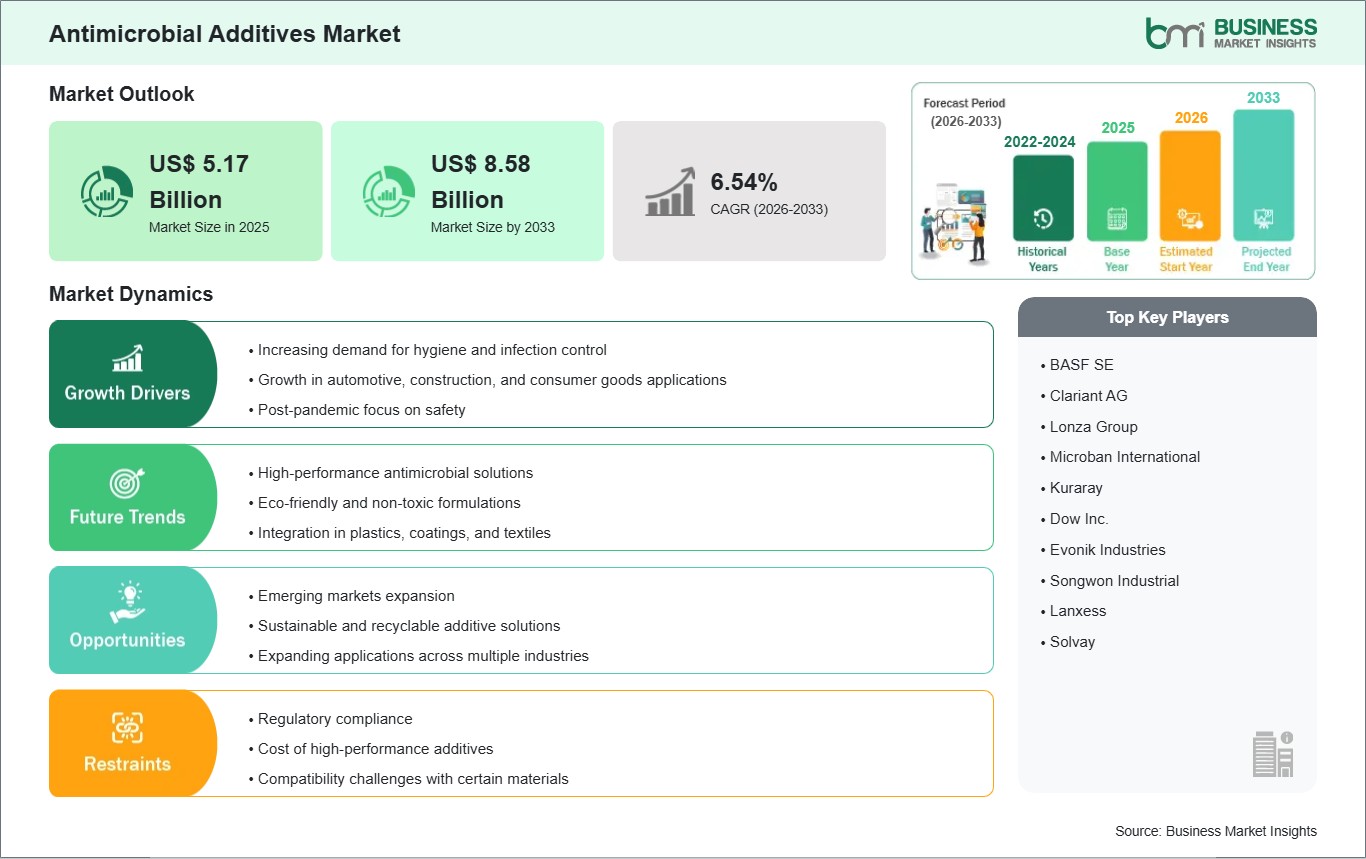
The Antimicrobial Additives Market size is expected to reach US$ 8.58 Billion by 2033 from US$ 5.17 Billion in 2025. The market is estimated to record a CAGR of 6.54% from 2026 to 2033.
The global antimicrobial additives market is experiencing strong growth, driven by increasing awareness of hygiene, infection control, and product safety across various industries. Antimicrobial additives are incorporated into materials such as plastics, coatings, and textiles to inhibit the growth of microorganisms, including bacteria, fungi, and mold.
The demand for these additives has significantly increased in the post-pandemic era, with industries prioritizing antimicrobial protection in both consumer and industrial products. Applications range from healthcare equipment and food packaging to construction materials and automotive interiors.
Technological advancements have led to the development of high-performance antimicrobial agents, including silver-based inorganic additives and organic compounds, offering long-lasting protection and compatibility with various substrates. Manufacturers are also focusing on regulatory compliance and safety standards, ensuring that additives meet global health and environmental guidelines.

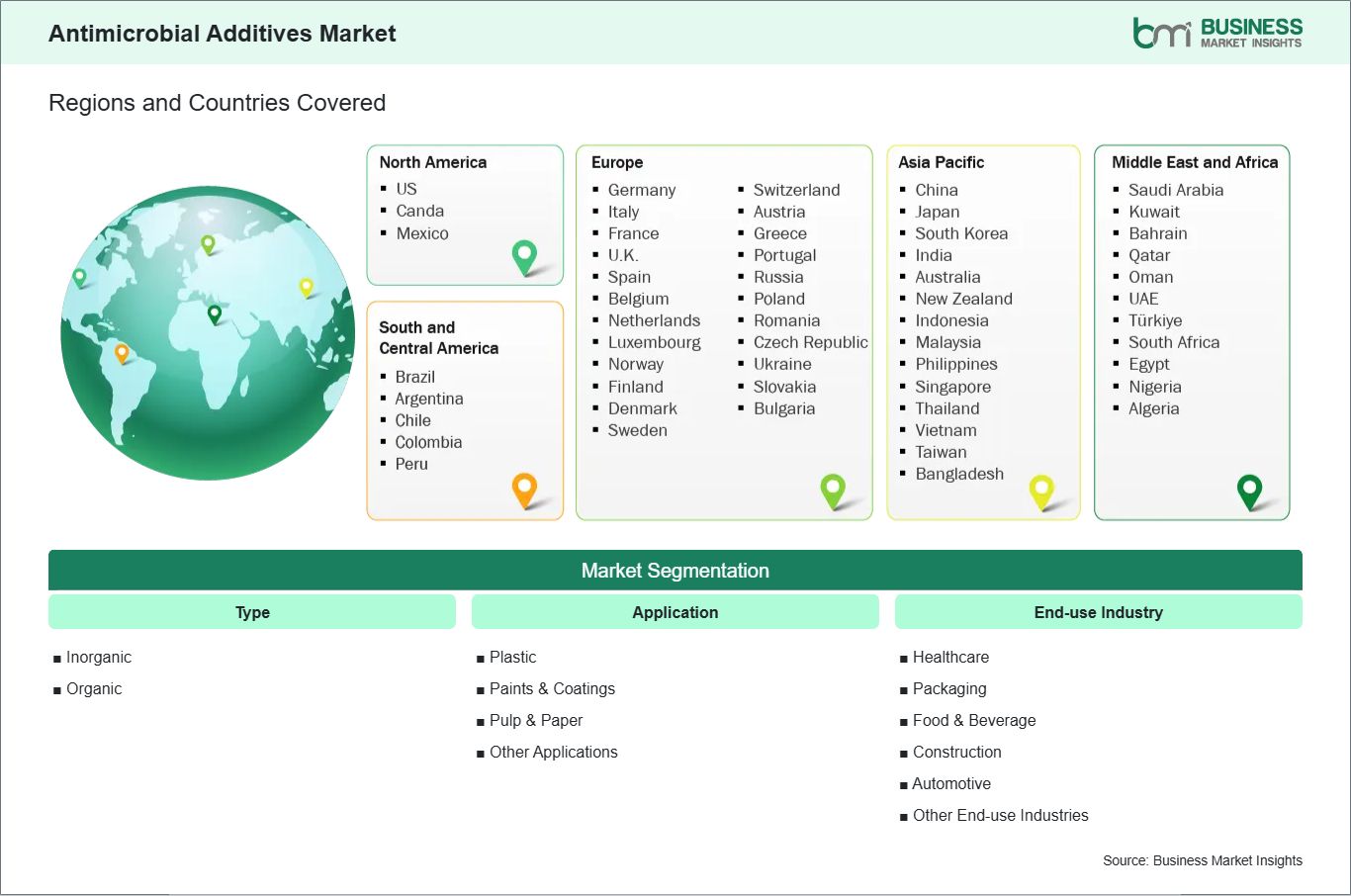
Key segments that contributed to the derivation of the antimicrobial additives market analysis are type, application, and end-use industry.
The antimicrobial additives market has seen rapid growth due to the increasing focus on maintaining proper hygiene and preventing pathogens from spreading. There is an increased demand from all types of facilities such as healthcare, food processing, and public infrastructure, for maintaining cleanliness and safety. Antimicrobial additives are being incorporated into a multitude of different products to reduce the risk of contamination and infection, thereby ensuring a safer environment for both workers and consumers. Hospitals and clinics are incorporating antimicrobial coatings into medical devices and surgical instruments, as well as high touch surfaces such as bed rails and door handles, to decrease pathogen transmission and improve patient outcomes. In the food processing industry, antimicrobial packaging materials are being used to increase the shelf life of products and to prevent spoilage, both of which make the end product safer for the consumer to eat. Public infrastructure is also integrating antimicrobial solutions into high‑traffic areas such as transportation terminals, schools, and office buildings to prevent the growth of microbes.
The increased awareness of global health issues, such as the COVID‑19 pandemic, has fueled the trend towards infection control within all industries at an accelerated rate. Consumer products such as textiles, personal care products, and household goods continue to integrate antimicrobial additives into their products in response to increased demand for hygiene focused solutions from consumers. This shows a chance in consumer.
The versatility of antimicrobial additives is driving their adoption across a wide range of industries, far beyond healthcare and food safety. In plastics, these additives are used in packaging films, consumer goods, and electronic devices to prevent microbial growth and maintain product integrity. For example, antimicrobial packaging ensures food remains fresh for longer, while consumer electronics benefit from coatings that reduce bacterial contamination on frequently touched surfaces.
In paints and coatings, antimicrobial additives enhance durability and surface protection, particularly in high‑moisture environments such as bathrooms, kitchens, and swimming pools. The construction industry is increasingly applying antimicrobial coatings to walls, flooring, and HVAC systems to improve indoor air quality and reduce the spread of mold and bacteria. This not only enhances building safety but also supports healthier living and working environments.
The automotive sector is another emerging application area, with manufacturers integrating antimicrobial materials into vehicle interiors. Steering wheels, seat fabrics, and air conditioning systems are being treated with additives to improve passenger safety and comfort. This reflects a growing consumer preference for vehicles that prioritize hygiene alongside performance.
Ongoing innovations in additive formulations are further expanding the market. Eco‑friendly and non‑toxic solutions are being developed to align with sustainability goals, ensuring compatibility with recyclable and biodegradable materials. These advancements open new opportunities in industries committed to reducing environmental impact while maintaining high performance standards. As antimicrobial additives continue to evolve, their role in enhancing safety, durability, and sustainability across multiple sectors is expected to grow significantly.

The Antimicrobial Additives demonstrates steady growth, with size and share analysis highlighting evolving trends and competitive dynamics among key players. The report examines subsegments categorized within type, application, and end-use industry, offering insights into their contribution to overall market performance.
By type, the inorganic subsegment dominated the market in 2025, driven by its superior durability and effectiveness.
Based on application, the plastic subsegment dominated the market in 2025, driven by widespread use in packaging and consumer products.
In terms of end-use industry, the healthcare subsegment dominated the market in 2025, driven by increasing demand for infection control solutions.
| Report Attribute | Details |
|---|---|
| Market size in 2025 | US$ 5.17 Billion |
| Market Size by 2033 | US$ 8.58 Billion |
| Global CAGR (2026 - 2033) | 6.54% |
| Historical Data | 2022-2024 |
| Forecast period | 2026-2033 |
| Segments Covered | By Type
|
|
Regions and Countries Covered
| |
| North America | US, Canada, Mexico |
| Europe | Belgium, Austria, Finland, Denmark, Greece, Poland, Romania, Russia, Ukraine, Czech Republic, Slovakia, Bulgaria, Italy, Luxembourg, Germany, Switzerland, France, Netherlands, Norway, Portugal, Spain, Sweden, United Kingdom |
| Asia-Pacific | Australia, China, India, Japan, South Korea, Indonesia, Malaysia, Philippines, Singapore, Thailand, Vietnam, Bangladesh, New Zealand, Taiwan |
| South and Central America | Brazil, Argentina, Peru, Chile, Colombia |
| Middle East and Africa | Bahrain, Kuwait, Oman, Qatar, Saudi Arabia, United Arab Emirates, Turkiye, South Africa, Egypt, Algeria, Nigeria |
| Market leaders and key company profiles |
|
The "Antimicrobial Additives Size and Forecast (2022 - 2033)" report provides a detailed analysis of the market covering below areas:
The geographical scope of the Antimicrobial Additives report is divided into North America, Asia Pacific, Europe, Middle East & Africa, and South & Central America. North America held the largest share in 2025.
North America dominates the market due to advanced healthcare infrastructure, stringent hygiene standards, and high adoption of antimicrobial technologies across industries. The region also benefits from strong regulatory frameworks and continuous innovation in material science.
Asia Pacific is witnessing rapid growth due to increasing industrialization, rising healthcare investments, and growing awareness of hygiene and safety. Countries such as China and India are key contributors to market expansion.
Europe emphasizes sustainability and regulatory compliance, driving the adoption of eco-friendly antimicrobial solutions. The Middle East & Africa and South & Central America are experiencing gradual growth, supported by improving healthcare infrastructure and industrial development.

The Antimicrobial Additives is evaluated by gathering qualitative and quantitative data post primary and secondary research, which includes important corporate publications, association data, and databases. A few of the key developments in the antimicrobial additives are:
The Antimicrobial Additives Market is valued at US$ 5.17 Billion in 2025, it is projected to reach US$ 8.58 Billion by 2033.
As per our report Antimicrobial Additives Market, the market size is valued at US$ 5.17 Billion in 2025, projecting it to reach US$ 8.58 Billion by 2033. This translates to a CAGR of approximately 6.54% during the forecast period.
The Antimicrobial Additives Market report typically cover these key segments-
The historic period, base year, and forecast period can vary slightly depending on the specific market research report. However, for the Antimicrobial Additives Market report:
The Antimicrobial Additives Market is populated by several key players, each contributing to its growth and innovation. Some of the major players include:
The Antimicrobial Additives Market report is valuable for diverse stakeholders, including:
Essentially, anyone involved in or considering involvement in the Antimicrobial Additives Market value chain can benefit from the information contained in a comprehensive market report.
Please tell us your area of interest
(Market Segments/ Regions and Countries/ Companies)