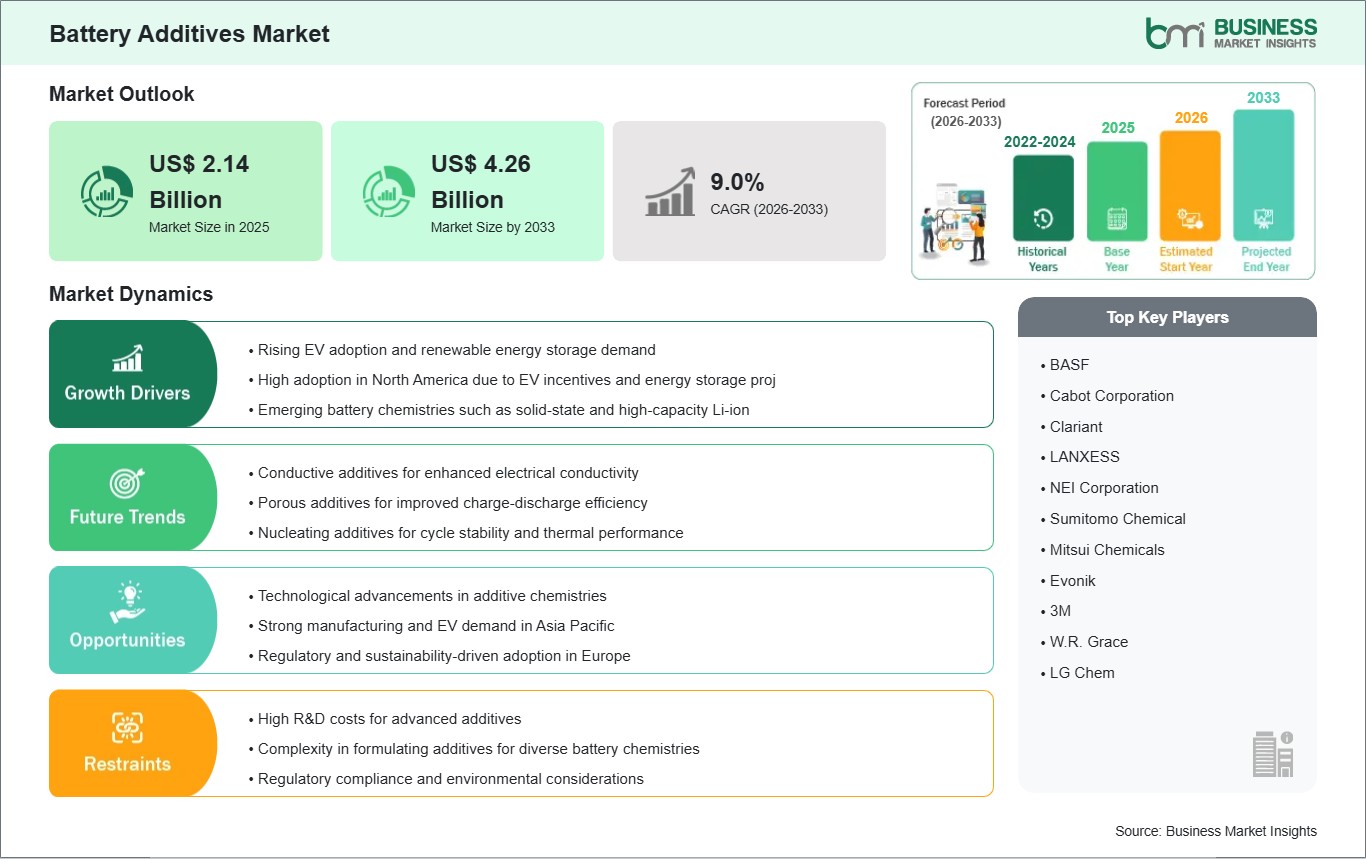
The Battery Additives Market size is expected to reach US$ 4.26 Billion by 2033 from US$ 2.14 Billion in 2025 .The market is estimated to record a CAGR of 9.0% from 2026 to 2033.
The global battery additives market is growing in response to rising demand for high-performance batteries in automotive, consumer electronics, and industrial sectors. Battery additives are specialized compounds incorporated into electrode materials, electrolytes, or separators to improve efficiency, energy density, and lifecycle performance. These additives help reduce internal resistance, enhance charge-discharge cycles, and improve thermal and chemical stability of batteries.
The surge in electric vehicle (EV) adoption, renewable energy storage systems, and portable electronics is driving market growth. Lead acid and lithium-ion batteries remain the dominant battery chemistries, with Li-ion batteries seeing faster growth due to their high energy density and lightweight properties. Advanced battery formulations incorporating conductive, porous, and nucleating additives are enabling higher performance and safety standards.
Competitive dynamics focus on innovation in additive chemistries, cost optimization, and sustainability. Companies are investing in research to develop additives that improve battery longevity, reduce dendrite formation, and enhance electrolyte stability. Collaborations with battery manufacturers and OEMs are accelerating commercialization and adoption of specialized additives in both emerging and developed markets. Regulatory compliance and environmental sustainability are also shaping product development strategies.

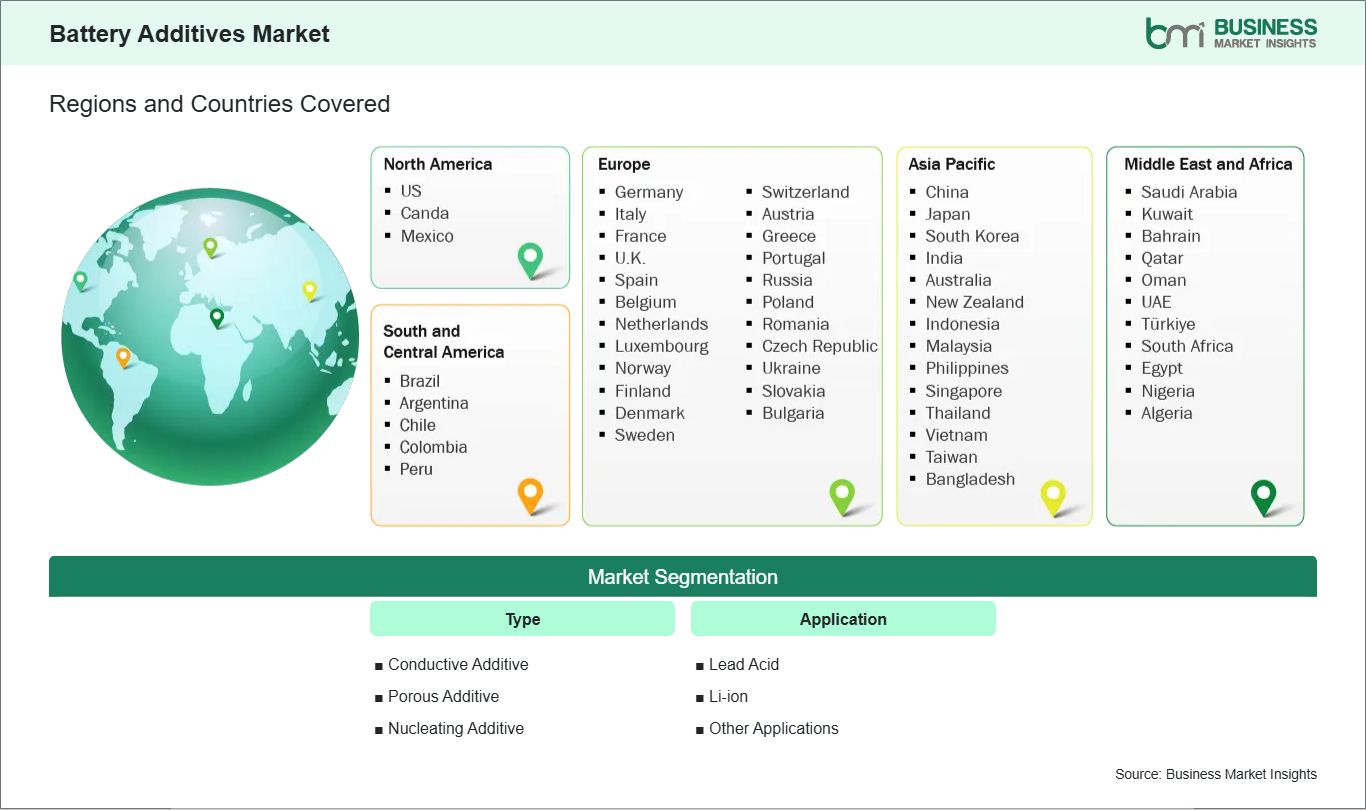
Key segments that contributed to the derivation of the battery additives market analysis are type and application.
The accelerating adoption of electric vehicles (EVs) and the rising demand for stationary energy storage systems are among the most significant drivers of the battery additives market. Governments worldwide are implementing stricter carbon emission reduction targets, while automakers are investing heavily in electrification strategies. This shift is creating unprecedented demand for high-performance batteries that can deliver longer driving ranges, faster charging capabilities, and enhanced safety. Battery additives play a crucial role in achieving these performance benchmarks. Conductive additives improve electrical conductivity and reduce internal resistance, enabling smoother energy flow and faster charging. Nucleating and porous additives optimize electrode structures, enhancing charge-discharge efficiency and cycle stability.
Beyond EVs, the growing penetration of renewable energy sources such as solar and wind is fueling demand for reliable energy storage solutions. Smart grids and distributed energy systems require batteries with high energy density and long lifespans to ensure consistent power supply. Additives that improve thermal stability and prevent degradation are vital for these applications. As energy storage becomes central to both mobility and power infrastructure, the role of battery additives in ensuring durability, safety, and efficiency is expanding rapidly. This convergence of EV adoption and renewable energy integration positions the battery additives market for sustained growth, as manufacturers and energy providers seek advanced solutions to meet evolving performance and sustainability requirements.
Innovation in additive chemistries is opening new frontiers in battery performance optimization. Traditional lithium-ion batteries are being enhanced with advanced additives that mitigate dendrite formation, improve electrolyte compatibility, and extend overall battery life. These improvements are critical for enabling next-generation applications such as ultra-fast charging and high-capacity energy storage. The development of solid-state batteries, hybrid chemistries, and high-capacity lithium-ion variants is further driving demand for specialized additives tailored to unique performance requirements.
Companies are also exploring environmentally friendly and bio-based additives to align with global sustainability goals. This shift reflects the industry’s commitment to reducing ecological impact while maintaining high performance standards. Emerging applications in aerospace, defense, and industrial sectors are creating additional opportunities, as these industries require energy storage systems with exceptional reliability and resilience. For instance, military-grade batteries demand additives that enhance safety under extreme conditions, while aerospace applications prioritize lightweight, high-capacity solutions.
Digitalization and advanced manufacturing techniques are also enabling precise formulation of additives, ensuring consistent quality and performance. As battery technologies evolve, the need for innovative additives will only intensify, creating a dynamic ecosystem of research, development, and commercialization. The combination of increasing battery adoption, technological innovation, and sustainability considerations positions the battery additives market for steady and diversified growth over the next decade, with opportunities spanning consumer electronics, EVs, renewable energy storage, and specialized industrial applications.

The Battery Additives Market demonstrates steady growth, with size and share analysis highlighting evolving trends and competitive dynamics among key players. The report examines subsegments categorized within type and application, offering insights into their contribution to overall market performance.
By type, the conductive additive subsegment dominated the market in 2025, driven by its ability to enhance electrode conductivity and battery efficiency.
In terms of application, the Li-ion subsegment dominated the market in 2025, driven by rapid EV adoption and high energy density requirements.
| Report Attribute | Details |
|---|---|
| Market size in 2025 | US$ 2.14 Billion |
| Market Size by 2033 | US$ 4.26 Billion |
| Global CAGR (2026 - 2033) | 9.0% |
| Historical Data | 2022-2024 |
| Forecast period | 2026-2033 |
| Segments Covered | By Type
|
|
Regions and Countries Covered
| |
| North America | US, Canada, Mexico |
| Europe | Belgium, Austria, Finland, Denmark, Greece, Poland, Romania, Russia, Ukraine, Czech Republic, Slovakia, Bulgaria, Italy, Luxembourg, Germany, Switzerland, France, Netherlands, Norway, Portugal, Spain, Sweden, United Kingdom |
| Asia-Pacific | Australia, China, India, Japan, South Korea, Indonesia, Malaysia, Philippines, Singapore, Thailand, Vietnam, Bangladesh, New Zealand, Taiwan |
| South and Central America | Brazil, Argentina, Peru, Chile, Colombia |
| Middle East and Africa | Bahrain, Kuwait, Oman, Qatar, Saudi Arabia, United Arab Emirates, Turkiye, South Africa, Egypt, Algeria, Nigeria |
| Market leaders and key company profiles |
|
The "Battery Additives Market Size and Forecast (2022 - 2033)" report provides a detailed analysis of the market covering below areas:
The geographical scope of the Battery Additives Market report is divided into North America, Asia Pacific, Europe, Middle East & Africa, and South & Central America. North America held the largest share in 2025.
In North America, the U.S. and Canada are experiencing rapid growth in EV adoption, supported by government incentives, infrastructure investments, and strong consumer demand for sustainable mobility. The region is also a leader in renewable energy storage projects, with large-scale solar and wind installations requiring advanced batteries. This dual push—mobility electrification and grid modernization—creates substantial demand for additives that improve energy density, cycle stability, and safety. North America’s focus on technological innovation and sustainability positions it as the largest and most influential market for battery additives. Asia Pacific remains a critical hub, led by China, Japan, and South Korea, where large-scale battery production and EV adoption continue to drive demand. The region benefits from established supply chains and manufacturing capacity, ensuring steady growth. Europe, meanwhile, is propelled by stringent emissions regulations and sustainability initiatives, with countries like Germany and France emphasizing advanced chemistries and eco-friendly additives.
Emerging markets in the Middle East & Africa and South & Central America are gradually adopting battery technologies to support grid modernization and industrial applications. While their shares are smaller, rising investments in renewable energy and electrification are expected to contribute to steady growth. Overall, North America’s leadership in EV adoption and energy storage integration, combined with Asia Pacific’s manufacturing strength, defines the global trajectory of the battery additives market, with North America holding the largest share.

The Battery Additives Market is evaluated by gathering qualitative and quantitative data post primary and secondary research, which includes important corporate publications, association data, and databases. A few of the key developments in the battery additives market are:
The Battery Additives Market is valued at US$ 2.14 Billion in 2025, it is projected to reach US$ 4.26 Billion by 2033.
As per our report Battery Additives Market, the market size is valued at US$ 2.14 Billion in 2025, projecting it to reach US$ 4.26 Billion by 2033. This translates to a CAGR of approximately 9.0% during the forecast period.
The Battery Additives Market report typically cover these key segments-
The historic period, base year, and forecast period can vary slightly depending on the specific market research report. However, for the Battery Additives Market report:
The Battery Additives Market is populated by several key players, each contributing to its growth and innovation. Some of the major players include:
The Battery Additives Market report is valuable for diverse stakeholders, including:
Essentially, anyone involved in or considering involvement in the Battery Additives Market value chain can benefit from the information contained in a comprehensive market report.
Please tell us your area of interest
(Market Segments/ Regions and Countries/ Companies)