Market Summary
Executive Summary and Global Market Analysis
The global rubber additives market serves as an essential component for the rubber and elastomer industry which includes chemical substances and their mixtures that improve the physical performance and longevity and manufacturing capabilities of both natural and synthetic rubber materials. Rubber additives include accelerators, antioxidants, vulcanization agents, fillers, plasticizers, and processing aids which together function as essential components that enhance the product's mechanical strength and ability to withstand high temperatures and aging and its overall performance.
The additives enable manufacturers to customize rubber compounds according to specific needs which include tires and industrial belts and hoses and footwear and seals through the process of enhancing properties like tensile strength and abrasion resistance and elasticity. The rubber additives market has become more important in multiple countries because end-use industries now require advanced rubber products which provide high performance. The automotive industry drives this market because manufacturers use rubber additives to create essential components which include tires and engine mounts and gaskets and vibration-dampening elements. The expansion of global vehicle production and replacement tire markets leads to growing requirements for advanced rubber materials which enhance vehicle safety and fuel efficiency and product durability. The construction and industrial sectors utilize rubber additives to improve the performance of conveyor belts, hoses, seals, and vibration control products which creates a boost in market demand.
Manufacturing centers throughout Europe and Asia Pacific have become common locations for producers to implement specialty additives which demonstrate their capabilities in applications that demand extreme performance from heavy machinery components and weather-resistant sealing systems. The rubber additives market encounters specific restrictions which create limits on its development. However, regulatory pressures concerning chemical safety and environmental impacts are also dictating trends in the development of additives, especially in developed countries. Some of the conventional additives, such as accelerators and plasticizers, were under scrutiny owing to health and ecological risks, and manufacturers were prompted to innovate green and eco-friendly alternatives.
Moreover, fluctuations in raw material costs and supplies, which are mostly of petrochemical origins, may also pose difficulties for manufacturers. Yet, the ongoing focus on material performance, green initiatives, and growth promises a bright outlook for the global rubber additives market.
Segment Analysis
Rubber Additives Market Segmentation
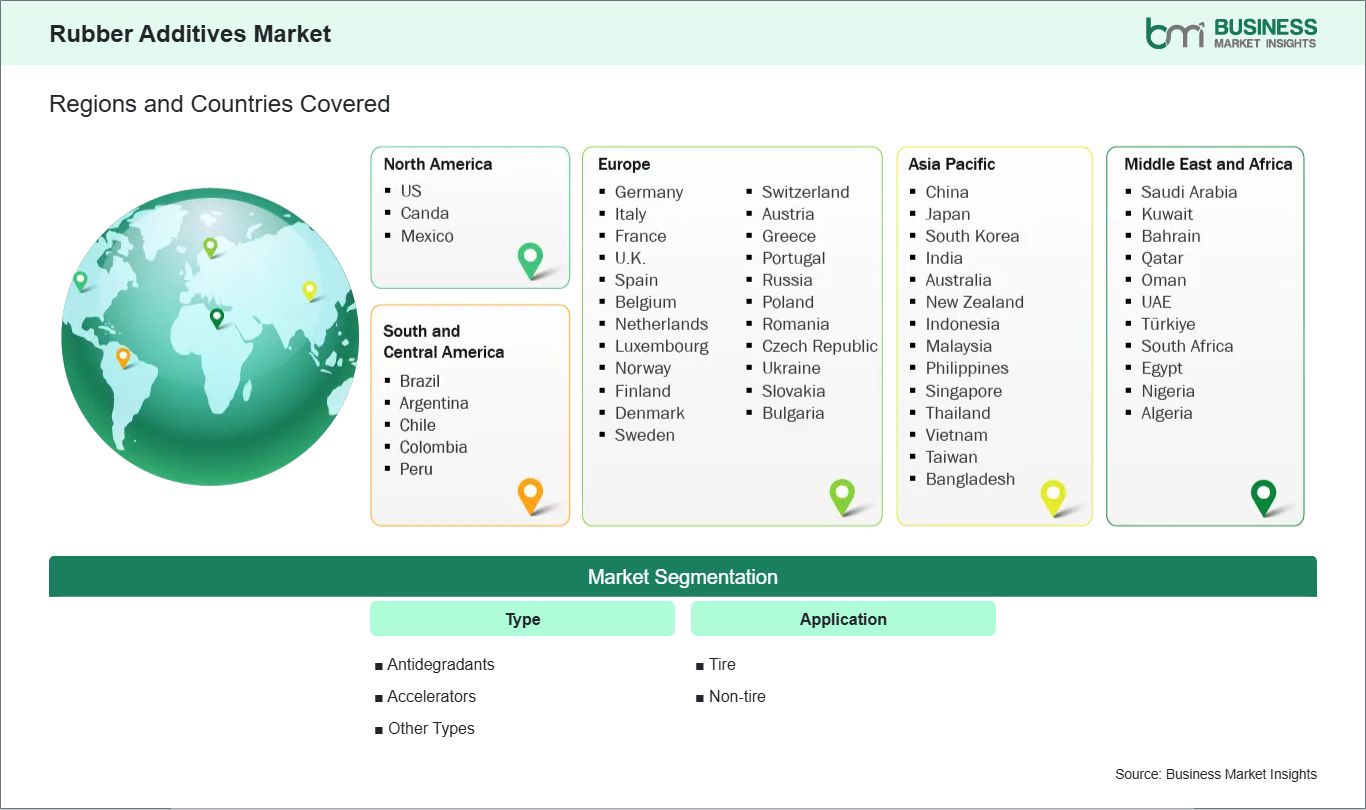
Key segments that contributed to the derivation of the rubber additives market analysis are type and application.
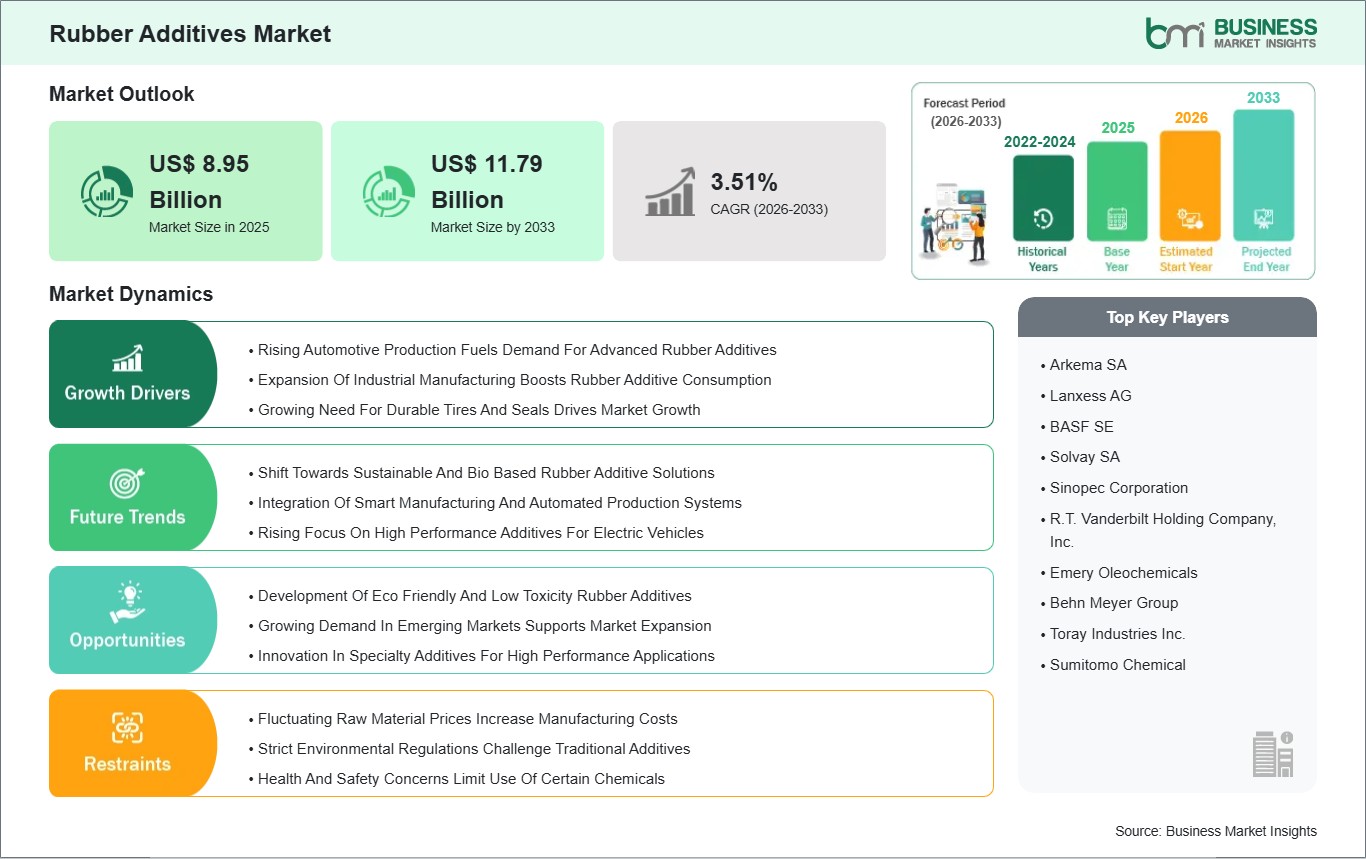
- By type, the rubber additives market is segmented into antidegradants, accelerators, others. The antidegradants segment dominated the market in 2025.
- Based on application, the rubber additives market is categorized into tire and non‑tire. The tire segment dominated the market in 2025.
Market Forces
Rubber Additives Market Drivers and Opportunities
Rising Automotive Production Fuels Demand For Advanced Rubber Additives
The global rubber additives market is strongly influenced by growth in automotive production, as vehicles require a wide range of rubber components — including tires, belts, hoses, seals, and gaskets — that rely on high‑performance additives to meet durability and safety requirements. In established automotive hubs like North America, Europe, and Japan, manufacturers adopt advanced antioxidants, accelerators, and processing aids that improve resistance to heat, wear, and environmental stress, ensuring parts remain functional over long service lives.
Emerging automotive markets in Asia Pacific and Latin America are also driving demand for specialized rubber additives. As production capacity expands and vehicle ownership rises, converters are increasingly specifying additives that enhance compound characteristics for greater fuel efficiency and ride comfort. Electric vehicles (EVs) add another dimension to this demand. EV components such as battery covers and vibration‑dampening mounts require rubber formulations with consistent performance under varied temperatures. This shift encourages additive suppliers to innovate compounds tailored to next‑generation automotive needs, reinforcing overall market consumption.
Development Of Eco Friendly And Low Toxicity Rubber Additives
The rubber additives market is currently moving toward environmentally sustainable and low harmful substance products because of sustainability trends and stricter environmental rules. The presence of hazardous chemicals in traditional additives creates environmental and health risks, which European and North American and Asian regulatory authorities demand safer product options. Producers now focus on developing water-dispersible and low VOC and bio-based substances that deliver the same performance benefits while they decrease their environmental footprint. Industrial manufacturers and automakers now choose additives which help decrease hazardous emissions that occur during both production and product usage.
The new antioxidant packages and curing agents now use safer chemical substances which maintain their thermal stability and mechanical strength, thus meeting environmental standards for rubber components used in green building and manufacturing applications. Emerging economies are gradually adopting these eco‑centric additives as global supply chains emphasize sustainability. The collaboration among additive producers, OEMs, and regulatory agencies enables technology transfer and educational initiatives about low-impact alternatives which help industries worldwide to adopt these solutions.
Size and Share Analysis
Rubber Additives Market Size and Share Analysis
The rubber additives market demonstrates steady growth, with size and share analysis highlighting evolving trends and competitive dynamics among key players. The report examines subsegments categorized within type and application, offering insights into their contribution to overall market performance.
By type, the antidegradants subsegment dominated the market in 2025, driven by their critical role in preventing aging and enhancing the durability of rubber products.
Based on application, the tire subsegment dominated the market in 2025, driven by the high demand for tires globally, which requires large volumes of rubber additives for performance and longevity.
Report Coverage
Rubber Additives Market Report Coverage and Deliverables
The "Rubber Additives Market Size and Forecast (2022 - 2033)" report provides a detailed analysis of the market covering below areas:
- Rubber Additives Market size and forecast at global, regional, and country levels for all the key market segments covered under the scope
- Rubber Additives Market trends, as well as drivers, restraints, and opportunities
- Rubber Additives Market analysis covering key trends, global and regional framework, major players, regulations, and recent developments
- Industry landscape and competition analysis covering market concentration, heat map analysis, prominent players, and recent developments for the Rubber Additives Market
- Detailed company profiles, including SWOT analysis
Geographic Insights
Rubber Additives Market Geographic Insights
The geographical scope of the Rubber Additives Market report is divided into North America, Asia Pacific, Europe, Middle East & Africa, and South & Central America. North America held the largest share in 2025.
The rubber additives market throughout the world today sees North America as its leading region because the continent possesses established automotive and aerospace and industrial manufacturing industries. Manufacturers in the region depend on sophisticated rubber additives which include accelerators and antioxidants and vulcanizing agents and processing aids to create their advanced tires and gaskets and hoses and seals and vibration-dampening parts. The strict regulatory requirements concerning safety and quality and environmental standards have driven businesses to embrace environmentally friendly and low-toxicity additives which are especially needed in automotive and industrial applications.
The European market operates at a mature stage which government regulations control while businesses must develop environmentally friendly products that meet emissions standards to abide by strict environmental regulations. The automotive industry along with construction and manufacturing sectors creates high demand in Germany and France and the UK for rubber compounds which possess durability and resistance to heat and chemicals.
The Asia Pacific region emerges as a rapidly expanding market because of its fast industrial growth and rising automotive production and increasing consumer goods consumption. High-performance additives receive adoption across China and India and Japan to enhance tire longevity and improve mechanical performance and boost environmental resistance. The construction and oil and gas and industrial sectors in Middle East and Africa experience gradual development because specialty rubber compounds function in hoses and seals and conveyor belts to maintain performance in severe temperature and demanding environmental situations.
The automotive manufacturing sector in South and Central America creates market prospects which will grow as infrastructure projects develop and the demand for quality-additive rubber components increases. Across all regions, the convergence of the growth of industry, automotive production, and the emphasis placed on sustainability has been defining the global market for rubber additives, with North America holding the dominant position based on its technological advancements, regulations, and industry landscape.
Industry Activity
Recent Developments
The Rubber Additives Market is evaluated by gathering qualitative and quantitative data post primary and secondary research, which includes important corporate publications, association data, and databases. A few of the key developments in the rubber additives market are:
- In March 2025, LANXESS announced that it showcased innovative and sustainable rubber additives at the Tire Technology Expo 2025, highlighting products such as Vulkanox HS Scopeblue (a sustainable antioxidant), Aflux SD (a superior processing agent), and eco‑friendlier release agents to support modern tire compound performance and reduce environmental impact.
- In December 2025, ZIBO CHEMIC NEW MATERIAL CO., LTD announced that it had entered into a long‑term cooperation agreement with a major enterprise in China`s rubber additive industry, integrating supply chain resources and technology to expand supply of core rubber additives (including accelerators, antioxidants, and insoluble sulfur) for global industries such as tire manufacturing and rubber products.
Trust & Transparency
Research Methodology
The market analysis combines proprietary research with secondary data from government agencies, company disclosures, regulatory filings, industry databases and expert interviews. Market estimates are validated through data triangulation, cross-market benchmarking and analyst
review.
View Full Research Methodology
Key Sources Referred:
World Health Organization (WHO) Organisation for Economic Cooperation and Development (OECD) The World Bank Group Worldometer The Lancet International Bar Association International Trade Administration