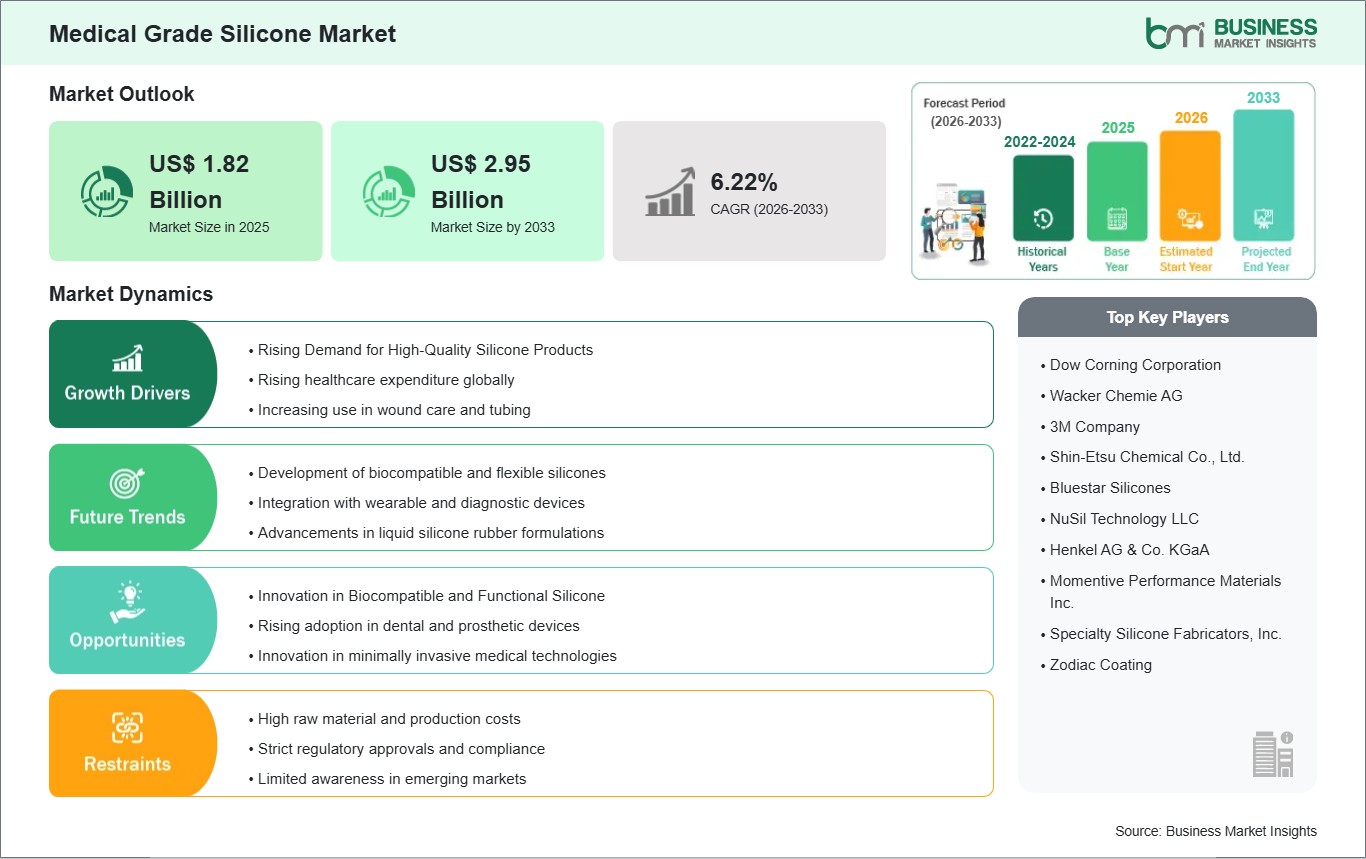
The Medical Grade Silicone Market size is expected to reach US$ 2.95 Billion by 2033 from US$ 1.82 Billion in 2025. The market is estimated to record a CAGR of 6.22% from 2026 to 2033.
Growth in the Worldwide Medical Grade Silicone Marketplace. The medical-grade silicones global marketplace continues to expand at an accelerated pace as the healthcare and medical device sectors require specific attributes from materials they use, including biocompatibility, flexibility, durability, and the ability to be sterilized. Medical-grade silicone is commonly found in many different types of medical devices, including implants, catheters, tubing, seals, wound care supplies, wearable medical devices, and drug delivery systems. This is due to the remarkable ability of silicone to be chemically inert, be thermally stable and maintain its performance properties regardless of how long they are exposed to bodily fluids. Driving factors include the increasing prevalence of chronic diseases, an aging population, and an increased use of minimally invasive surgical procedures, which necessitate the use of flexible and durable materials to enhance patient safety and comfort.
Innovations in the medical-grade silicone industry are primarily focused on high-purity silicones, liquid silicone rubbers, and custom silicone formulations that exhibit superior mechanical properties, have antimicrobial resistance, and have longer-lasting product lifecycles. Manufacturers are also investigating the use of bio-based silicones and environmentally sustainable manufacturing processes to conform to regulatory and ecological concerns. The global medical-grade silicone marketplace is also supported through advances in additive manufacturing technology, molding technologies, and surface finishing processes that are expanding upon the potential applications of silicone products. Manufacturers who offer customized solutions, regulatory compliance, and technical expertise for specialized medical applications will be well-positioned to take advantage of opportunities within this highly niche market.
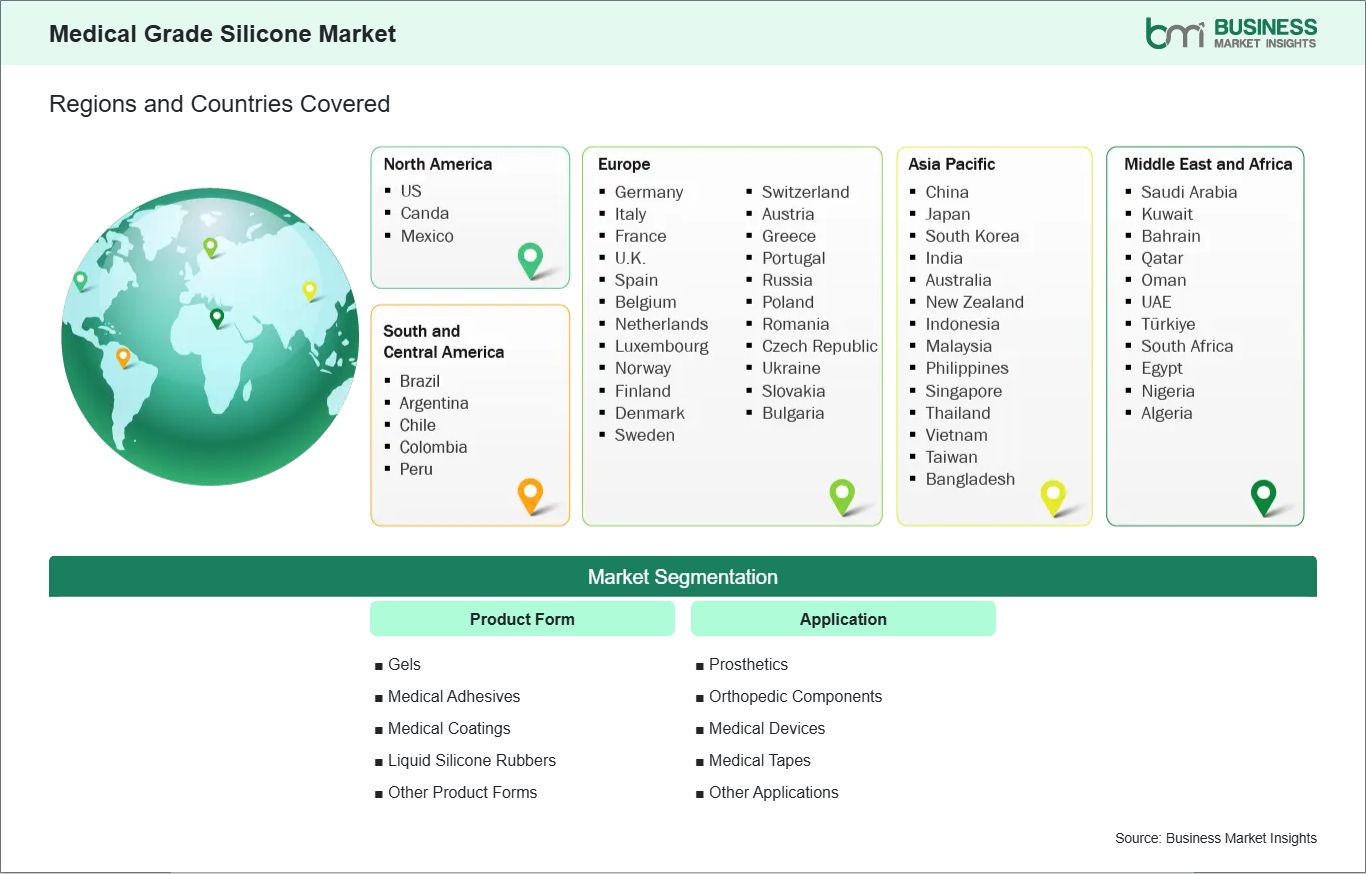
Key segments that contributed to the derivation of the medical grade silicone market analysis are product form and application.
As an increasing number of people have a demand for high quality silicone, biocompatible silicone will also be in demand more than before, and this is driving both the medical-grade silicone market as well as the entire global economics of healthcare. Silicone is used extensively in healthcare applications; it has several properties, such as its flexibility, chemical stability, and ability to withstand high temperatures, which make it a very practical choice for many applications such as catheters, tubing, various seals and prosthetics. Because silicone is inert, it is also safe, and it is non-reactive with the human body, so silicone is the ideal material to provide patient care while ensuring that healthcare providers can efficiently treat patients. Both hospitals and clinics can depend on the reliability and long-term durability of silicone when using it in their patient-facing products. When products are continually being used, such as in a medical device manufacturer`s operation, the ability to provide long-lasting performance of that product is essential to ensure that patients receive safe, effective, and efficient treatment.
As the volume of surgical procedures, minimally invasive procedures, and wearable medical devices continues to increase, the medical-grade silicone market will continue to be driven by these developments, which will eventually result in greater demand for medical-grade silicone. Through innovation and ongoing R&D efforts, manufacturers will also continue to supply more medical-grade silicone with the highest levels of purity, greater tensile strength, and compatibility with sterilization. Ultimately, silicone is a durable, flexible and biocompatible product; therefore, this makes the market for medical-grade silicone an area we expect to see steady global growth within hospitals and clinics as well as the manufacturing of medical devices.
Technological advancements are fueling innovation in medical grade silicone, focusing on biocompatibility, durability, and functional enhancements. Manufacturers are developing formulations that provide improved mechanical strength, elasticity, and sterilization tolerance while maintaining compatibility with sensitive human tissue. Research is also emphasizing multifunctional applications, such as antimicrobial silicone, implantable devices with enhanced performance, and coatings for medical instruments. These innovations expand the scope of medical silicone beyond traditional uses, enabling safer, longer-lasting, and more efficient healthcare solutions. Collaboration between silicone producers, medical device manufacturers, and healthcare providers is accelerating the development of customized solutions for specific clinical needs. By combining performance, reliability, and biocompatibility, these innovations are driving broader adoption and positioning the medical grade silicone market for sustained global growth across surgical, therapeutic, and diagnostic applications.

The medical grade silicone market demonstrates steady growth, with size and share analysis highlighting evolving trends and competitive dynamics among key players. The report examines subsegments categorized within product form and application, offering insights into their contribution to overall market performance.
By Product Form, the gels subsegment dominated the market in 2025, driven by its wide application in soft tissue implants, wound care gels, and skin‑friendly cushioning products that benefit from excellent biocompatibility and flexibility.
Based on Application, the prosthetics subsegment dominated the market in 2025, supported by increasing demand for custom prosthetic devices and implants that rely on silicone`s tissue‑like properties and comfort features.
| Report Attribute | Details |
|---|---|
| Market size in 2025 | US$ 1.82 Billion |
| Market Size by 2033 | US$ 2.95 Billion |
| Global CAGR (2026 - 2033) | 6.22% |
| Historical Data | 2022-2024 |
| Forecast period | 2026-2033 |
| Segments Covered | By Product Form
|
|
Regions and Countries Covered
| |
| North America | US, Canada, Mexico |
| Europe | Belgium, Austria, Finland, Denmark, Greece, Poland, Romania, Russia, Ukraine, Czech Republic, Slovakia, Bulgaria, Italy, Luxembourg, Germany, Switzerland, France, Netherlands, Norway, Portugal, Spain, Sweden, United Kingdom |
| Asia-Pacific | Australia, China, India, Japan, South Korea, Indonesia, Malaysia, Philippines, Singapore, Thailand, Vietnam, Bangladesh, New Zealand, Taiwan |
| South and Central America | Brazil, Argentina, Peru, Chile, Colombia |
| Middle East and Africa | Bahrain, Kuwait, Oman, Qatar, Saudi Arabia, United Arab Emirates, Turkiye, South Africa, Egypt, Algeria, Nigeria |
| Market leaders and key company profiles |
|
The "Medical Grade Silicone Market Size and Forecast (2022 - 2033)" report provides a detailed analysis of the market covering below areas:
The geographical scope of the Medical Grade Silicone Market report is divided into North America, Asia Pacific, Europe, Middle East & Africa, and South & Central America. North America held the largest share in 2025.
Regional adoption of medical grade silicone reflects healthcare infrastructure, technological capabilities, and regulatory standards. North America leads due to advanced healthcare systems, high surgical volumes, and widespread adoption in implants, catheters, and medical devices.
Europe demonstrates strong demand, driven by stringent regulatory compliance, focus on patient safety, and increasing use of silicone in complex medical applications.
Asia Pacific is the fastest-growing region, fueled by expanding healthcare facilities, rising surgical procedures, and growing medical device manufacturing.
Middle East & Africa is emerging, with adoption supported by hospital modernization and increasing demand for durable, biocompatible medical materials.
South & Central America is gradually increasing utilization due to expanding healthcare access and rising adoption of innovative medical devices.
Across all regions, market growth is influenced by material performance, biocompatibility, sterilization compatibility, regulatory compliance, and application-specific customization, positioning medical grade silicone as a critical material in modern healthcare delivery.
The Medical Grade Silicone Market is evaluated by gathering qualitative and quantitative data post primary and secondary research, which includes important corporate publications, association data, and databases. A few of the key developments in the medical grade silicone market are:
The Medical Grade Silicone Market is valued at US$ 1.82 Billion in 2025, it is projected to reach US$ 2.95 Billion by 2033.
As per our report Medical Grade Silicone Market, the market size is valued at US$ 1.82 Billion in 2025, projecting it to reach US$ 2.95 Billion by 2033. This translates to a CAGR of approximately 6.22% during the forecast period.
The Medical Grade Silicone Market report typically cover these key segments-
The historic period, base year, and forecast period can vary slightly depending on the specific market research report. However, for the Medical Grade Silicone Market report:
The Medical Grade Silicone Market is populated by several key players, each contributing to its growth and innovation. Some of the major players include:
The Medical Grade Silicone Market report is valuable for diverse stakeholders, including:
Essentially, anyone involved in or considering involvement in the Medical Grade Silicone Market value chain can benefit from the information contained in a comprehensive market report.
Please tell us your area of interest
(Market Segments/ Regions and Countries/ Companies)