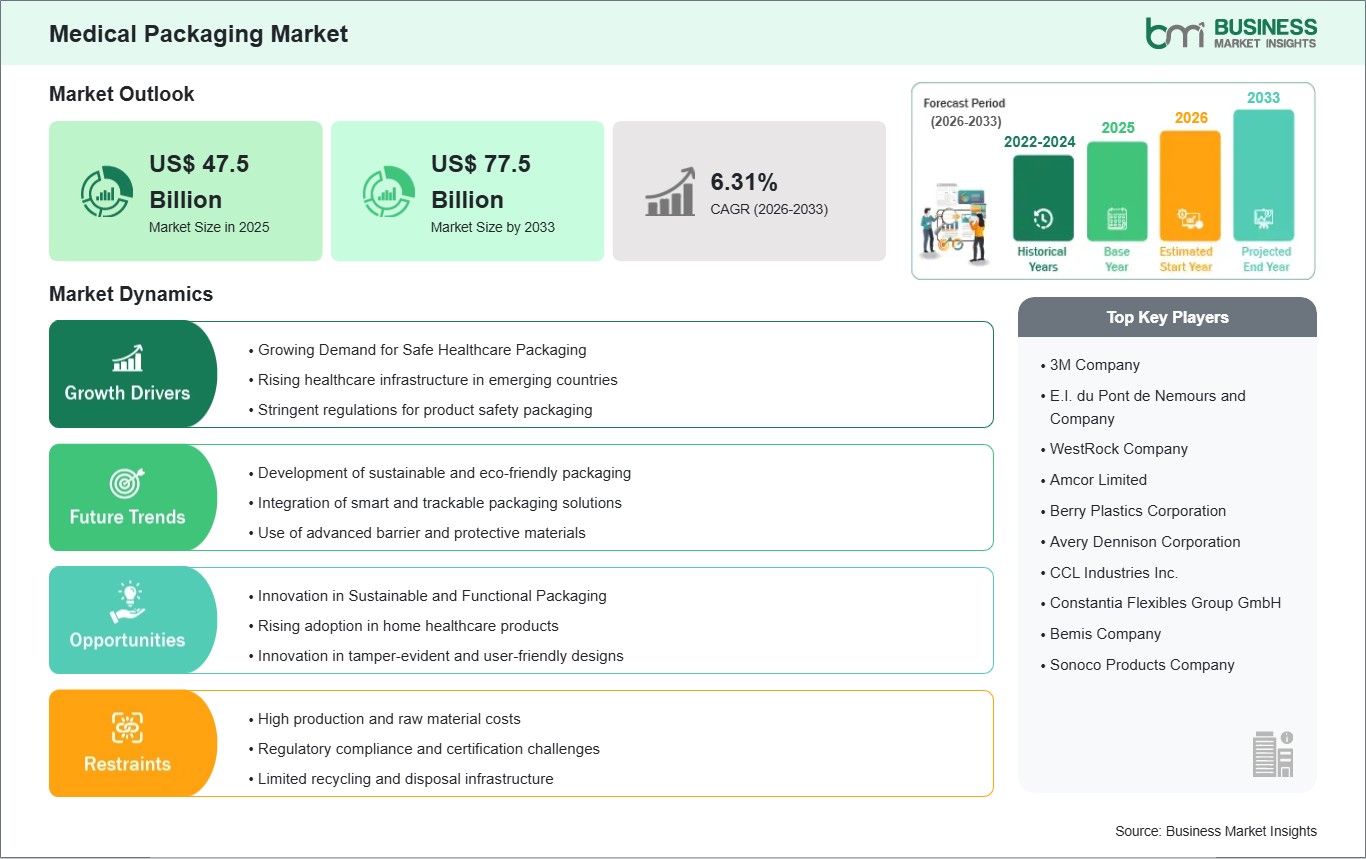
The Medical Packaging Market size is expected to reach US$ 77.5 Billion by 2033 from US$ 47.5 Billion in 2025. The market is estimated to record a CAGR of 6.31% from 2026 to 2033.
The medical packaging industry is growing rapidly throughout the world, as stakeholders in the healthcare production cycle, including providers, pharmaceutical companies and medical manufacturers, are placing a higher value on producing and maintaining product safety through regulatory compliance and supply chain efficiency. The term "medical packaging" refers to any primary, secondary or tertiary package that is designed to protect pharmaceuticals, diagnostics, surgical instruments, and medical devices from contamination, damage or environmental exposure. Medical packaging uses materials that include plastic, glass, paperboard and aluminum, and features what is known as specialized coatings and barrier technologies to provide an aseptic environment within the package and extend the shelf life of products.
The global demand for sterile products continues to grow due to rising levels of pharmaceutical production and product adoption of prefilled syringes; the expansion of cold-chain logistics for transporting temperature-sensitive products is also having a positive effect on the growth of the medical packaging industry. Innovations such as the introduction of smart packaging, tamper-evident solutions and antimicrobial-coated packaging will provide manufacturers with enhanced methodology in ensuring product security and traceability, as well as improving patient safety.
The focus of many manufacturers in developing environmentally sustainable, recyclable, biodegradable and low-carbon packaging solutions is continuing to grow within the industry. Manufacturers are also increasingly focused on providing customized solutions, regulatory compliance, and integration with automated packaging systems as a means of increasing efficiency and reducing overall operational costs. In summary, as healthcare continues to shift its focus toward increasing safety for patients, increasing patient compliance, and increasing logistical efficiency, medical packaging will play a key role in the healthcare supply chain in providing product integrity and achieving operational excellence.

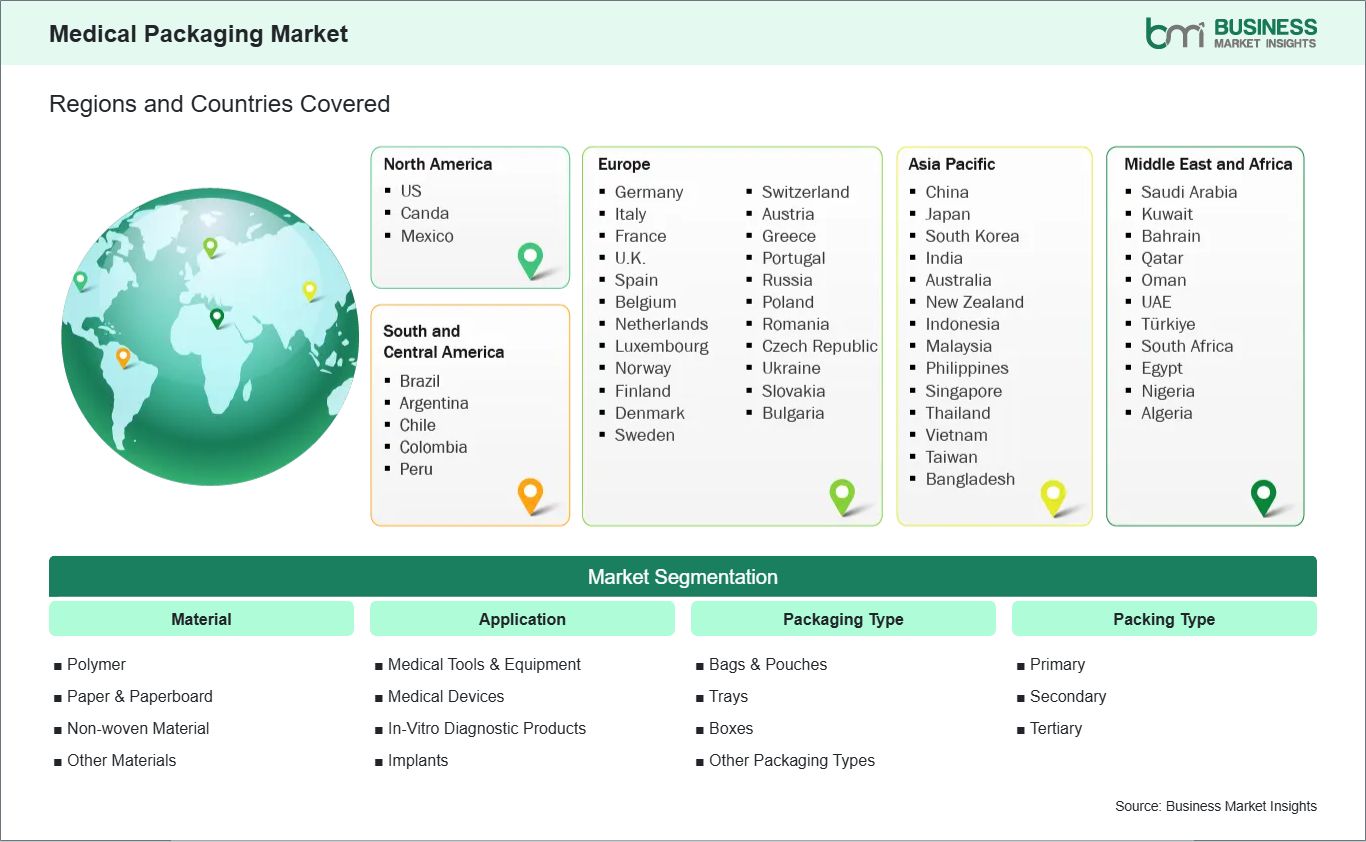
Key segments that contributed to the derivation of the medical packaging market analysis are material, application, packaging type, and packing type.
The global medical packaging market is being driven by the increasing demand for safe, reliable, and tamper-evident packaging solutions in the healthcare industry. Medical devices, pharmaceuticals, diagnostics, and biologics need to be packed in a way that protects them from contamination, moisture, and physical damage. Advanced packaging formats, including blister packs, prefilled syringes, pouches, and rigid containers, are being used to pack various healthcare products, which are being increasingly used in hospitals, pharmacies, and manufacturing industries. The increasing number of pharmaceutical formulations, vaccines, and single-use medical devices is also driving the demand for packaging solutions. Packaging solutions that provide protection to the products along with ease of use are being increasingly used in the healthcare industry, which is a positive factor for the growth of the global medical packaging market. The emphasis on quality, regulatory, and compliance issues is also driving the demand for innovative packaging solutions, which is a positive factor for the growth of the global medical packaging market.
Technological innovation is shaping the medical packaging market by delivering sustainable, functional, and cost-effective solutions. Manufacturers are developing eco-friendly materials, biodegradable films, and recyclable containers that reduce environmental impact while meeting stringent healthcare standards. Research is also advancing smart and functional packaging, such as tamper-evident seals, temperature-sensitive indicators, and anti-counterfeiting features, which improve patient safety and product monitoring. These innovations allow healthcare providers to ensure proper storage, prevent misuse, and extend product shelf life. Collaborations between packaging suppliers, pharmaceutical companies, and medical device manufacturers are accelerating customized solutions for specific applications. By integrating sustainability, functionality, and regulatory compliance, the medical packaging market is experiencing broader adoption. These advancements are positioning the market for long-term growth, catering to evolving healthcare needs and global regulatory requirements.
The medical packaging market demonstrates steady growth, with size and share analysis highlighting evolving trends and competitive dynamics among key players. The report examines subsegments categorized within material, application, packaging type, and packing type, offering insights into their contribution to overall market performance.
By Material, the polymer subsegment dominated the market in 2025, driven by its durability, versatility, and broad use in ensuring product protection across medical tools, devices, and disposables.
Based on Application, the medical tools & equipment subsegment dominated the market in 2025, supported by widespread use in hospitals and clinics for diagnostics, surgery, wound care, and other procedures.
On the basis of Packaging Type, the bags & pouches subsegment dominated the market in 2025, owing to their ease of use, cost efficiency, and suitability for a variety of medical products.
On the basis of Packing Type, the primary packaging subsegment dominated the market in 2025, driven by its direct contact with medical products and critical role in product integrity and sterility.
| Report Attribute | Details |
|---|---|
| Market size in 2025 | US$ 47.5 Billion |
| Market Size by 2033 | US$ 77.5 Billion |
| Global CAGR (2026 - 2033) | 6.31% |
| Historical Data | 2022-2024 |
| Forecast period | 2026-2033 |
| Segments Covered | By Material
|
|
Regions and Countries Covered
| |
| North America | US, Canada, Mexico |
| Europe | Belgium, Austria, Finland, Denmark, Greece, Poland, Romania, Russia, Ukraine, Czech Republic, Slovakia, Bulgaria, Italy, Luxembourg, Germany, Switzerland, France, Netherlands, Norway, Portugal, Spain, Sweden, United Kingdom |
| Asia-Pacific | Australia, China, India, Japan, South Korea, Indonesia, Malaysia, Philippines, Singapore, Thailand, Vietnam, Bangladesh, New Zealand, Taiwan |
| South and Central America | Brazil, Argentina, Peru, Chile, Colombia |
| Middle East and Africa | Bahrain, Kuwait, Oman, Qatar, Saudi Arabia, United Arab Emirates, Turkiye, South Africa, Egypt, Algeria, Nigeria |
| Market leaders and key company profiles |
|
The "Medical Packaging Market Size and Forecast (2022 - 2033)" report provides a detailed analysis of the market covering below areas:
The geographical scope of the Medical Packaging Market report is divided into North America, Asia Pacific, Europe, Middle East & Africa, and South & Central America. North America held the largest share in 2025.
Regional dynamics in the medical packaging market reflect healthcare infrastructure, regulatory frameworks, and manufacturing capabilities. North America dominates due to a mature healthcare ecosystem, high pharmaceutical production, and stringent regulatory standards emphasizing safety, sterility, and traceability.
Europe demonstrates strong adoption, driven by compliance with stringent packaging regulations, focus on patient safety, and demand for sustainable and advanced packaging solutions.
Asia Pacific is the fastest-growing region, fueled by expanding healthcare access, rising pharmaceutical manufacturing, increasing medical device production, and adoption of cold-chain logistics.
Middle East & Africa is emerging, supported by healthcare modernization, expansion of hospital networks, and growing demand for protective and tamper-evident packaging.
South & Central America is gradually increasing adoption due to expanding pharmaceutical and medical device markets and growing emphasis on quality and compliance.
Across all regions, product safety, regulatory adherence, sustainability, material innovation, and operational efficiency are key factors driving the growth of the medical packaging market, positioning it as a critical enabler for healthcare delivery and supply chain resilience.

The Medical Packaging Market is evaluated by gathering qualitative and quantitative data post primary and secondary research, which includes important corporate publications, association data, and databases. A few of the key developments in the medical packaging market are:
The Medical Packaging Market is valued at US$ 47.5 Billion in 2025, it is projected to reach US$ 77.5 Billion by 2033.
As per our report Medical Packaging Market, the market size is valued at US$ 47.5 Billion in 2025, projecting it to reach US$ 77.5 Billion by 2033. This translates to a CAGR of approximately 6.31% during the forecast period.
The Medical Packaging Market report typically cover these key segments-
The historic period, base year, and forecast period can vary slightly depending on the specific market research report. However, for the Medical Packaging Market report:
The Medical Packaging Market is populated by several key players, each contributing to its growth and innovation. Some of the major players include:
The Medical Packaging Market report is valuable for diverse stakeholders, including:
Essentially, anyone involved in or considering involvement in the Medical Packaging Market value chain can benefit from the information contained in a comprehensive market report.
Please tell us your area of interest
(Market Segments/ Regions and Countries/ Companies)