Flexible Packaging Market Outlook (2022-2033)

Historic Data: 2022-2024   |   Base Year: 2025   |   Forecast Period: 2026-2033
Report Content: Market Scope, Market Segmentation, Market Dynamics, and Competitive Analysis

Report Coverage:
  • Material (Paper, Plastic, and Aluminum)
  • Packaging Type (Pouches, Rollstock, Bags, Films and Wraps, and Others)
  • Printing Technology (Flexography, Rotogravure, Digital Printing, and Lithography)
  • End Use (Food, Beverages, Pharmaceutical, Personal Care and Cosmetics, Household, Pet Food, and Others)

No. of Pages: 400
Report Code: BMIPUB00032569
Category: Chemicals and Materials
Flexible Packaging Market

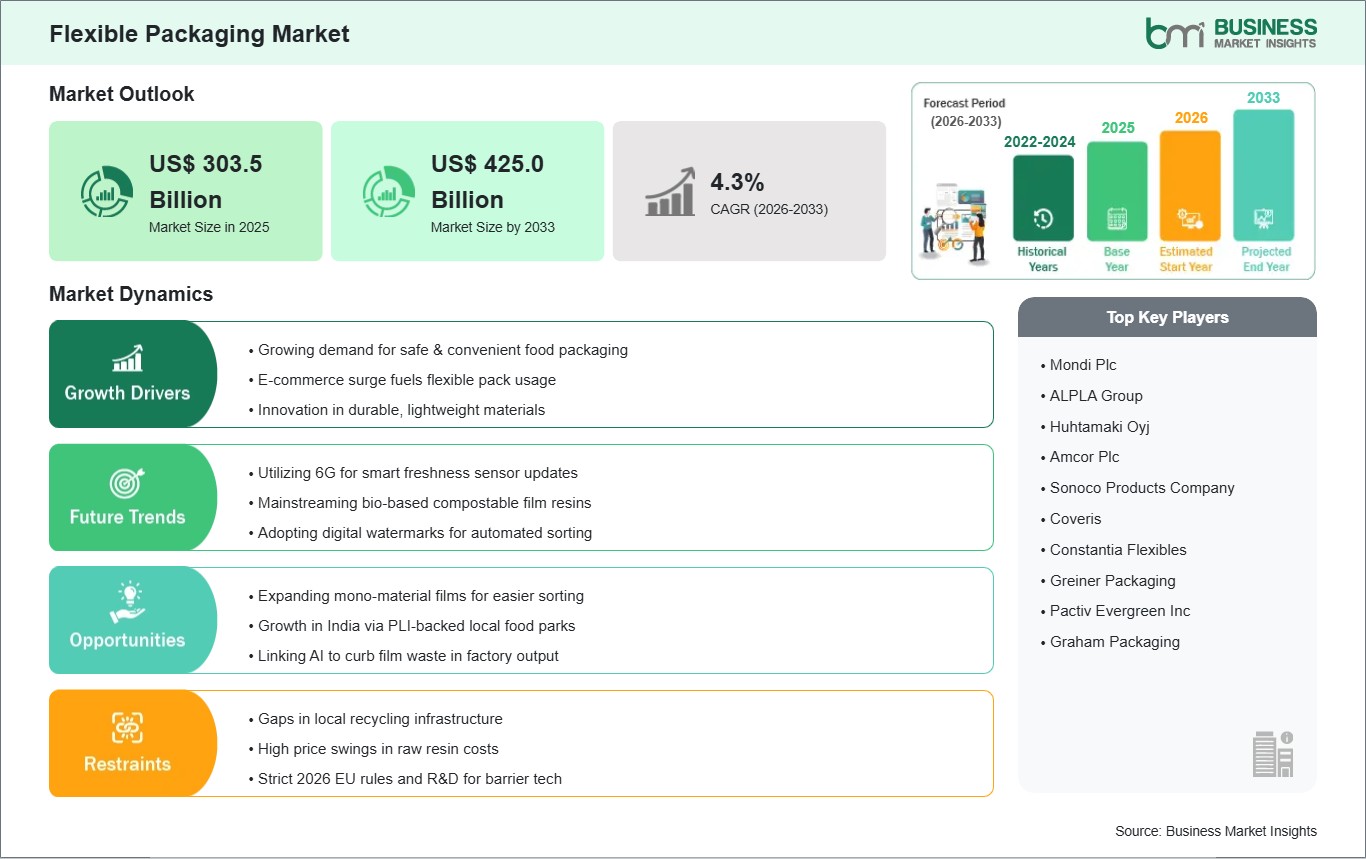
The Flexible Packaging market size is expected to reach US$ 425.0 billion by 2033 from US$ 303.5 billion in 2025. The market is estimated to record a CAGR of 4.3% from 2026 to 2033.

Executive Summary and Global Market Analysis:

Flexible packaging plays an important role in global trade by helping with logistics and preserving products. It includes stand-up pouches, vacuum packaging, retort pouches, and laminated tubes. These options have clear benefits, such as lowering shipping-related carbon emissions as they are lightweight and helping perishable goods last longer. The market is growing quickly, mainly as a result of the rise in e-commerce, more demand for convenient 'on-the-go' packaging, and the need for strong barriers in pharmaceuticals. The industry is also moving toward using more paper-based and single-material designs to support circular economy goals and meet global sustainability standards.

However, several challenges can restrain market growth: inadequate recycling infrastructure for complex multi-layer laminates remains a significant barrier to achieving a fully circular economy. Extreme price volatility of raw materials and the high R&D costs associated with developing sustainable, high-barrier alternatives pose constant margin hurdles for manufacturers. The industry also faces challenges from strict single-use plastic rules and ongoing technical difficulties in producing biodegradable resins that perform as well as fossil-based polymers. Despite these hurdles, the market holds immense opportunities in the universal mandate for decarbonized supply chains and the accelerating deployment of smart packaging featuring RFID and QR-enabled traceability. The transition toward AI-driven material optimization and chemical recycling technologies is expected to create significant opportunities for market growth.

Flexible Packaging Market - Strategic Insights:

global-market-strategic-framework
Get more information on this report

Flexible Packaging Market Segmentation Analysis:

Key segments that contributed to the derivation of the Flexible Packaging market analysis are material, packaging type, printing technology, and end use.

  • By Material, the market is segmented into Paper, Plastic, and Aluminum.
  • By Packaging Type, the market is segmented into Pouches, Rollstock, Bags, Films and Wraps, and Others.
  • By Printing Technology, the market is segmented into Flexography, Rotogravure, Digital Printing, and Lithography.
  • By End Use, the market is segmented into Food, Beverages, Pharmaceutical, Personal Care and Cosmetics, Household, Pet Food, and Others.

Flexible Packaging Market Drivers and Opportunities:

Growing Demand for Convenience Lifestyles and Supply Chain Efficiency 

As fast-paced, urban lifestyles continue to dominate consumer behavior, there is a noticeable shift toward packaging options that offer convenience, portability, and ease of use. Lightweight, resealable formats such as stand-up pouches, sachets, and flexible wraps are becoming the preferred choice, particularly among on-the-go consumers seeking products that fit seamlessly into their daily routines. This trend is especially strong in the food and beverage sector, where flexible packaging not only improves user convenience but also extends product shelf life. Advanced barrier properties—designed to protect contents from moisture, oxygen, and light—help maintain freshness longer and significantly reduce food spoilage.

Beyond evolving consumer expectations, flexible packaging delivers substantial supply chain and operational advantages. Compared to rigid containers made from glass, metal, or hard plastics, flexible formats are much lighter and require far less storage and transport space. This allows companies to ship more units per load, dramatically lowering logistics costs and reducing fuel consumption across distribution networks. These efficiencies become even more critical in the booming e-commerce sector, where packaging must balance durability with minimal environmental impact.

For brands navigating global online marketplaces, flexible packaging offers a compelling combination of protective strength, reduced shipping weight, and a smaller carbon footprint. Together, these attributes are positioning flexible materials as a strategic enabler of both cost efficiency and sustainability in modern packaging ecosystems. 

Emergence of Circularity and Bio-Material Innovation

Historically, flexible packaging faced significant recycling challenges due to its multilayer construction, which often combined several different plastic types to achieve the desired strength, barrier performance, and sealability. These mixed-material structures were nearly impossible to separate during waste processing, resulting in low recovery rates and high landfill dependence. On the flip side, the development of high-performance mono-material solutions—specifically mono-PE (polyethylene) and mono-PP (polypropylene) films—has transformed the sustainability landscape. These films maintain the functionality of traditional multilayer structures while being fully compatible with existing mechanical recycling streams. This advancement directly supports intensifying regulatory requirements, including the EU’s Green Deal targets and the growing implementation of plastic taxes worldwide, which demand greater recyclability and reduced material complexity.

Simultaneously, new opportunities are emerging in bio-based, biodegradable, and compostable substrates. These materials provide plastic-free alternatives well-suited for zero-waste and premium eco-conscious applications, helping brands differentiate in competitive markets. The rise of Smart Packaging—incorporating features such as QR codes, freshness indicators, and traceability sensors—adds another high-value growth avenue by enabling real-time food safety monitoring and improved consumer transparency.

Manufacturers that invest in advanced “paperization,” shifting from plastic to fiber-based flexible formats, are also gaining a strategic edge. When combined with automated, high-speed production technologies, these innovations position companies to lead a market increasingly driven by circularity, recyclability, and reduced environmental impact rather than single-use convenience.

Flexible Packaging Market Size and Share Analysis:

The Flexible Packaging market demonstrates steady growth, with size and share analysis revealing evolving trends and competitive positioning among key players. The report further examines subsegments categorized within material, packaging type, printing technology, and end use, offering insights into their contribution to overall market performance.

For instance, the Plastic subsegment is a primary focus for innovation, particularly in the development of Films and Wraps. Industry leaders are increasingly moving away from complex multi-layer laminates in favor of mono-material polyolefin films to enhance recyclability. This transition is especially prevalent in the Food sector, where high-barrier films are essential for maintaining the freshness of snacks and frozen goods. To support these sustainable initiatives, Flexography remains the preferred choice for high-speed, cost-effective production of large-volume food wraps.

Flexible Packaging Market Report Highlights:

Report Attribute Details
Market size in 2025 US$ 303.5 Billion
Market Size by 2033 US$ 425.0 Billion
Global CAGR (2026 - 2033)4.3%
Historical Data 2022-2024
Forecast period 2026-2033
Segments Covered By Material
  • Paper
  • Plastic
  • Aluminum
By Packaging Type
  • Pouches
  • Rollstock
  • Bags
  • Films and Wraps
  • Others
By Printing Technology
  • Flexography
  • Rotogravure
  • Digital Printing
  • Lithography
By End Use
  • Food
  • Beverages
  • Pharmaceutical
  • Personal Care and Cosmetics
  • Household
  • Pet Food
  • Others
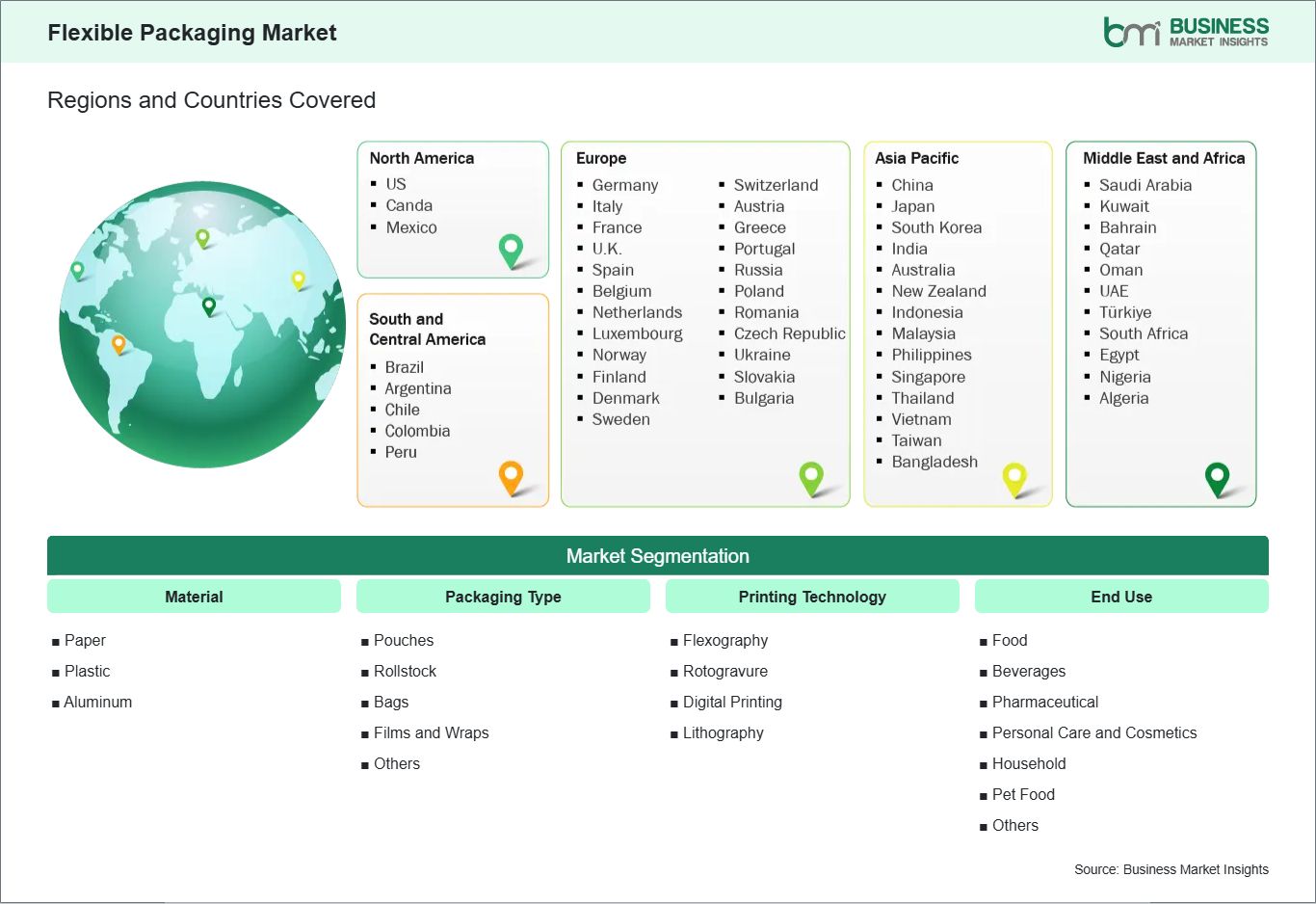
Regions and Countries Covered
North America US, Canada, Mexico
Europe Belgium, Austria, Finland, Denmark, Greece, Poland, Romania, Russia, Ukraine, Czech Republic, Slovakia, Bulgaria, Italy, Luxembourg, Germany, Switzerland, France, Netherlands, Norway, Portugal, Spain, Sweden, United Kingdom
Asia-Pacific Australia, China, India, Japan, South Korea, Indonesia, Malaysia, Philippines, Singapore, Thailand, Vietnam, Bangladesh, New Zealand, Taiwan
South and Central America Brazil, Argentina, Peru, Chile, Colombia
Middle East and Africa Bahrain, Kuwait, Oman, Qatar, Saudi Arabia, United Arab Emirates, Turkiye, South Africa, Egypt, Algeria, Nigeria
Market leaders and key company profiles
  • Mondi Plc
  • ALPLA Group
  • Huhtamaki Oyj
  • Amcor Plc
  • Sonoco Products Company
  • Coveris
  • Constantia Flexibles
  • Greiner Packaging
  • Pactiv Evergreen Inc
  • Graham Packaging
Get more information on this report

Flexible Packaging Market Report Coverage and Deliverables:

The Flexible Packaging Market Size and Forecast (2022–2033) report provides a detailed analysis of the market covering below areas:

  • Flexible Packaging market size and forecast at global, regional, and country levels for all the key market segments covered under the scope
  • Flexible Packaging market trends, as well as market dynamics such as drivers, restraints, and key opportunities
  • Flexible Packaging market analysis covering key market trends, global and regional framework, major players, regulations, and recent market developments
  • Industry landscape and competition analysis covering market concentration, heat map analysis, prominent players, and recent developments for the Flexible Packaging market
  • Detailed company profiles, including SWOT analysis

Flexible Packaging Market Geographic Insights:

The geographical scope of the Flexible Packaging market report is divided into five regions: North America, Asia Pacific, Europe, Middle East & Africa, and South & Central America. 

The Asia-Pacific Flexible Packaging Market is segmented into China, Japan, South Korea, India, Australia, New Zealand, Indonesia, Malaysia, the Philippines, Singapore, Thailand, Vietnam, Taiwan, Bangladesh, and the Rest of Asia. The market is primarily driven by the massive expansion of the food and beverage sector and the rise of e-commerce.

Growth is further bolstered by the "paperization" trend and the adoption of mono-material films to meet new recycling mandates in countries like Japan and South Korea. The shift toward single-serve sachets in emerging Southeast Asian cities and the integration of smart packaging (QR/NFC) for track-and-trace capabilities solidify Asia-Pacific as the critical global hub for flexible packaging innovation and sustainable manufacturing.

global-market-geography
Get more information on this report

Flexible Packaging Market Research Report Guidance:

  • The report includes qualitative and quantitative data in the Flexible Packaging market across material, packaging type, printing technology, end use, and geography.
  • The report starts with the key takeaways (chapter 2), highlighting the key trends and outlook of the Flexible Packaging market.
  • Chapter 3 includes the research methodology of the study.
  • Chapter 4 further includes ecosystem analysis.
  • Chapter 5 highlights the major industry dynamics in the Flexible Packaging market, including factors that are driving the market, prevailing deterrents, potential opportunities, as well as future trends. Impact analysis of these drivers and restraints is also covered in this section.
  • Chapter 6 discusses the Flexible Packaging market scenario, in terms of historical market revenues, and forecast till the year 2033.
  • Chapters 7 to 10 cover Flexible Packaging market segments by material, packaging type, printing technology, end use, and geography across North America, Europe, Asia Pacific, Middle East and Africa, and South and Central America. They cover the market volume, revenue forecast, and factors driving the market.
  • Chapter 11 describes the competitive analysis along with the heat map analysis for the key players operating in the market.
  • Chapter 12 describes the industry landscape analysis. It provides detailed descriptions of business activities such as market initiatives, new developments, mergers, and joint ventures globally, along with a competitive landscape.
  • Chapter 13 provides detailed profiles of the major companies operating in the Flexible Packaging market. Companies have been profiled on the basis of their key facts, business descriptions, products and services, financial overview, SWOT analysis, and key developments.
  • Chapter 14, i.e., the appendix, is inclusive of a brief overview of the company, list of abbreviations, and disclaimer.

Flexible Packaging Market News and Key Development:

The Flexible Packaging market is evaluated by gathering qualitative and quantitative data post primary and secondary research, which includes important corporate publications, association data, and databases. A few of the key developments in the Flexible Packaging market are:

  • In March 2025, Borealis launched Borcycle™ M CWT120CL, a recycled linear low-density low density flexible packaging grade with 85% PCR content, designed to advance circularity in non-food flexible packaging. Produced with 85% post-consumer recyclate (PCR) and 15% LLDPE booster, it is ideal for high-end applications where sustainability and circularity matter.
  • In July 2025, Mondi, a global leader in sustainable paper and packaging, announced that they are set to take centre stage at Fachpack 2025 in Nuremberg, showcasing its unique wide range of packaging solutions—from kraft paper, solid board, corrugated solutions to functional barrier papers and flexible plastic-based packaging—tailored to meet the varied needs of its customers. By bringing this holistic offering to the show, Mondi reaffirms its unique position offering a comprehensive approach to packaging that delivers fit-for-purpose solutions and clear advantages for customers.

Key Sources Referred:

  • World Bank – Global Trade Indicators
  • World Trade Organization (WTO)
  • International Monetary Fund (IMF)
  • International Trade Administration (ITA)
  • Company Websites
  • Company Annual Reports
  • Company Investor Presentations
The List of Companies - Flexible Packaging Market
  • Mondi Plc
  • ALPLA Group
  • Huhtamaki Oyj
  • Amcor Plc
  • Sonoco Products Company
  • Coveris
  • Constantia Flexibles
  • Greiner Packaging
  • Pactiv Evergreen Inc
  • Graham Packaging
Frequently Asked Questions
How big is the Flexible Packaging Market?

The Flexible Packaging Market is valued at US$ 303.5 Billion in 2025, it is projected to reach US$ 425.0 Billion by 2033.

What is the CAGR for Flexible Packaging Market by (2026 - 2033)?

As per our report Flexible Packaging Market, the market size is valued at US$ 303.5 Billion in 2025, projecting it to reach US$ 425.0 Billion by 2033. This translates to a CAGR of approximately 4.3% during the forecast period.

What segments are covered in this report?

The Flexible Packaging Market report typically cover these key segments-

  • Material (Paper, Plastic, and Aluminum)
  • Packaging Type (Pouches, Rollstock, Bags, Films and Wraps, and Others)
  • Printing Technology (Flexography, Rotogravure, Digital Printing, and Lithography)
  • End Use (Food, Beverages, Pharmaceutical, Personal Care and Cosmetics, Household, Pet Food, and Others)

What is the historic period, base year, and forecast period taken for Flexible Packaging Market?

The historic period, base year, and forecast period can vary slightly depending on the specific market research report. However, for the Flexible Packaging Market report:

  • Historic Period : 2022-2024
  • Base Year : 2025
  • Forecast Period : 2026-2033
  • Who are the major players in Flexible Packaging Market?

    The Flexible Packaging Market is populated by several key players, each contributing to its growth and innovation. Some of the major players include:

  • Mondi Plc
  • ALPLA Group
  • Huhtamaki Oyj
  • Amcor Plc
  • Sonoco Products Company
  • Coveris
  • Constantia Flexibles
  • Greiner Packaging
  • Pactiv Evergreen Inc
  • Graham Packaging
  • Who should buy this report?

    The Flexible Packaging Market report is valuable for diverse stakeholders, including:

    • Investors: Provides insights for investment decisions pertaining to market growth, companies, or industry insights. Helps assess market attractiveness and potential returns.
    • Industry Players: Offers competitive intelligence, market sizing, and trend analysis to inform strategic planning, product development, and sales strategies.
    • Suppliers and Manufacturers: Helps understand market demand for components, materials, and services related to concerned industry.
    • Researchers and Consultants: Provides data and analysis for academic research, consulting projects, and market studies.
    • Financial Institutions: Helps assess risks and opportunities associated with financing or investing in the concerned market.

    Essentially, anyone involved in or considering involvement in the Flexible Packaging Market value chain can benefit from the information contained in a comprehensive market report.

    Available Report Formats

    pdf-format excel-format pptx-format
    Buy Now
    Sales Assistance
    +1 646 791 7070 (US & UK)
    Customization Form

    Please tell us your area of interest
    (Market Segments/ Regions and Countries/ Companies)