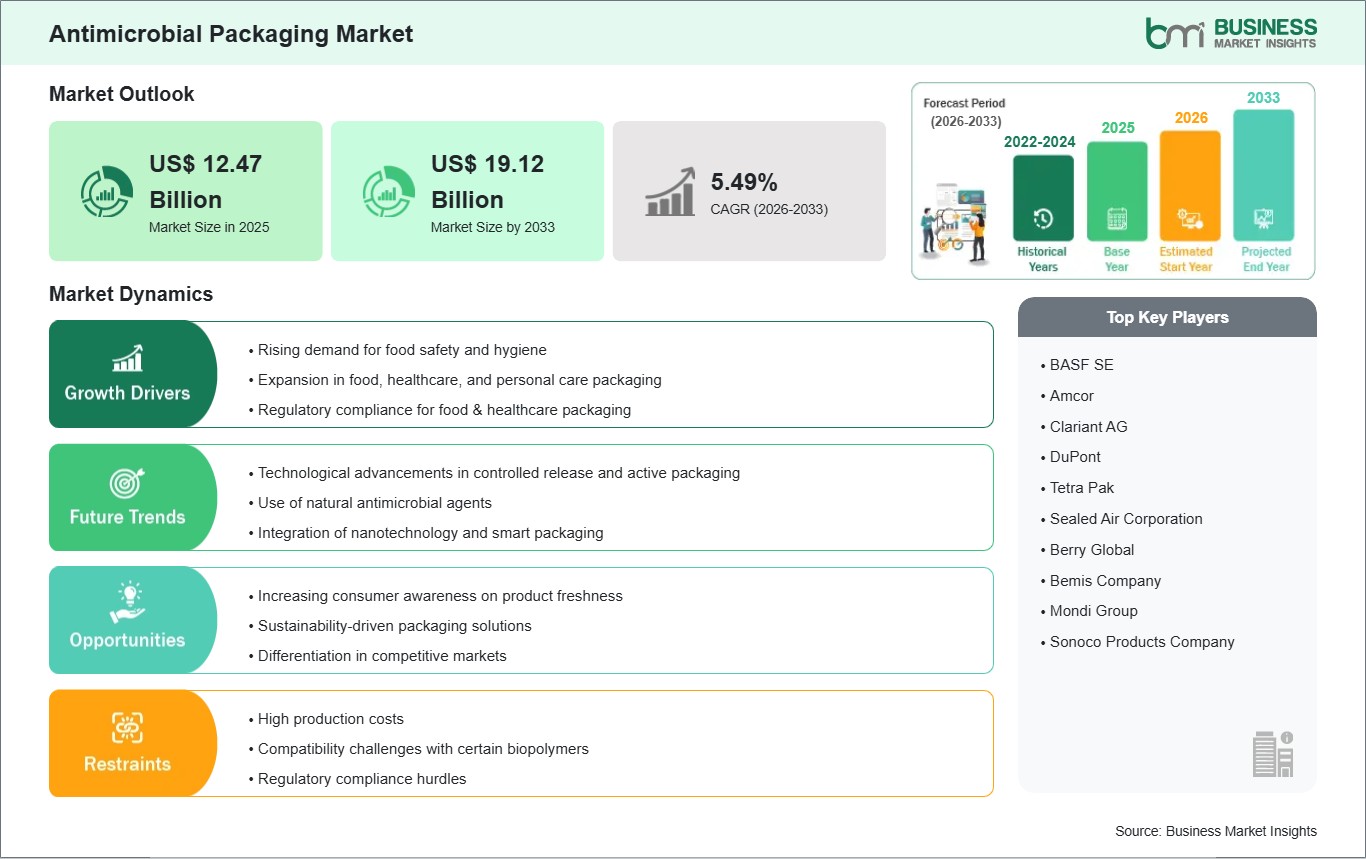
The Antimicrobial Packaging Market size is expected to reach US$ 19.12 Billion by 2033 from US$ 12.47 Billion in 2025. The market is estimated to record a CAGR of 5.49% from 2026 to 2033.
The global antimicrobial packaging market is growing rapidly, driven by rising demand for hygienic, safe, and long shelf-life packaging across food & beverages, healthcare, and personal care industries. Antimicrobial packaging integrates agents that inhibit microbial growth, ensuring product safety, reducing spoilage, and extending freshness. These solutions are critical for perishable foods, medical devices, pharmaceuticals, and cosmetic products.
Consumer awareness on hygiene and food safety, reinforced by global health concerns, is encouraging manufacturers to adopt antimicrobial technologies. Regulatory mandates on food safety, hygiene, and shelf-life extension are further driving adoption, making antimicrobial packaging a critical component in modern supply chains.

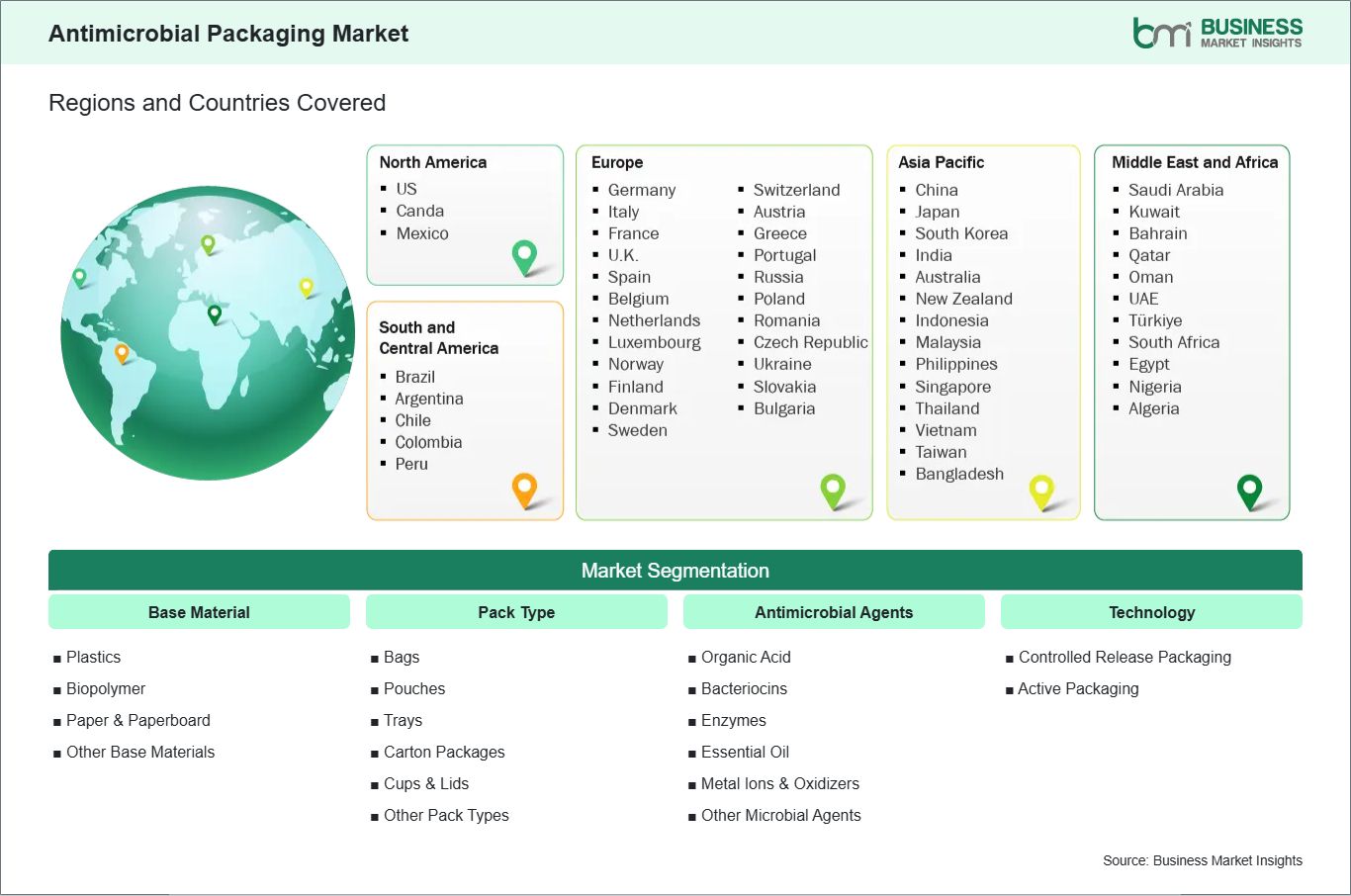
Key segments that contributed to the derivation of the antimicrobial packaging market analysis are base material, pack type, antimicrobial agent, technology, and end-user industry.
The issue of food safety is becoming increasingly important to consumers globally and as a result, has been a key driver behind the rapid growth of antimicrobials within the category of packaging. The rising incidence of foodborne illness, food contamination, and food spoilage has significantly increased consumer awareness regarding the need for safe and sanitary food packaging. Antimicrobial packaging is a very effective way of addressing these concerns by utilising this type of agent which helps inhibit microbial growth thus enabling the shelf life of the product to be extended and the quality of the product maintained while simultaneously reducing waste. The importance of this type of packaging on perishables like dairy, meat, seafood, and fresh produce is critical, as a lack of adequate management of these products can result in very rapid spoilage.
More importantly, consumers today are more cognizant of their food and are demanding packaging that not only protects their food from spoilage, but also keeps it fresh and safe for the entirety of its lifecycle. In turn, food retailers and manufacturers are turning to the use of antimicrobial packaging to create consumer trust and comply with rules and regulations. The benefits derived from this type of packaging also extend beyond just food safety; by reducing the levels of spoilage and waste, antimicrobial packaging also goes towards supporting companies' sustainability goals by reducing unnecessary losses and improving overall efficiency within the company's supply chain.
The emergence of global food e-commerce and global food trade has also put a spotlight on the need for packaging that can withstand long shipping times to ensure that the product is protected while being transported. Given all that has been mentioned, antimicrobial packaging offers the potential for companies to differentiate themselves in the competitive marketplace.
The antimicrobial packaging industry is being revolutionized by technological advancements which allow for more effective, sustainable and diverse options. Controlled-release technology, an innovative product in the industry, is joining traditional antimicrobial materials to provide gradual (delayed) release of antimicrobial agents from packaging materials. The result is continuous antimicrobial protection against microorganisms for the entire shelf life of the packaged products. Active antimicrobial coatings are another exciting development, as they create surfaces on both food and non-food products that are less likely to be contaminated and provide an overall safer product.
There is an increasing amount of evidence supporting the use of natural antimicrobial agents, such as essential oils, plant extracts and bacteriocins, as an environmentally friendly alternative to synthetic chemical products. The use of biobased solutions will appeal to consumers who are concerned about the environmental impact of traditional packaging, particularly given recent regulatory trends pushing for the use of safer, non-toxic materials. The integration of such agents into biopolymer based packaging will provide opportunities for continued sustainable innovation, particularly in terms of combining hygiene with recycling and biodegradability.
The use of nanotechnology in designing antimicrobial products is also providing enhanced performance, through the ability to accurately place antimicrobial agents at the molecular level, thus enabling longer-lasting antimicrobial activity. There are also new smart packaging materials being produced that can respond to the presence of microorganisms or indicate when products are spoiled or deteriorating, adding additional value to consumers and manufacturers.

The Antimicrobial Packaging Market demonstrates steady growth, with size and share analysis highlighting evolving trends and competitive dynamics among key players. The report examines subsegments categorized within base material, pack type, antimicrobial agent, technology, and end-user industry, offering insights into their contribution to overall market performance.
By base material, the plastics subsegment dominated the market in 2025, driven by its widespread use, versatility, and compatibility with antimicrobial agents
Based on pack type, the pouches subsegment dominated the market in 2025, driven by convenience, cost-effectiveness, and compatibility with antimicrobial solutions.
In terms of antimicrobial agent, the organic acids subsegment dominated the market in 2025, driven by its proven efficacy and regulatory acceptance for food contact.
The active packaging technology segment dominated the market in 2025, driven by its ability to continuously inhibit microbial growth and enhance product shelf life.
By end-user industry, the food & beverages subsegment dominated the market in 2025 , driven by the growing need for safe, long-lasting packaged food products.
| Report Attribute | Details |
|---|---|
| Market size in 2025 | US$ 12.47 Billion |
| Market Size by 2033 | US$ 19.12 Billion |
| Global CAGR (2026 - 2033) | 5.49% |
| Historical Data | 2022-2024 |
| Forecast period | 2026-2033 |
| Segments Covered | By Base Material
|
|
Regions and Countries Covered
| |
| North America | US, Canada, Mexico |
| Europe | Belgium, Austria, Finland, Denmark, Greece, Poland, Romania, Russia, Ukraine, Czech Republic, Slovakia, Bulgaria, Italy, Luxembourg, Germany, Switzerland, France, Netherlands, Norway, Portugal, Spain, Sweden, United Kingdom |
| Asia-Pacific | Australia, China, India, Japan, South Korea, Indonesia, Malaysia, Philippines, Singapore, Thailand, Vietnam, Bangladesh, New Zealand, Taiwan |
| South and Central America | Brazil, Argentina, Peru, Chile, Colombia |
| Middle East and Africa | Bahrain, Kuwait, Oman, Qatar, Saudi Arabia, United Arab Emirates, Turkiye, South Africa, Egypt, Algeria, Nigeria |
| Market leaders and key company profiles |
|
The "Antimicrobial Packaging Market Size and Forecast (2022 - 2033)" report provides a detailed analysis of the market covering below areas:
The geographical scope of the Antimicrobial Packaging Market report is divided into North America, Asia Pacific, Europe, Middle East & Africa, and South & Central America. North America held the largest share in 2025.
North America continues to dominate the global antimicrobial packaging market, supported by stringent food safety regulations, advanced packaging technologies, and high consumer awareness. Agencies such as the U.S. Food and Drug Administration (FDA) and the Environmental Protection Agency (EPA) enforce strict standards on food hygiene and packaging safety, compelling manufacturers to adopt antimicrobial solutions. The region also benefits from strong R&D investment and technological innovation, with companies integrating controlled‑release systems and active antimicrobial coatings into packaging materials. High consumer awareness regarding foodborne illnesses and contamination further drives demand, making antimicrobial packaging a mainstream solution across food, healthcare, and personal care industries.
Asia Pacific is witnessing rapid growth, driven by rising packaged food consumption, expanding healthcare infrastructure, and growing demand for personal care products. Countries such as China, India, and Japan are experiencing a surge in urbanization and lifestyle changes, leading to increased reliance on packaged goods. The healthcare sector is also expanding, with hospitals and pharmaceutical companies adopting antimicrobial packaging to ensure sterility and safety. Rising disposable incomes and consumer awareness are accelerating adoption, positioning Asia Pacific as the fastest‑growing regional market.
Europe places strong emphasis on sustainability and regulatory compliance. The European Chemicals Agency (ECHA) and the European Commission enforce strict guidelines on packaging materials, encouraging the use of eco‑friendly antimicrobial solutions. Biopolymer‑based packaging and recyclable materials are gaining traction, aligning with Europe`s broader sustainability agenda.
Meanwhile, the Middle East & Africa and South & Central America are emerging markets. Growth here is supported by increasing industrialization, retail expansion, and food safety initiatives. Governments are promoting hygiene standards, and rising consumer awareness is creating opportunities for antimicrobial packaging adoption across food, healthcare, and retail sectors.

The Antimicrobial Packaging Market is evaluated by gathering qualitative and quantitative data post primary and secondary research, which includes important corporate publications, association data, and databases. A few of the key developments in the antimicrobial packaging market are:
The Antimicrobial Packaging Market is valued at US$ 12.47 Billion in 2025, it is projected to reach US$ 19.12 Billion by 2033.
As per our report Antimicrobial Packaging Market, the market size is valued at US$ 12.47 Billion in 2025, projecting it to reach US$ 19.12 Billion by 2033. This translates to a CAGR of approximately 5.49% during the forecast period.
The Antimicrobial Packaging Market report typically cover these key segments-
The historic period, base year, and forecast period can vary slightly depending on the specific market research report. However, for the Antimicrobial Packaging Market report:
The Antimicrobial Packaging Market is populated by several key players, each contributing to its growth and innovation. Some of the major players include:
The Antimicrobial Packaging Market report is valuable for diverse stakeholders, including:
Essentially, anyone involved in or considering involvement in the Antimicrobial Packaging Market value chain can benefit from the information contained in a comprehensive market report.
Please tell us your area of interest
(Market Segments/ Regions and Countries/ Companies)