Market Summary
Executive Summary and Global Market Analysis
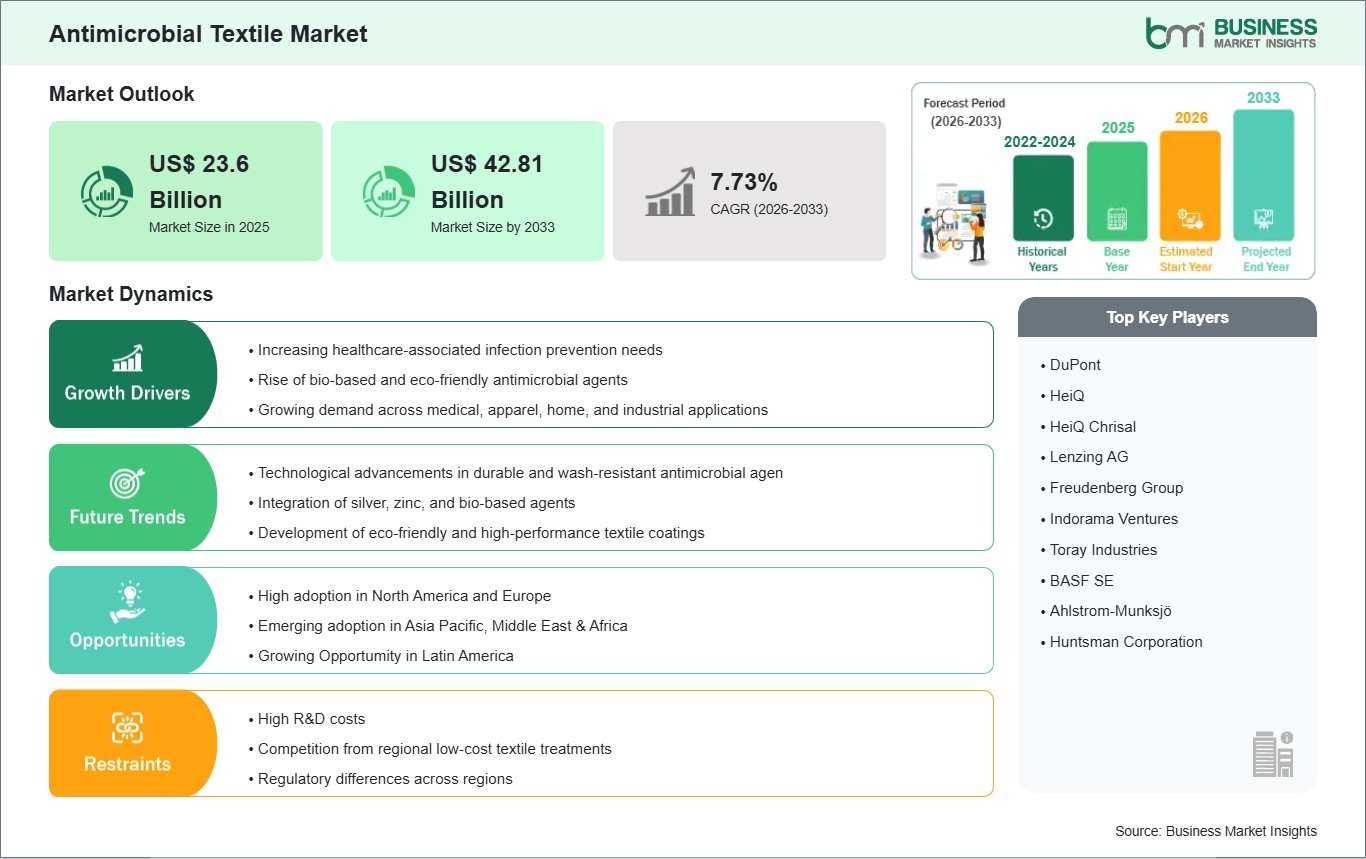
The global antimicrobial textile market is defined by the growing need for hygiene, infection prevention, and sustainable solutions across healthcare, apparel, home, and industrial applications. Antimicrobial textiles, treated with synthetic, metallic, or bio-based agents, are increasingly adopted to inhibit bacterial, fungal, and viral growth, providing long-term protection and safety.
The rising prevalence of healthcare-associated infections (HAIs), heightened public awareness regarding hygiene, and increased demand for functional and protective fabrics are major growth drivers. Medical textiles, such as hospital linens, scrubs, surgical gowns, and protective apparel, remain key contributors to the market, while commercial, home, and industrial applications continue to expand.
Technological innovations in active agents and textile processing enhance durability, wash-resistance, and fabric compatibility, while bio-based antimicrobial solutions address environmental concerns. Market players are focusing on product differentiation through R&D, incorporating durable, eco-friendly, and high-performance antimicrobial treatments to meet consumer, institutional, and regulatory requirements.
The market is witnessing broad adoption across developed regions due to regulatory support and advanced infrastructure, while emerging regions are focusing on affordable and accessible solutions. Strategic initiatives, collaborations, and sustainable innovations are positioning antimicrobial textiles as critical components of public health, hygiene, and industrial safety.
Segment Analysis
Antimicrobial Textile Market Segmentation
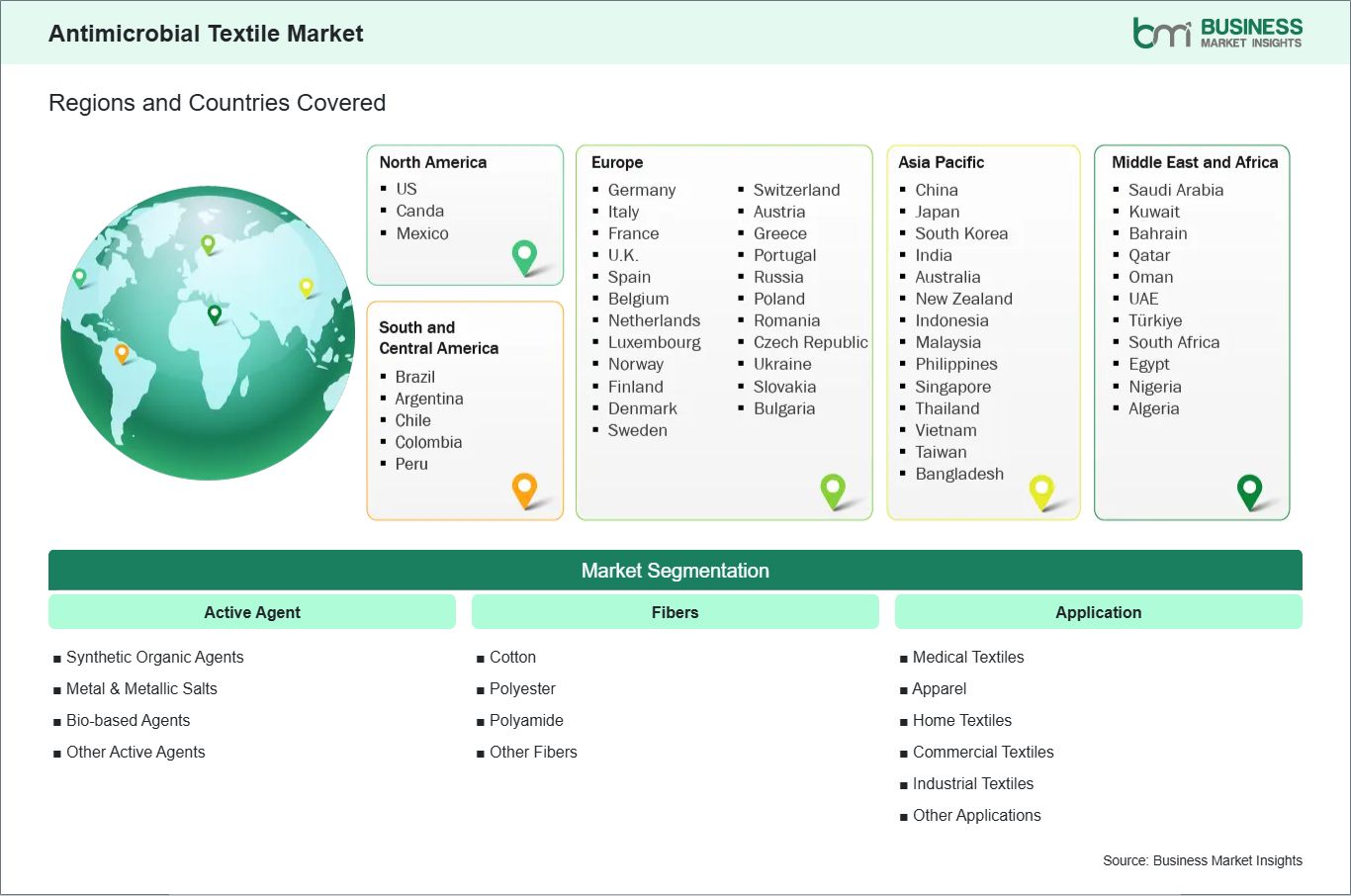
Key segments that contributed to the derivation of the antimicrobial textile market analysis are active agent, fiber type, and application.
- By Active Agent, the antimicrobial textile market is segmented into synthetic organic agents, metal & metallic salts, bio-based agents, and other active agents. The metal & metallic salts segment dominated the market in 2025.
- By Fiber, the antimicrobial textile market is segmented into cotton, polyester, polyamide, and other fibers. The cotton segment dominated the market in 2025.
- In terms of application, the antimicrobial textile market is segmented into medical textiles, apparel, home textiles, commercial textiles, industrial textiles, and other applications. The medical textiles segment dominated the market in 2025.
Market Forces
Antimicrobial Textile Market Drivers and Opportunities
Increasing Healthcare-Associated Infection (HAI) Prevention Needs
Healthcare-associated infections and the growing emphasis on hygiene in public and institutional spaces are major drivers for antimicrobial textiles. Hospitals, clinics, and healthcare facilities increasingly rely on antimicrobial-treated linens, surgical gowns, and patient bedding to minimize infection risks. These textiles reduce bacterial and fungal contamination, improving patient safety, compliance, and operational efficiency.
The COVID-19 pandemic amplified awareness of surface contamination and infection control, further boosting demand across healthcare, hospitality, and commercial environments. Consumer and institutional focus on safety, combined with stringent hygiene regulations, has created strong adoption incentives. Technological advancements in durable, wash-resistant coatings and integration of silver, zinc, or bio-based agents ensure long-lasting protection, providing both performance and confidence for users.
Rise of Bio-Based and Eco-Friendly Antimicrobial Agents
Sustainability trends and environmental regulations are creating opportunities for bio-based antimicrobial agents in textiles. Derived from natural sources like chitosan, plant extracts, or enzymes, these agents are biodegradable, non-toxic, and safe for prolonged skin contact, making them attractive for healthcare, apparel, and home textile applications.
Consumer preference for eco-friendly fabrics is rising, especially in developed regions with strict chemical safety standards. Innovations in nanofiber coatings, encapsulation, and bio-based formulations have enhanced durability, antimicrobial efficiency, and wash-resistance, allowing these sustainable options to compete with traditional chemical and metallic agents. The adoption of green antimicrobial textiles provides manufacturers with opportunities to differentiate products, comply with regulations, and meet growing consumer demand for safe, environmentally responsible fabrics.
Size and Share Analysis
Antimicrobial Textile Market Size and Share Analysis
The Antimicrobial Textile Market demonstrates steady growth, with size and share analysis highlighting evolving trends and competitive dynamics among key players. The report examines subsegments categorized within active agent, fiber type, and application, offering insights into their contribution to overall market performance.
By active agent, the metal & metallic salts subsegment dominated the market in 2025, driven by superior antimicrobial performance and long-lasting efficacy.
By fiber, the cotton subsegment dominated the market in 2025, driven by its widespread use across medical, apparel, and home textile applications.
In terms of application, the medical textiles subsegment dominated the market in 2025, driven by increasing infection control requirements and rising healthcare infrastructure investments.
Report Coverage
Antimicrobial Textile Market Report Coverage and Deliverables
The "Antimicrobial Textile Market Size and Forecast (2022 - 2033)" report provides a detailed analysis of the market covering below areas:
- Antimicrobial Textile Market size and forecast at global, regional, and country levels for all the key market segments covered under the scope
- Antimicrobial Textile Market trends, as well as drivers, restraints, and opportunities
- Antimicrobial Textile Market analysis covering key trends, global and regional framework, major players, regulations, and recent developments
- Industry landscape and competition analysis covering market concentration, heat map analysis, prominent players, and recent developments for the Antimicrobial Textile Market
- Detailed company profiles, including SWOT analysis
Geographic Insights
Antimicrobial Textile Market Geographic Insights
The geographical scope of the Antimicrobial Textile Market report is divided into North America, Asia Pacific, Europe, Middle East & Africa, and South & Central America. North America held the largest share in 2025.
In North America, strict regulations, advanced healthcare infrastructure, and institutional adoption have established the US and Canada as early adopters of advanced antimicrobial fabrics. Manufacturers focus on durable, high-performance textiles for hospitals, commercial spaces, and apparel.
In Europe, sustainability initiatives, regulatory compliance, and infection prevention policies drive adoption, with Germany, the UK, and France leading in healthcare and commercial applications.
Developed markets in Japan and South Korea are adopting bio-based and high-performance antimicrobial fibers, while emerging markets in India and Southeast Asia prioritize affordable solutions.
Latin America and Middle East & Africa exhibit early adoption in urban centers with growing healthcare and industrial sectors. Across all regions, local regulations, safety standards, and consumer awareness guide market strategies.
Industry Activity
Recent Developments
The Antimicrobial Textile Market is evaluated by gathering qualitative and quantitative data post primary and secondary research, which includes important corporate publications, association data, and databases. A few of the key developments in the antimicrobial textile market are:
- In November 2025, DuPont unveiled Tyvek APX at the A+A 2025 trade fair in Düsseldorf, Germany. This next‑generation disposable chemical garment fabric integrates antimicrobial protection with unprecedented breathability and durability. It represents the most advanced evolution of Tyvek material, designed for industrial, pharmaceutical, and chemical sectors where worker safety and hygiene are critical.
- In September 2024, HeiQ, along with its subsidiary HeiQ Chrisal, announced a breakthrough synbiotic cleaning technology combining probiotics and prebiotics to combat antimicrobial resistance (AMR). This innovation was presented ahead of the UN General Assembly’s high-level meeting on AMR. The solution is designed for textiles, cleaning, water treatment, and farming applications, promoting a healthy microbiome while preventing microbial contamination.
Trust & Transparency
Research Methodology
The market analysis combines proprietary research with secondary data from government agencies, company disclosures, regulatory filings, industry databases and expert interviews. Market estimates are validated through data triangulation, cross-market benchmarking and analyst
review.
View Full Research Methodology
Key Sources Referred:
U.S. Food and Drug Administration (FDA)World Health Organization (WHO)International Organization for Standardization (ISO)European Chemicals Agency (ECHA)Environmental Protection Agency (EPA, USA)Health and Safety Executive (HSE, UK)International Trade Administration