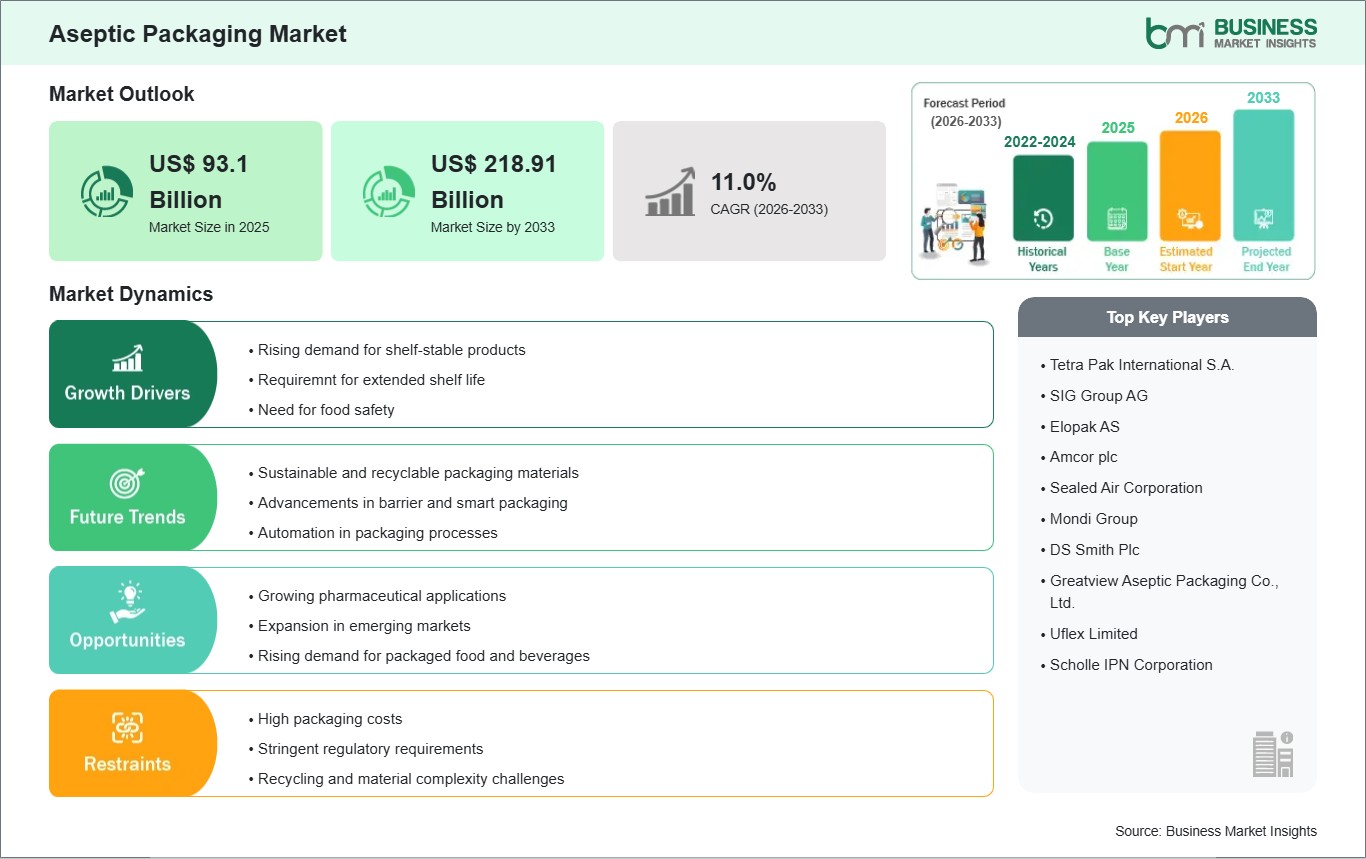
The Aseptic Packaging Market size is expected to reach US$ 218.91 Billion by 2033 from US$ 93.1 Billion in 2025 .The market is estimated to record a CAGR of 11.0% from 2026 to 2033.
The global aseptic packaging market is defined by the increasing demand for extended shelf-life products, improved food safety, and reduced reliance on cold-chain logistics. Aseptic packaging involves sterilizing both the product and packaging separately before sealing in a sterile environment, enabling long-term storage without preservatives or refrigeration. This technology has become critical across food, beverage, and pharmaceutical industries, particularly for liquid and sensitive products.
The market is witnessing strong growth driven by changing consumer preferences toward convenience, ready-to-consume products, and health-conscious consumption patterns. Rapid urbanization, rising disposable incomes, and expanding retail infrastructure are further contributing to increased demand for packaged food and beverages globally. Additionally, pharmaceutical applications are gaining traction due to the need for sterile and contamination-free packaging solutions.
Competitive dynamics are increasingly centered on sustainability, material innovation, and efficiency in packaging processes. Companies are investing in recyclable and bio-based materials to address environmental concerns while maintaining product integrity. Technological advancements such as multilayer barrier systems and smart packaging integration are also enhancing product safety and traceability. Strategic collaborations between packaging manufacturers and food & pharmaceutical companies are shaping innovation pipelines and strengthening market positioning.

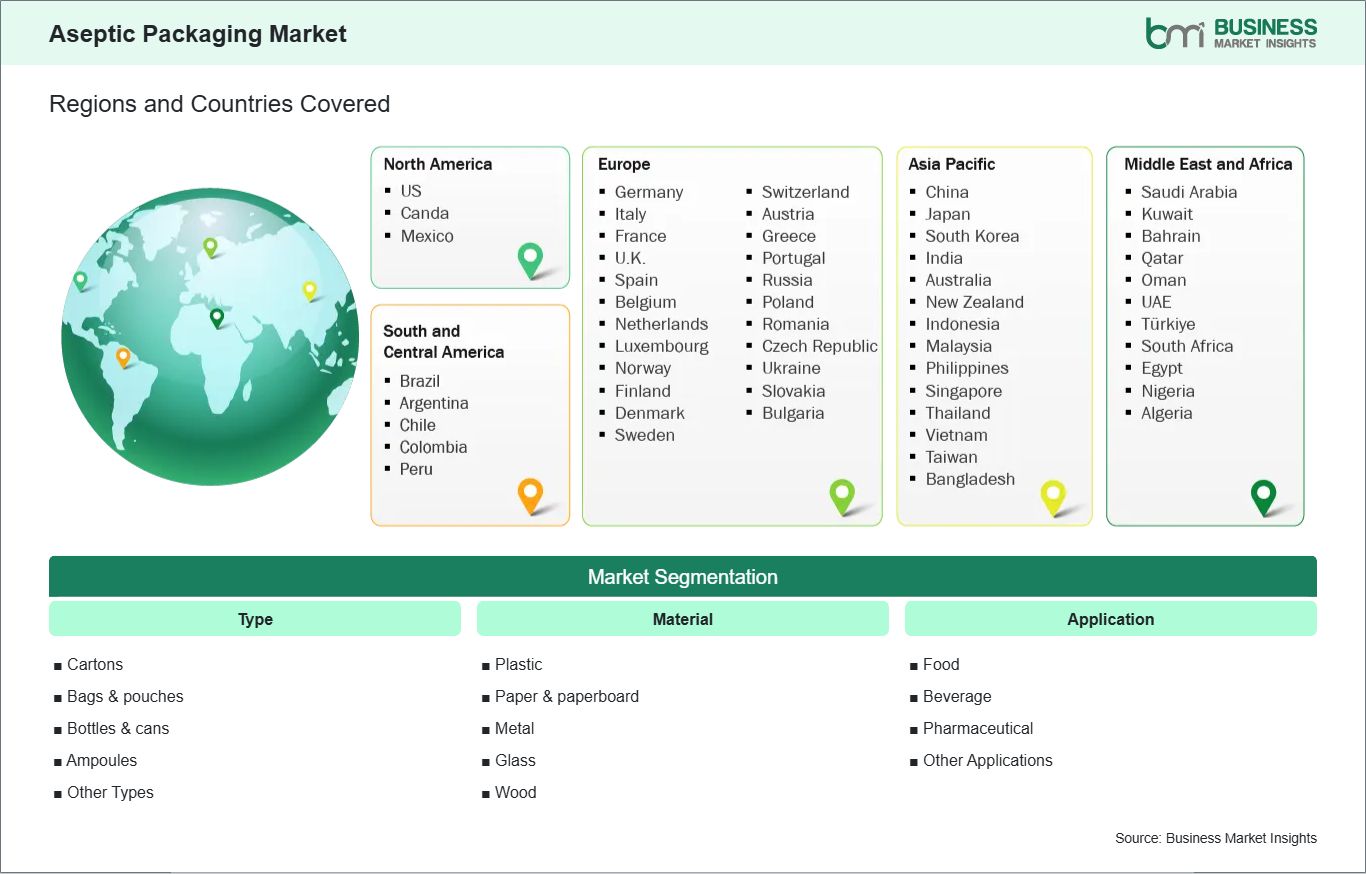
Key segments that contributed to the derivation of the aseptic packaging market analysis are type, material, and application.
Changes in how people are living are influencing their purchasing habits. With a global shift towards convenience-focused lifestyles, the demand for shelf-stable food and beverage products is growing rapidly and driving growth in the aseptic packaging market. Consumers today prefer products that have a long shelf life without refrigeration while still maintaining freshness, flavor and nutritional value. The use of aseptic packaging provides a critical solution for meeting those desires through the use of advanced sterilization methods combined with protective packaging materials that provide extended shelf life. Additionally, this trend is particularly pronounced in categories such as dairy, juice, soup, and ready-to-drink products, which rely heavily on safety and convenience. By providing the ability to store products longer, aseptic packaging reduces food waste and improves supply chain efficiency, facilitating the movement of food and beverage products to new and larger markets.
Increasingly dense populations and the growing trend of prepackaged foods are driving consumers toward pet food products and making them more inclined to buy them because they provide an easy-to-use option that matches their busy schedules. The development of new technologies, such as improved barrier properties, lighter weight packaging materials and environmentally friendly packaging materials, is also contributing significantly to the growth of the aseptic packaging market, providing manufacturers with cost savings as well as supporting environmental sustainability efforts. As the preferences of consumers continue to evolve toward convenience, health and sustainability, aseptic packaging will continue to play a vital role in the food and beverage industry by ensuring the safety of products.
With strong performance numbers in recent years, the pharmaceutical industry has become a significant contributor to the overall growth of the aseptic packaging marketplace due to the critical nature of providing sterile and contamination-free packages for injectable drugs, biologics, and vaccines. To maintain the stability and safety of these products throughout their lifecycle, pharmaceutical manufacturers require a packaging solution that can provide those qualities, so they rely on the use of aseptic technologies. Some of the most common applications in which aseptic packaging provides sterility and patient safety include ampoules, vials, and prefilled syringes. The increasing prevalence of chronic disease, along with the increasing demand for biologics and advanced therapies, continues to drive the need for reliable packaging for drug products. Regulatory agencies around the world enforce strict guidelines with regard to the safety and quality of drug products, which forces pharmaceutical manufacturers to utilize aseptic packaging technologies in order to meet compliance requirements.
In addition to this, the implementation of new automated systems, robotic systems, and digital monitoring systems is further improving the efficiency, accuracy, and reliability of the pharmaceutical packaging process. By eliminating human error, these innovative technologies have improved the scalability of pharmaceutical packaging and render aseptic packaging necessary for modern healthcare supply chains. As the pharmaceutical industry continues to expand and innovate – especially regarding biologics and personalized medicine – the demand for high-quality aseptic packaging is expected to increase substantially, resulting in new opportunities for manufacturers and solidifying its role as a key enabler of successful healthcare delivery.

The Aseptic Packaging Market demonstrates steady growth, with size and share analysis highlighting evolving trends and competitive dynamics among key players. The report examines subsegments categorized within type, material, and application, offering insights into their contribution to overall market performance.
By type, the cartons subsegment dominated the market in 2025, driven by their versatility, lightweight nature, and strong barrier properties.
Based on material, the plastic subsegment dominated the market in 2025, driven by its durability, flexibility, and cost-effectiveness.
In terms of application, the beverage subsegment dominated the market in 2025, driven by high demand for shelf-stable drinks and dairy products.
| Report Attribute | Details |
|---|---|
| Market size in 2025 | US$ 93.1 Billion |
| Market Size by 2033 | US$ 218.91 Billion |
| Global CAGR (2026 - 2033) | 11.0% |
| Historical Data | 2022-2024 |
| Forecast period | 2026-2033 |
| Segments Covered | By Type
|
|
Regions and Countries Covered
| |
| North America | US, Canada, Mexico |
| Europe | Belgium, Austria, Finland, Denmark, Greece, Poland, Romania, Russia, Ukraine, Czech Republic, Slovakia, Bulgaria, Italy, Luxembourg, Germany, Switzerland, France, Netherlands, Norway, Portugal, Spain, Sweden, United Kingdom |
| Asia-Pacific | Australia, China, India, Japan, South Korea, Indonesia, Malaysia, Philippines, Singapore, Thailand, Vietnam, Bangladesh, New Zealand, Taiwan |
| South and Central America | Brazil, Argentina, Peru, Chile, Colombia |
| Middle East and Africa | Bahrain, Kuwait, Oman, Qatar, Saudi Arabia, United Arab Emirates, Turkiye, South Africa, Egypt, Algeria, Nigeria |
| Market leaders and key company profiles |
|
The "Aseptic Packaging Market Size and Forecast (2022 - 2033)" report provides a detailed analysis of the market covering below areas:
The geographical scope of the Aseptic Packaging Market report is divided into North America, Asia Pacific, Europe, Middle East & Africa, and South & Central America. North America held the largest share in 2025.
The adoption and maturity of aseptic packaging vary significantly across regions, influenced by consumer behavior, industrial development, and regulatory standards. In North America, strong demand for convenience foods and advanced packaging technologies drives market growth. The region benefits from well-established food processing industries and stringent safety regulations that promote aseptic solutions. In Europe, sustainability and environmental regulations play a crucial role in shaping the market. The region emphasizes recyclable materials and eco-friendly packaging solutions, encouraging innovation in paper-based and biodegradable aseptic formats. Countries such as Germany, France, and the UK are leading adopters of sustainable packaging technologies.
Asia Pacific is the fastest-growing and dominant region, driven by rapid urbanization, expanding middle-class populations, and increasing consumption of packaged food and beverages. Countries such as China and India are witnessing strong demand due to changing lifestyles and growing retail sectors.
Latin America and the Middle East & Africa are experiencing gradual growth, supported by improving infrastructure and rising awareness of food safety. Across all regions, evolving consumer preferences and regulatory frameworks continue to influence market dynamics and growth opportunities.

The Aseptic Packaging Market is evaluated by gathering qualitative and quantitative data post primary and secondary research, which includes important corporate publications, association data, and databases. A few of the key developments in the aseptic packaging market are:
The Aseptic Packaging Market is valued at US$ 93.1 Billion in 2025, it is projected to reach US$ 218.91 Billion by 2033.
As per our report Aseptic Packaging Market, the market size is valued at US$ 93.1 Billion in 2025, projecting it to reach US$ 218.91 Billion by 2033. This translates to a CAGR of approximately 11.0% during the forecast period.
The Aseptic Packaging Market report typically cover these key segments-
The historic period, base year, and forecast period can vary slightly depending on the specific market research report. However, for the Aseptic Packaging Market report:
The Aseptic Packaging Market is populated by several key players, each contributing to its growth and innovation. Some of the major players include:
The Aseptic Packaging Market report is valuable for diverse stakeholders, including:
Essentially, anyone involved in or considering involvement in the Aseptic Packaging Market value chain can benefit from the information contained in a comprehensive market report.
Please tell us your area of interest
(Market Segments/ Regions and Countries/ Companies)