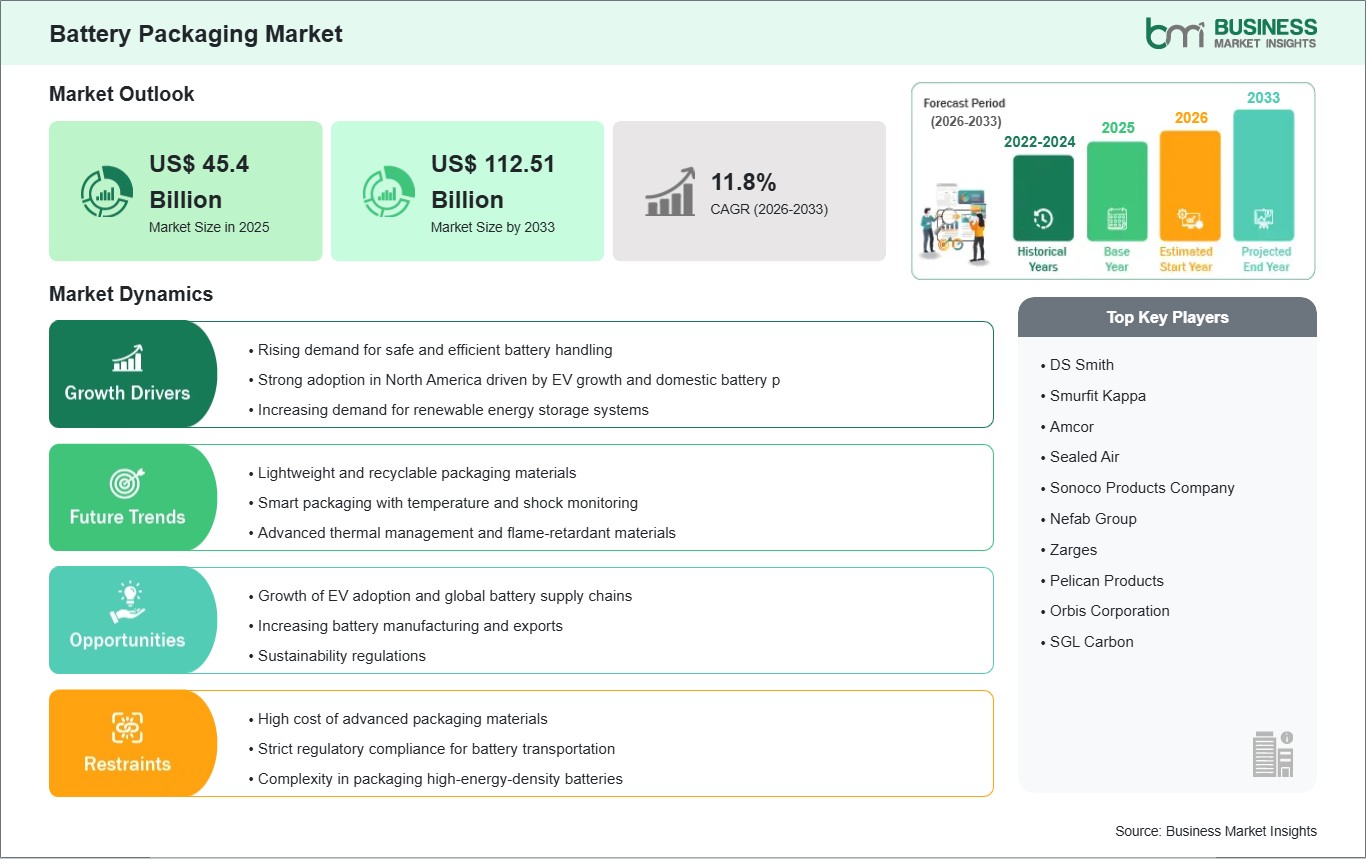
The Battery Packaging Market size is expected to reach US$ 112.51 Billion by 2033 from US$ 45.4 Billion in 2025 .The market is estimated to record a CAGR of 11.8% from 2026 to 2033.
The global battery packaging market is driven by the rapid expansion of battery manufacturing across automotive, consumer electronics, and energy storage industries. Battery packaging plays a crucial role in ensuring the safety, performance, and longevity of batteries by providing protection against mechanical damage, thermal fluctuations, and environmental exposure. Packaging solutions are designed to meet stringent safety standards, particularly for lithium-ion batteries, which are widely used in electric vehicles and portable electronic devices.
The market is witnessing significant growth due to the increasing adoption of electric vehicles and renewable energy storage systems. As battery demand rises, manufacturers are focusing on developing advanced packaging solutions that enhance thermal management, structural integrity, and transport safety. Additionally, the need for compliance with international safety and transportation regulations is driving innovation in battery packaging materials and designs.
Competitive dynamics in the battery packaging market are centered on material innovation, sustainability, and cost optimization. Companies are investing in lightweight and recyclable packaging materials while maintaining high safety standards. Strategic collaborations between battery manufacturers and packaging solution providers are further supporting market growth. Technological advancements in smart packaging and monitoring systems are also emerging as key trends shaping the market landscape.

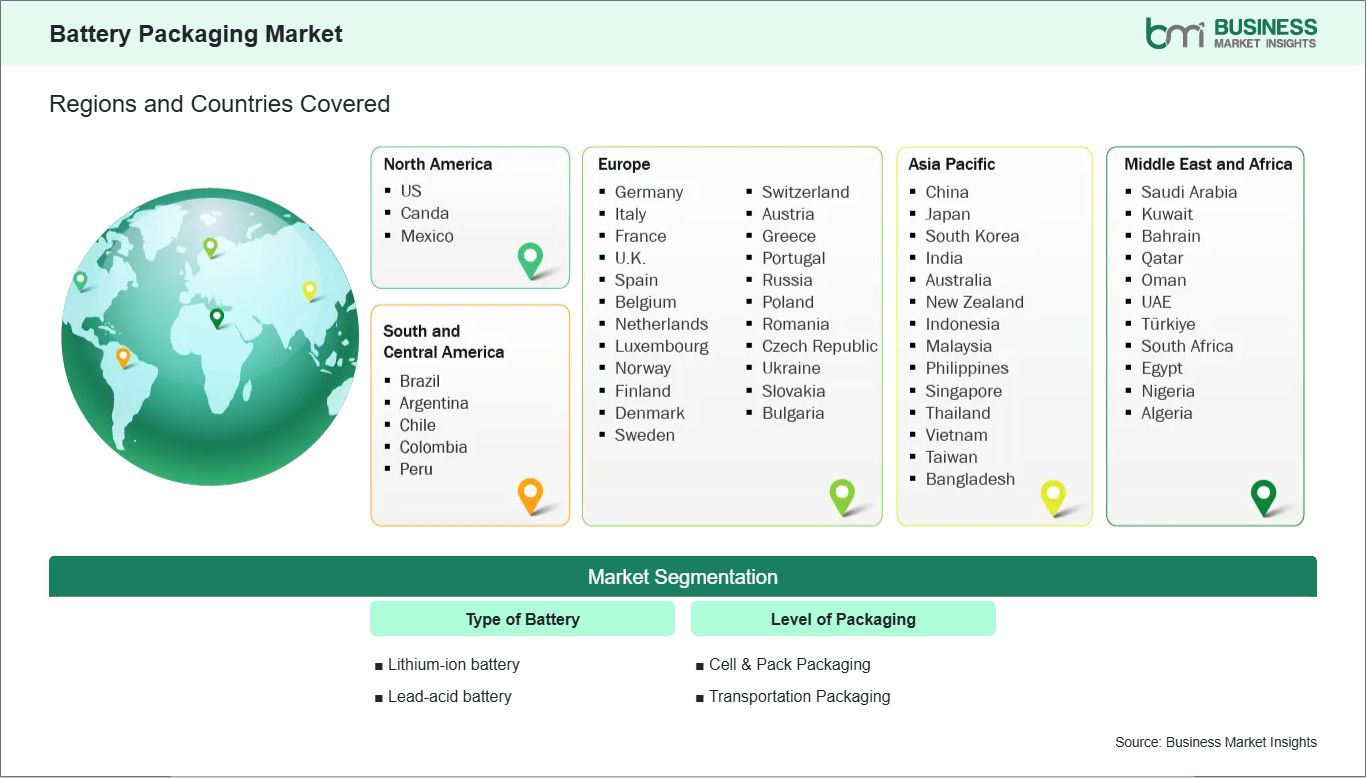
Key segments that contributed to the derivation of the battery packaging market analysis are type of battery and level of packaging.
Batteries are being used more than ever in electric cars, consumer equipment, and also for heavy industry leading to an increased demand in battery packaging. Batteries like lithium-ion batteries are very sensitive to things like physical damage, heat and short-circuiting, so advanced battery packaging solutions will play a major role in ensuring that batteries can be handled safely and stored properly. The role of the packaging system is to provide mechanical protection, thermal insulation and to contain any hazardous materials if there should be a failure.
The design of batteries has become more complicated and the energy density of batteries has increased making it necessary to have packaging solutions that meet the demands of both stability and performance through the life of the battery. In terms of maintaining structural integrity and optimizing thermal management within battery systems, packing cells and packs has an important function in achieving both goals.
In addition to new technologies, as more people are using batteries as energy supplies, the need for packaged products that meet strict standards has increased. Battery shipping regulations require specialized packaging of lithium-ion batteries due to their flammable nature, which must meet the standards defined by the IATA requirements.
New technologies are providing packaging options that include flame-retardant polymers and certain structures which absorb shock, thus providing additional safety and reliability for battery users. As the use of batteries continues to expand to more industries, demand for high-performance packaging will likely continue to grow.
As manufacturers of electric vehicles grow rapidly and global battery supply chains continue to grow rapidly, tremendous opportunities are being created in the battery packaging sector. Increased production and transport of lithium-ion batteries call for effective means of packaging these materials to protect them safely while they are stored in warehouses and transported from one point to another.
Transportation packaging systems must be able to withstand the stresses of being handled at various points during transport, including package orientation during transport, and resist the risk of leaking contents and thermal runaway.
Globalisation of battery manufacturing and supply chains is creating a new level of demand for standardised and efficient packaging solutions. Manufacturers are investing in packaging designs that will improve space efficiency, decrease shipping costs, and enhance logistics systems. The e-commerce boom and global trade expansion of battery devices have contributed to an increase in the demand for dependable transportation packaging.
Sustainability has emerged as a special opportunity area for manufacturers by developing recyclable or reusable packaging systems, along with using new forms of innovative technologies for smart packaging, such as sensors that can monitor temperature and shock. These technologies increase supply chain visibility, security, and safety. The battery ecosystem is constantly changing; therefore, the increasing demand for sustainable and advanced packaging solutions will provide long-term opportunity for manufacturers in the market.

The Battery Packaging Market demonstrates steady growth, with size and share analysis highlighting evolving trends and competitive dynamics among key players. The report examines subsegments categorized within type of battery and level of packaging, offering insights into their contribution to overall market performance.
By type of battery, the lithium-ion battery subsegment dominated the market in 2025, driven by increasing adoption in electric vehicles and consumer electronics.
Based on level of packaging, the cell & pack packaging subsegment dominated the market in 2025, driven by its critical role in battery assembly and performance optimization.
| Report Attribute | Details |
|---|---|
| Market size in 2025 | US$ 45.4 Billion |
| Market Size by 2033 | US$ 112.51 Billion |
| Global CAGR (2026 - 2033) | 11.8% |
| Historical Data | 2022-2024 |
| Forecast period | 2026-2033 |
| Segments Covered | By Type of Battery
|
|
Regions and Countries Covered
| |
| North America | US, Canada, Mexico |
| Europe | Belgium, Austria, Finland, Denmark, Greece, Poland, Romania, Russia, Ukraine, Czech Republic, Slovakia, Bulgaria, Italy, Luxembourg, Germany, Switzerland, France, Netherlands, Norway, Portugal, Spain, Sweden, United Kingdom |
| Asia-Pacific | Australia, China, India, Japan, South Korea, Indonesia, Malaysia, Philippines, Singapore, Thailand, Vietnam, Bangladesh, New Zealand, Taiwan |
| South and Central America | Brazil, Argentina, Peru, Chile, Colombia |
| Middle East and Africa | Bahrain, Kuwait, Oman, Qatar, Saudi Arabia, United Arab Emirates, Turkiye, South Africa, Egypt, Algeria, Nigeria |
| Market leaders and key company profiles |
|
The "Battery Packaging Market Size and Forecast (2022 - 2033)" report provides a detailed analysis of the market covering below areas:
The geographical scope of the Battery Packaging Market report is divided into North America, Asia Pacific, Europe, Middle East & Africa, and South & Central America. North America held the largest share in 2025.
In North America, the U.S. and Canada are experiencing strong growth in EV adoption, supported by government incentives, charging infrastructure expansion, and rising consumer demand for sustainable mobility. At the same time, investments in domestic gigafactories and advanced battery production facilities are boosting the need for reliable packaging solutions that ensure safety, efficiency, and compliance with stringent standards. The region’s well-developed logistics infrastructure further supports large-scale distribution, positioning North America as the leading market for battery packaging solutions.
Asia Pacific remains a critical hub, with its established supply chains and manufacturing dominance. China continues to lead in EV production and battery exports, while Japan and South Korea contribute through technological innovation and advanced packaging designs. Europe is also witnessing significant growth, driven by strict safety regulations, sustainability initiatives, and the expansion of EV and renewable energy sectors. Countries like Germany and France are investing heavily in packaging technologies that align with environmental goals.
Meanwhile, emerging regions in the Middle East & Africa and South & Central America are gradually adopting advanced packaging solutions to support grid modernization, industrial applications, and growing battery demand. Although their market shares are smaller, rising investments in renewable energy and electrification are expected to contribute to steady growth. Overall, North America’s leadership in EV adoption and domestic battery production, combined with Asia Pacific’s manufacturing strength, defines the global trajectory of the battery packaging solutions market.

The Battery Packaging Market is evaluated by gathering qualitative and quantitative data post primary and secondary research, which includes important corporate publications, association data, and databases. A few of the key developments in the battery packaging market are:
The Battery Packaging Market is valued at US$ 45.4 Billion in 2025, it is projected to reach US$ 112.51 Billion by 2033.
As per our report Battery Packaging Market, the market size is valued at US$ 45.4 Billion in 2025, projecting it to reach US$ 112.51 Billion by 2033. This translates to a CAGR of approximately 11.8% during the forecast period.
The Battery Packaging Market report typically cover these key segments-
The historic period, base year, and forecast period can vary slightly depending on the specific market research report. However, for the Battery Packaging Market report:
The Battery Packaging Market is populated by several key players, each contributing to its growth and innovation. Some of the major players include:
The Battery Packaging Market report is valuable for diverse stakeholders, including:
Essentially, anyone involved in or considering involvement in the Battery Packaging Market value chain can benefit from the information contained in a comprehensive market report.
Please tell us your area of interest
(Market Segments/ Regions and Countries/ Companies)