Market Summary
Executive Summary and Global Market Analysis
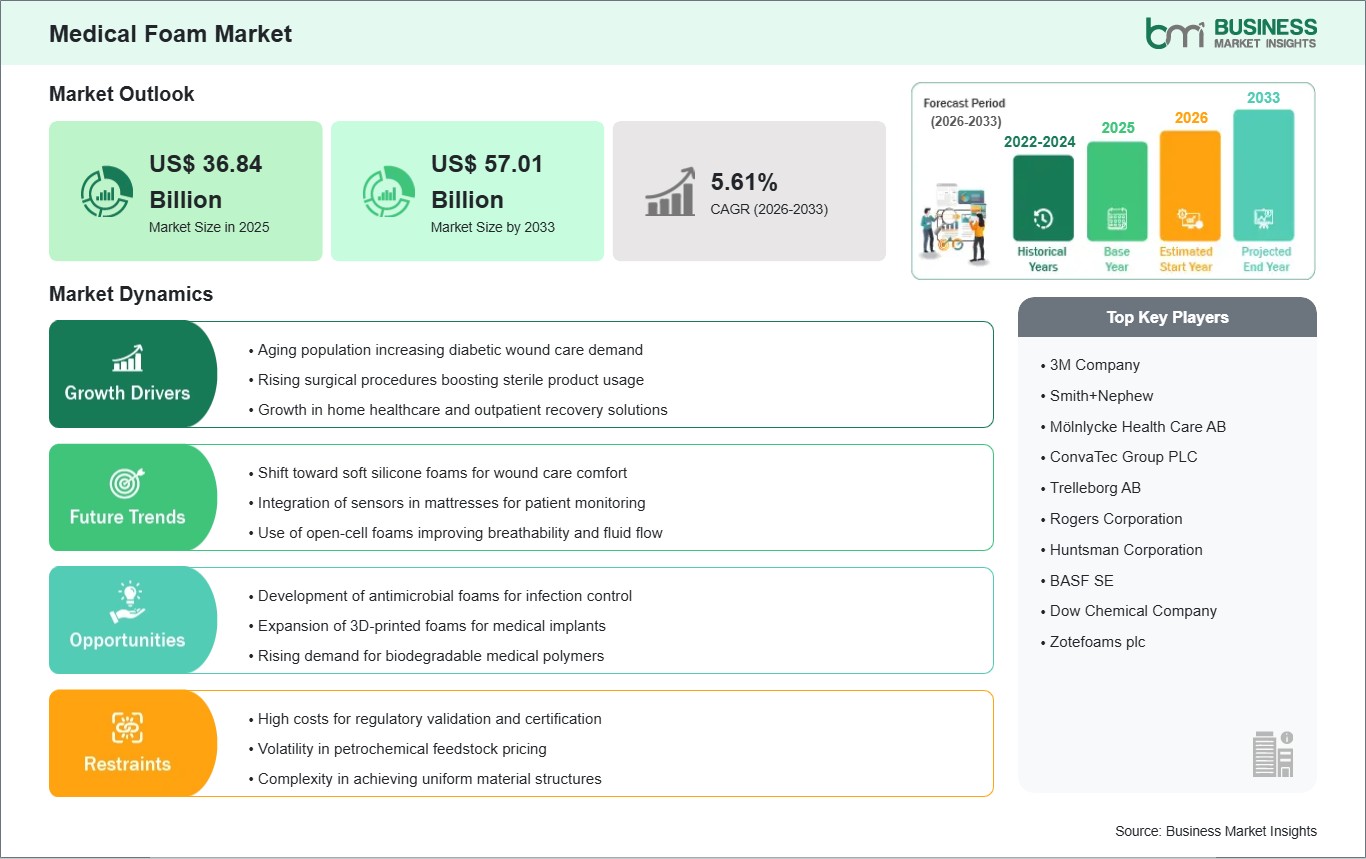
The global medical foam industry is in a state of rapid technological evolution, and this can be explained by the twin demands of safety and efficiency. The industry is growing as the medical profession moves toward more comfortable and sterile products for both acute and chronic patient care. Flexible foams, especially those of the latest polyurethane and silicone types, are still the heart of the industry, as they are so useful for a wide range of products from surgical padding to complex wound management. The industry is becoming characterized by the solution of complex clinical problems, and this is especially important in a world where the population is becoming older.
Recent trends suggest that there is an increasing focus on sustainability and compliance with regulations, with significant investment in clean chemistries adhering to the latest Medical Device Regulations (MDR) guidelines. This includes moving away from volatile organic compounds (VOC) and moving towards bio-based or recycled materials, if possible. Although commodity materials are used in these industries, medical-grade materials require extremely pure materials capable of withstanding harsh sterilization processes such as Gamma Radiation and Ethylene Oxide (EtO) sterilization. Despite some challenges in terms of raw materials and certification, the medical foam industry is expected to grow in the future with the advent of new technologies such as 3D printing in the next generation of medical-grade foams.
Segment Analysis
Medical Foam Market Segmentation
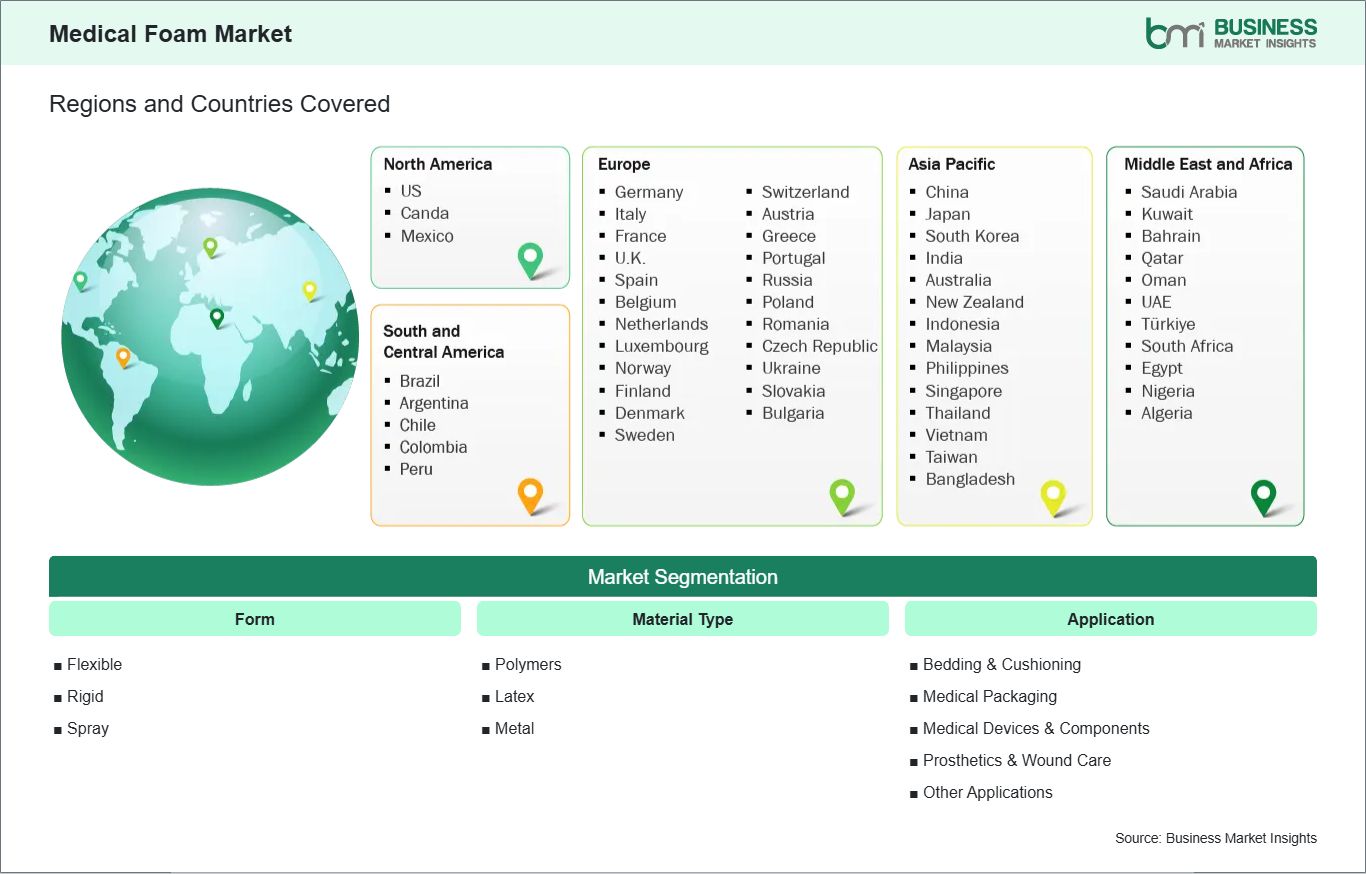
Key segments that contributed to the derivation of the Medical Foam market analysis are form, material type, and application.
- By form, the medical foam market is segmented into Flexible, Rigid, and Spray. The Flexible segment dominated the market in 2025.
- By material type, the medical foam market is segmented into Polymers, Latex, and Metal. The Polymers segment dominated the market in 2025.
- By application, the medical foam market is segmented into Bedding & Cushioning, Medical Packaging, Medical Devices & Components, Prosthetics & Wound Care, and Other Applications. The Bedding & Cushioning segment dominated the market in 2025.
Market Forces
Medical Foam Market Drivers and Opportunities
Rising geriatric population and prevalence of chronic diabetic wounds
The demographic shift in the global population, characterized by a larger number of older people, is a significant factor contributing to the growth of the medical foam market. The increase in the number of older people in the global population also leads to a rise in the number of people suffering from type 2 diabetes and venous insufficiency, which often results in chronic wounds that are difficult to heal. Medical foams, especially flexible polyurethane and silicone foams, are considered the standard for treating these conditions because of their superior exudate management capabilities. The moist environment and the absorbent nature of medical foams are important for speeding up the natural healing process and preventing secondary infections.
Apart from the active wound care, elderly patients are also more prone to mobility-related problems, which necessitate bed rest for long periods of time. This, in turn, has fueled the requirement for specialized foam materials used in the design of cushions aimed at preventing pressure ulcers, commonly referred to as bedsores. Health facilities are now adopting multilayered, high resiliency foam mattresses, which can better disperse the weight of the patients in comparison to conventional mattresses featuring springs or fibers. With the focus of healthcare facilities worldwide on creating a comfortable environment for patients, which in turn reduces the probability of complications arising in old-age facilities, the requirement for such protective foams is expected to grow steadily.
Development of antimicrobial and silver-infused foam for infection control
The critical focus on reducing hospital-acquired infections (HAIs) has opened a significant growth opportunity for the integration of antimicrobial agents directly into the medical foam matrix. By infusing foams with silver, polyhexamethylene biguanide (PHMB), or other bioactive compounds, manufacturers can offer products that actively inhibit the growth of bacteria and fungi within the dressing or cushion. This innovation is particularly valuable in prosthetics and advanced wound care, where the interface between the device and the skin is a high-risk area for microbial colonization. These functionalized foams provide an added layer of security for clinicians and patients, potentially reducing the need for systemic antibiotics.
This technological evolution is also expanding into the realm of medical packaging and hospital disposables. Antimicrobial foam inserts are being used to protect delicate surgical instruments during transit while ensuring that the sterile barrier remains uncompromised by microbial growth. As regulatory bodies implement stricter penalties for infection rates in clinical settings, the adoption of these specialized "active" foam materials is moving from a premium niche to a standard requirement. For material scientists, this represents a transition toward higher-value, engineered solutions where the foam is no longer just a passive mechanical support but an active participant in the clinical pathway.
Size and Share Analysis
Medical Foam Market Size and Share Analysis
The global Medical Foam market is experiencing steady growth, with market size and share analysis reflecting evolving treatment preferences and competitive dynamics among key players. The report evaluates important subsegments categorized within form, material type, and application, highlighting their respective contributions to overall market performance.
By form, the Flexible subsegment dominated the market in 2025 because of its widespread utility in patient-contact applications such as mattresses, support surfaces, and advanced wound dressings that require high contouring and pressure redistribution.
By material type, the Polymers subsegment dominated the market in 2025 as polyurethane and polyolefin foams offer unmatched biocompatibility, sterilization stability, and cost-efficiency compared to traditional natural rubber or specialty metal foams.
By application, the Bedding & Cushioning subsegment dominated the market in 2025 due to the continuous expansion of global hospital bed capacities and the rising focus on preventing hospital-acquired pressure ulcers through high-performance pressure-relief foam systems.
Report Coverage
Medical Foam Market Report Coverage and Deliverables
The "Medical Foam Market Size and Forecast (2022 - 2033)" report provides a detailed analysis of the market covering below areas:
- Medical Foam market size and forecast at the regional and country levels for segments covered under the scope
- Medical Foam market trends, as well as drivers, restraints, and opportunities
- Medical Foam market analysis covering key trends, regional framework, major players, regulations, and recent developments
- Industry landscape and competition analysis covering market concentration, heat map analysis, prominent players, and recent developments for the Medical Foam market
- Detailed company profiles, including SWOT analysis
Geographic Insights
Medical Foam Market Geographic Insights
The geographical scope of the Medical Foam market report is divided into: North America, Asia Pacific, Europe, Middle East & Africa, and South & Central America. North America held the largest share in 2025.
North America stands as the dominant region in the medical foam market, rooted in the region's highly sophisticated healthcare infrastructure and its high expenditure on medical services. The United States, in particular, is the primary engine of this growth, home to many of the world's leading medical device and pharmaceutical companies. The presence of these industry giants fosters a high-innovation environment where new foam technologies, such as specialized orthopedic components and advanced wound care dressings, are rapidly prototyped, tested, and brought to market.
The region's dominance is further solidified by a strong regulatory focus on patient safety and the reduction of hospital-acquired complications. U.S. healthcare policies that penalize facilities for high rates of pressure ulcers have directly accelerated the adoption of premium foam-based bedding and cushioning systems. Additionally, the booming home healthcare sector in North America has created a secondary surge in demand for easy-to-use foam products that allow patients to manage recovery outside of traditional hospital settings. With an established supply chain and a continuous influx of R&D investment in material science, North America is expected to maintain its leading position as the global hub for medical foam innovation and consumption.
Industry Activity
Recent Developments
The Medical Foam market is evaluated by gathering qualitative and quantitative data post primary and secondary research, which includes important corporate publications, association data, and databases. A few of the key developments in the Medical Foam market are:
- In February 2025, UFP Technologies, announced the acquisition of AJR Enterprises, a medical device packaging and foam fabrication company, to expand its capabilities in medical foam-based protective packaging and components for healthcare applications.
- In October 2024, Rogers Corporation, announced continued expansion of its advanced foam solutions portfolio for medical and healthcare applications, focusing on high-performance materials for cushioning, sealing, and device protection.
- In June 2023, Trelleborg Group, announced the expansion of its healthcare & medical business, including engineered polymer and foam solutions, to support growth in medical device and life sciences applications.
Trust & Transparency
Research Methodology
The market analysis combines proprietary research with secondary data from government agencies, company disclosures, regulatory filings, industry databases and expert interviews. Market estimates are validated through data triangulation, cross-market benchmarking and analyst
review.
View Full Research Methodology
Key Sources Referred:
American Chemistry Council (ACC)International Council of Chemical Associations (ICCA)European Chemical Industry Council (Cefic)China National Building Materials Group (CNBM)Indian Minerals & Granite Exporters Association (IMGEA)Japan Mining Industry Association (JMIA)Brazilian Mining Association (IBRAM)Gulf Petrochemicals and Chemicals Association (GPCA)Company WebsitesCompany Annual ReportsCompany Investor Presentations