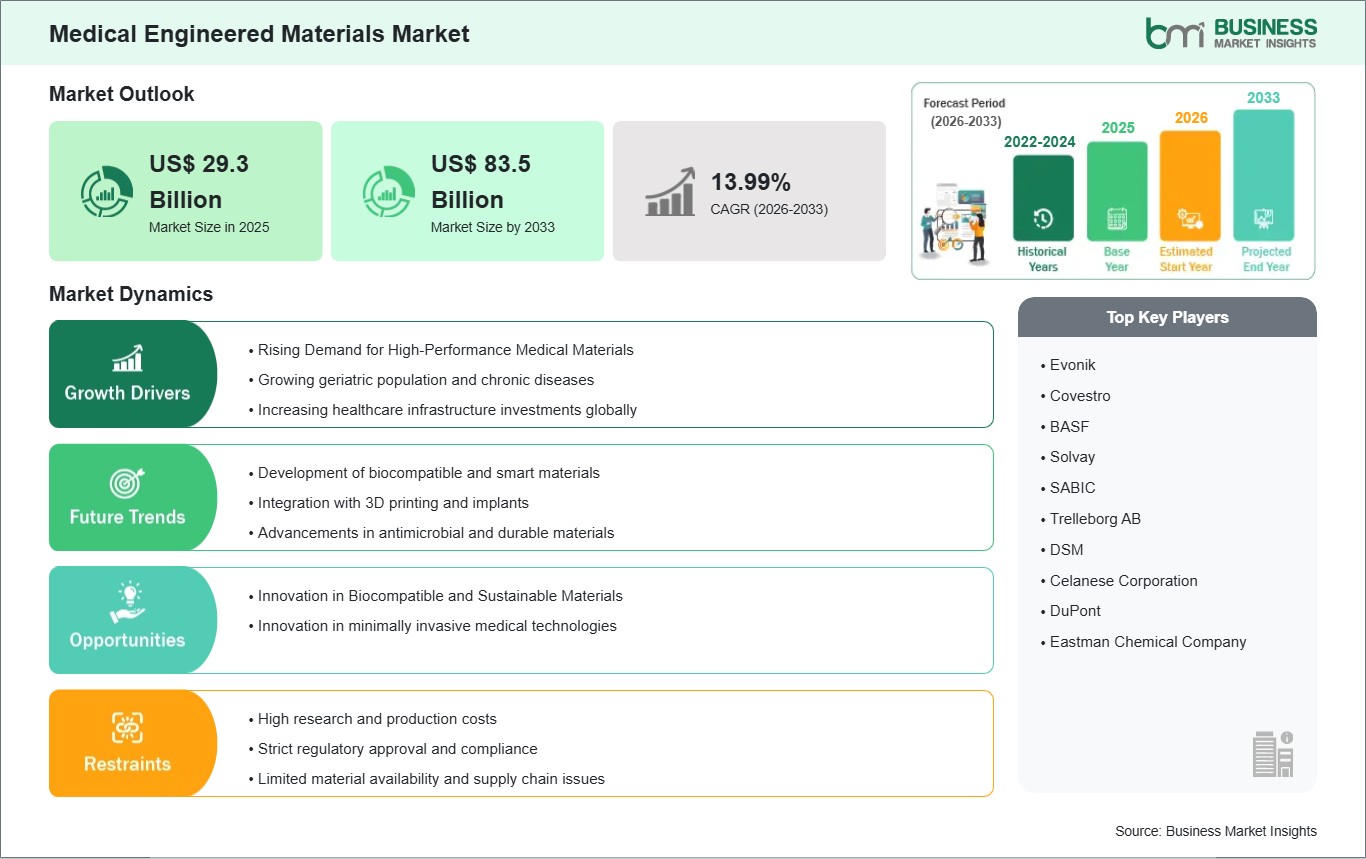
The Medical Engineered Materials Market size is expected to reach US$ 83.5 Billion by 2033 from US$ 29.3 Billion in 2025. The market is estimated to record a CAGR of 13.99% from 2026 to 2033.
The medical engineered material industry is increasing steadily at the global level as medical facilities and medical device manufacturers seek advanced material properties that offer the necessary combination of biocompatibility, durability, and performance. Medical engineered materials include high-performance polymers, composites, bioresorbable polymers, and specialty ceramics. These materials are used in medical implants, surgical instruments, prosthetics, diagnostics, and wearable devices. The industry is driven by the increasing incidence of chronic diseases, the number of surgical procedures, and the aging population that requires long-term implantable medical devices. Advances in material designs seek to improve the mechanical properties of the material, chemical properties, sterilization compatibility, and safety of the material while ensuring the necessary lightweight and flexible properties.
Moreover, there is an increased interest in bioengineered products that are bioresorbable, which reduces the chances of rejection, thus enhancing post-surgical results. The medical industry`s focus on minimally invasive procedures, comfort, and durable products is inspiring manufacturers to invest in research, development, precision engineering, and manufacturing processes that are compliant with industry regulations. Sustainability and cost-effectiveness are also playing a significant role in the choice of medical materials, with companies looking to incorporate recyclable products. Companies that specialize in providing specific solutions, technical assistance, and optimization of medical materials are likely to have a competitive edge in this highly specialized industry.

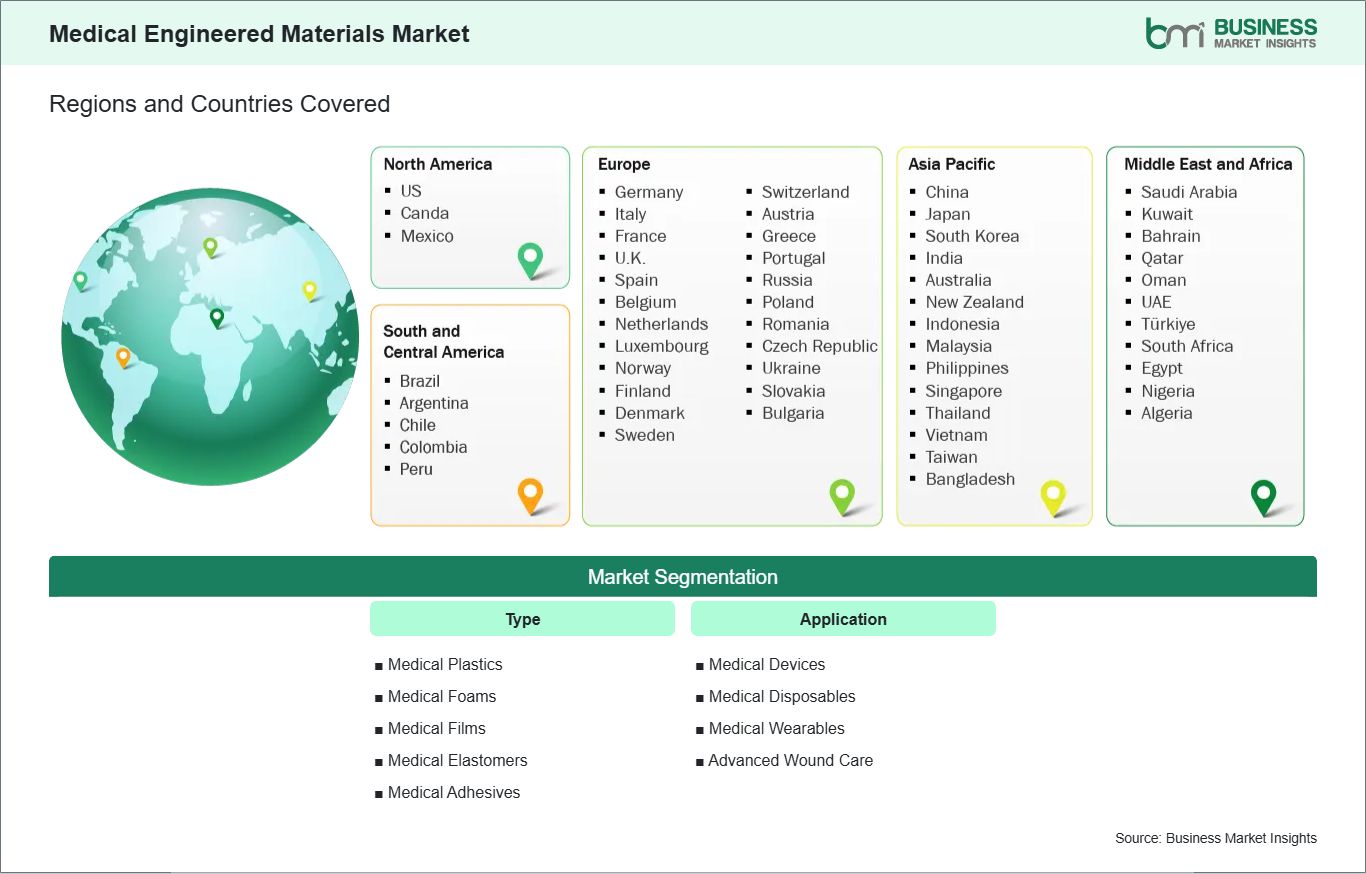
Key segments that contributed to the derivation of the medical engineered materials market analysis are type and application.
The global medical engineered materials market is being driven by the increasing demand for high-performance materials in medical devices, implants, and surgical instruments. Advanced materials are essential to enhance biocompatibility, mechanical strength, and durability, ensuring patient safety and improving clinical outcomes. Hospitals, clinics, and medical device manufacturers are seeking materials that meet rigorous quality standards while enabling innovative treatment solutions. In orthopedic implants, cardiovascular devices, and prosthetics, engineered materials such as biopolymers, ceramics, and specialty metals provide reliable performance under physiological conditions. These materials reduce wear, improve longevity, and minimize risks of infection or rejection.
The rising prevalence of chronic diseases, aging populations, and the growing number of minimally invasive procedures are further increasing demand for high-quality medical materials. Additionally, medical research and product development are encouraging the adoption of engineered materials capable of supporting drug delivery systems, tissue engineering, and diagnostic devices. The combination of functional performance, safety, and regulatory compliance is positioning the medical engineered materials market for steady growth across hospitals, research institutions, and medical device manufacturing.
Technological advancements are driving innovation in medical engineered materials, focusing on biocompatibility, sustainability, and multifunctionality. Manufacturers are developing materials that are lightweight, durable, and compatible with human tissue while minimizing environmental impact. Eco-friendly production methods and recyclable or bio-based materials are gaining traction to meet regulatory and sustainability standards. Research is also focused on creating materials with enhanced antimicrobial, anti-inflammatory, or controlled-release properties, enabling next-generation implants, wound care products, and medical devices.
Advanced polymers, composites, and ceramics allow for improved design flexibility, performance under stress, and tailored functionality for specific applications. Collaborations between material scientists, medical device developers, and healthcare providers are accelerating the creation of application-specific solutions. The integration of performance, safety, and sustainability in engineered medical materials is driving wider adoption and positioning the market for long-term global growth across surgical, diagnostic, and therapeutic applications.

The medical engineered materials market demonstrates steady growth, with size and share analysis highlighting evolving trends and competitive dynamics among key players. The report examines subsegments categorized within type and application, offering insights into their contribution to overall market performance.
By Type, the medical plastics subsegment dominated the market in 2025, driven by its extensive use in medical devices, diagnostic tools, disposables, and other healthcare equipment.
Based on Application, the medical disposables subsegment dominated the market in 2025, supported by increasing demand for consumable medical products such as surgical supplies and laboratory accessories.
| Report Attribute | Details |
|---|---|
| Market size in 2025 | US$ 29.3 Billion |
| Market Size by 2033 | US$ 83.5 Billion |
| Global CAGR (2026 - 2033) | 13.99% |
| Historical Data | 2022-2024 |
| Forecast period | 2026-2033 |
| Segments Covered | By Type
|
|
Regions and Countries Covered
| |
| North America | US, Canada, Mexico |
| Europe | Belgium, Austria, Finland, Denmark, Greece, Poland, Romania, Russia, Ukraine, Czech Republic, Slovakia, Bulgaria, Italy, Luxembourg, Germany, Switzerland, France, Netherlands, Norway, Portugal, Spain, Sweden, United Kingdom |
| Asia-Pacific | Australia, China, India, Japan, South Korea, Indonesia, Malaysia, Philippines, Singapore, Thailand, Vietnam, Bangladesh, New Zealand, Taiwan |
| South and Central America | Brazil, Argentina, Peru, Chile, Colombia |
| Middle East and Africa | Bahrain, Kuwait, Oman, Qatar, Saudi Arabia, United Arab Emirates, Turkiye, South Africa, Egypt, Algeria, Nigeria |
| Market leaders and key company profiles |
|
The "Medical Engineered Materials Market Size and Forecast (2022 - 2033)" report provides a detailed analysis of the market covering below areas:
The geographical scope of the Medical Engineered Materials Market report is divided into North America, Asia Pacific, Europe, Middle East & Africa, and South & Central America. North America held the largest share in 2025.
Regional adoption of medical engineered materials varies based on healthcare infrastructure, technological advancement, and medical device integration. North America dominates, supported by sophisticated healthcare systems and strong adoption of advanced implants, surgical tools, and diagnostics.
Europe demonstrates robust demand, driven by a focus on patient safety, regulatory compliance, and integration of high-performance materials in medical devices.
Asia Pacific is the fastest-growing region, with growth fueled by expanding healthcare access, rising surgeries, and increasing investment in medical device manufacturing.
Middle East & Africa is emerging, supported by modernization of hospitals and growing demand for advanced surgical solutions.
South & Central America is gradually increasing adoption, with growth linked to expanding healthcare services, rising chronic disease prevalence, and adoption of modern medical technologies. Across all regions, product innovation, biocompatibility, performance reliability, and regulatory compliance are key factors driving market expansion and positioning manufacturers to capture long-term opportunities in the medical engineered materials market.

The Medical Engineered Materials Market is evaluated by gathering qualitative and quantitative data post primary and secondary research, which includes important corporate publications, association data, and databases. A few of the key developments in the medical engineered materials market are:
The Medical Engineered Materials Market is valued at US$ 29.3 Billion in 2025, it is projected to reach US$ 83.5 Billion by 2033.
As per our report Medical Engineered Materials Market, the market size is valued at US$ 29.3 Billion in 2025, projecting it to reach US$ 83.5 Billion by 2033. This translates to a CAGR of approximately 13.99% during the forecast period.
The Medical Engineered Materials Market report typically cover these key segments-
The historic period, base year, and forecast period can vary slightly depending on the specific market research report. However, for the Medical Engineered Materials Market report:
The Medical Engineered Materials Market is populated by several key players, each contributing to its growth and innovation. Some of the major players include:
The Medical Engineered Materials Market report is valuable for diverse stakeholders, including:
Essentially, anyone involved in or considering involvement in the Medical Engineered Materials Market value chain can benefit from the information contained in a comprehensive market report.
Please tell us your area of interest
(Market Segments/ Regions and Countries/ Companies)