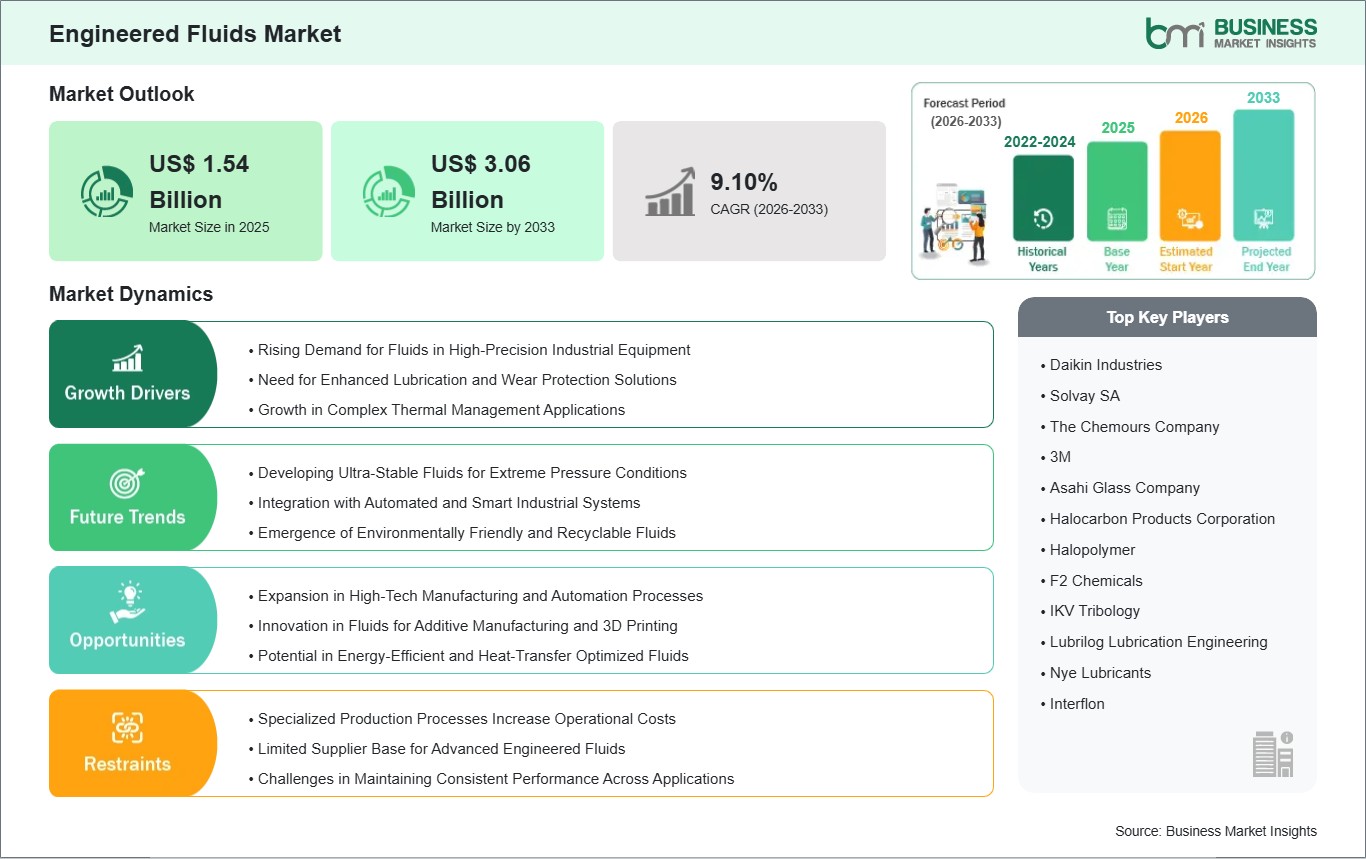
The Engineered Fluids Market size is expected to reach US$ 3.06 Billion by 2033 from US$ 1.54 Billion in 2025 .The market is estimated to record a CAGR of 9.10% from 2026 to 2033.
The definition of the engineered fluids market worldwide can be characterized based on the function it performs in facilitating controlled chemical and physical interactions within highly specialized systems. The fluids are formulated, as opposed to merely being used for lubrication and cooling, to actually impact how materials perform during operation, including surface tension, electrostatics, and chemistry. In industries such as electronics, pharmaceuticals, and various coating processes, engineered fluids function as process enablers, defining product consistency and surface quality. The fluid`s capacity to sustain uniformity in micro-level environments has become critical as product tolerances continue to tighten. A major contributor to the growth of the market has been the increasing requirement for fluids that can function without affecting other sensitive materials, including polymers, semiconductors, or reactive metals. Engineered fluids are commonly used based on the inert or reactive properties of the fluids, which guarantee the fluids will not damage the substrate or alter the properties of the final product. However, the market has also had certain limitations, including the specificity of the formulation of the fluids, which makes it difficult to apply the fluids used for one process to other processes. In addition, the disposal of certain specialty fluids has posed a challenge, especially when working with highly regulated industries. However, the need for fluids that can interact with other materials has continued to grow, thus increasing the importance of engineered fluids.

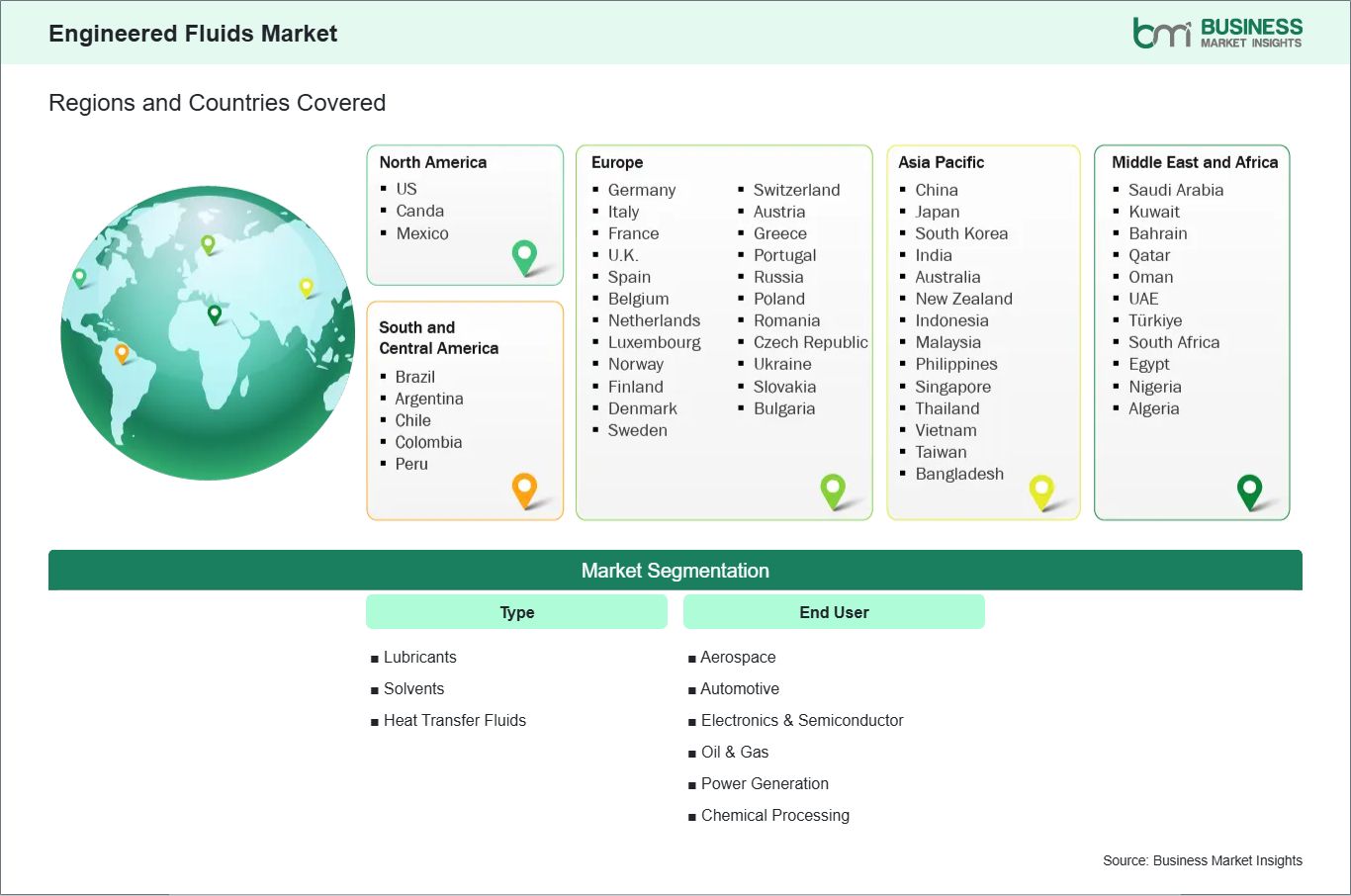
Key segments that contributed to the derivation of the engineered fluids market analysis are type and end user.
The ever-increasing complexity of precise industrial equipment is fueling the need for engineered fluids. The role of these fluids in maintaining the performance and lifespan of precise machinery is critical in the aerospace, electronic, and medical device manufacturing industries. The precise lubrication properties of these fluids are essential in maintaining the accuracy of equipment, as even the slightest change in their properties may have a significant impact on the overall functioning of the machines.
Engineered fluids are being increasingly used in the manufacturing process to improve the efficiency and lifespan of the equipment. The heat and friction produced by the high-speed machines and automated tools are significant and may have a negative impact on the functioning of the machines if not controlled properly. The precise properties of these fluids enable the machines to function smoothly even in the most critical situations.
The adoption of engineered fluids also reflects a broader industry emphasis on quality and reliability. In sectors where precision and tolerance standards are exceptionally high, these fluids are integral to maintaining production integrity. By preventing mechanical failures and reducing maintenance frequency, engineered fluids support both operational efficiency and long-term cost savings, making them a key driver of industrial performance.
The rise of high-tech manufacturing and automated production lines is creating significant opportunities for engineered fluids. Automated machinery, robotics, and precision assembly systems require fluids that can handle rapid movement, tight tolerances, and consistent performance. Engineered fluids enable smoother operation, reduce friction, and extend the life of these high-value assets, supporting the efficiency and scalability of modern factories.
Innovation in formulation is further expanding market potential. Fluids designed for extreme temperatures, specialized chemical resistance, and low environmental impact allow manufacturers to meet the demanding requirements of cutting-edge applications. This opens opportunities in sectors such as semiconductors, renewable energy equipment, and additive manufacturing, where high-performance fluids are essential for maintaining process stability and product quality.
There is also growing demand from maintenance and retrofitting applications. As older production systems are upgraded or integrated with automated lines, engineered fluids are required to ensure compatibility and enhanced performance. With global industries increasingly focusing on automation, precision, and sustainability, the market for engineered fluids is positioned to grow steadily, supporting the next generation of high-tech manufacturing worldwide.

The engineered fluids market is experiencing steady growth, with market size and share analysis reflecting evolving treatment preferences and competitive dynamics among key players. The report evaluates important subsegments categorized within type and end user, highlighting their respective contributions to overall market performance.
By type, the Lubricants subsegment dominated the Engineered Fluids market in 2025. Lubricants offer superior thermal stability, friction reduction, and wear protection, making them highly suitable for industrial and high-performance applications, which drives their widespread adoption.
In terms of end user, the Electronics & Semiconductor subsegment dominated the Engineered Fluids market in 2025. Electronics and semiconductor applications benefit from engineered fluids’ ability to ensure precision cooling, contamination control, and reliability, supporting strong market demand.
| Report Attribute | Details |
|---|---|
| Market size in 2025 | US$ 1.54 Billion |
| Market Size by 2033 | US$ 3.06 Billion |
| Global CAGR (2026 - 2033) | 9.10% |
| Historical Data | 2022-2024 |
| Forecast period | 2026-2033 |
| Segments Covered | By Type
|
|
Regions and Countries Covered
| |
| North America | US, Canada, Mexico |
| Europe | Belgium, Austria, Finland, Denmark, Greece, Poland, Romania, Russia, Ukraine, Czech Republic, Slovakia, Bulgaria, Italy, Luxembourg, Germany, Switzerland, France, Netherlands, Norway, Portugal, Spain, Sweden, United Kingdom |
| Asia-Pacific | Australia, China, India, Japan, South Korea, Indonesia, Malaysia, Philippines, Singapore, Thailand, Vietnam, Bangladesh, New Zealand, Taiwan |
| South and Central America | Brazil, Argentina, Peru, Chile, Colombia |
| Middle East and Africa | Bahrain, Kuwait, Oman, Qatar, Saudi Arabia, United Arab Emirates, Turkiye, South Africa, Egypt, Algeria, Nigeria |
| Market leaders and key company profiles |
|
The "Engineered Fluids Market Size and Forecast (2022 - 2033)" report provides a detailed analysis of the market covering below areas:
The geographical scope of the Engineered Fluids market report is divided into five regions: North America, Asia Pacific, Europe, Middle East & Africa, and South & Central America. The Engineered Fluids market in North America is expected to grow during the forecast period.
North America leads the engineered fluids market due to its strong presence in industries where material compatibility and process precision are critical. The region`s dominance is particularly evident in semiconductor fabrication, medical device manufacturing, and specialty coatings, where fluids must interact with sensitive surfaces without causing contamination or structural change. In these sectors, engineered fluids are evaluated based on how they behave at the interface between materials, rather than just their bulk properties.
A unique characteristic of the North American market is its emphasis on compliance with highly specific chemical regulations and material safety standards. Fluids are often designed to meet strict purity requirements, especially in applications where trace impurities can affect final product performance. Additionally, companies in the region invest heavily in testing fluid behavior under controlled conditions to ensure compatibility with emerging materials such as advanced composites and micro-scale components. While the need for application-specific customization can increase costs and limit standardization, North America`s focus on precision chemistry and material interaction ensures its continued leadership, shaping how engineered fluids are developed and applied in specialized industrial processes worldwide.

The engineered fluids market is evaluated by gathering qualitative and quantitative data post primary and secondary research, which includes important corporate publications, association data, and databases. A few of the key developments in the engineered fluids market are:
The Engineered Fluids Market is valued at US$ 1.54 Billion in 2025, it is projected to reach US$ 3.06 Billion by 2033.
As per our report Engineered Fluids Market, the market size is valued at US$ 1.54 Billion in 2025, projecting it to reach US$ 3.06 Billion by 2033. This translates to a CAGR of approximately 9.10% during the forecast period.
The Engineered Fluids Market report typically cover these key segments-
The historic period, base year, and forecast period can vary slightly depending on the specific market research report. However, for the Engineered Fluids Market report:
The Engineered Fluids Market is populated by several key players, each contributing to its growth and innovation. Some of the major players include:
The Engineered Fluids Market report is valuable for diverse stakeholders, including:
Essentially, anyone involved in or considering involvement in the Engineered Fluids Market value chain can benefit from the information contained in a comprehensive market report.
Please tell us your area of interest
(Market Segments/ Regions and Countries/ Companies)