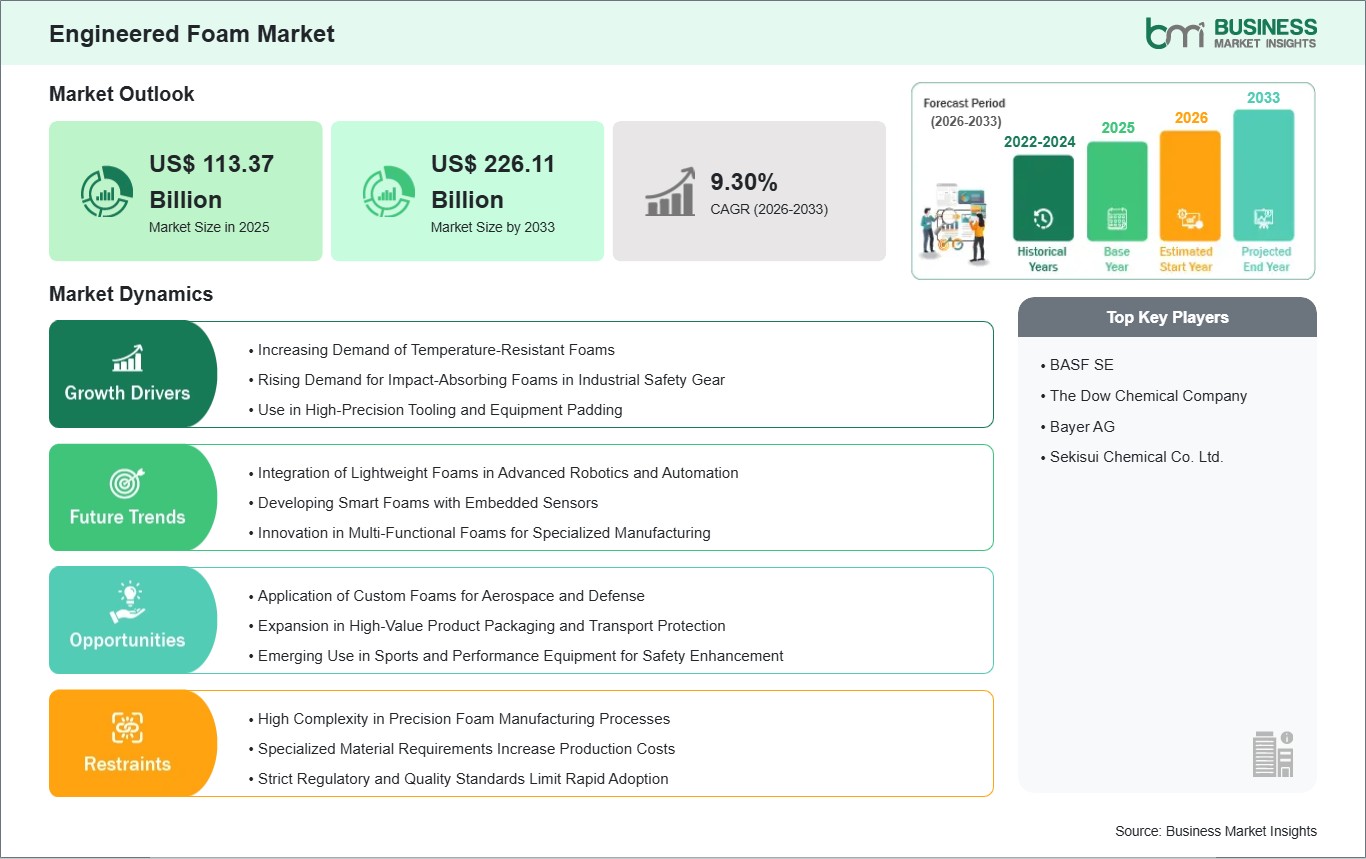
The Engineered Foam Market size is expected to reach US$ 226.11 Billion by 2033 from US$ 113.37 Billion in 2025 .The market is estimated to record a CAGR of 9.30% from 2026 to 2033.
The engineered foam market worldwide is influenced by the need for products that have lightweight properties and are flexible in terms of customization of their structural and functional properties. Engineered foams, like polyurethane, polystyrene, and other polymer-based foams, are being used in the aerospace, automotive, packaging, and sports industries, among others, where the density, impact resistance, and thermal insulation properties are of significant importance. Unlike regular products, engineered foams have the ability to be engineered based on the requirements of their mechanical, thermal, and acoustic properties. Some of the main factors driving this market are the increased focus on product miniaturization and multifunctional components, where foams are required to offer cushioning, vibration damping, and insulation properties. The versatility of engineered foams helps in reducing material complexity and assembly time by incorporating multiple functions into a single part. Some of the main constraints in this market are the cost incurred during production, mainly for specially formulated materials, and difficulties in scaling up complex-structured foams while maintaining uniformity. Another constraint is that some types of foam require careful handling because they are sensitive to temperature and humidity during production. However, constant developments in material science and customization for different applications are contributing to market growth, thus making engineered foams integral to contemporary industrial design.

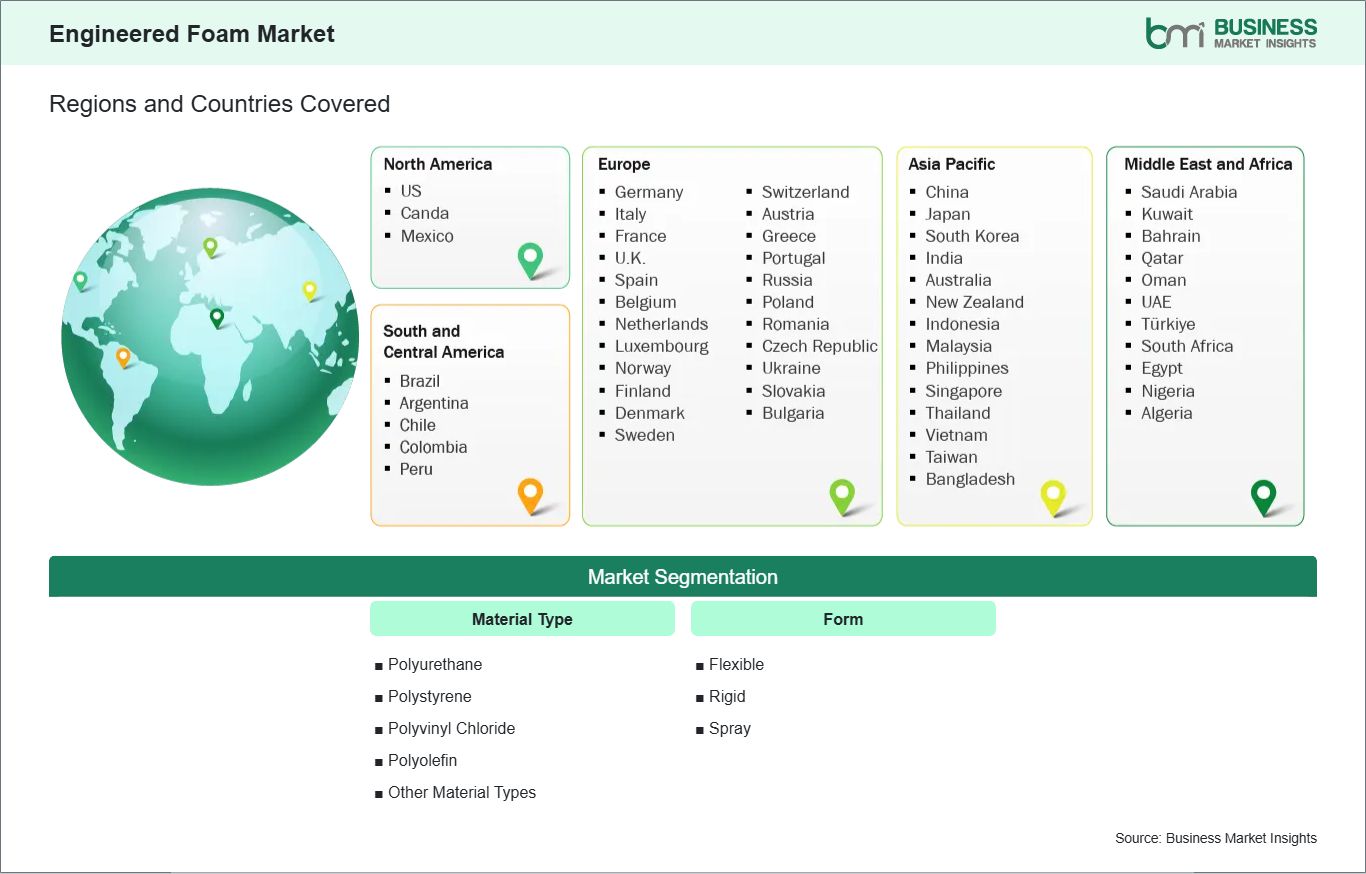
Key segments that contributed to the derivation of the engineered foam market analysis are type, form, and end user.
The demand for temperature-resistant engineered foams is rising as industries require materials that can perform under extreme thermal conditions. These foams are used to insulate equipment, pipelines, and industrial systems where heat retention or protection against high temperatures is critical. Their ability to maintain structural integrity and thermal stability under fluctuating conditions makes them essential in energy, chemical, and heavy machinery sectors.
High-temperature applications often involve both safety and efficiency considerations. Temperature-resistant foams prevent heat loss or protect personnel from exposure to hot surfaces, enhancing operational safety while optimizing energy use. This dual benefit is particularly important in industrial and manufacturing environments where even minor thermal inefficiencies can result in significant operational costs.
In addition to industrial use, temperature-resistant foams are finding applications in electronics and high-performance appliances. Components such as batteries, power electronics, and HVAC systems rely on foams that can withstand high temperatures without degradation. As equipment designs become more compact and thermally demanding, the requirement for engineered foams that deliver reliable performance continues to drive global demand.
Customized foams are generating new and unique opportunities in the aerospace and defense segments. The need for lightweight materials, coupled with their mechanical, thermal, and acoustic properties, is critical in the aerospace and defense industries. Customized foams are being increasingly used in aircraft interiors, missile casings, and vehicle insulation.
The need for fuel-efficient aircraft is generating new opportunities in the aerospace sector, and customized foams are playing a significant role in this area. Customized foams are being used as a replacement material in aircraft and defense applications, as they are lightweight and have the ability to provide the necessary strength and thermal properties required in these applications.
Additionally, innovations in foaming technologies and material formulations are enabling integration into critical components, such as impact-resistant panels, thermal shields, and acoustic liners. This allows aerospace and defense manufacturers to meet stringent safety, performance, and regulatory standards while reducing assembly complexity. As global defense modernization and aerospace expansion continue, custom-engineered foams are poised to play an increasingly strategic role in high-performance, mission-critical applications.

The engineered foam market is experiencing steady growth, with market size and share analysis reflecting evolving treatment preferences and competitive dynamics among key players. The report evaluates important subsegments categorized within type, form, and end user, highlighting their respective contributions to overall market performance.
By material type, the Polyurethane subsegment dominated the Engineered Foam market in 2025. Polyurethane foams offer excellent thermal insulation, mechanical strength, and versatility, making them highly suitable for a wide range of industrial and commercial applications, which drives their widespread adoption.
Based on form, the Rigid subsegment dominated the Engineered Foam market in 2025. Rigid foams provide superior structural support, durability, and thermal performance, supporting strong demand across construction, manufacturing, and insulation applications.
In terms of end user, the Manufacturing & Construction subsegment dominated the Engineered Foam market in 2025. These industries benefit from engineered foams’ ability to enhance product performance, energy efficiency, and cost-effectiveness, reinforcing the dominance of this segment.
| Report Attribute | Details |
|---|---|
| Market size in 2025 | US$ 113.37 Billion |
| Market Size by 2033 | US$ 226.11 Billion |
| Global CAGR (2026 - 2033) | 9.30% |
| Historical Data | 2022-2024 |
| Forecast period | 2026-2033 |
| Segments Covered | By Material Type
|
|
Regions and Countries Covered
| |
| North America | US, Canada, Mexico |
| Europe | Belgium, Austria, Finland, Denmark, Greece, Poland, Romania, Russia, Ukraine, Czech Republic, Slovakia, Bulgaria, Italy, Luxembourg, Germany, Switzerland, France, Netherlands, Norway, Portugal, Spain, Sweden, United Kingdom |
| Asia-Pacific | Australia, China, India, Japan, South Korea, Indonesia, Malaysia, Philippines, Singapore, Thailand, Vietnam, Bangladesh, New Zealand, Taiwan |
| South and Central America | Brazil, Argentina, Peru, Chile, Colombia |
| Middle East and Africa | Bahrain, Kuwait, Oman, Qatar, Saudi Arabia, United Arab Emirates, Turkiye, South Africa, Egypt, Algeria, Nigeria |
| Market leaders and key company profiles |
|
The "Engineered Foam Market Size and Forecast (2022 - 2033)" report provides a detailed analysis of the market covering below areas:
The geographical scope of the Engineered Foam market report is divided into five regions: North America, Asia Pacific, Europe, Middle East & Africa, and South & Central America. The Engineered Foam market in North America is expected to grow during the forecast period.
North America leads in the global market for engineered foam because of its strong and highly developed ecosystem in terms of technology and industries. In this region, engineered foam plays a critical role in auto parts for absorbing impacts and sound insulation, in aircraft for structural components, and in electronic items for packaging. The region`s industries recognize the value of foam materials beyond their mechanical properties and also for their versatility in new designs that reduce product weights. The unique feature of the North American market is the emphasis given to multifunctional foam solutions, with manufacturers working to create foams that can perform multiple functions, such as thermal management, acoustic dampening, and mechanical cushioning in one product, thus allowing for more efficient product designs. There is cooperation between research centers and market players to create foams for new applications, such as vibration resistance in aerospace or high-impact protection in e-commerce logistics. Despite the high production costs and difficulties in maintaining foam structures in large quantities, the North American market will continue to dominate, as it emphasizes innovation in product designs, material performance, and high-end applications, thus leading the world in trends for engineered foams.

The engineered foam market is evaluated by gathering qualitative and quantitative data post primary and secondary research, which includes important corporate publications, association data, and databases. A few of the key developments in the engineered foam market are:
The Engineered Foam Market is valued at US$ 113.37 Billion in 2025, it is projected to reach US$ 226.11 Billion by 2033.
As per our report Engineered Foam Market, the market size is valued at US$ 113.37 Billion in 2025, projecting it to reach US$ 226.11 Billion by 2033. This translates to a CAGR of approximately 9.30% during the forecast period.
The Engineered Foam Market report typically cover these key segments-
The historic period, base year, and forecast period can vary slightly depending on the specific market research report. However, for the Engineered Foam Market report:
The Engineered Foam Market is populated by several key players, each contributing to its growth and innovation. Some of the major players include:
The Engineered Foam Market report is valuable for diverse stakeholders, including:
Essentially, anyone involved in or considering involvement in the Engineered Foam Market value chain can benefit from the information contained in a comprehensive market report.
Please tell us your area of interest
(Market Segments/ Regions and Countries/ Companies)