Market Summary
Executive Summary and Global Market Analysis
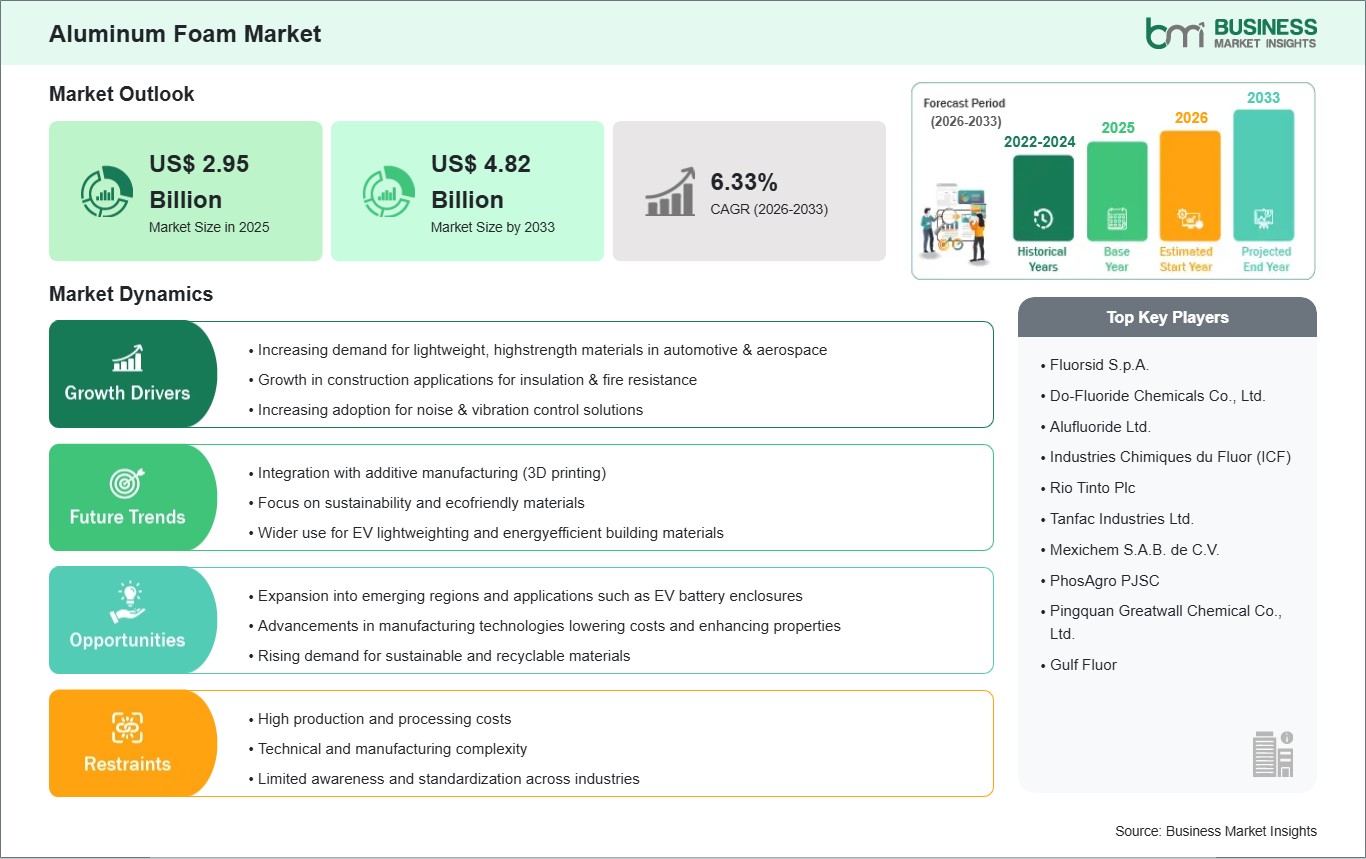
Aluminum foam has several unique features, including low density, a high stiffness-to-weight ratio, excellent sound absorption, thermal insulation, and outstanding impact resistance. The market includes both open-cell and closed-cell aluminum foams made through different manufacturing methods. These materials are increasingly used in automotive, aerospace, construction, industrial machinery, defense, and transportation to promote safety, reduce noise, and enhance structural efficiency. The growing focus on lightweight design, fuel efficiency, and better crash management systems is helping adoption, especially in mobility and infrastructure projects.
The market is changing due to improvements in foam production technology, better control of pore structure, and connections with composite systems. However, challenges like high production costs, limited large-scale manufacturing capabilities, and issues with design standardization still exist. Ongoing investments in research and development, expansions at pilot-scale, and rising interest from automotive manufacturers and construction companies are boosting commercialization prospects. In the medium to long term, the increasing use of aluminum foam in electric vehicles, eco-friendly buildings, and defense projects, along with recycling-friendly manufacturing methods, is expected to solidify the role of aluminum foam in sustainable and high-performance material solutions.
Segment Analysis
Aluminum Foam Market Segmentation
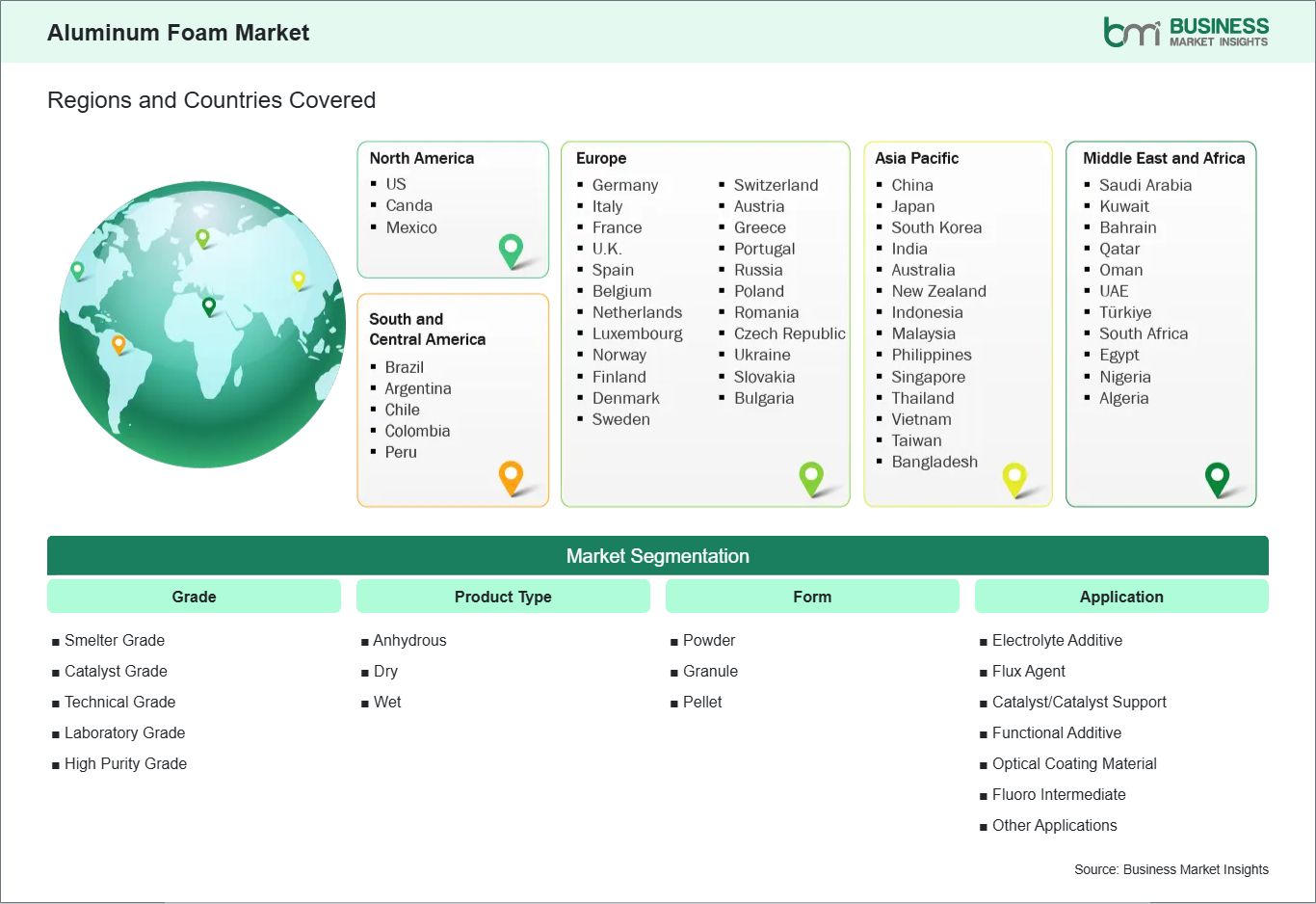
Key segments that contributed to the derivation of the aluminum foam market analysis are type, application, and end-use industry.
- By type, the market is segmented into open-cell aluminum foam and closed-cell aluminum foam. The closed-cell aluminum foam segment dominated the market in 2025.
- By application, the market is segmented into anti-intrusion bars, heat exchangers, sound absorbers, filters, and others. The anti-intrusion bars segment dominated the market in 2025.
- By end-use industry, the market is segmented into automotive, construction and infrastructure, industrial, and others. The automotive segment held the largest market share in 2025.
Market Forces
Aluminum Foam Market Drivers and Opportunities
Rising Demand for Lightweight and Energy-Absorbing Materials
Aluminum foam has a unique blend of low density, high stiffness, and excellent impact resistance, making it ideal for anti-intrusion bars, crash management systems, and structural reinforcements. In the automotive sector, increasing focus on passenger safety and fuel efficiency is pushing manufacturers to use lightweight materials that can cut vehicle weight without sacrificing structural strength. Moreover, the growth of electric vehicles is boosting the need for materials that extend range while providing thermal insulation and battery protection. In construction and infrastructure, aluminum foam is being used more often for noise reduction, vibration damping, and impact control in buildings and transport systems. Its recyclability and resistance to corrosion also support its use in applications where durability and sustainability matter, solidifying its role as an important factor in market growth.
Expanding Use in Electric Vehicles and Sustainable Construction
Open-cell aluminum foam is becoming popular for heat exchangers, filters, and sound absorbers because of its high surface area, permeability, and thermal conductivity. As industries look for compact, energy-efficient cooling systems and better noise control, aluminum foam provides a good alternative to traditional materials. The growth in industrial automation, renewable energy systems, and manufacturing facilities is driving the demand for effective heat dissipation and filtration solutions.
In construction and infrastructure, increased investments in smart cities and sustainable buildings are creating chances for aluminum foam-based sound and insulation systems. Ongoing improvements in foam manufacturing technologies, such as better pore structure control and cost savings, are likely to enhance scalability and performance. These developments position aluminum foam as a hopeful material for the next generation of thermal and acoustic applications, paving the way for long-term market growth.
Size and Share Analysis
Aluminum Foam Market Size and Share Analysis
The aluminum foam market demonstrates steady growth, with size and share analysis revealing evolving trends and competitive positioning among key players. The report further examines subsegments categorized within type, application, and end-use industry, offering insights into their contribution to overall market performance. By type, the closed-cell aluminum foam subsegment holds the largest market share. This dominance is due to its high compressive strength, excellent energy absorption, and strong stability under impact. Closed-cell aluminum foam is commonly used in anti-intrusion bars and structural reinforcement components, especially in cars, where passenger safety and reducing weight are crucial. Its ability to keep mechanical strength while lowering overall mass helps solidify its market position. The growth in this segment comes from stricter vehicle safety rules, an increase in electric vehicle production, and a higher demand for lightweight, crash-resistant materials. Continuous improvements in manufacturing processes and the uniformity of the foam are also improving performance consistency, which encourages wider use in automotive and industrial applications.
Report Coverage
Aluminum Foam Market Report Coverage and Deliverables
The " Aluminum Foam Market Size and Forecast (2022–2033)" report provides a detailed analysis of the market covering below areas:
- Aluminum foam market size and forecast at global, regional, and country levels for all the key market segments covered under the scope
- Aluminum foam market trends, as well as market dynamics such as drivers, restraints, and key opportunities
- Aluminum foam market analysis covering key market trends, global and regional framework, major players, regulations, and recent market developments
- Industry landscape and competition analysis covering market concentration, heat map analysis, prominent players, and recent developments for the aluminum foam market
- Detailed company profiles, including SWOT analysis
Geographic Insights
Aluminum Foam Market Geographic Insights
The geographical scope of the aluminum foam market report is divided into five regions: North America, Asia Pacific, Europe, the Middle East & Africa, and South & Central America. The aluminum foam market in Asia Pacific is expected to grow significantly during the forecast period. This is due to rapid industrial growth, increased automotive production, and rising infrastructure investments in the region. Countries like China, Japan, and South Korea are leading in the use of lightweight materials to support electric vehicles, high-speed trains, and urban construction. The region has strong aluminum production capacity, affordable manufacturing, and growing research and development focused on improving materials. Automotive companies in Asia Pacific are using aluminum foam more in safety and structural parts to meet tougher safety and efficiency standards.
Additionally, large infrastructure projects are increasing the need for sound absorption and impact reduction solutions. North America and Europe are also significant markets, driven by strong demand in aerospace, automotive safety, and industrial uses. However, Asia Pacific's manufacturing scale, end-use demand, and supportive government actions make it the top region in the global aluminum foam market.
Industry Activity
Recent Developments
The aluminum foam market is evaluated by gathering qualitative and quantitative data post primary and secondary research, which includes important corporate publications, association data, and databases. A few of the key developments in the aluminum foam market are:
- In May 2025, Cymat Technologies increased its production capacity for aluminum foam panels. This move aimed to meet rising demand from the automotive and architectural noise-control markets. It supports the use of lighter and more sustainable materials.
- In April 2025, Shinko Wire Company reported progress in making closed-cell aluminum foam. This improvement enhances energy absorption performance for automotive crash management systems.
Trust & Transparency
Research Methodology
The market analysis combines proprietary research with secondary data from government agencies, company disclosures, regulatory filings, industry databases and expert interviews. Market estimates are validated through data triangulation, cross-market benchmarking and analyst
review.
View Full Research Methodology
Key Sources Referred:
World Bank – Global Trade IndicatorsWorld Trade Organization (WTO)International Monetary Fund (IMF)International Trade Administration (ITA)Company WebsitesCompany Annual ReportsCompany Investor PresentationsThe Aluminum Association (AA)International Aluminum Institute (IAI)World Foundry Organization (WFO)Asia Pacific Aluminum Council (APAC)European Foundry Association (CAEF)