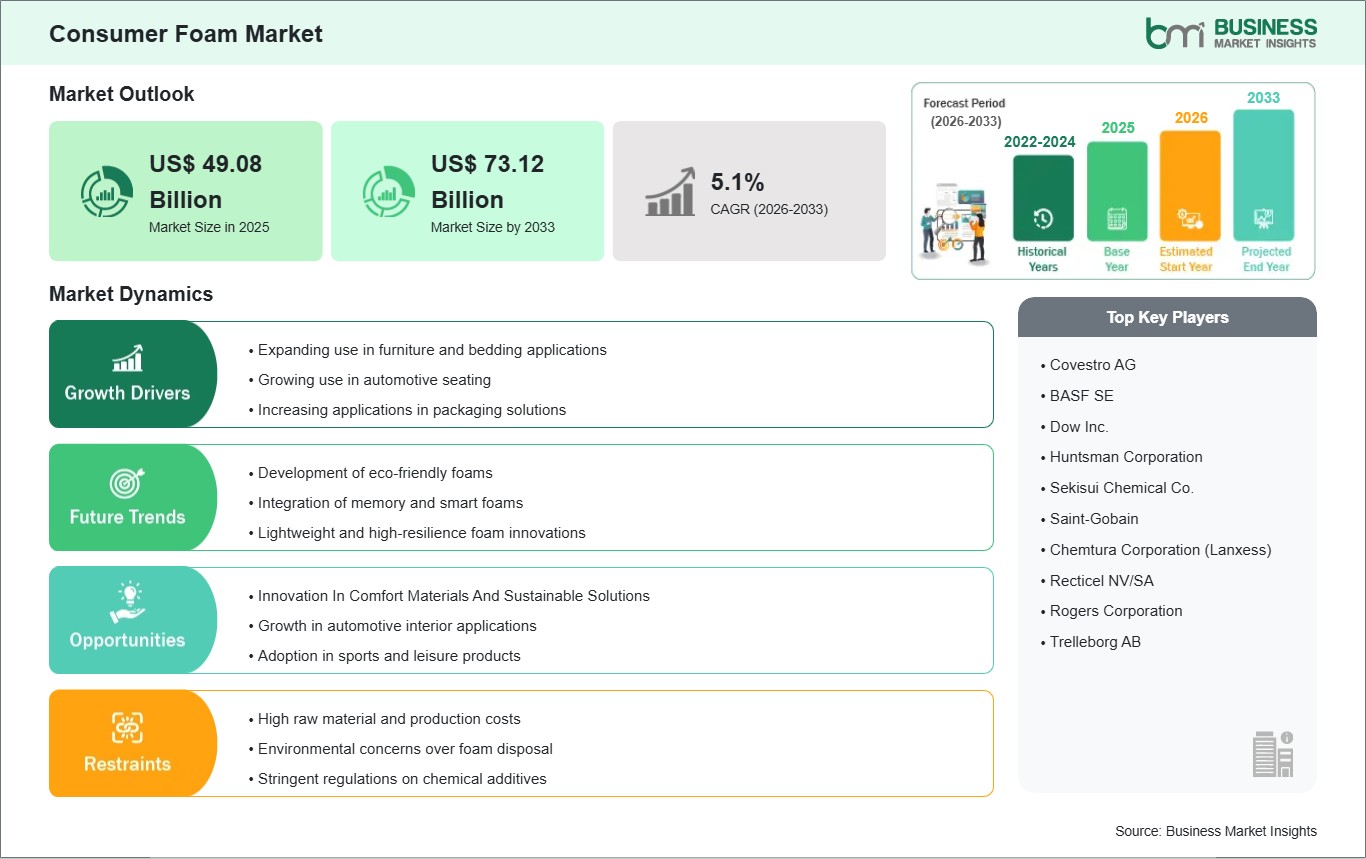
The consumer foam market size is expected to reach US$ 73.12 billion by 2033 from US$ 49.08 billion in 2025. The market is estimated to record a CAGR of 5.1% from 2026 to 2033.
The consumer foam market is showing positive growth trends, primarily driven by the increasing demand for comfort-oriented, lightweight, and performance-enhancing materials in daily consumer applications. Consumer foams, which include polyurethane, polystyrene, and polyolefin types, are widely used in bedding, furniture, footwear, consumer electronics, and automotive interior applications where cushioning, insulation, and durability are key performance characteristics. Increased consumer focus on ergonomics, sleep, and comfort has led to a significant increase in demand for high-performance consumer foams, including memory foam and high-resilience types. Bedding and furniture are other key demand drivers, fueled by urbanization, increasing disposable incomes, and home improvement trends in both developed and developing markets. From a material perspective, flexible polyurethane foam continues to be the leading type due to its flexibility, cost advantages, and its ability to be used in a variety of applications ranging from furniture to automotive interiors. Additionally, the integration of consumer foams within sports and recreational equipment, as well as protective gear, is further broadening the scope of consumer foams. This is primarily attributed to the increase in consumer participation in fitness and recreational activities. Market participants are emphasizing the need for innovation in consumer foams, such as eco-friendly foams, bio-based raw materials, and durability, to meet sustainability objectives. However, factors such as environmental concerns for the disposal of foams, recyclability, and the volatility of petrochemical raw materials pricing are affecting the cost structure and innovation strategies of consumer foams. The competitive landscape of consumer foams is influenced by both global chemical companies and specialized consumer foam manufacturers, who are focusing on the development of new and efficient manufacturing technologies. The consumer foams industry is expected to sustain a steady growth rate, considering the dynamics of consumer behavior, innovations, and the increasing scope of consumer foams in enhancing consumer products.

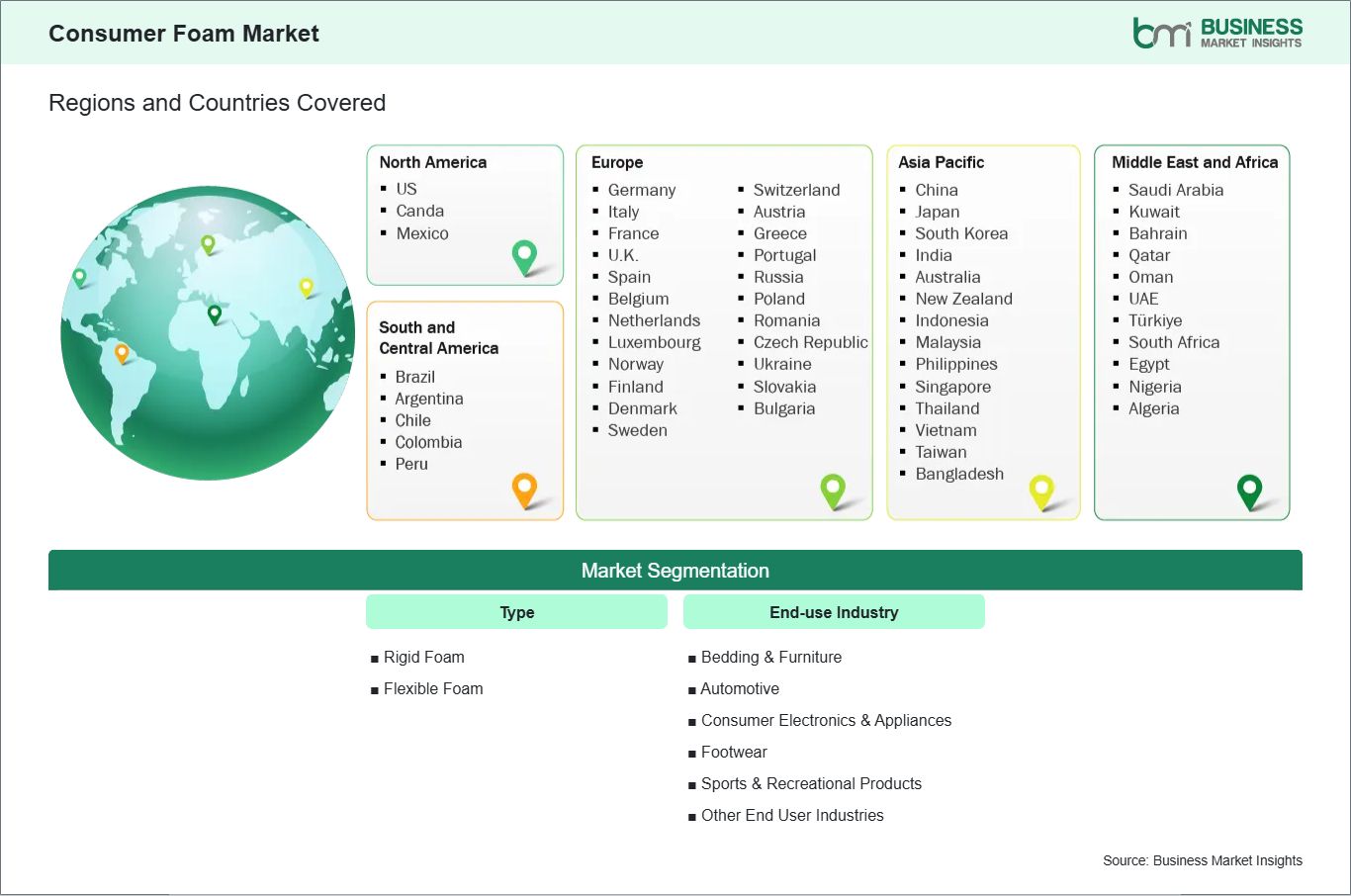
Key segments that contributed to the derivation of the consumer foam market analysis are type and end-use industry.
By Type, the consumer foam market is segmented into rigid foam and flexible foam. The flexible foam segment dominated the market in 2025.
Ont he Basis of End-use Industry, the consumer foam market is segmented into bedding & furniture, automotive, consumer electronics & appliances, footwear, sports & recreational products, and others. The bedding & furniture segment dominated the market in 2025.
Currently, the global consumer foam industry is growing steadily. The consumer foams, such as polyurethane, memory, and latex foams, are used in a wide range of products. The consumer foams are used in mattresses, sofas, cushions, and pillows. The consumer foams are important since they are used to enhance the consumer experience. The consumer foams are important since they are used to provide comfort, support, and durability.
In the bedding industry, the consumer foams are important since they are used to enhance the quality of sleep. The consumer foams, especially memory foams, are important since they are used to adapt to the contours of the consumer's body. The memory foams are important since they are used to distribute the consumer's weight. In furniture, the consumer foams are important since they are used to provide comfort and durability. The consumer foams are important since they are used to enhance the integrity of furniture.
The increasing focus on lifestyle improvement and comfort-oriented products is further supporting the industry. Consumers are seeking products that combine durability with enhanced comfort, leading to higher demand for advanced foam materials. Additionally, the growth of residential construction and home furnishing activities contributes to increased consumption of consumer foam products. The ability of these materials to offer customization, resilience, and long-term performance ensures their continued importance in everyday consumer applications, supporting sustained global demand.
Innovation and sustainability are significant factors in the consumer foam market. Manufacturers are creating innovative foams that not only provide comfort, durability, and performance but also address environmental concerns. New foams are being developed with improved breathability, temperature control, and durability to provide better consumer experiences in bedding and furniture products.
Eco-friendly foams are also becoming more prominent in the market, which is shifting the focus of manufacturers towards creating more eco-friendly foams that not only reduce environmental harm but also provide the properties required in consumer foams. Manufacturers are also trying to develop foams with low emission processes and materials that are environmentally friendly, which is also in line with the shift towards eco-friendly products in the market.
Technological advancements are enabling the development of specialized foams with tailored properties such as enhanced elasticity, moisture resistance, and antimicrobial features. These innovations support a wide range of applications, including healthcare bedding, premium furniture, and travel accessories. The integration of performance-focused and environmentally responsible materials reflects the evolving expectations of consumers and industries alike. As demand for comfort-driven and sustainable solutions continues to rise, innovation in foam materials is expected to remain a central factor in shaping the future of the global consumer foam industry.

The consumer foam market demonstrates steady growth, with size and share analysis highlighting evolving trends and competitive dynamics among key players. The report examines subsegments categorized within type and end-use industry, offering insights into their contribution to overall market performance.
By Type, the flexible foam subsegment dominated the market in 2025, driven by its versatility, lightweight properties, and widespread use across multiple consumer applications.
On the Basis of End-use Industry, the bedding & furniture subsegment dominated the market in 2025, propelled by high demand for foam in mattresses, sofas, and home furnishing products.
| Report Attribute | Details |
|---|---|
| Market size in 2025 | US$ 49.08 Billion |
| Market Size by 2033 | US$ 73.12 Billion |
| Global CAGR (2026 - 2033) | 5.1% |
| Historical Data | 2022-2024 |
| Forecast period | 2026-2033 |
| Segments Covered | By Type
|
|
Regions and Countries Covered
| |
| North America | US, Canada, Mexico |
| Europe | Belgium, Austria, Finland, Denmark, Greece, Poland, Romania, Russia, Ukraine, Czech Republic, Slovakia, Bulgaria, Italy, Luxembourg, Germany, Switzerland, France, Netherlands, Norway, Portugal, Spain, Sweden, United Kingdom |
| Asia-Pacific | Australia, China, India, Japan, South Korea, Indonesia, Malaysia, Philippines, Singapore, Thailand, Vietnam, Bangladesh, New Zealand, Taiwan |
| South and Central America | Brazil, Argentina, Peru, Chile, Colombia |
| Middle East and Africa | Bahrain, Kuwait, Oman, Qatar, Saudi Arabia, United Arab Emirates, Turkiye, South Africa, Egypt, Algeria, Nigeria |
| Market leaders and key company profiles |
|
The "Consumer Foam Market Size and Forecast (2022 - 2033)" report provides a detailed analysis of the market covering below areas:
The geographical scope of the Consumer Foam Market report is divided into North America, Asia Pacific, Europe, Middle East & Africa, and South & Central America. North America held the largest share in 2025.
Regional-level dynamics in the consumer foam market highlight varying growth patterns influenced by consumer lifestyles, industrial development, and economic conditions. North America represents a mature yet dominant market, driven by high consumer spending on premium bedding, furniture, and automotive interiors. The region benefits from strong brand presence, advanced manufacturing capabilities, and a well-established retail ecosystem that supports the adoption of high-performance and specialty foam products. Sustainability trends are also prominent, with increasing demand for eco-friendly and recyclable foam materials. Europe demonstrates stable growth, led by countries such as Germany, France, and the UK, where stringent environmental regulations and consumer preference for sustainable products influence foam manufacturing and consumption. The region shows strong demand for high-quality mattresses, furniture, and insulation materials, supported by a focus on durability and product lifecycle performance. The Asia Pacific region dominates global consumption, driven by rapid urbanization, population growth, and rising disposable incomes in countries such as China and India. Expanding middle-class populations and increasing demand for affordable yet comfortable consumer goods significantly boost foam usage across furniture, footwear, and electronics applications. In the Middle East & Africa, growth is emerging with increasing construction activity and rising consumer awareness of comfort products, although adoption remains uneven due to economic disparities. South & Central America, led by Brazil and Mexico, shows moderate growth supported by expanding residential markets and automotive production, while economic volatility and pricing sensitivity influence purchasing patterns. Collectively, these regional trends reflect a balance between mature markets emphasizing innovation and sustainability, and emerging regions driving volume growth through rising consumer demand.

The Consumer Foam Market is evaluated by gathering qualitative and quantitative data post primary and secondary research, which includes important corporate publications, association data, and databases. A few of the key developments in the consumer foam market are:
The Consumer Foam Market is valued at US$ 49.08 Billion in 2025, it is projected to reach US$ 73.12 Billion by 2033.
As per our report Consumer Foam Market, the market size is valued at US$ 49.08 Billion in 2025, projecting it to reach US$ 73.12 Billion by 2033. This translates to a CAGR of approximately 5.1% during the forecast period.
The Consumer Foam Market report typically cover these key segments-
The historic period, base year, and forecast period can vary slightly depending on the specific market research report. However, for the Consumer Foam Market report:
The Consumer Foam Market is populated by several key players, each contributing to its growth and innovation. Some of the major players include:
The Consumer Foam Market report is valuable for diverse stakeholders, including:
Essentially, anyone involved in or considering involvement in the Consumer Foam Market value chain can benefit from the information contained in a comprehensive market report.
Please tell us your area of interest
(Market Segments/ Regions and Countries/ Companies)