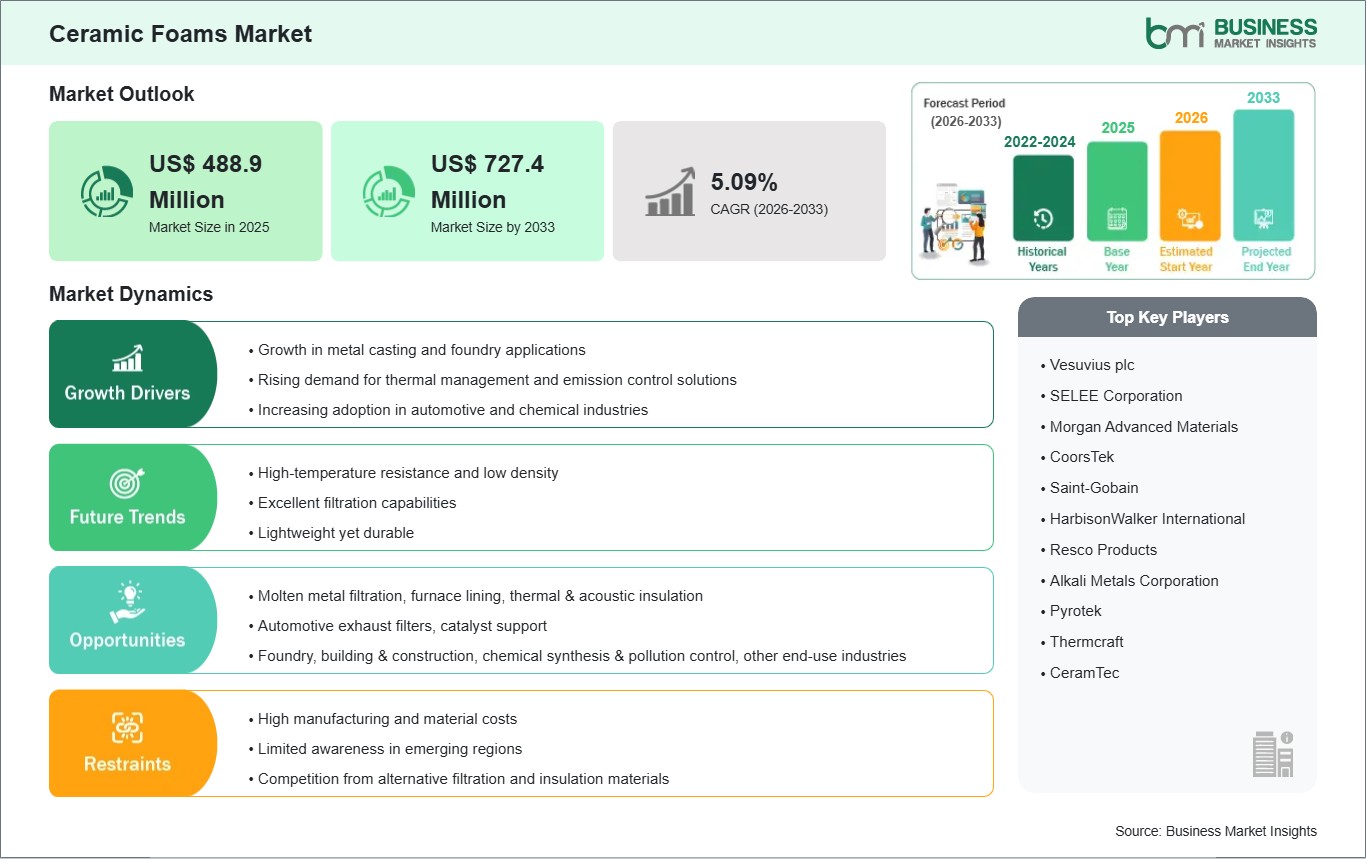
The Ceramic Foams Market size is expected to reach US$ 727.4 Million by 2033 from US$ 488.9 Million in 2025. The market is estimated to record a CAGR of 5.09% from 2026 to 2033.
The global ceramic foams market is experiencing steady growth driven by increasing demand for high-temperature resistant and lightweight materials across industrial applications. Ceramic foams are porous materials characterized by their high thermal stability, low density, and excellent filtration capabilities, making them suitable for use in extreme environments.
Ceramic foams are widely utilized in molten metal filtration, thermal insulation, catalyst support, and exhaust filtration systems. Their ability to withstand high temperatures, resist chemical corrosion, and provide efficient filtration makes them essential in industries such as foundry, automotive, and chemical processing.
Growing industrialization and expansion of metal casting and automotive industries are significantly contributing to market growth. Increasing environmental regulations and the need for efficient pollution control systems are further driving adoption across emission control and filtration applications.

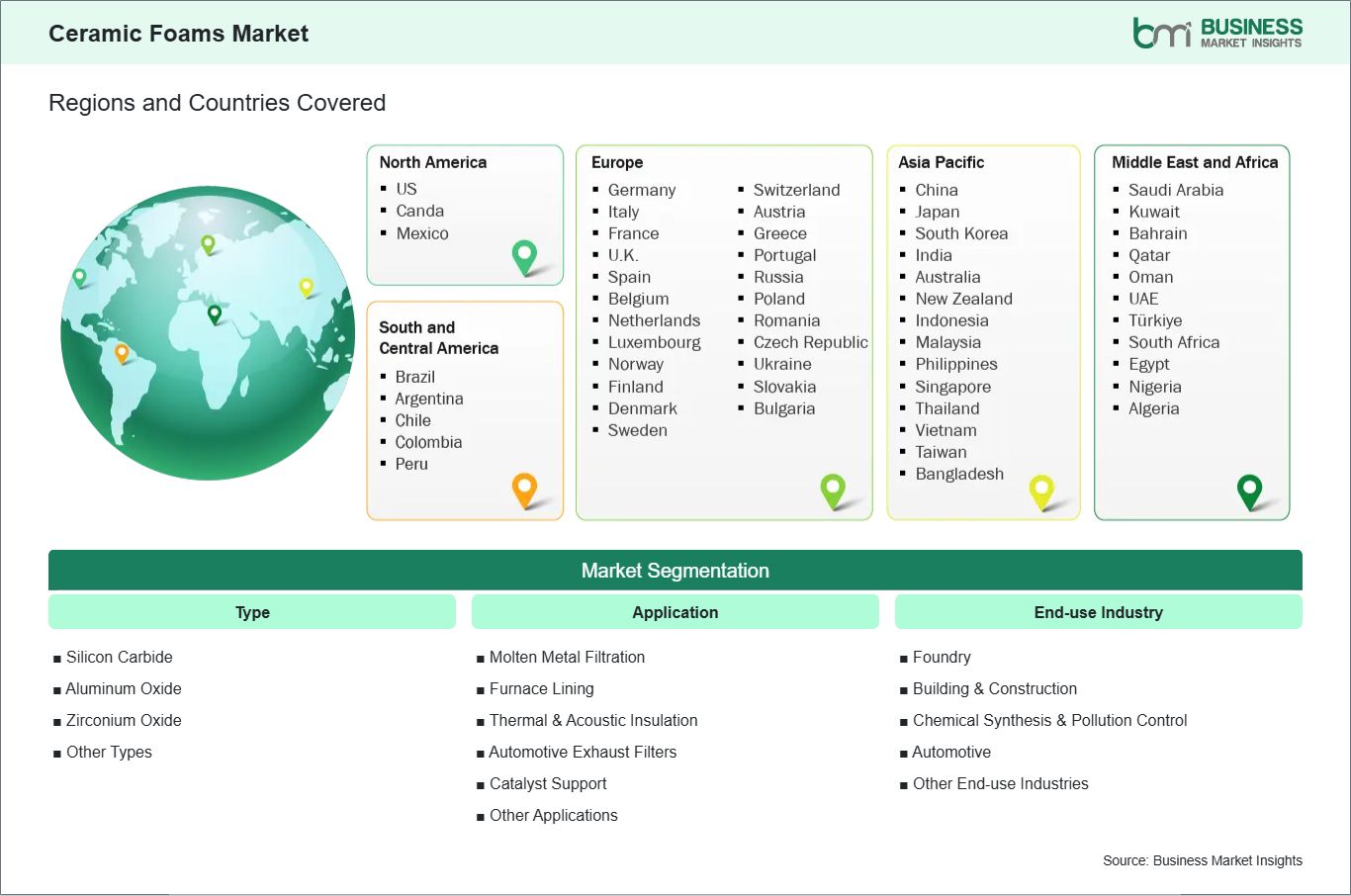
Key segments that contributed to the derivation of the ceramic foams market analysis are type, application, and end-use industry.
The growing popularity of metal castings with high quality is primarily due to the growing demand from industries like automotive, aerospace, and heavy machinery. The role of ceramic foam filters in filtering out molten metals is key to this demand. These filters have a pivotal role in clearing molten metals of all impurities and inclusions that can affect the structural integrity of the cast items. By improving cast product quality, filtration systems reduce defect rates and improve the mechanical properties of metal products by providing a more consistent product. Ceramic foams are therefore critical in modern-day foundry operations because of the demands of precision and dependability.
With the automotive industry placing demands for lightweight but strong components, the need for defect-free castings has become more significant than ever. Aerospace applications also require a very high level of quality and performance; even slight defects can result in expensive failures. With ceramic foams providing the required filtration performance to meet the stringent demands of safety and quality required by both industries, there continue to be growing uses for ceramic foams in many sectors.
Emerging economies are also contributing to the demand for ceramic foams as they look to establish manufacturing bases and invest in newer technologies for the foundry industry.
Ceramic foams are gaining prominence in thermal management and emission control applications due to their unique porous structure and high thermal stability. Their ability to withstand extreme temperatures makes them ideal for use in furnaces, kilns, and industrial heating systems, where efficient insulation is critical for energy conservation and operational safety. By reducing heat loss and improving thermal efficiency, ceramic foams contribute to lower energy consumption and enhanced performance in industrial processes.
In the automotive sector, ceramic foams are widely used in exhaust filters and catalyst support systems. These applications are essential for reducing harmful emissions and ensuring compliance with increasingly stringent environmental regulations worldwide. As governments push for cleaner transportation solutions, ceramic foams provide the durability and efficiency needed to support advanced emission control technologies. Their role in reducing air pollution and improving fuel efficiency positions them as a key material in sustainable mobility.
Beyond automotive, the chemical industry is adopting ceramic foams for catalyst support and filtration processes. Their high surface area and structural stability enhance reaction efficiency, reduce environmental impact, and improve overall process reliability. This makes them valuable in applications ranging from petrochemical refining to specialty chemical production.
The growing emphasis on energy efficiency, pollution reduction, and sustainable industrial practices is creating new opportunities for ceramic foams. Their versatility across thermal management, emission control, and chemical processing ensures that they will remain a vital material in addressing global challenges related to energy use and environmental protection.

The Ceramic Foams Market demonstrates steady growth, with size and share analysis highlighting evolving trends and competitive dynamics among key players. The report examines subsegments categorized within type, application, and end-use industry, offering insights into their contribution to overall market performance.
By type, the silicon carbide subsegment dominated the market in 2025, driven by its superior thermal conductivity and resistance to high temperatures.
In terms of application, the molten metal filtration subsegment dominated the market in 2025, driven by extensive use in foundry operations.
Based on end-use industry, the foundry subsegment dominated the market in 2025, driven by increasing demand for high-quality metal casting and industrial components.
| Report Attribute | Details |
|---|---|
| Market size in 2025 | US$ 488.9 Million |
| Market Size by 2033 | US$ 727.4 Million |
| Global CAGR (2026 - 2033) | 5.09% |
| Historical Data | 2022-2024 |
| Forecast period | 2026-2033 |
| Segments Covered | By Type
|
|
Regions and Countries Covered
| |
| North America | US, Canada, Mexico |
| Europe | Belgium, Austria, Finland, Denmark, Greece, Poland, Romania, Russia, Ukraine, Czech Republic, Slovakia, Bulgaria, Italy, Luxembourg, Germany, Switzerland, France, Netherlands, Norway, Portugal, Spain, Sweden, United Kingdom |
| Asia-Pacific | Australia, China, India, Japan, South Korea, Indonesia, Malaysia, Philippines, Singapore, Thailand, Vietnam, Bangladesh, New Zealand, Taiwan |
| South and Central America | Brazil, Argentina, Peru, Chile, Colombia |
| Middle East and Africa | Bahrain, Kuwait, Oman, Qatar, Saudi Arabia, United Arab Emirates, Turkiye, South Africa, Egypt, Algeria, Nigeria |
| Market leaders and key company profiles |
|
The "Ceramic Foams Market Size and Forecast (2022 - 2033)" report provides a detailed analysis of the market covering below areas:
The geographical scope of the Ceramic Foams Market report is divided into North America, Asia Pacific, Europe, Middle East & Africa, and South & Central America. North America held the largest share in 2025.
North America is witnessing steady growth due to advanced industrial infrastructure and increasing adoption of high-performance materials in aerospace and automotive sectors. Environmental regulations are also encouraging the use of ceramic foams in emission control applications.
Asia Pacific is a key market driven by strong growth in manufacturing, metal casting, and automotive industries in countries such as China, India, and Japan. The region’s expanding industrial base and increasing demand for high-quality metal products are supporting market growth.
Europe is experiencing significant growth, supported by stringent environmental standards and a strong focus on sustainable industrial practices. Countries such as Germany, France, and the UK are adopting advanced filtration and insulation materials, driving demand for ceramic foams.
In the Middle East & Africa, the market is expanding due to industrial development and infrastructure investments. Meanwhile, South & Central America is experiencing moderate growth, supported by rising manufacturing and construction activities.
Across all regions, industrial expansion, environmental regulations, and technological advancements are shaping market dynamics.

The Ceramic Foams Market is evaluated by gathering qualitative and quantitative data post primary and secondary research, which includes important corporate publications, association data, and databases. A few of the key developments in the ceramic foams market are:
The Ceramic Foams Market is valued at US$ 488.9 Million in 2025, it is projected to reach US$ 727.4 Million by 2033.
As per our report Ceramic Foams Market, the market size is valued at US$ 488.9 Million in 2025, projecting it to reach US$ 727.4 Million by 2033. This translates to a CAGR of approximately 5.09% during the forecast period.
The Ceramic Foams Market report typically cover these key segments-
The historic period, base year, and forecast period can vary slightly depending on the specific market research report. However, for the Ceramic Foams Market report:
The Ceramic Foams Market is populated by several key players, each contributing to its growth and innovation. Some of the major players include:
The Ceramic Foams Market report is valuable for diverse stakeholders, including:
Essentially, anyone involved in or considering involvement in the Ceramic Foams Market value chain can benefit from the information contained in a comprehensive market report.
Please tell us your area of interest
(Market Segments/ Regions and Countries/ Companies)