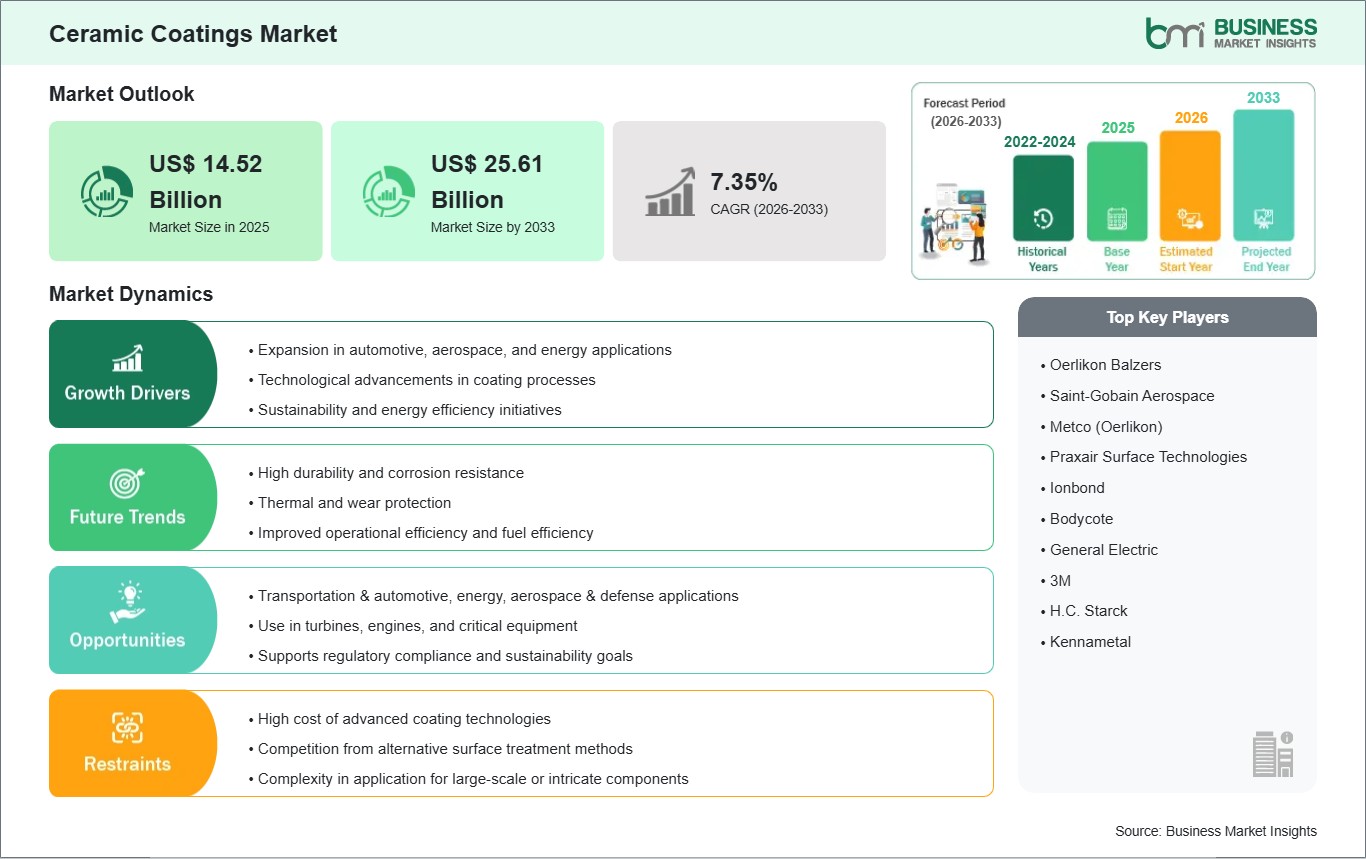
The Ceramic Coatings Market size is expected to reach US$ 25.61 Billion by 2033 from US$ 14.52 Billion in 2025. The market is estimated to record a CAGR of 7.35% from 2026 to 2033.
The global ceramic coatings market is witnessing strong growth driven by increasing demand for high-performance surface protection solutions across various industries. Ceramic coatings are widely used to enhance the durability, corrosion resistance, thermal stability, and wear resistance of components exposed to harsh environments. These coatings are essential in extending the lifespan and improving the efficiency of critical equipment and machinery.
The growing demand from industries such as automotive, aerospace, energy, and industrial manufacturing is significantly contributing to market expansion. Ceramic coatings are increasingly being adopted to improve fuel efficiency, reduce maintenance costs, and enhance operational performance.
Technological advancements in coating processes, including thermal spray, physical vapor deposition (PVD), and chemical vapor deposition (CVD), are further driving market growth. Additionally, the rising focus on sustainability and energy efficiency is encouraging the use of ceramic coatings in applications such as thermal barrier coatings and emission control systems.

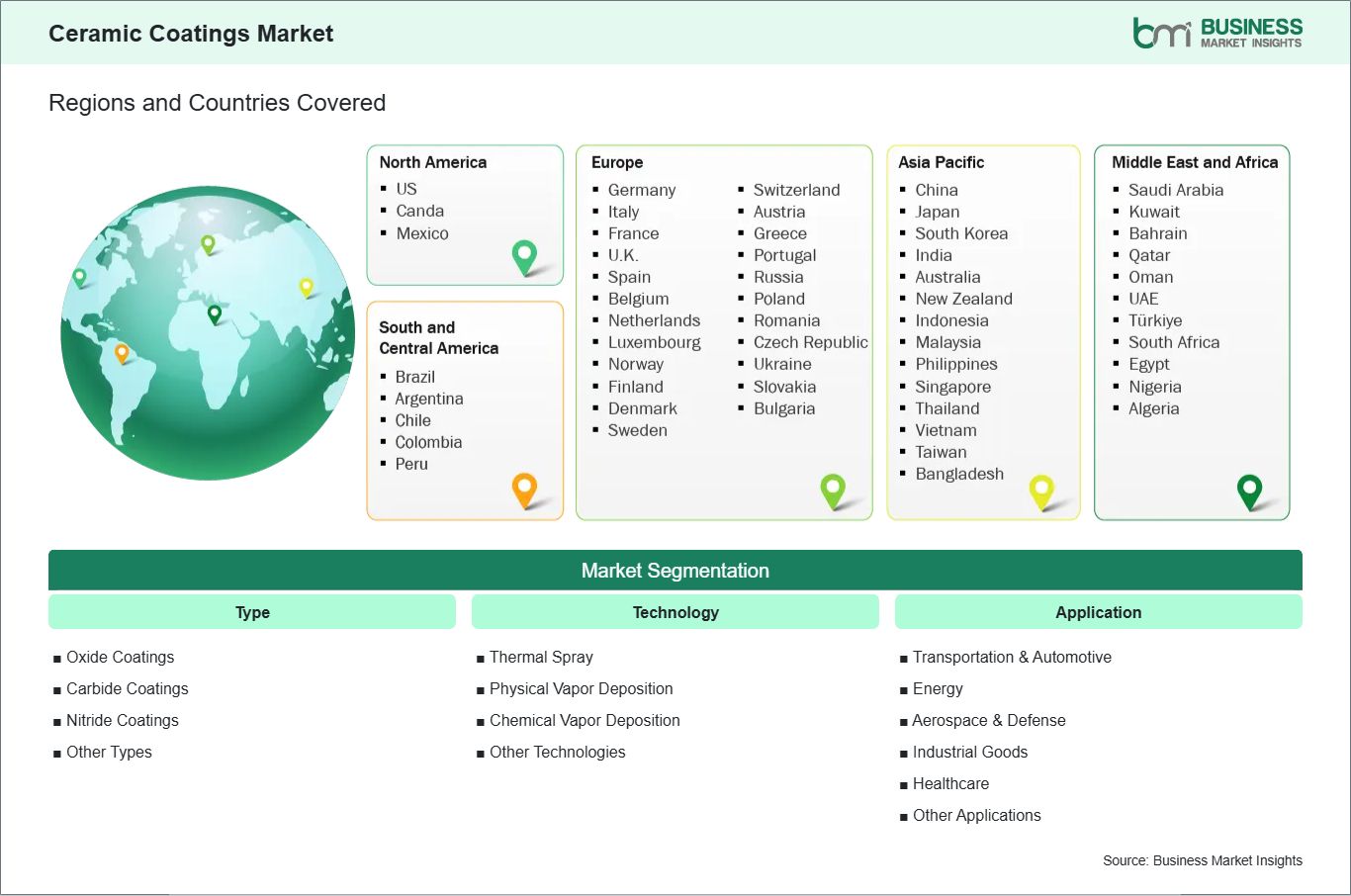
Key segments that contributed to the derivation of the ceramic coatings market analysis are type, technology, and application.
One of the main forces behind the growth of the ceramic coatings market is the increasing need for materials that can withstand severe operating conditions. Industries including automotive, aerospace, and heavy manufacturing require components to withstand wear, corrosion, and extreme heat, while still functioning efficiently and safely. In addition to protecting machine components from wear and corrosion damage, ceramic coatings provide an additional layer of protection for a component's durability through physically preventing the two surfaces from making contact with each other, thus providing a decrease in friction and lengthening the life of critical parts. The combination of these factors results in decreased maintenance costs and improved operational reliability, both of which are critical in industries where even a short period without the use of machinery can result in tremendous expense. In the automotive and transportation industries, ceramic coatings are being applied to engine parts, exhaust systems, and braking systems with increasing frequency. Ceramic coatings' ability to withstand higher levels of thermal loading and lower levels of friction contribute directly to increased fuel efficiency and decreased levels of emissions. This directly supports global environmental regulations that dictate that vehicles must be cleaner and more fuel-efficient than in the past. In addition to performance advantages, consumers place a high value on the aesthetic advantages of ceramic coatings, such as scratch resistance and long-lasting appearance.
As many industries seek to maximize performance and sustainable development, ceramic coatings are quickly becoming a necessity. The ability of ceramic coatings to reduce environmental and safety regulatory requirements, in conjunction with the many advantages they provide in the area of wear reduction and increased efficiency, are also providing manufacturers with a method of complying with ever-stricter regulations. As global demand for higher performing products continues to grow, so too will the ceramic coatings market.
The aerospace and energy industries offer some of the most promising opportunities for ceramic coating growth in years to come. For example, ceramic coatings are widely used in the aerospace industry to provide thermal insulation in engines and turbines, allowing the various components to endure exceptionally high temperatures while reaching peak operating efficiencies. This is significant as the increasing demand for air travel and military equipment continues to grow, thereby increasing the usage of advanced materials with the ability to provide performance and safety. Therefore, the ceramic coating technology is essential for the aviation industry, as it enhances fuel efficiency, decreases the frequency of maintenance cycles, and increases the operational lifespan of aircraft engines.
In the energy sector, ceramic coatings are also used in equipment used in power generation, oil and gas, and renewable energy systems. Due to their resistance to corrosion, oxidation, and thermal degradation, ceramic coatings deliver consistent performance in challenging operating environments. For example, ceramic coatings offer protection against wear and chemical exposure for all turbine applications at power plants and for all pipelines that are associated with oil and gas production. As the global energy infrastructure expands, it is expected that the demand for durable, high-efficiency coatings will also rise substantially.
In addition, the industrial manufacturing industry indicates a significant reliance on ceramic coatings to enhance the operational life of tools, machinery, and equipment in production. The reduction of wear and increased resistance to harsh operating conditions that result from using ceramic coatings will ultimately improve productivity.

The Ceramic Coatings Market demonstrates steady growth, with size and share analysis highlighting evolving trends and competitive dynamics among key players. The report examines subsegments categorized within type, technology, and application, offering insights into their contribution to overall market performance.
Based on type, the oxide coatings subsegment dominated the market in 2025, driven by their widespread use in thermal barrier and corrosion-resistant applications.
Based on technology, the thermal spray subsegment dominated the market in 2025, driven by its cost-effectiveness and versatility in coating large surfaces.
In terms of application, the transportation & automotive subsegment dominated the market in 2025, driven by increasing demand for fuel-efficient and durable vehicle components.
| Report Attribute | Details |
|---|---|
| Market size in 2025 | US$ 14.52 Billion |
| Market Size by 2033 | US$ 25.61 Billion |
| Global CAGR (2026 - 2033) | 7.35% |
| Historical Data | 2022-2024 |
| Forecast period | 2026-2033 |
| Segments Covered | By Type
|
|
Regions and Countries Covered
| |
| North America | US, Canada, Mexico |
| Europe | Belgium, Austria, Finland, Denmark, Greece, Poland, Romania, Russia, Ukraine, Czech Republic, Slovakia, Bulgaria, Italy, Luxembourg, Germany, Switzerland, France, Netherlands, Norway, Portugal, Spain, Sweden, United Kingdom |
| Asia-Pacific | Australia, China, India, Japan, South Korea, Indonesia, Malaysia, Philippines, Singapore, Thailand, Vietnam, Bangladesh, New Zealand, Taiwan |
| South and Central America | Brazil, Argentina, Peru, Chile, Colombia |
| Middle East and Africa | Bahrain, Kuwait, Oman, Qatar, Saudi Arabia, United Arab Emirates, Turkiye, South Africa, Egypt, Algeria, Nigeria |
| Market leaders and key company profiles |
|
The "Ceramic Coatings Market Size and Forecast (2022 - 2033)" report provides a detailed analysis of the market covering below areas:
The geographical scope of the Ceramic Coatings Market report is divided into North America, Asia Pacific, Europe, Middle East & Africa, and South & Central America. North America held the largest share in 2025.
North America is a mature market characterized by strong demand from aerospace, automotive, and energy sectors. The presence of advanced manufacturing capabilities and significant investments in research and development are driving the adoption of ceramic coatings in the region.
Europe is witnessing steady growth, supported by stringent environmental regulations and a strong automotive and aerospace industry base. Countries such as Germany, France, and the UK are focusing on energy-efficient technologies, driving demand for ceramic coatings.
Asia Pacific is expected to register significant growth due to rapid industrialization, urbanization, and expansion of manufacturing industries. Countries such as China, India, Japan, and South Korea are key contributors to market growth, driven by increasing demand from automotive and industrial sectors.
In the Middle East & Africa, the market is expanding due to growth in oil & gas and energy sectors. Meanwhile, South & Central America is experiencing moderate growth, supported by industrial development and infrastructure investments.
Across all regions, technological advancements, industrial expansion, and sustainability initiatives are shaping market dynamics.

The Ceramic Coatings Market is evaluated by gathering qualitative and quantitative data post primary and secondary research, which includes important corporate publications, association data, and databases. A few of the key developments in the ceramic coatings market are:
The Ceramic Coatings Market is valued at US$ 14.52 Billion in 2025, it is projected to reach US$ 25.61 Billion by 2033.
As per our report Ceramic Coatings Market, the market size is valued at US$ 14.52 Billion in 2025, projecting it to reach US$ 25.61 Billion by 2033. This translates to a CAGR of approximately 7.35% during the forecast period.
The Ceramic Coatings Market report typically cover these key segments-
The historic period, base year, and forecast period can vary slightly depending on the specific market research report. However, for the Ceramic Coatings Market report:
The Ceramic Coatings Market is populated by several key players, each contributing to its growth and innovation. Some of the major players include:
The Ceramic Coatings Market report is valuable for diverse stakeholders, including:
Essentially, anyone involved in or considering involvement in the Ceramic Coatings Market value chain can benefit from the information contained in a comprehensive market report.
Please tell us your area of interest
(Market Segments/ Regions and Countries/ Companies)