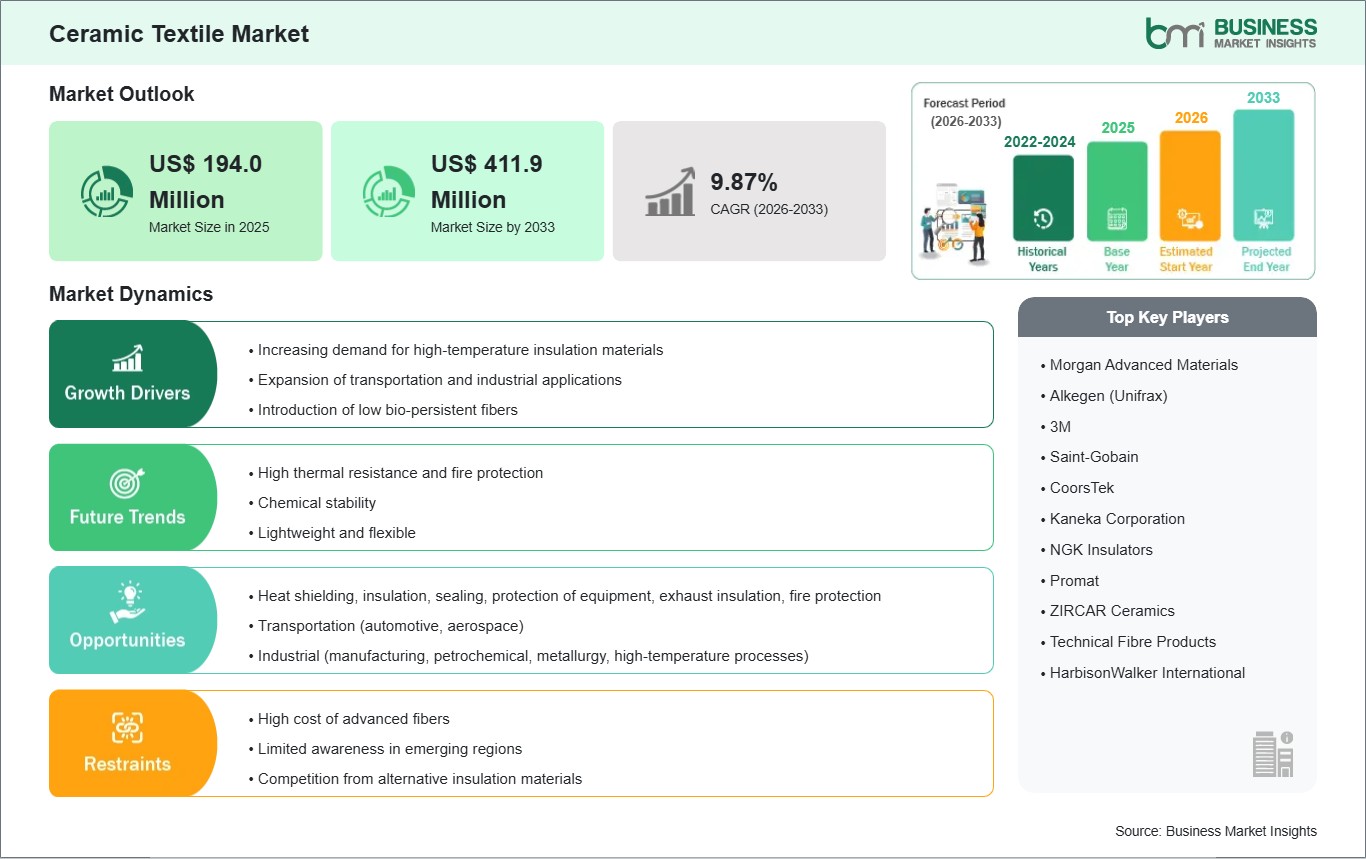
The Ceramic Textile Market size is expected to reach US$ 411.9 Million by 2033 from US$ 194.0 Million in 2025. The market is estimated to record a CAGR of 9.87% from 2026 to 2033.
The global ceramic textile market is experiencing steady growth driven by increasing demand for high-temperature resistant and lightweight insulation materials across industrial applications. Ceramic textiles are composed of refractory ceramic fibers and are widely used in extreme heat environments due to their excellent thermal insulation, fire resistance, and chemical stability.
These materials are commonly utilized in applications such as heat shielding, insulation, sealing, and protection of equipment operating under high temperatures. Their flexibility and durability make them suitable for use in furnaces, kilns, exhaust systems, and fire protection systems.
The growing emphasis on energy efficiency, safety standards, and industrial performance is significantly contributing to market growth. Additionally, advancements in fiber technology are improving the performance characteristics of ceramic textiles, including enhanced thermal resistance and reduced health risks associated with traditional materials.

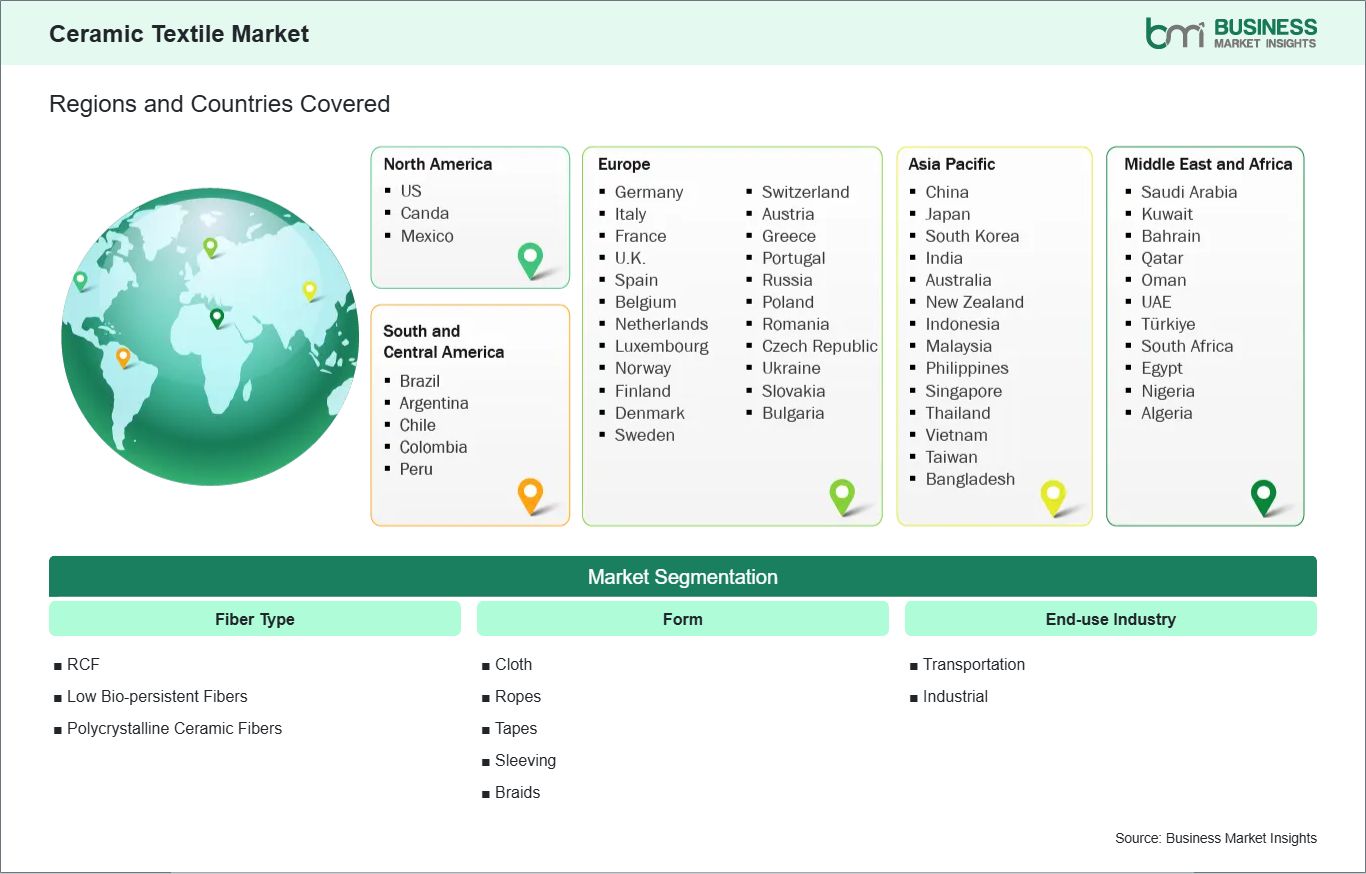
Key segments that contributed to the derivation of the ceramic textile market analysis are fiber type, form, and end-use industry.
Ceramic textiles are becoming increasingly necessary in the production of materials that can handle extreme temperatures in a variety of industrial applications. Industries that use metals, generate power, or manufacture advanced products all require insulation to be effective and efficient, safe for workers, and ensure equipment will last for many years. Examples of ceramic textiles are all products manufactured from refractor fiber include fabric, rope, and tape. These products provide excellent thermal insulation and are resistive to thermal shock. Additionally ceramic textiles have the ability to maintain their structural integrity when exposed to elevated temperatures, making them essential in applications where conventional materials would separate.
Examples of industrial use for ceramic textiles are as linings for furnaces, as expansion joint materials, and as protection for equipment that must endure high heat environments. By reducing the amount of heat that is lost through the use of these products, they also allow for increased energy efficiency of equipment and ultimately lower operational costs, both of which are becoming increasingly important with all companies moving towards a more sustainable operation environment. Due to the fact that ceramic textiles are extremely durable, they also reduce the amount of maintenance that is required, therefore increasing a company’s overall productivity.
Countries and regions that have a large number of expanding heavy industrial industries, such as Asia-Pacific, represent a very large percentage of current demand for ceramic textiles due to the rapid rate of industrialization and the tremendous need for infrastructure. It is also noted that increased global government regulations relating to safety and energy require all industries to invest in insulation products that are substantially more advanced than their current materials. As industries continue to have performance demands that are beyond all current levels of capability, ceramic textiles will play a critical role in providing a safer work environment.
Many avenues for growth in the transportation sector exist because of its desire for high-performance materials that are lightweight and increase transportation's safety and efficiency.
The automotive industry has already been using ceramic textiles for services such as exhaust insulation, heat shields, and fire protection. The dual capabilities of lightweight and resistance to high temperatures allow ceramic textiles to help enhance the overall fuel efficiency of cars since they assist with compliance with global government environmental regulations regarding emission reductions.
In addition to the automotive industry, the aerospace industry has many applications where ceramic textiles may be utilized including insulations on engines and fireproof components; therefore they must have reliable performance with safety in extreme heat conditions and/or extreme environments when in operation.
The industrial sector is experiencing the most substantial growth due to the increasing applications of ceramic textiles. In the manufacturing process specifically, ceramic textiles can be used to create gaskets, seals, and insulation; all of these products aid in maintaining the efficiency of the manufacturing process while protecting machinery from excessive heat damage.
Ceramic textiles have shown versatility in performing across many industries such as petrochemical, metallurgy, and any application that utilizes high temperatures.
Recently introduced to the market are low bio-persistent fibers. The goal for creating this new product line was to address many of the workplace and environmental risks traditionally associated with refractory ceramic fibers. This type of material will perform the same high standards as traditional ceramic fiber products but will be safer for workers and decrease environmental impact as compared to traditional products.
The introduction of this innovative product line generates new opportunities for developing ceramic textiles in a sustainable manner and to promote safer developed products, providing greater opportunities for acceptance across multiple sectors of industry, potentially creating additional market avenues for combining ceramic textiles and the development of multi-modal transportation systems.

The Ceramic Textile Market demonstrates steady growth, with size and share analysis highlighting evolving trends and competitive dynamics among key players. The report examines subsegments categorized within fiber type, form, and end-use industry, offering insights into their contribution to overall market performance.
By fiber type, the RCF subsegment dominated the market in 2025, driven by its widespread use in high-temperature insulation applications.
Based on form, the cloth subsegment dominated the market in 2025, driven by its versatility and extensive use in industrial insulation and protection.
In terms of end-use industry, the industrial subsegment dominated the market in 2025, driven by increasing demand for thermal insulation and safety solutions across manufacturing sectors.
| Report Attribute | Details |
|---|---|
| Market size in 2025 | US$ 194.0 Million |
| Market Size by 2033 | US$ 411.9 Million |
| Global CAGR (2026 - 2033) | 9.87% |
| Historical Data | 2022-2024 |
| Forecast period | 2026-2033 |
| Segments Covered | By Fiber Type
|
|
Regions and Countries Covered
| |
| North America | US, Canada, Mexico |
| Europe | Belgium, Austria, Finland, Denmark, Greece, Poland, Romania, Russia, Ukraine, Czech Republic, Slovakia, Bulgaria, Italy, Luxembourg, Germany, Switzerland, France, Netherlands, Norway, Portugal, Spain, Sweden, United Kingdom |
| Asia-Pacific | Australia, China, India, Japan, South Korea, Indonesia, Malaysia, Philippines, Singapore, Thailand, Vietnam, Bangladesh, New Zealand, Taiwan |
| South and Central America | Brazil, Argentina, Peru, Chile, Colombia |
| Middle East and Africa | Bahrain, Kuwait, Oman, Qatar, Saudi Arabia, United Arab Emirates, Turkiye, South Africa, Egypt, Algeria, Nigeria |
| Market leaders and key company profiles |
|
The "Ceramic Textile Market Size and Forecast (2022 - 2033)" report provides a detailed analysis of the market covering below areas:
The geographical scope of the Ceramic Textile Market report is divided into North America, Asia Pacific, Europe, Middle East & Africa, and South & Central America. North America held the largest share in 2025.
North America is witnessing steady growth due to advanced industrial infrastructure and increasing adoption of high-performance insulation materials in aerospace and automotive industries.
Europe is experiencing significant growth, supported by stringent safety and environmental regulations. Countries such as Germany, France, and the UK are focusing on energy efficiency and advanced manufacturing technologies, driving demand for ceramic textiles.
Asia Pacific is a key market driven by rapid industrialization and growth in manufacturing sectors in countries such as China, India, and Japan. The region’s expanding industrial base and increasing demand for high-temperature materials are supporting market growth.
In the Middle East & Africa, the market is expanding due to growth in oil & gas and industrial sectors. Meanwhile, South & Central America is experiencing moderate growth, supported by industrial development and infrastructure investments.
Across all regions, industrial expansion, technological advancements, and sustainability initiatives are shaping market dynamics.

The Ceramic Textile Market is evaluated by gathering qualitative and quantitative data post primary and secondary research, which includes important corporate publications, association data, and databases. A few of the key developments in the ceramic textile market are:
The Ceramic Textile Market is valued at US$ 194.0 Million in 2025, it is projected to reach US$ 411.9 Million by 2033.
As per our report Ceramic Textile Market, the market size is valued at US$ 194.0 Million in 2025, projecting it to reach US$ 411.9 Million by 2033. This translates to a CAGR of approximately 9.87% during the forecast period.
The Ceramic Textile Market report typically cover these key segments-
The historic period, base year, and forecast period can vary slightly depending on the specific market research report. However, for the Ceramic Textile Market report:
The Ceramic Textile Market is populated by several key players, each contributing to its growth and innovation. Some of the major players include:
The Ceramic Textile Market report is valuable for diverse stakeholders, including:
Essentially, anyone involved in or considering involvement in the Ceramic Textile Market value chain can benefit from the information contained in a comprehensive market report.
Please tell us your area of interest
(Market Segments/ Regions and Countries/ Companies)