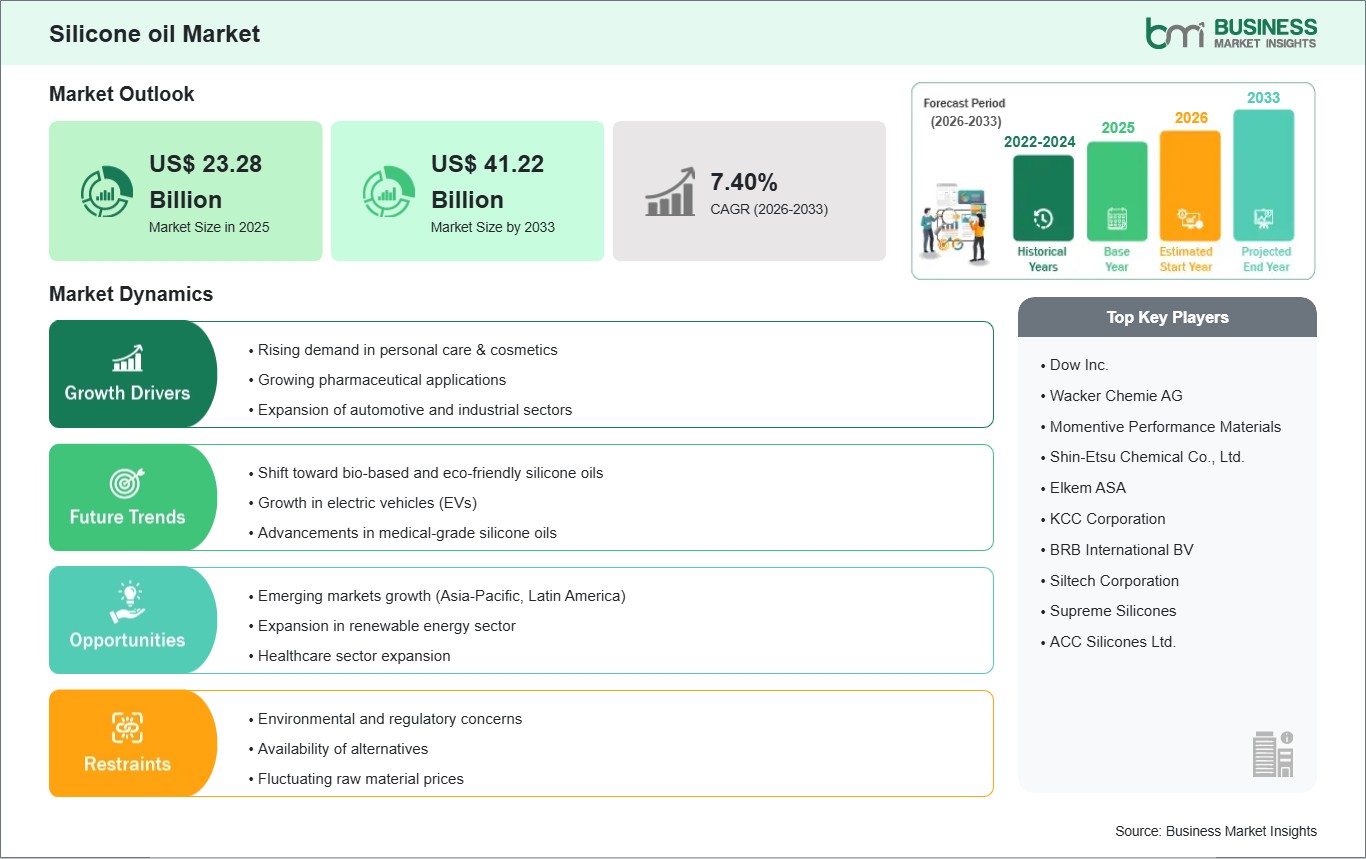
The Silicone oil Market size is expected to reach US$ 41.22 billion by 2033 from US$ 23.28 billion in 2025. The market is estimated to record a CAGR of 7.40% from 2026 to 2033.
The global silicone oil market is experiencing steady expansion driven by its versatility, thermal stability, and chemical inertness across a wide range of industrial and consumer applications. Silicone oils are extensively used in personal care products, pharmaceuticals, automotive fluids, electrical insulation, and industrial lubricants due to their superior performance under extreme temperatures and environmental conditions. Increasing demand from the cosmetics and personal care sector remains a primary growth driver, as silicone oils enhance texture, spreadability, and moisture retention in skincare and haircare formulations. Additionally, the automotive and electronics industries are contributing significantly, particularly with the rising need for high-performance lubricants and dielectric fluids in advanced systems.
On a global scale, sustainability trends are shaping product innovation, with manufacturers focusing on low-volatility and environmentally compliant silicone fluids. However, the market faces constraints such as regulatory scrutiny over certain silicone compounds and fluctuating raw material availability, which can impact production costs and supply consistency. Competition from alternative materials in cost-sensitive applications also presents a challenge. Despite these restraints, technological advancements and increasing penetration in emerging applications—such as renewable energy systems and medical-grade formulations are expected to support long-term market resilience and diversification.
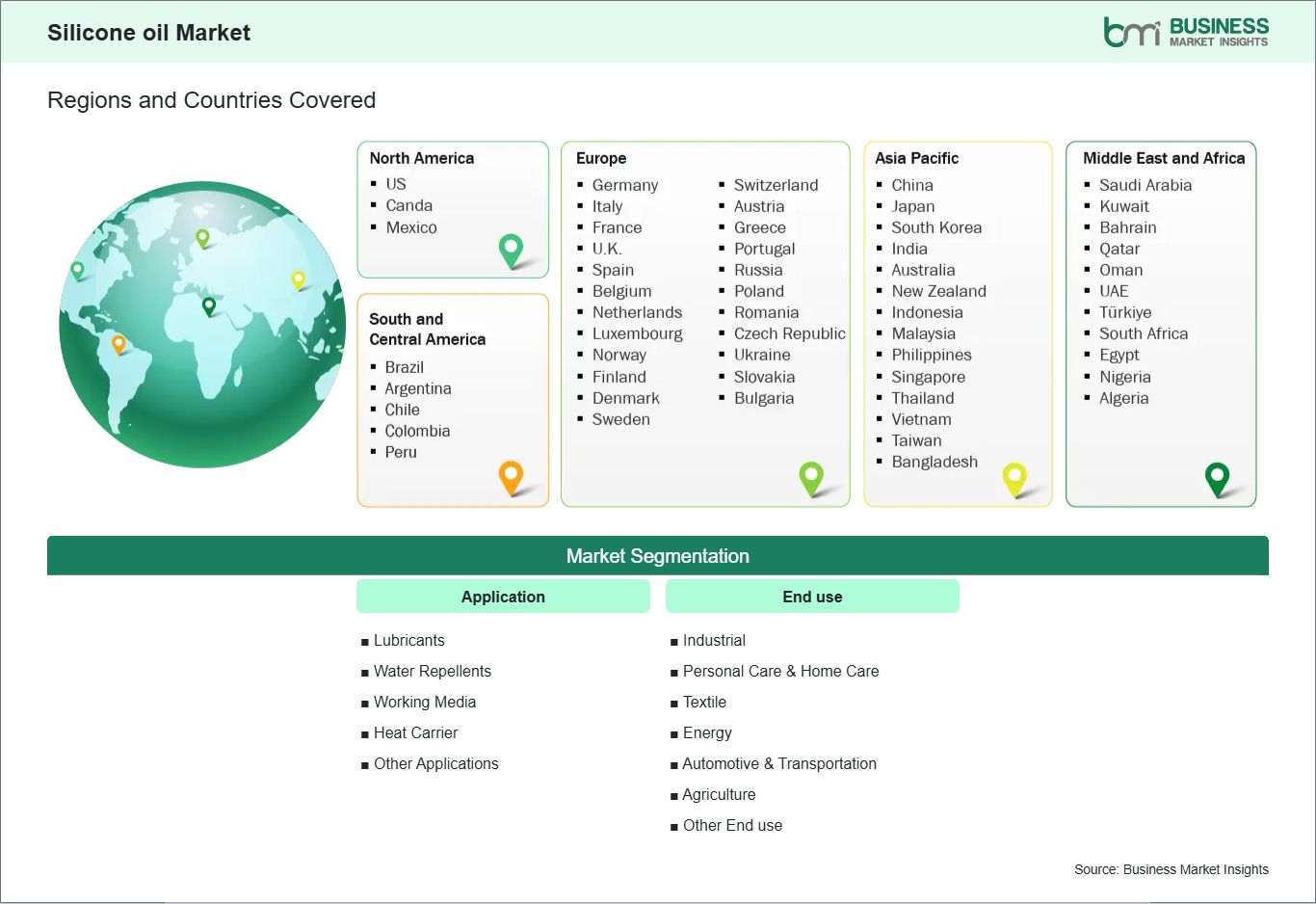
Key segments that contributed to the derivation of the silicone oil market analysis are application and end use.
The Western European market for silicone oil has shown significant growth, mainly because of the increased demand from the pharmaceutical and healthcare industries. Germany, Switzerland, and the Netherlands are among the major pharmaceutical industries that use large quantities of the product as a lubricant and defoaming agent in the production equipment. In the production of sterile injectables and medical devices, high purity-grade silicone oil is gaining popularity over other grades because of its stability and compatibility. For example, the pharmaceutical manufacturing output in Germany is growing by nearly 4% each year over the last five years, reflecting the increased use of specialized lubricant fluids, including silicone oil.
Moreover, the aging population in Western Europe and an increased number of clinical trials have fueled the development of biologics and high-tech drugs. Silicone oil plays an essential part in pre-filled syringes and vials to ensure proper dosing and minimize friction. French and Italian pharmaceutical companies have reported increased procurement of medical-grade silicone fluids in recent procurement rounds, especially for ophthalmic and injectable products. This has prompted silicone manufacturers in Western Europe to ramp up production of ultra-high purity grades.
Besides, increased regulatory scrutiny of quality and contamination control measures have seen an increased preference for silicone oils with strict certifications. Innovation among pharmaceutical companies in France and Italy to comply with Good Manufacturing Practice (GMP) guidelines has seen an increased partnership between silicone suppliers and pharmaceutical OEMs, thus promoting a diversified product portfolio for critical healthcare applications in Western European markets.
The renewable energy shift in Western Europe is another major driving factor behind the growth of the global silicone oil market. The renewable energy shift is driven by the increased use of renewable energy sources, such as solar and wind energy, in the region. The heat transfer fluids and dielectric fluids in the transformers of wind farms are the primary application areas of silicone oil, and the renewable energy shift is expected to drive the market growth in the region.
Spain's concentrated solar power capacity continues to rise, with over 10 GW in its project pipelines for 2030. This means it needs reliable thermal fluids for efficient working at high temperatures. In this regard, silicone oils with high thermal degradation resistance have been a popular choice for parabolic trough systems and other forms of CSP technology. In Germany's offshore wind sector, too, silicone dielectric fluids have been increasingly finding use for cooling transformers, providing longer service lives and lowering operating costs for utilities in offshore conditions.
Moreover, government initiatives in Western Europe's countries to achieve net-zero targets have encouraged investment in next-gen forms of renewable energy infrastructure. Incentives and carbon pricing have prompted utilities to select long-life, thermally stable fluids like silicone oils for longer operating lives and cost advantages. This is in line with sustainability targets and has prompted alliances between renewable energy project developers and silicone manufacturers to develop optimized formulations for different climatic conditions prevalent in this region.

The silicone oil market is experiencing steady growth, with market size and share analysis reflecting evolving treatment preferences and competitive dynamics among key players. The report evaluates important subsegments categorized within application and end use highlighting their respective contributions to overall market performance.
By application, the lubricants subsegment dominated the Silicone oil market in 2025 because core strength lies in maintaining stable viscosity across very high and very low temperatures, which makes it far more reliable than mineral oils in critical systems. Industries prefer it in precision machinery, automotive components, and electrical systems where failure risk must be minimized.
Based on end use, the personal care & home care subsegment dominated the silicone oil market in 2025 because it cuts across multiple applications simultaneously lubrication, insulation, damping, and heat transfer. Manufacturing expansion, automation, and equipment sophistication are increasing dependence on high-performance specialty fluids, including silicone oil. Compared to personal care industrial demand is broader, more consistent, and volume-driven.
| Report Attribute | Details |
|---|---|
| Market size in 2025 | US$ 23.28 Billion |
| Market Size by 2033 | US$ 41.22 Billion |
| Global CAGR (2026 - 2033) | 7.40% |
| Historical Data | 2022-2024 |
| Forecast period | 2026-2033 |
| Segments Covered | By Application
|
|
Regions and Countries Covered
| |
| North America | US, Canada, Mexico |
| Europe | Belgium, Austria, Finland, Denmark, Greece, Poland, Romania, Russia, Ukraine, Czech Republic, Slovakia, Bulgaria, Italy, Luxembourg, Germany, Switzerland, France, Netherlands, Norway, Portugal, Spain, Sweden, United Kingdom |
| Asia-Pacific | Australia, China, India, Japan, South Korea, Indonesia, Malaysia, Philippines, Singapore, Thailand, Vietnam, Bangladesh, New Zealand, Taiwan |
| South and Central America | Brazil, Argentina, Peru, Chile, Colombia |
| Middle East and Africa | Bahrain, Kuwait, Oman, Qatar, Saudi Arabia, United Arab Emirates, Turkiye, South Africa, Egypt, Algeria, Nigeria |
| Market leaders and key company profiles |
|
The "Silicone Oil Market Size and Forecast (2022 - 2033)" report provides a detailed analysis of the market covering below areas:
The geographical scope of the Silicone oil market report is divided into five regions: North America, Asia Pacific, Europe, Middle East & Africa, and South & Central America. The Silicone oil market in North America is expected to grow during the forecast period.
North America holds a dominant position in the global silicone oil market, supported by a mature industrial base and strong demand across high-value sectors. The region benefits from a well-established personal care and cosmetics industry, where silicone oils are integral to premium product formulations emphasizing performance and sensory appeal. Additionally, the presence of advanced automotive and aerospace manufacturing ecosystems drives the use of silicone oils in lubrication, damping, and thermal management applications.
The growing adoption of electric vehicles has further reinforced demand for specialty silicone fluids used in battery cooling and electronic component protection. The United States leads regional consumption, supported by ongoing innovation, robust R&D infrastructure, and strong collaboration between chemical manufacturers and end-use industries. Regulatory frameworks in North America encourage the development of safer and more sustainable silicone variants, prompting companies to invest in bio-based and low-emission formulations. Canada also contributes through its expanding industrial and energy sectors, where silicone oils are utilized in harsh operating environments.
Overall, North America's dominance is characterized by technological sophistication, product innovation, and a strong emphasis on quality and compliance, positioning it as a key hub for both production and advanced application development.
The silicone oil market is evaluated by gathering qualitative and quantitative data post primary and secondary research, which includes important corporate publications, association data, and databases. A few of the key developments in the silicone oil market are:
The Silicone oil Market is valued at US$ 23.28 Billion in 2025, it is projected to reach US$ 41.22 Billion by 2033.
As per our report Silicone oil Market, the market size is valued at US$ 23.28 Billion in 2025, projecting it to reach US$ 41.22 Billion by 2033. This translates to a CAGR of approximately 7.40% during the forecast period.
The Silicone oil Market report typically cover these key segments-
The historic period, base year, and forecast period can vary slightly depending on the specific market research report. However, for the Silicone oil Market report:
The Silicone oil Market is populated by several key players, each contributing to its growth and innovation. Some of the major players include:
The Silicone oil Market report is valuable for diverse stakeholders, including:
Essentially, anyone involved in or considering involvement in the Silicone oil Market value chain can benefit from the information contained in a comprehensive market report.
Please tell us your area of interest
(Market Segments/ Regions and Countries/ Companies)