Gear Oil Market Outlook (2022-2033)

Historic Data: 2022-2024   |   Base Year: 2025   |   Forecast Period: 2026-2033
Report Content: Market Scope, Market Segmentation, Market Dynamics, and Competitive Analysis

Report Coverage:
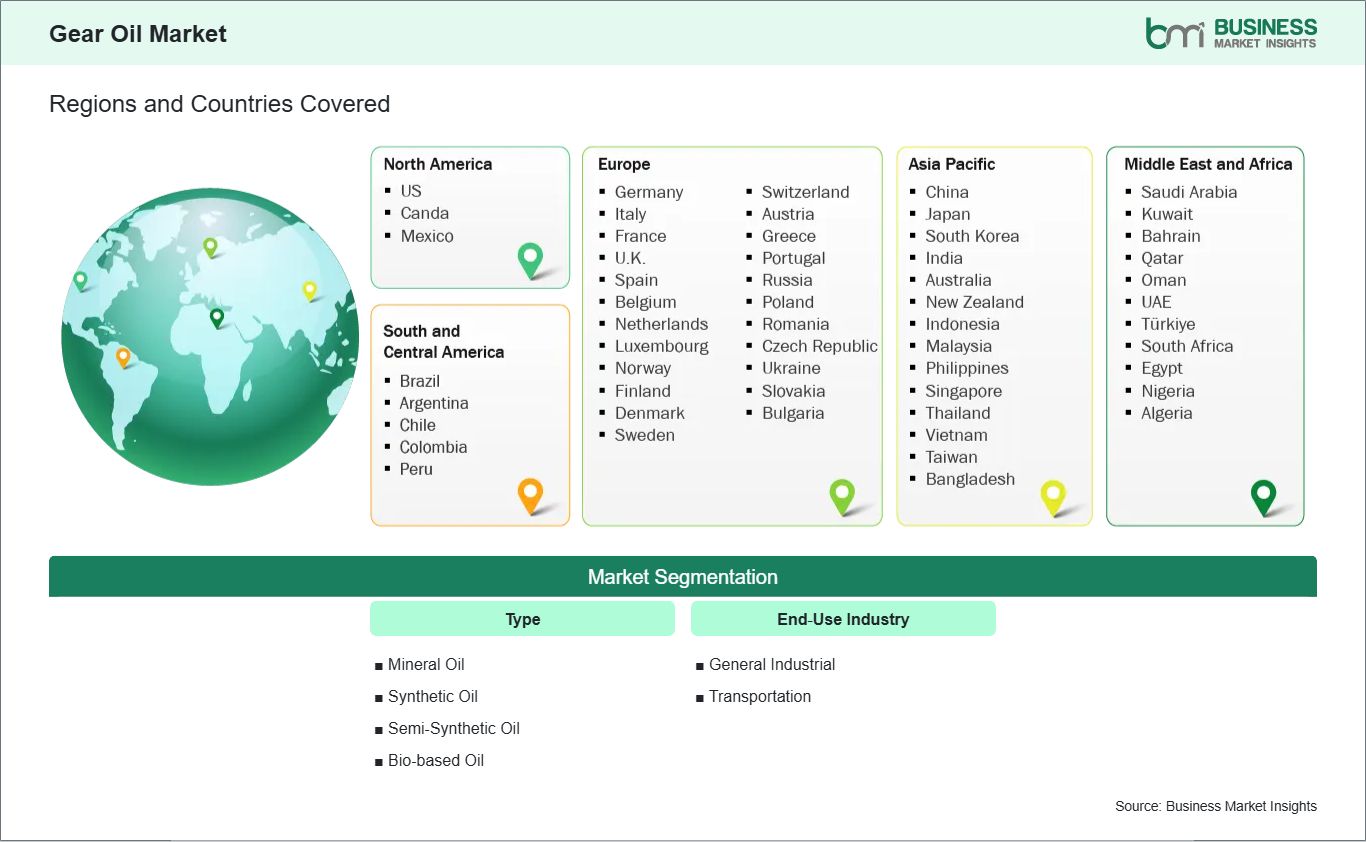
  • Type (Mineral Oil, Synthetic Oil, Semi-Synthetic Oil, Bio-based Oil)
  • End-Use Industry (General Industrial, Transportation)

No. of Pages: 408
Report Code: BMIPUB00033954
Category: Chemicals and Materials
Gear Oil Market

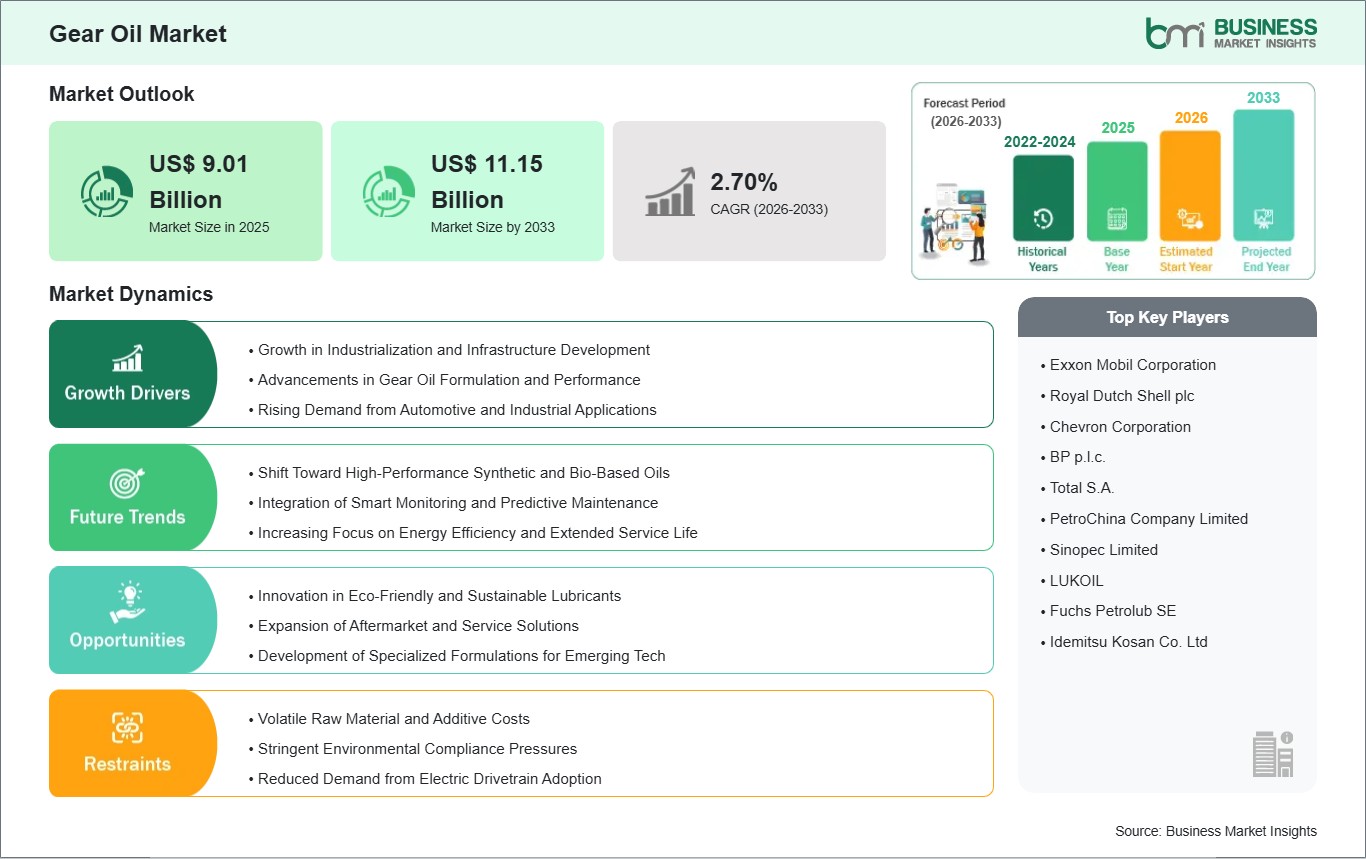
The Gear Oil Market size is expected to reach US$ 11.15 Billion by 2033 from US$ 9.01 Billion in 2025. The market is estimated to record a CAGR of 2.70% from 2026 to 2033.

Executive Summary and Global Market Analysis:

The global gear oil market is a vital segment of the broader industrial and automotive lubricants industry, focused on fluids that protect and enhance the performance of gear systems in machinery and vehicles. Gear oil is engineered to provide robust lubrication under high pressure and extreme conditions, reducing friction, minimizing wear, and ensuring smooth power transmission. Demand for gear oil is driven by expanding industrial activity, increasing vehicle production, and the growing emphasis on equipment reliability and lifecycle maintenance. As manufacturers and end‑users seek to optimize operational efficiency and reduce downtime, there is heightened adoption of advanced gear oils that offer enhanced thermal stability, superior anti‑wear properties, and extended service intervals. Growing infrastructure and manufacturing investments, automation trends, and an expanding fleet of commercial vehicles that need regular gear maintenance are some of the major factors driving the market. Furthermore, the industry's emphasis on sustainability has encouraged the creation of gear oils with enhanced biodegradability and energy-saving compositions.

The market does, however, encounter difficulties. Base oil costs are impacted by fluctuating crude oil prices, which can reduce profits for both producers and consumers. Suppliers are under pressure to innovate while controlling compliance costs as a result of environmental rules intended to lower hydrocarbon emissions. Another barrier to the shift to electric vehicles is the potential for non-traditional drivetrains to lower demand for conventional gear oils in some markets. Despite these challenges, the global industry is still strong thanks to ongoing technology advancements and expanding maintenance cultures in the transportation and industrial sectors.

Gear Oil Market - Strategic Insights:

global-market-strategic-framework
Get more information on this report

Gear Oil Market Segmentation Analysis:

Key segments that contributed to the derivation of the gear oil market analysis are type and end‑use industry.

  • By type, the gear oil market is segmented into mineral oil, synthetic oil, semi‑synthetic oil, and bio‑based oil. The mineral oil subsegment dominated the market in 2025.
  • Based on end‑use industry, the gear oil market is classified into general industrial and transportation. The general industrial subsegment dominated the market in 2025.

Gear Oil Market Drivers and Opportunities:

Growth in Industrialization and Infrastructure Development

The increasing trend of industrialization and infrastructure development is expected to propel the demand for gear oils. As industries grow in size, so does their equipment, making it extremely important for gear oils to play their part in ensuring the efficiency and longevity of equipment. Industrial machines, construction equipment, and transportation systems all require gear oils for smoother operation, reduced friction, and prevention of overheating. In this regard, it is extremely important for gear oils to play their part, not only in ensuring efficiency but also in increasing the longevity of equipment.

As infrastructure projects continue to rise, as well as the modernization of manufacturing processes, the demands placed on gear systems continue to rise as well. The current era has seen the need for machinery to run for longer periods of time, under heavier loads, and at faster speeds than ever before. The necessity for lubricants that are capable of handling high pressure, extreme temperatures, and constant mechanical stress has never been more important. The gear oils that are currently in use are becoming more efficient, providing better anti-wear properties, as well as the ability to handle high temperatures and oxidation. The importance of gear oils has now become indispensable to any organization that seeks to optimize production.

Additionally, the incorporation of complex mechanical systems in various industries highlights the need for preventive maintenance with adequate lubrication support. Organizations have come to realize that investing in good-quality gear oils is not just a maintenance activity; it is a strategic activity that secures productivity for the company while avoiding unexpected repair bills. With further development in the process of industrialization, the need for gear oils that are durable, efficient, and flexible is anticipated to remain high, thereby reiterating their importance in the industry.

Innovation in Eco‑Friendly and Sustainable Lubricants

Sustainability and environmental concerns have become a key factor that is altering the gear oils industry. Businesses are now looking for products that not only have high lubricating capabilities but also have a lower environmental footprint. New products that have been developed in the area of eco-friendly and sustainable gear oils, such as synthetic, semi-synthetic, and bio-based oils, have helped industries achieve their goals in this area.

With the technological improvements achieved so far, it is now possible for the gear oils currently available to provide the best properties in terms of anti-wear performance, thermal stability, and oxidation resistance, even if the oils are now produced from more environmentally friendly sources. This means that the additive system and formulation methods now provide the necessary properties for the eco-friendly gear oils to perform under the toughest conditions without compromising their efficiency.

In addition, the push for sustainability is driving the adoption of smart maintenance and condition monitoring solutions that optimize lubricant use and extend service intervals. By using advanced gear oils in conjunction with predictive maintenance, organizations can reduce waste, improve machine reliability, and contribute to long-term environmental goals. The ongoing innovation in eco-friendly lubricants illustrates how the gear oil market is evolving to meet both operational and environmental demands, positioning high-performance, sustainable products as essential for the future of modern industry.

Gear Oil Market Size and Share Analysis:

The gear oil market is experiencing steady growth, with market size and share analysis reflecting evolving treatment preferences and competitive dynamics among key players. The report evaluates important subsegments categorized within type, and end-use industry, highlighting their respective contributions to overall market performance.

By type, the mineral oil subsegment dominated the gear oil market in 2025. Mineral oils provide reliable lubrication and thermal stability at an economical cost, making them highly suitable for a wide range of industrial applications, which drives their widespread adoption.

Based on end-use industry, the general industrial subsegment dominated the gear oil market in 2025. General industrial applications require consistent performance under varying loads and temperatures, making this segment highly suitable for machinery and equipment maintenance needs, which drives its widespread adoption.

Gear Oil Market Report Highlights:

Report Attribute Details
Market size in 2025 US$ 9.01 Billion
Market Size by 2033 US$ 11.15 Billion
Global CAGR (2026 - 2033)2.70%
Historical Data 2022-2024
Forecast period 2026-2033
Segments Covered By Type
  • Mineral Oil
  • Synthetic Oil
  • Semi-Synthetic Oil
  • Bio-based Oil
By End-Use Industry
  • General Industrial
  • Transportation
Regions and Countries Covered
North America US, Canada, Mexico
Europe Belgium, Austria, Finland, Denmark, Greece, Poland, Romania, Russia, Ukraine, Czech Republic, Slovakia, Bulgaria, Italy, Luxembourg, Germany, Switzerland, France, Netherlands, Norway, Portugal, Spain, Sweden, United Kingdom
Asia-Pacific Australia, China, India, Japan, South Korea, Indonesia, Malaysia, Philippines, Singapore, Thailand, Vietnam, Bangladesh, New Zealand, Taiwan
South and Central America Brazil, Argentina, Peru, Chile, Colombia
Middle East and Africa Bahrain, Kuwait, Oman, Qatar, Saudi Arabia, United Arab Emirates, Turkiye, South Africa, Egypt, Algeria, Nigeria
Market leaders and key company profiles
  • Exxon Mobil Corporation
  • Royal Dutch Shell plc
  • Chevron Corporation
  • BP p.l.c.
  • Total S.A.
  • PetroChina Company Limited
  • Sinopec Limited
  • LUKOIL
  • Fuchs Petrolub SE
  • Idemitsu Kosan Co. Ltd
Get more information on this report

Gear Oil Market Report Coverage and Deliverables:

The "Gear Oil Market Size and Forecast (2022 - 2033)" report provides a detailed analysis of the market covering below areas:

  • Gear Oil market size and forecast at global, regional, and country levels for all the key market segments covered under the scope
  • Gear Oil market trends, as well as drivers, restraints, and opportunities
  • Gear Oil market analysis covering key trends, regional framework, major players, regulations, and recent developments
  • Industry landscape and competition analysis covering market concentration, heat map analysis, prominent players, and recent developments for the Gear Oil market
  • Detailed company profiles, including SWOT analysis

Gear Oil Market Geographic Insights:

The geographical scope of the Gear Oil market report is divided into five regions: North America, Asia Pacific, Europe, Middle East & Africa, and South & Central America. The Gear Oil market in North America is expected to grow during the forecast period.

North America serves as the dominant region in the global gear oil market, shaped by a mature industrial base, stringent performance and environmental standards, and a substantial automotive and heavy‑equipment sector. The region`s advanced manufacturing capabilities and extensive transportation infrastructure drive consistent demand for high‑performance gear oils. In automotive applications, commercial vehicles, construction machinery, and agricultural equipment form significant end‑user segments, each relying on specialized gear oil formulations to maintain performance under challenging operating conditions.

Regulatory frameworks in North America emphasize not only emissions reduction but also equipment durability and emissions‑related fuel efficiency, pushing OEMs and lubricant suppliers to adopt advanced gear oil technologies. Major lubricant manufacturers and strong aftermarket networks in North America help drive fast product innovation and keep gear oils widely available. Suppliers are now focusing on gear oils that offer both strong performance and sustainability, such as products that improve fuel economy or work with new engine and drivetrain designs.

The region`s culture of regular vehicle maintenance and aftermarket service also keeps demand steady, even after the original equipment fill. Although the move toward electric vehicles raises long-term questions for traditional lubricants, industries like machinery and commercial transport still support North America`s leading role. In short, the region`s active industry, regulations, and technology advances all help keep the gear oil market dynamic.

global-market-geography
Get more information on this report

Gear Oil Market Research Report Guidance:

  • The report includes qualitative and quantitative data in the Gear Oil market across type, end-use industry, and geography.
  • The report starts with the key takeaways (chapter 2), highlighting the key trends and outlook of the Gear Oil market.
  • Chapter 3 focuses on the research methodology of the study.
  • Chapter 4 includes ecosystem analysis.
  • Chapter 5 highlights the major industry dynamics in the Gear Oil market, including factors that are driving the market, prevailing deterrents, potential opportunities, as well as future trends. Impact analysis of these drivers and restraints is also covered in this section.
  • Chapter 6 discusses the Gear Oil market scenario, in terms of historical market revenues, and forecast till the year 2033.
  • Chapters 7 to 9 cover the Gear Oil market segments by type, end-use industry, and geography across North America, Europe, Asia Pacific, Middle East and Africa, and South and Central America. They cover the market volume, revenue forecast, and factors driving the market.
  • Chapter 10 describes the competitive analysis with the heat map analysis for the key players operating in the market.
  • Chapter 11 describes the industry landscape analysis. It provides detailed descriptions of business activities such as market initiatives, new developments, mergers, and joint ventures globally, along with a competitive landscape.
  • Chapter 12 provides detailed profiles of the major companies operating in the Gear Oil market. Companies have been profiled on the basis of their key facts, business descriptions, products, financial overview, SWOT analysis, and key developments.
  • Chapter 13, i.e., the appendix, is inclusive of a brief overview of the company, list of abbreviations, and disclaimer.

Gear Oil Market News and Key Development:

The gear oil market is evaluated by gathering qualitative and quantitative data post primary and secondary research, which includes important corporate publications, association data, and databases. A few of the key developments in the gear oil market are:

  • In October 2025, Shell Lubricants India (a subsidiary of Shell plc) announced that it unveiled a new range of advanced lubricant products including the Shell Spirax S4 GX 75W90 synthetic gear oil, engineered for manual transmissions in passenger cars and light commercial vehicles with broader OEM compatibility, underlining Shell`s global product technology rollout into gear oils.
  • In August 2024, Kluber Lubrication also announced that it introduced a new Gear Oil Booster and Rescue Grease product designed to enhance gear oil performance and extend gearbox service life, particularly for high‑demand applications like wind turbines, expanding its specialty gear lubricant solutions.

Key Sources Referred:

  • International Organization for Standardization (ISO)
  • American Society for Testing and Materials (ASTM International)
  • Bureau of Indian Standards (BIS)
  • Environmental Protection Agency (EPA), USA
  • European Chemicals Agency (ECHA)
  • Central Pollution Control Board (CPCB), India
  • Ministry of Chemicals and Fertilizers, India
  • American Chemistry Council (ACC)
  • Indian Chemical Council (ICC)
  • European Chemical Industry Council (Cefic)
  • Specialty Chemical Association of India (SCAI)
  • Company Websites
  • Company Annual Reports
  • Company Investor Presentations
The List of Companies - Gear Oil Market
  • Exxon Mobil Corporation
  • Royal Dutch Shell plc
  • Chevron Corporation
  • BP p.l.c.
  • Total S.A.
  • PetroChina Company Limited
  • Sinopec Limited
  • LUKOIL
  • Fuchs Petrolub SE
  • Idemitsu Kosan Co. Ltd
Frequently Asked Questions
How big is the Gear Oil Market?

The Gear Oil Market is valued at US$ 9.01 Billion in 2025, it is projected to reach US$ 11.15 Billion by 2033.

What is the CAGR for Gear Oil Market by (2026 - 2033)?

As per our report Gear Oil Market, the market size is valued at US$ 9.01 Billion in 2025, projecting it to reach US$ 11.15 Billion by 2033. This translates to a CAGR of approximately 2.70% during the forecast period.

What segments are covered in this report?

The Gear Oil Market report typically cover these key segments-

  • Type (Mineral Oil, Synthetic Oil, Semi-Synthetic Oil, Bio-based Oil)
  • End-Use Industry (General Industrial, Transportation)

What is the historic period, base year, and forecast period taken for Gear Oil Market?

The historic period, base year, and forecast period can vary slightly depending on the specific market research report. However, for the Gear Oil Market report:

  • Historic Period : 2022-2024
  • Base Year : 2025
  • Forecast Period : 2026-2033
  • Who are the major players in Gear Oil Market?

    The Gear Oil Market is populated by several key players, each contributing to its growth and innovation. Some of the major players include:

  • Exxon Mobil Corporation
  • Royal Dutch Shell plc
  • Chevron Corporation
  • BP p.l.c.
  • Total S.A.
  • PetroChina Company Limited
  • Sinopec Limited
  • LUKOIL
  • Fuchs Petrolub SE
  • Idemitsu Kosan Co. Ltd
  • Who should buy this report?

    The Gear Oil Market report is valuable for diverse stakeholders, including:

    • Investors: Provides insights for investment decisions pertaining to market growth, companies, or industry insights. Helps assess market attractiveness and potential returns.
    • Industry Players: Offers competitive intelligence, market sizing, and trend analysis to inform strategic planning, product development, and sales strategies.
    • Suppliers and Manufacturers: Helps understand market demand for components, materials, and services related to concerned industry.
    • Researchers and Consultants: Provides data and analysis for academic research, consulting projects, and market studies.
    • Financial Institutions: Helps assess risks and opportunities associated with financing or investing in the concerned market.

    Essentially, anyone involved in or considering involvement in the Gear Oil Market value chain can benefit from the information contained in a comprehensive market report.

    Available Report Formats

    pdf-format excel-format pptx-format
    Buy Now
    Sales Assistance
    +1 646 791 7070 (US & UK)
    Customization Form

    Please tell us your area of interest
    (Market Segments/ Regions and Countries/ Companies)