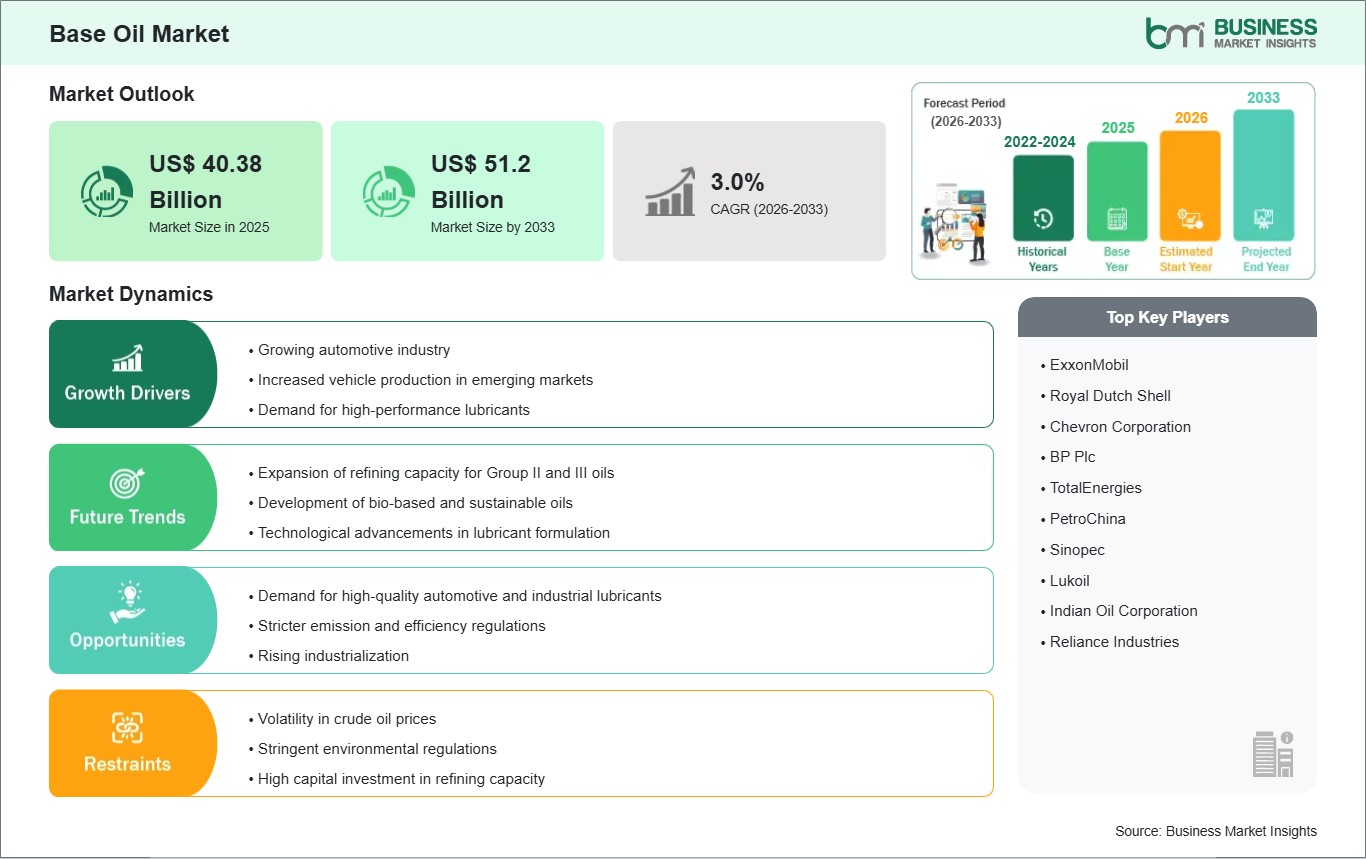
The Base Oil Market size is expected to reach US$ 51.2 Billion by 2033 from US$ 40.38 Billion in 2025 .The market is estimated to record a CAGR of 3.0% from 2026 to 2033.
The global base oil market is defined by its critical role as a primary raw material in the formulation of lubricants used across automotive, industrial, and marine sectors. Base oils are categorized into different groups based on refining processes and performance characteristics, with higher group oils offering superior oxidation stability, viscosity index, and environmental performance. The market is undergoing a structural shift toward higher-quality base oils such as Group II, Group III, and synthetic variants, driven by evolving engine technologies and stricter emission regulations.
The increasing demand for high-performance lubricants in modern engines and industrial machinery is a key factor shaping the market. Automotive manufacturers are developing advanced engines that require lubricants with improved thermal stability and efficiency, thereby boosting demand for premium base oils. Additionally, industrial expansion and infrastructure development are contributing to the growing consumption of industrial lubricants globally.
Competitive dynamics in the base oil market are centered on refining capacity expansion, technological advancements, and supply chain optimization. Major players are investing in hydrocracking and catalytic dewaxing technologies to enhance product quality and meet regulatory standards. Sustainability is also becoming a focal point, with increasing interest in bio-based and environmentally friendly base oils. Strategic partnerships, mergers, and capacity expansions are influencing market competition and enabling companies to strengthen their global presence.

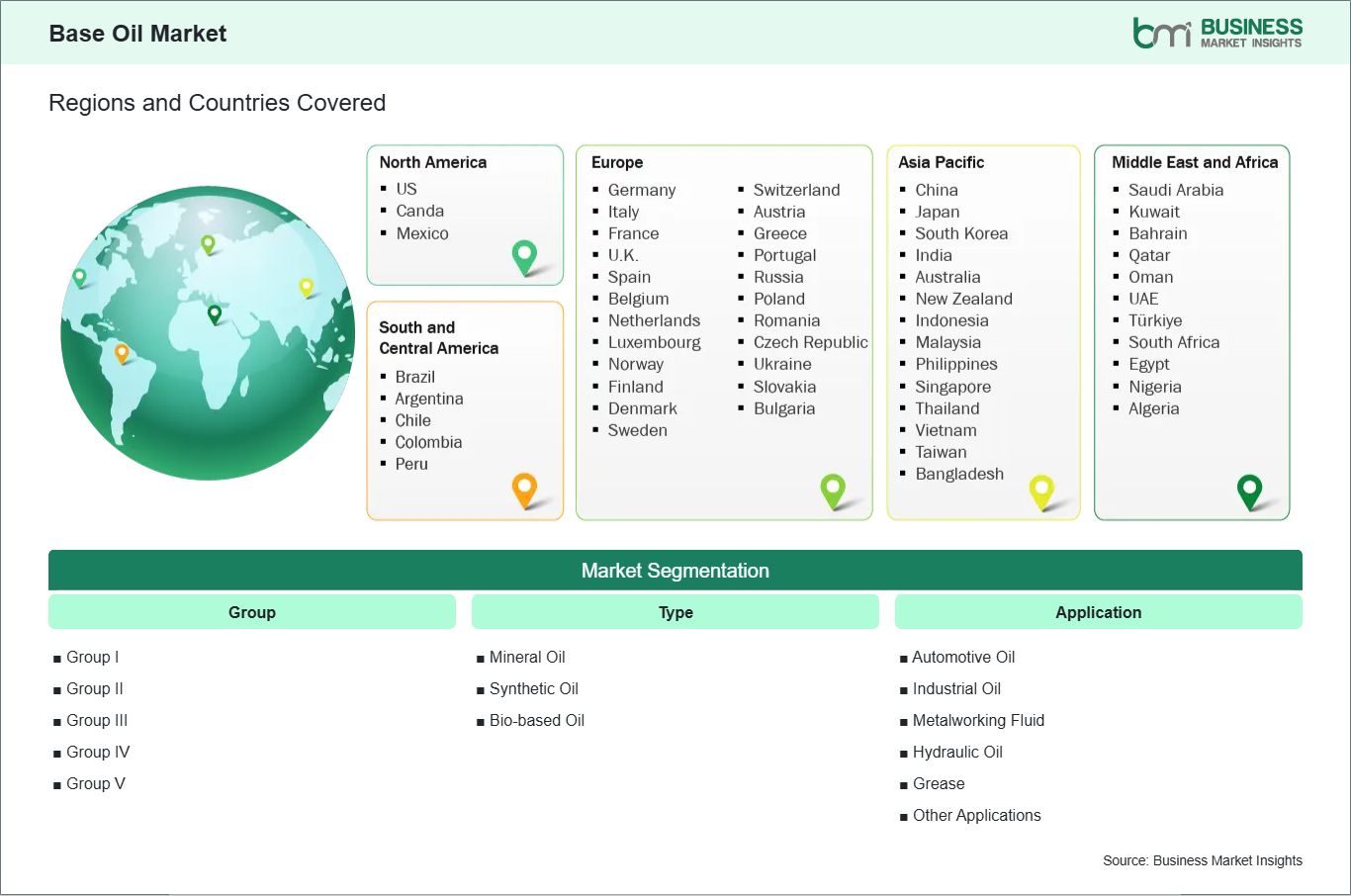
Key segments that contributed to the derivation of the base oil market analysis are group, type, and application.
The global automotive market is still on the upward trend, which has continued to spark demand in the base oil industry. Base oils are the foundation of all types of lubricants, including engine oils, transmission fluids, and greases, which are essential to keeping a vehicle running smoothly while also minimizing wear and prolonging its lifespan. As passenger car production and commercial vehicle production rises, this is especially true in countries such as India, China, and Brazil, where the demand for high-quality lubricants is increasing at an unprecedented rate. Today's vehicles are being built and operated subject to increasingly stringent emission and efficiency regulations, which means there is a need for state-of-the-art lubricants that are manufactured with Group II and III base oils.
The type of base oils will determine whether a vehicle will have superior oxidative stability, viscosity control, and performance during high-stress conditions. Furthermore, with the rise of electric vehicles (EVs), the base oil requirements are changing. While most EVs do not use as many traditional lubricants, they will require specialized fluids to cool, transmit and manage heat; thus, providing new opportunities for base oil manufacturers. Additionally, the advancements made in engine design and lubricant chemistry are complementing this trend, whereby the automotive manufacturers are looking for lubricants that improve fuel efficiency while reducing their carbon footprint. As the automotive industry continues to move toward both sustainability and technological advancements, the demand for higher-performing base oils will also continue to increase.
The rapid industrialization of many developing regions is also supporting the expansion of the base oil industry. Lubricants are essential for the efficient operation of industrial machinery and heavy equipment, with base oils being one of main components of these formulations. The booming manufacturing, construction, mining and energy industries in countries such as China, India and Southeast Asia has led to an increase in the global demand for industrial oils (and fluids). Hydraulic systems, gear boxes, compressors, and metalworking applications all use base oils, where reliability and performance, which are critical to productivity, are important. Industries are striving to reduce downtime and maintenance costs, so the need for high-performance, durable lubricants is increasing. Furthermore, the desire for sustainable solutions has accelerated the development of bio-based and environmentally friendly base oils, which can help offset the ecological footprint while still meeting performance specifications. Bio-based and environmentally friendly base oils are becoming more popular in industries committed to environmentally friendly choices and compliance with existing regulations.
Technological advancements in lubricant formulation, such as improved thermal stability and longer drain intervals, will continue to help achieve efficiencies within the industrial sectors. With the continued growth of global industrial production, especially in developing countries, there will be a significant increase in demand for base oils. The trend will create many opportunities for companies in this market to innovate and develop unique industrial offerings.

The Base Oil Market demonstrates steady growth, with size and share analysis highlighting evolving trends and competitive dynamics among key players. The report examines subsegments categorized within group, type, and application, offering insights into their contribution to overall market performance.
By group, the Group II subsegment dominated the market in 2025, driven by its improved performance characteristics and cost-effectiveness compared to traditional base oils.
Based on type, the mineral oil subsegment dominated the market in 2025, driven by its widespread availability and lower production cost.
In terms of application, the automotive oil subsegment dominated the market in 2025, driven by high demand from the global vehicle fleet and lubricant consumption.
| Report Attribute | Details |
|---|---|
| Market size in 2025 | US$ 40.38 Billion |
| Market Size by 2033 | US$ 51.2 Billion |
| Global CAGR (2026 - 2033) | 3.0% |
| Historical Data | 2022-2024 |
| Forecast period | 2026-2033 |
| Segments Covered | By Group
|
|
Regions and Countries Covered
| |
| North America | US, Canada, Mexico |
| Europe | Belgium, Austria, Finland, Denmark, Greece, Poland, Romania, Russia, Ukraine, Czech Republic, Slovakia, Bulgaria, Italy, Luxembourg, Germany, Switzerland, France, Netherlands, Norway, Portugal, Spain, Sweden, United Kingdom |
| Asia-Pacific | Australia, China, India, Japan, South Korea, Indonesia, Malaysia, Philippines, Singapore, Thailand, Vietnam, Bangladesh, New Zealand, Taiwan |
| South and Central America | Brazil, Argentina, Peru, Chile, Colombia |
| Middle East and Africa | Bahrain, Kuwait, Oman, Qatar, Saudi Arabia, United Arab Emirates, Turkiye, South Africa, Egypt, Algeria, Nigeria |
| Market leaders and key company profiles |
|
The "Base Oil Market Size and Forecast (2022 - 2033)" report provides a detailed analysis of the market covering below areas:
The geographical scope of the Base Oil Market report is divided into North America, Asia Pacific, Europe, Middle East & Africa, and South & Central America. North America held the largest share in 2025.
The adoption and demand for base oils vary significantly across regions, influenced by industrial activity, automotive production, and regulatory frameworks. In North America, the market is characterized by a strong shift toward high-quality base oils such as Group II and Group III, driven by stringent emission regulations and advanced automotive technologies. The region also benefits from well-established refining infrastructure and technological capabilities.
In Europe, environmental regulations and sustainability goals are shaping the market landscape. The demand for low-emission lubricants and bio-based oils is increasing, encouraging manufacturers to invest in cleaner production processes and innovative formulations. Countries such as Germany, France, and the UK are leading adopters of high-performance lubricants.
Asia Pacific is the dominant and fastest-growing region, driven by rapid industrialization, expanding automotive production, and increasing energy demand. Countries such as China and India are witnessing significant growth in lubricant consumption due to infrastructure development and rising vehicle ownership.
The Middle East & Africa region plays a crucial role as a major producer of base oils, supported by abundant crude oil resources and refining capacity. Latin America is experiencing moderate growth, driven by industrial expansion and increasing automotive demand. Across all regions, economic development, regulatory policies, and technological advancements continue to influence market dynamics.

The Base Oil Market is evaluated by gathering qualitative and quantitative data post primary and secondary research, which includes important corporate publications, association data, and databases. A few of the key developments in the base oil market are:
The Base Oil Market is valued at US$ 40.38 Billion in 2025, it is projected to reach US$ 51.2 Billion by 2033.
As per our report Base Oil Market, the market size is valued at US$ 40.38 Billion in 2025, projecting it to reach US$ 51.2 Billion by 2033. This translates to a CAGR of approximately 3.0% during the forecast period.
The Base Oil Market report typically cover these key segments-
The historic period, base year, and forecast period can vary slightly depending on the specific market research report. However, for the Base Oil Market report:
The Base Oil Market is populated by several key players, each contributing to its growth and innovation. Some of the major players include:
The Base Oil Market report is valuable for diverse stakeholders, including:
Essentially, anyone involved in or considering involvement in the Base Oil Market value chain can benefit from the information contained in a comprehensive market report.
Please tell us your area of interest
(Market Segments/ Regions and Countries/ Companies)