Market Summary
Executive Summary and Global Market Analysis
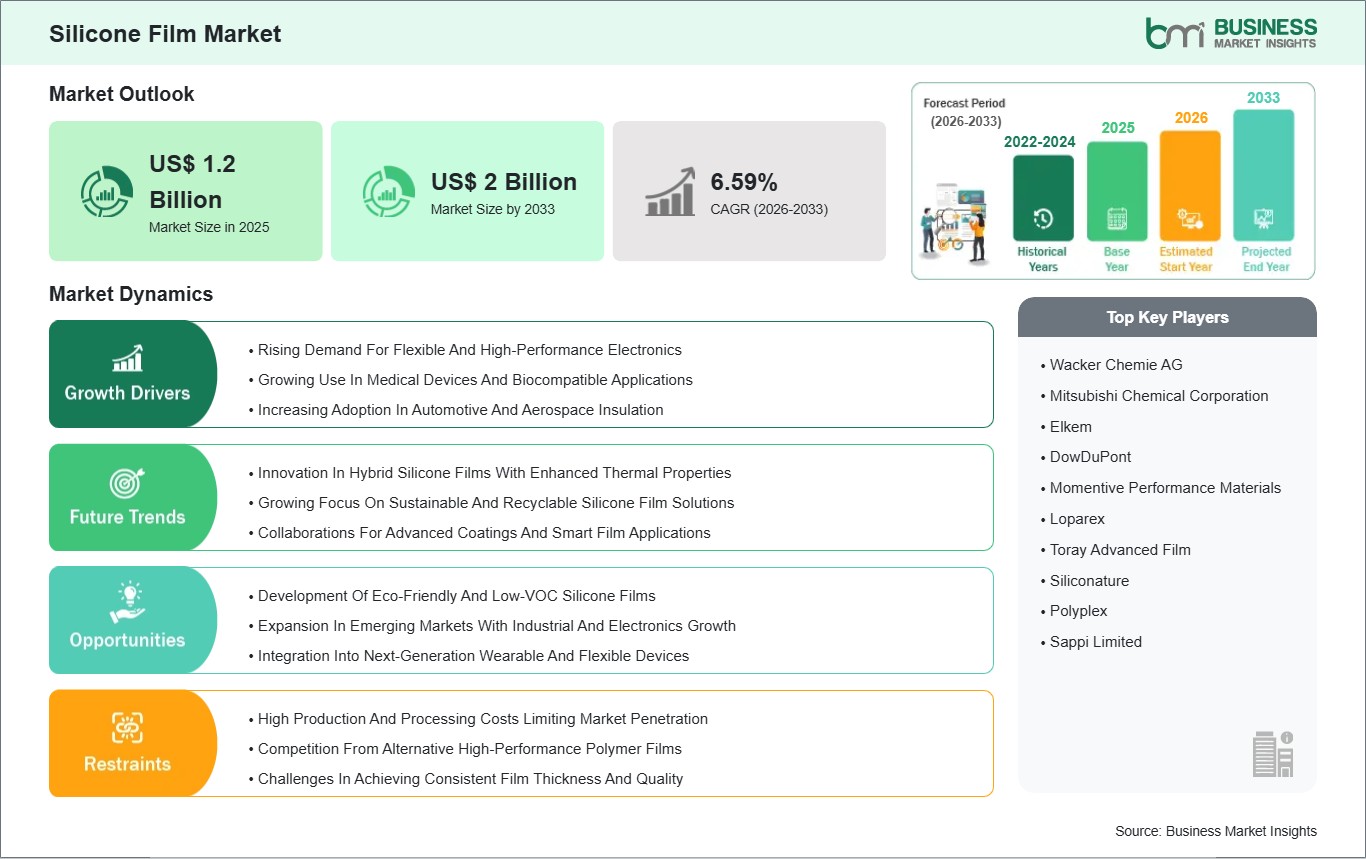
The global silicone film market is witnessing strong growth because various end‑use industries now require high‑performance functional films that provide durable and flexible and thermally and chemically resistant properties. Silicone films represent specialized polymeric materials which design through silicone elastomers to produce a material that maintains high temperature resistance and excellent dielectric properties while sustaining environmental and UV stability and showing flexibility during all temperature ranges. The unique properties of silicone films enable their use in critical performance applications which include electronics medical devices industrial insulation automotive aerospace and advanced packaging. The electronics industry uses silicone films to create insulation and protective overlays and keyboard membranes and flexible circuitry substrates which need to deliver reliable performance throughout their entire product lifespan.
The medical device sector uses silicone films for their biocompatibility and sterilization simplicity and inert properties which enable their use in regulatory compliant adhesive tapes and wound care products and component liners . The global market for flexible and wearable electronics has created a major demand for materials which can withstand both bending movements and environmental conditions without losing their operational capabilities. The tensile strength and resilient properties of silicone films make them essential for flexible display technology and sensor systems and wearable health monitoring devices. Their excellent insulation and heat resistance properties make them suitable for use in high‑temperature gaskets and protective shields and electrical insulation systems which operate in power generation and manufacturing environments.
The rising demand for product safety and extended product lifespan which manufacturers must satisfy through new regulatory requirements has led manufacturers to discontinue their usage of old polymer films and start using silicone products which provide wider temperature performance and superior environmental resistance. The Silicone Film Market experiences difficulties from its expensive materials combined with high processing expenses which hinders adoption within markets that require low-cost solutions for consumer packaging and general industrial applications.
The market encounters restrictions because customers choose other high-performance polymers which include fluoropolymers and polyimides instead of silicone because those materials meet their cost and specific properties requirements better than silicone does. The silicone film market shows potential for global growth because of ongoing film processing developments and hybrid silicone composite innovations and the rising need for advanced functional films which support emerging technologies.
Segment Analysis
Silicone Film Market Segmentation
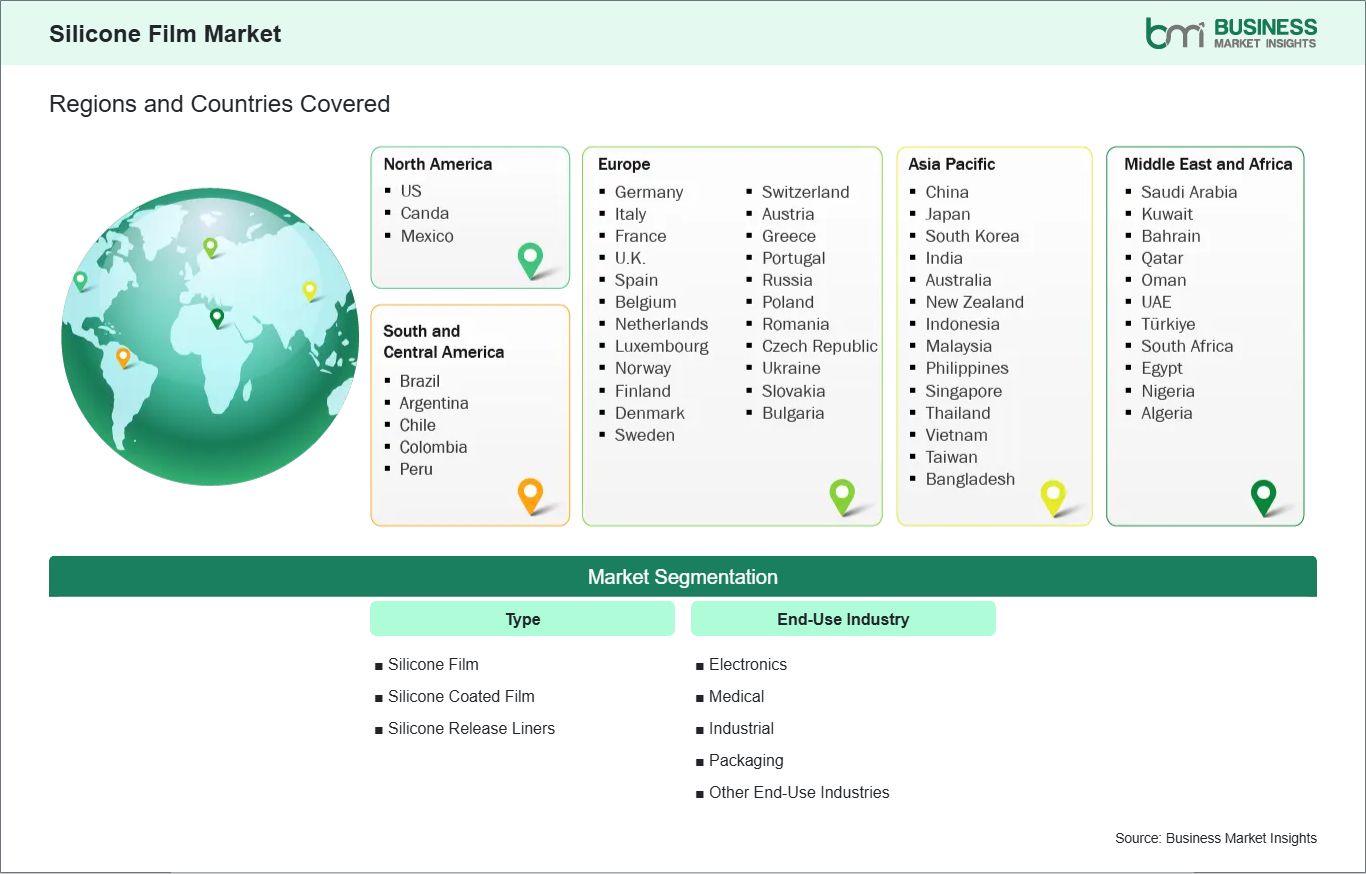
Key segments that contributed to the derivation of the silicone film market analysis are type and end-use industry.
- By type, the silicone film market is segmented into silicone film, silicone coated film, and silicone release liners. The silicone release liners segment dominated the market in 2025.
- Based on end-use industry, the silicone film market is categorized into electronics, medical, industrial, packaging, and other end-use industries. The electronics segment dominated the market in 2025.
Market Forces
Silicone Film Market Drivers and Opportunities
Rising Demand For Flexible And High‑Performance Electronics
The worldwide rise in flexible high-performance electronics drives demand for silicone films because manufacturers require materials that maintain flexibility while providing thermal insulation and electrical protection and environmental durability. Silicone films are used in flexible displays and foldable devices and wearable gadgets and advanced touch sensors because they maintain performance during repeated bending and stretching and thermal cycling. The silicone films serve as a dependable substrate for electronics manufacturers across North America and Asia Pacific and Europe who aim to create new product designs that maintain performance throughout their entire lifespan. Silicone films serve two essential functions because they provide protective encasement for delicate electronic components which must function in extremely demanding situations.
The combination of silicone hydrophobic properties and UV resistance makes these films essential for ruggedized devices because they protect consumer electronics from moisture and temperature changes and outdoor conditions. The use of silicone films in industrial and IoT sensors enhances durability while protecting signal strength which results in dependable performance for automation and smart infrastructure systems. The semiconductor industry requires better insulating materials because its manufacturing processes need to achieve smaller nodes and higher operating frequencies. The telecommunications and 5G infrastructure use silicone films which function as dielectric layers and flexible interconnects to meet the performance requirements of upcoming network technologies.
Development Of Eco‑Friendly And Low‑VOC Silicone Films
Sustainability requirements are driving changes in the silicone film industry which experiences rising demand for environmentally friendly products that meet both environmental standards and green building specifications. North America and Europe established strict air quality regulations which led companies to commit to emission reductions that resulted in suppliers developing new silicone film products which decreased their volatile organic compounds emissions during production and application processes. The low-VOC products provide equivalent thermal and mechanical properties which enable people to work in healthier environments throughout the city.
The Asia Pacific region which includes China and India has started to adopt eco-compliant silicone films because their governments expand environmental regulations while customers choose materials that create less environmental damage. Local manufacturers are making investments to develop better processing methods and material sourcing capabilities which will help them attain sustainability certification while maintaining their product performance standards to meet customer needs across different industrial and construction and electronics markets. The worldwide adoption of eco-friendly silicone films helps businesses meet environmental regulations while advancing their sustainability initiatives in multiple international markets.
Size and Share Analysis
Silicone Film Market Size and Share Analysis
The silicone film market demonstrates steady growth, with size and share analysis highlighting evolving trends and competitive dynamics among key players. The report examines subsegments categorized within type and end-use industry, offering insights into their contribution to overall market performance.
By type, the silicone release liners subsegment dominated the market in 2025, driven by its extensive use in adhesive applications, protective films, and industrial processes requiring reliable release properties.
Based on end-use industry, the electronics subsegment dominated the market in 2025, driven by growing demand for silicone films in flexible circuits, insulation, and electronic component protection.
Report Coverage
Silicone Film Market Report Coverage and Deliverables
The "Silicone Film Market Size and Forecast (2022 - 2033)" report provides a detailed analysis of the market covering below areas:
- Silicone Film Market size and forecast at global, regional, and country levels for all the key market segments covered under the scope
- Silicone Film Market trends, as well as drivers, restraints, and opportunities
- Silicone Film Market analysis covering key trends, global and regional framework, major players, regulations, and recent developments
- Industry landscape and competition analysis covering market concentration, heat map analysis, prominent players, and recent developments for the Silicone Film Market
- Detailed company profiles, including SWOT analysis
Geographic Insights
Silicone Film Market Geographic Insights
The geographical scope of the Silicone Film Market report is divided into North America, Asia Pacific, Europe, Middle East & Africa, and South & Central America. North America held the largest share in 2025.
North America leads the global silicone film market because its manufacturing industries use advanced technologies and its businesses first adopted high-performance functional materials in industrial electronics aerospace automotive and medical fields. The electronics and semiconductor industries in the United States and Canada drive demand for silicone films which serve as essential insulation and protective masking materials and flexible circuit substrates and thermal interface solutions. Manufacturers use silicone films instead of traditional polymer materials because the region's strict quality standards and safety requirements and reliability standards demand superior thermal stability and dielectric performance and UV resistance and protection against mechanical stress.
Europe follows Europe as Germany France and the UK lead the adoption of industrial automation and medical devices and aerospace applications which use silicone films for protective coatings and flexible sensors and medical-grade adhesive layers used in diagnostics and wound care.
The rising demand in Asia Pacific electronics manufacturing centers that exist in China, Japan, South Korea, and India comes from the increasing need for consumer electronics and automotive sensors and flexible displays. The market potential for the region increases because of rapid industrialization and rising disposable incomes and government programs that promote advanced technology use.
The Middle East and Africa mainly use silicone films for oil and gas and construction work and industrial insulation purposes, but their need for high-temperature protective coatings and extreme weather protective coatings continues to increase.
The automotive and energy industries drive silicone film adoption in South and Central America through their use of the material for insulation purposes and acoustic damping needs and flexible protective layer requirements.
The North American market establishes its technological supremacy which Europe follows through regulatory requirements that drive new innovations while Asian Pacific regions expand their manufacturing capacity and Middle Eastern and African territories develop their industrial base and South American regions advance their industrial growth.
The material functions as an essential component which delivers high-performance attributes along with durable characteristics and multiple functions to various regions despite different patterns of cost sensitivity and adoption among those regions.
Industry Activity
Recent Developments
The Silicone Film Market is evaluated by gathering qualitative and quantitative data post primary and secondary research, which includes important corporate publications, association data, and databases. A few of the key developments in the silicone film market are:
- In April 2025, Momentive Performance Materials announced that it had launched Harmonie™ NatuVel gel — a 100% biobased elastomer gel developed through global collaboration to meet rising consumer and sustainability demands across multiple markets. This development highlights the company`s ongoing innovation in silicone‑based materials that can complement advanced silicone film applications in areas such as flexible polymers and eco‑friendly solutions.
- In March 2023, Dow Inc. announced that it expanded its portfolio of silicone‑based products with the launch of the DOWSIL™ PV product line for photovoltaic module assembly, strengthening its materials offerings that include silicone films and coatings used in renewable energy and power systems.
Trust & Transparency
Research Methodology
The market analysis combines proprietary research with secondary data from government agencies, company disclosures, regulatory filings, industry databases and expert interviews. Market estimates are validated through data triangulation, cross-market benchmarking and analyst
review.
View Full Research Methodology
Key Sources Referred:
World Health Organization (WHO) Organisation for Economic Cooperation and Development (OECD) The World Bank Group Worldometer The Lancet International Bar Association International Trade Administration