
Shunt Capacitor Market Outlook: Size, Share, Trends, Growth Analysis, Competitive Landscape & Forecast, 2026-2033

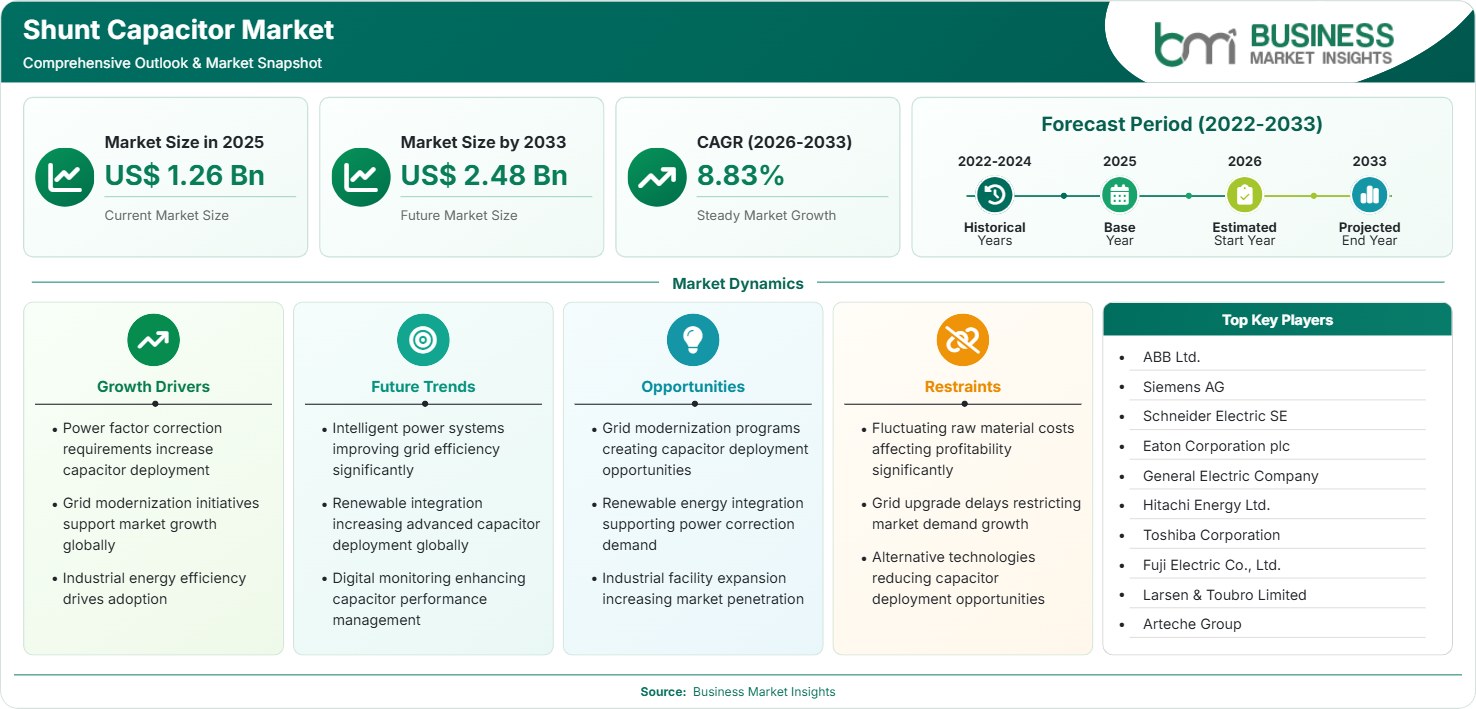
The Shunt Capacitor Market size was valued at US$ 1.26 Billion in 2025 and is projected to reach US$ 2.48 Billion by 2033, growing at a CAGR of 8.83% during 2026–2033, driven by grid modernization, reactive power compensation demand, renewable integration, industrial power quality requirements, transmission expansion investments, and utility efforts to improve voltage stability and reduce distribution losses.

Report Coverage
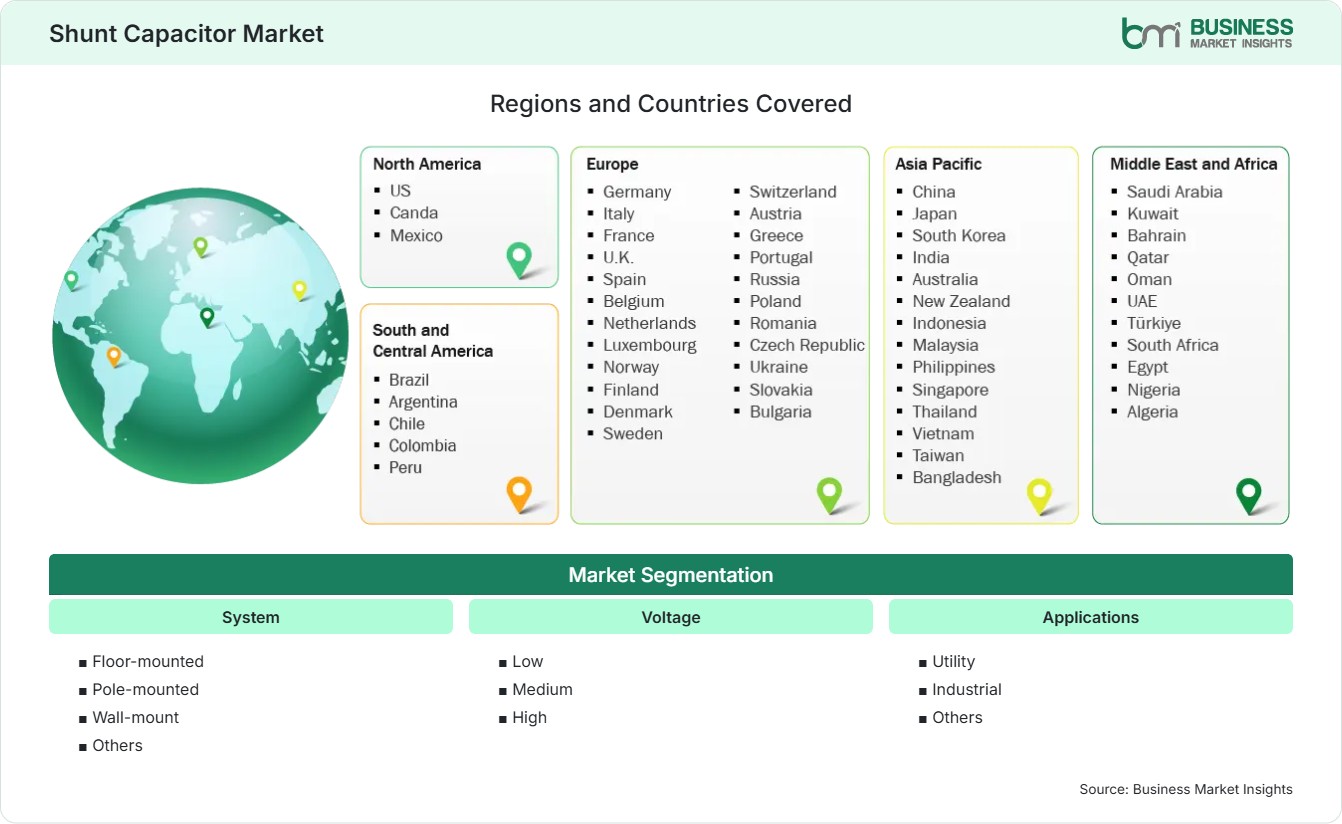
  • System: Floor-mounted, Pole-mounted, Wall-mount, Others
  • Voltage: Low, Medium, High
  • Applications: Utility, Industrial, Others
US$ 1.26 Bn Market size in 2025
US$ 2.48 Bn Market Size by 2033
8.83% CAGR, 2026 - 2033
2026-2033 Forecast Period

AI Overview

Shunt Capacitor Market Summary

  • North America Region: North America holds a market share of 33%–36% in 2025, growing with a CAGR of 7.8%–8.4% during 2026–2033, supported by grid modernization, aging network upgrades, utility efficiency mandates, renewable integration, power quality improvements, and rising transmission investments across utility and industrial sectors.
  • Fastest Growing Region: Asia Pacific holds a market share of 28%–31% in 2025, growing with a CAGR of 10.2%–11.0% during 2026–2033, driven by industrial electrification, transmission network additions, expanding renewable capacity, urban infrastructure projects, grid reliability initiatives, and increasing investments in power quality enhancement technologies.
  • Leading Segment: Utility applications account for a 51%–54% share in 2025 and are expected to grow at a CAGR of 8.9%–9.5%, supported by transmission expansion, reactive power management requirements, voltage optimization programs, renewable grid connections, and utility-led investment in distribution efficiency improvements.
  • High Growth Segment: High-voltage systems represent a 21%–24% share in 2025 and are forecast to grow at a CAGR of 10.4%–11.2%, benefiting from long-distance transmission projects, renewable energy integration, substation modernization, grid strengthening initiatives, and increasing demand for reactive power compensation assets.
  • Key Market Opportunity: Large-scale renewable integration requires advanced voltage regulation and reactive power support. Growing deployment of solar, wind, and transmission infrastructure creates substantial demand for capacitor installations across utility substations and grid networks.
  • Major Market Players: ABB Ltd., Siemens AG, Schneider Electric SE, Eaton Corporation plc, General Electric Company, Hitachi Energy Ltd., Toshiba Corporation, Fuji Electric Co., Ltd., Larsen & Toubro Limited, and Arteche Group.
Strategic Insights

Shunt Capacitor Market: Strategic Insights

Shunt Capacitor Market Strategic Framework
FREE PDF
Request your free sample
Request free sample
Stakeholder View

Key Takeaways

  • The industry ecosystem is tightly linked to the utilities, the EPCs, the transmission operators, the component manufacturers, the dielectric material suppliers and the substation integrators. Supply chain resilience is therefore a real differentiator for the leading players in the market.
  • Utility-owned transmission and distribution networks represent the biggest revenue opportunity as the need for reactive power compensation grows in line with the growth in renewable energy interconnections and network expansion projects.
  • Product innovation is moving in the direction of smart capacitor banks with digital monitoring, remote diagnostics, switching automation, and grid analytics capabilities to improve operational efficiency and asset performance.
  • Asia Pacific has by far the most attractive long-term investment case with continued infrastructure spend, massive transmission build-out and growing electricity demand in the industrialized economies.
  • Consolidation activity is increasingly being directed at the grid technologies, substation automation and power quality portfolios, enabling the companies to offer more integrated solutions for utility modernization programs.
  • Increasing emphasis on energy efficiency, voltage stability and power factor correction is driving energy procurement up the list of priorities for industrial customers looking to reduce their losses and get the most out of their electrical infrastructure.
Geographic Outlook

Shunt Capacitor Market Regional Highlights

North America Shunt Capacitor Market

North America accounted for approximately 33%–36% of global Shunt Capacitor Market revenue in 2025 and is projected to expand at a 7.8%–8.4% CAGR through 2033. Large-scale transmission investments, grid modernization initiatives, renewable integration requirements, and aging infrastructure replacement support demand.

  • Grid modernization programs are all about voltage stability, power quality, and improved distribution efficiency and, as such, see the widespread deployment of compensation equipment across both the transmission and distribution networks.
  • Renewable energy integration leads to increased reactive power requirements, which in turn creates ongoing procurement requirements for the utility managing the solar and wind interconnections.
  • Industrial operators are still going ahead and investing in energy efficiency measures to reduce losses and improve power factor performance, which is further underpinning the commercial demand.
  • Digital substation deployment and the drive towards automation are both encouraging the uptake of intelligent capacitor solutions which are capable of remote monitoring and predictive maintenance.
  • Transmission expansion investments underpin the long-term equipment procurement pipelines of network operators and utility infrastructure developers.

US Shunt Capacitor Market

The United States represents approximately 76%–80% Shunt Capacitor Market share within North America and is expected to grow at an 8.0%–8.6% CAGR between 2026 and 2033. Federal and state-level infrastructure programs support transmission upgrades, renewable integration, and resilience investments.

  • Large renewable interconnection queues are still going up, and this is continuing to drive up the demand for voltage support infrastructure across the transmission networks and substations.
  • Data center expansion and electrification are driving up electricity demand, and that in turn is prompting the utilities to invest in power quality enhancement assets.
  • Aging transmission infrastructure replacement programs create a constant stream of procurement opportunities for capacitor bank suppliers and engineering contractors.
  • Advanced grid control technologies enable the deployment of intelligent switching and monitoring solutions as part of the compensation system.

Europe Shunt Capacitor Market

Europe represented around 24%–27% of global Shunt Capacitor Market revenue in 2025 and is anticipated to register a 7.5%–8.2% CAGR through 2033. Increasing renewable-energy penetration, cross-border transmission investments, and decarbonization targets drive equipment deployment.

  • Renewable integration programs in Germany, Spain, and the UK all result in increased network balancing requirements and so support the continued deployment of reactive power compensation assets in substations and on transmission corridors.
  • European TSOs are rolling out high-voltage infrastructure to link in the renewable generation, thereby creating long-term opportunities for voltage control and power quality equipment.
  • Industrial energy efficiency regulations have a strong incentive for manufacturers to improve their power factor performance and, as such, we see widespread adoption across the automotive, chemical, metals and process industries.
  • Digital substation investments enable intelligent monitoring capabilities which in turn improve asset utilization, maintenance efficiency and system reliability across the entire utility network.
  • Poland is seeing some of the strongest regional growth as a result of grid modernization and the integration of renewables, which are placing a greater demand on voltage regulation capability.

Asia Pacific Shunt Capacitor Market

Asia Pacific accounted for approximately 28%–31% of global Shunt Capacitor Market demand during 2025 and is projected to achieve the fastest regional CAGR of 10.2%–11.0% through 2033. Rapid industrialization, urbanization, and electricity consumption growth stimulate infrastructure investment.

  • China is continuing to build out its ultra-high-voltage transmission networks, and this is creating massive demand for voltage control infrastructure and compensation technologies to support system stability.
  • India is expanding its renewable energy capacity and its transmission connectivity, which in turn is increasing the demand for more sophisticated solutions to improve grid efficiency and reactive power management.
  • Southeast Asian economies are investing in urban infrastructure and industrial development programs which require a high degree of reliability in electricity distribution performance.
  • Utilities are increasingly using digital monitoring to improve system performance, reduce technical losses and improve service reliability.
  • Manufacturing growth across the region is underpinning industrial uptake with a focus on operational efficiency and power quality performance improvements.

Rest of World Shunt Capacitor Market

Rest of World accounted for approximately 10%–13% of global Shunt Capacitor Market revenue in 2025 and is expected to expand at an 8.8%–9.6% CAGR through 2033. South and Central America benefit from renewable integration and transmission upgrades led by Brazil, which remains the largest regional market.

  • Brazil is still the number one demand center, driven by transmission network expansion, the integration of renewables and utility investments aimed at reducing system losses.
  • Saudi Arabia is seeing significant growth, with the utilities playing a key role in improving grid resilience and underpinning the country's large-scale infrastructure development programs.
  • Expanding the electrification programs in selected African countries will create further opportunities for distribution network optimization and for the deployment of voltage support technologies.
  • Renewable energy projects in Chile, the UAE and South Africa all have a continuous requirement for reactive power compensation equipment.
  • Industrial development and mining activity create further demand for power factor correction solutions to improve efficiency.
Global Market Geography
FREE PDF
Request your free sample
Request free sample
Segment Analysis

Shunt Capacitor Market Segmentation

System

The System segment accounted for approximately 34%–37% market share in 2025 and is projected to expand at an 8.5%–9.1% CAGR through the forecast period. The Shunt Capacitor Market scope continues expanding as utilities prioritize flexible installation configurations optimized for operational efficiency, voltage regulation, and network reliability.

  • Floor-mounted: Widely adopted in utility substations and industrial facilities due to ease of maintenance, higher capacity handling, and suitability for permanent reactive power compensation applications.
  • Pole-mounted: Commonly used in distribution networks where utilities require localized voltage support, reduced line losses, and economical deployment across geographically dispersed service territories.
  • Wall-mount: Preferred in space-constrained installations, commercial facilities, and compact substations where practical placement and operational accessibility are important considerations.

Voltage

The Voltage segment represented nearly 30%–33% market share in 2025 and is expected to register a 9.2%–9.8% CAGR through 2033. Current Shunt Capacitor Market trends increasingly favor advanced high-voltage installations designed to strengthen system stability and support long-distance power transmission efficiency.

  • Low: Primarily serves commercial facilities, buildings, and light industrial applications requiring power-factor correction and improved electrical efficiency.
  • Medium: Extensively used across distribution networks and industrial plants where voltage regulation and loss reduction remain critical operating priorities.
  • High: Gains traction through transmission-expansion projects, renewable interconnections, and utility modernization programs requiring sophisticated reactive power management capabilities.

Applications

The Applications segment held approximately 51%–54% market share in 2025 and is forecast to grow at an 8.9%–9.5% CAGR. The Shunt Capacitor Market size continues to benefit from demand across grid operators, industrial facilities, and infrastructure projects requiring enhanced power quality and voltage-control performance.

  • Utility: Represents the largest adoption category, supported by network expansion, voltage-stability requirements, renewable integration initiatives, and ongoing grid modernization investments worldwide.
  • Industrial: Driven by manufacturing, mining, metals, petrochemicals, and process industries focused on improving power-factor performance and reducing energy losses.
Market Forces

Shunt Capacitor Market Dynamics

Key Market Drivers

Expansion of Transmission and Distribution Infrastructure

Global electricity demand growth and grid expansion programs continue to strengthen demand for reactive power compensation equipment. According to the International Energy Agency, transmission and distribution investments are increasing significantly as countries modernize networks to support electrification and renewable integration. This factor directly supports Shunt Capacitor Market growth by increasing installations in substations and distribution networks. Growing investments in transmission corridors, smart grids, and interconnection projects create recurring procurement opportunities. Network operators increasingly deploy capacitor banks to improve power factor, enhance energy efficiency, and optimize utilization of existing infrastructure assets.

Rising Renewable Energy Integration Requirements

The rapid deployment of wind and solar generation creates additional requirements for voltage regulation and reactive power management. Variable renewable generation can introduce grid stability challenges that require utilities to adopt compensation technologies supporting network performance. As countries pursue decarbonization targets, transmission operators increasingly integrate renewable resources into existing grids. These developments reinforce Shunt Capacitor Market trends associated with advanced substation modernization and voltage-control investments.

Growing Industrial Need for Power Quality Improvement

Industrial sites are under constant pressure to improve their operational efficiency and reduce their electricity costs. Many industrial sites (manufacturing plants, mines, metal producers, process industries, etc.) will have power factor correction equipment in place to improve their power factor and thereby reduce their penalties. The modern industrial automation systems require a very stable voltage to maintain the level of productivity and equipment reliability. As industrial electrification continues to ramp up, the site's focus is on technologies that will improve energy use and reduce stress on the network.

Key Market Opportunities

Smart Capacitor Banks and Digital Grid Applications

Digitalization of the utility infrastructure is a massive investment opportunity. Utilities are increasingly moving to intelligent substations with remote monitoring, predictive maintenance, and automated switching. You've got intelligent capacitor banks with digital control platforms which provide a much better level of visibility and reduce maintenance costs. The smart grid is in its infancy, and the move towards smart grid architectures is creating a very favorable environment for the vendors of connected and analytics-enabled solutions. These systems can provide real-time voltage control and a much more responsive grid under changing operating conditions.

Emerging Economy Transmission Modernization Programs

Large-scale transmission projects across Asia, the Middle East, Africa, and Latin America offer substantial expansion opportunities. Governments are allocating capital toward network modernization, electrification, and renewable-energy connectivity. New substations and high-voltage transmission corridors require reliable reactive power management infrastructure. The Shunt Capacitor Market Forecasts indicate particularly strong potential in economies experiencing rapid industrialization and urbanization. Market participants capable of providing cost-effective solutions tailored to local utility requirements can benefit from rising procurement activity. Long-term infrastructure programs also support recurring replacement and upgrade demand, improving revenue visibility for equipment suppliers and engineering partners.

High-Voltage Renewable Energy Corridors

Investment in long-distance transmission infrastructure continues to rise as countries connect their renewable generation resources to major load centers. HV capacitor installations are a key element in maintaining voltage stability and enabling effective power transfer. The development of renewable energy corridors (offshore wind, large-scale solar parks, interregional interconnection projects, etc.) is creating significant demand. Utility planners are increasingly specifying advanced compensation as part of their transmission development frameworks.

Market Restraints and Challenges

High Initial Capital Costs for Utility Deployments

Factor: Utility-scale installations are inherently capital intensive, with large outlays required for equipment, engineering, installation, protection, and commissioning. Impact: Budgetary constraints can have a direct bearing on the timing of purchase decisions, especially in emerging markets and with smaller utilities that have limited capital. Whilst compensation technologies will generate significant savings over the lifetime of the project, the project economics will be affected by the cost of financing and competing infrastructure demands.

Operational Complexity and Maintenance Requirements

Factor: Modern installations will require careful integration with the existing network architecture, protection systems, switching equipment, and operational protocols. Impact: Utilities and industrial operators will face increased complexity in maintenance planning, diagnostics, and performance monitoring. Incorrect specification or lack of system coordination can in fact lead to a reduction in the efficiency gains and can have a negative impact on the reliability results.

Company Analysis

Competitive Landscape

The competitive environment remains characterized by established electrical-equipment manufacturers, grid-technology leaders, and specialized power-quality providers. Current Shunt Capacitor Market analysis highlights increasing emphasis on digital substations, high-voltage systems, and utility modernization solutions.

Company Name

Overview

Products and Services relevant to this market

ABB Ltd.

Global electrification and automation company with extensive utility and industrial infrastructure presence across major regions.

Shunt capacitors, capacitor banks, reactive power compensation systems, digital substation technologies, and grid modernization solutions.

Siemens AG

Major energy and industrial technology provider supporting transmission, distribution, and infrastructure projects worldwide.

Capacitor banks, grid control technologies, voltage regulation equipment, and power quality enhancement systems.

Schneider Electric SE

Leading energy management and automation specialist serving utilities, buildings, and industrial customers.

Power factor correction solutions, capacitor banks, monitoring systems, and electrical distribution technologies.

Eaton Corporation plc

Diversified power management company focused on electrical reliability, efficiency, and infrastructure solutions.

Capacitor banks, reactive compensation equipment, switchgear, and power quality management products.

General Electric Company

Global energy infrastructure supplier supporting utilities, transmission operators, and industrial sectors.

Grid solutions, reactive power compensation technologies, substation equipment, and transmission infrastructure systems.

Hitachi Energy Ltd.

Specialized power-grid technology provider with strong utility and renewable integration capabilities.

High-voltage capacitors, grid stabilization technologies, reactive power systems, and substation solutions.

Toshiba Corporation

Technology and infrastructure company serving utility and industrial power markets globally.

Capacitor systems, substation equipment, transmission technologies, and electrical infrastructure services.

Fuji Electric Co., Ltd.

Japanese electrical equipment manufacturer focused on energy and industrial automation applications.

Power quality solutions, capacitor systems, industrial electrical equipment, and energy management technologies.

Larsen & Toubro Limited

Engineering and infrastructure leader active in power transmission and utility development projects.

EPC services, substation solutions, capacitor installations, and transmission infrastructure projects.

Arteche Group

Specialist provider of grid equipment and electrical measurement technologies.

Reactive compensation systems, capacitor equipment, monitoring devices, and substation components.

Trust & Transparency

Research Methodology

The market analysis combines proprietary research with secondary data from government agencies, company disclosures, regulatory filings, industry databases and expert interviews. Market estimates are validated through data triangulation, cross-market benchmarking and analyst review.

View Full Research Methodology

Questions Answered

Frequently Asked Questions

What does the Shunt Capacitor Market Report typically evaluate?

A comprehensive report assesses market size, competitive positioning, technology developments, regional demand patterns, investment opportunities, application trends, regulatory factors, and long-term growth prospects across key segments.

Which region offers the strongest future growth potential?

Asia Pacific presents the strongest growth outlook due to ongoing industrialization, urbanization, transmission investments, renewable-energy deployment, and rising electricity consumption across major economies.

How do shunt capacitors support renewable-energy integration?

They provide reactive power compensation that helps stabilize voltage profiles, improve power quality, and maintain efficient electricity transmission within grids containing high levels of variable renewable generation.

Which application segment generates the highest revenue?

Utility applications represent the largest revenue contributor because transmission and distribution operators require voltage regulation, loss reduction, and power-factor correction solutions across expanding electricity networks.

What factors are accelerating adoption of shunt capacitors worldwide?

Increasing electricity demand, renewable-energy integration, transmission expansion, industrial electrification, and efficiency requirements are encouraging utilities and industries to deploy reactive power compensation technologies for network optimization and voltage stabilization.

Access the Full Shunt Capacitor Market Report

Get segment-level forecasts, regional estimates, competitive benchmarking, company profiles and downloadable Excel datasets.

Access the full Shunt Capacitor Market Report
350 pages PDF & Excel | 2026-11-10
Similar Research

Related Market Reports