Hydraulic Fracturing Market Outlook: Size, Share, Trends, Growth Analysis, Competitive Landscape & Forecast, 2026-2033

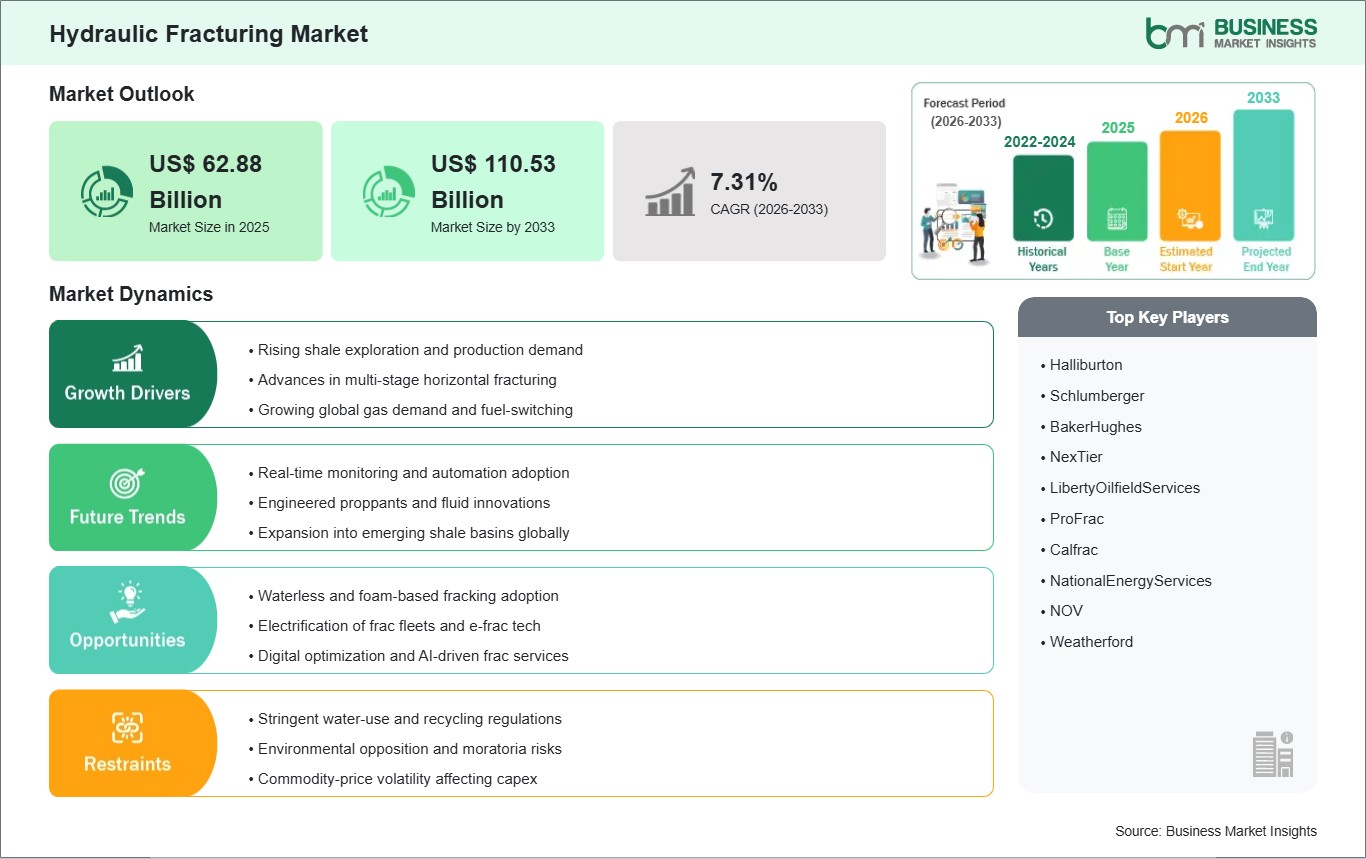
The Hydraulic Fracturing Market size is expected to reach US$ 110.53 Billion by 2033 from US$ 62.88 Billion in 2025.The market is estimated to record a CAGR of 7.31% from 2026 to 2033.

Report Coverage
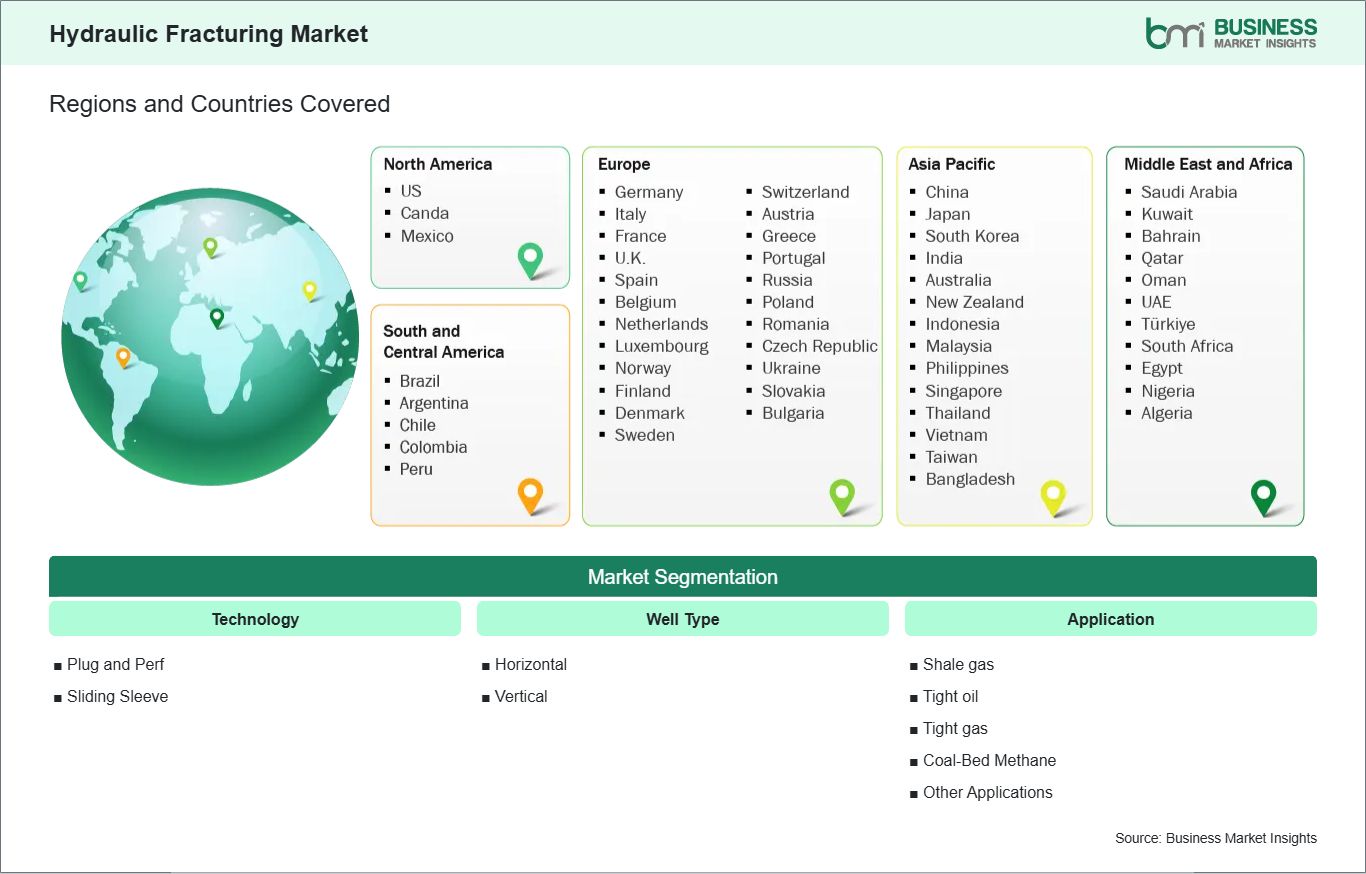
  • Technology: Plug and Perf, Sliding Sleeve
  • Well Type: Horizontal, Vertical
  • Application: Shale gas, Tight oil, Tight gas, Coal-Bed Methane, Other Applications
US$ 62.88 Bn Market size in 2025
US$ 110.53 Bn Market Size by 2033
7.31% CAGR, 2026 - 2033
2026-2033 Forecast Period

01 Market Summery

Executive Summary and Global Market Analysis

Hydraulic fracturing is a technique used underground to improve the flow of hydrocarbons by creating fractures in rock formations that do not allow fluids to pass through easily. This method is often used in unconventional reservoirs where natural extraction rates are too low for it to be profitable. The process involves injecting high-pressure fluids and transporting proppants to keep the fractures open. Energy security needs and the push to exploit unconventional resources are changing how operators work in different areas. Companies aim to improve well productivity while handling the complexity of reservoirs through better control of fracture shapes. Cost-efficiency also plays a role in their decisions, especially in mature basins where output is declining.

In terms of segments, horizontal wells make up a large part of operations since they have better access to hydrocarbon-rich formations. Shale gas and tight oil are the main applications, showing the financial appeal of large unconventional reserves. There is a trend toward multi-stage completion designs that improve how efficiently a reservoir can be drained. Progress in digital monitoring, microseismic tracking, and fluid chemistry optimization is improving the accuracy of fractures and reducing uncertainty in operations. Using real-time data analytics is helping to make better decisions during the stimulation process. Standardizing equipment and automating services are making execution faster across well programs with high volumes. In a competitive landscape, service providers are focusing on complete well completion solutions and cost-effective pumping services. Companies are increasingly positioned based on their unique technologies and expertise specific to each basin. Contract structures are also changing to performance-based models, reflecting the higher efficiency expectations from operators.

02 Strategic Insights

Hydraulic Fracturing Market: Strategic Insights

hydraulic-fracturing-market-market-strategic-framework
FREE PDF
Request your free sample
Request free sample
03 Segment Analysis

Hydraulic Fracturing Market Segmentation

By Technology

  • Plug and Perf – Dominates multi-stage completion in shale formations
  • Sliding Sleeve:Used in uniform stimulation across extended laterals

By Well Type

  • Horizontal: High reservoir contact improves hydrocarbon recovery efficiency
  • Vertical: Applied in simpler geological formations with limited lateral reach

By Application

  • Shale Gas: Primary contributor due to extensive unconventional reserves
  • Tight oil: Supports production in low-permeability oil-bearing rocks
  • Tight Gas: Enables extraction from compact sandstone formations
  • Coal-Bed Methane: Utilizes fracture networks in coal seams
  • Other Applications: Includes emerging and niche reservoir types
04 Market Forces

Hydraulic Fracturing Market Drivers and Opportunities

Expanding Unconventional Resource Development

Rising exploitation of shale and tight reservoirs is increasing the dependence on stimulation techniques. Operators need to create controlled fractures to unlock trapped hydrocarbons in low-permeability formations. This need is speeding up the adoption in both mature and emerging basins. Drilling programs are more frequently designed around multi-stage hydraulic fracturing setups to improve productivity consistency. The impact is evident in higher well completion intensity across unconventional plays. Energy-producing regions are focusing on reservoir optimization strategies to keep output stable. This trend highlights hydraulic fracturing as a necessary part of unconventional extraction practices.

Digitalization and Precision Stimulation Technologies

Modeling tools and real-time monitoring systems are improving fracture placement accuracy. Better simulation capabilities allow for more effective prediction of reservoir behavior under different pressure conditions. Fluid optimization technologies are also improving proppant transport efficiency during injection cycles. Future growth is expected with the integration of automated control systems and predictive analytics. These advancements help with cost management and lower operational uncertainty. The sector is shifting toward precision-driven stimulation practices that improve recovery efficiency across complex geological formations.

05 Size and Share Analysis

Hydraulic Fracturing Market Size and Share Analysis

The Hydraulic Fracturing Market is projected to grow from US$ 62.88 Billion in 2025 to US$ 110.53 Billion by 2033 , registering a CAGR of 7.31% from 2026 to 2033.

The hydraulic fracturing market is valued at 2025-USD 57.19 Billion, 2033 - USD 90.92 Billion, CAGR -6.0%, reflecting shifting investment patterns across unconventional extraction projects. Despite changes in energy patterns, long-term deployment still depends on improving reservoir productivity. In terms of technology, there is a greater focus on multi-stage completion methods that support long lateral wells. Standardizing equipment and integrating services are improving efficiency in key basins. Service providers are focusing on scalable pumping capacity to support high-intensity drilling cycles. The main applications are in shale gas and tight oil extraction. These areas continue to see steady use because of the abundant resources and their economic feasibility under optimized production conditions.

06 Report Highlights

Hydraulic Fracturing Market Report Highlights

Report Attribute Details
Market size in 2025 US$ 62.88 Billion
Market Size by 2033 US$ 110.53 Billion
Global CAGR (2026 - 2033)7.31%
Historical Data 2022-2024
Forecast period 2026-2033
Segments Covered By Technology
  • Plug and Perf
  • Sliding Sleeve
By Well Type
  • Horizontal
  • Vertical
By Application
  • Shale gas
  • Tight oil
  • Tight gas
  • Coal-Bed Methane
  • Other Applications
Regions and Countries Covered
North America US, Canada, Mexico
Europe Germany, Italy, France, U.K., Spain, Belgium, Netherlands, Luxembourg, Norway, Finland, Denmark, Sweden, Switzerland, Austria, Greece, Portugal, Russia, Poland, Romania, Czech Republic, Ukraine, Slovakia, Bulgaria
Asia-Pacific China, Japan, South Korea, India, Australia, New Zealand, Indonesia, Malaysia, Philippines, Singapore, Thailand, Vietnam, Taiwan, Bangladesh
South and Central America Brazil, Argentina, Chile, Colombia, Peru
Middle East and Africa Saudi Arabia, United Arab Emirates, Kuwait, Bahrain, Qatar, Oman, Turkiye, South Africa, Egypt, Nigeria, Algeria
Market leaders and key company profiles
  • Halliburton
  • Schlumberger
  • BakerHughes
  • NexTier
  • LibertyOilfieldServices
  • ProFrac
  • Calfrac
  • NationalEnergyServices
  • NOV
  • Weatherford
FREE PDF
Request your free sample
Request free sample
07 Report Coverage

Hydraulic Fracturing Market Report Coverage and Deliverables

The " Hydraulic Fracturing Market Size and Forecast (2022-2033)" report provides a detailed analysis of the market covering below areas:

  • Market size and forecast at global, regional, and country levels for all market segments covered under the scope
  • Market trends, as well as drivers, restraints, and opportunities
  • Market analysis covering key trends, global and regional framework, major players, regulations, and recent developments
  • Industry landscape and competition analysis covering market concentration, heat map analysis, prominent players, and recent developments for the Hydraulic fracturing market
  • Detailed company profiles, including SWOT analysis
08 Geographic Insights

Hydraulic Fracturing Market Geographic Insights

The hydraulic fracturing market shows different regional adoption patterns shaped by geological features, regulations, and energy demand. North America demonstrates strong operational maturity due to extensive shale formations and a well-established service infrastructure. Ongoing improvements in efficiency and high-density well development maintain strong activity levels in major producing areas. Asia Pacific is slowly growing, driven by increasing energy consumption and the search for unconventional reserves. Operators are adopting new technologies as they assess local resource potential to ensure long-term supply. Europe and emerging markets show limited growth because of environmental concerns and resource limitations. Activity levels depend on selective exploration initiatives and pilot-scale projects, while regulations continue to influence future opportunities.

global-market-geography
FREE PDF
Request your free sample
Request free sample
09 Report Guidance

Hydraulic Fracturing Market Report Guidance

  • The report includes qualitative and quantitative data for the hydraulic fracturing market across technology, well type, application, and geography.
  • The report starts with the key takeaways (chapter 2), highlighting the key trends and outlook of the hydraulic fracturing market.
  • Chapter 3 focuses on the research methodology of the study.
  • Chapter 4 includes ecosystem analysis.
  • Chapter 5 highlights the major industry dynamics in the hydraulic fracturing market, including factors that are driving the market, prevailing deterrents, potential opportunities, as well as future trends. Impact analysis of these drivers and restraints is also covered in this section.
  • Chapter 6 discusses the hydraulic fracturing market scenario, in terms of historical market revenues, and forecast till the year 2033.
  • Chapters 7 to 10 cover hydraulic fracturing market segments by technology, well type, application, and geography across North America, Europe, Asia Pacific, Middle East and Africa, and South and Central America. They cover the market revenue, forecast, and factors driving the market.
  • Chapter 11 describes the competitive analysis along with the heat map analysis for the key players operating in the market.
  • Chapter 12 describes the industry landscape analysis. It provides detailed descriptions of business activities such as market initiatives, new developments, mergers, and joint ventures globally, along with a competitive landscape.
  • Chapter 13 provides detailed profiles of the major companies operating in the hydraulic fracturing market. Companies have been profiled on the basis of their key facts, business descriptions, products and services, financial overview, SWOT analysis, and key developments.
  • Chapter 14, i.e., the appendix, is inclusive of a brief overview of the company, list of abbreviations, and disclaimer.
10 Industry Activity

Recent Developments

The hydraulic fracturing market is evaluated by gathering qualitative and quantitative data post primary and secondary research, which includes important corporate publications, association data, and databases. A few of the key developments in the hydraulic fracturing market are:

  • June 2025: Chevron and Halliburton launched an intelligent hydraulic fracturing system using closed-loop automation and real-time subsurface feedback to optimize frac stage execution and well performance.
    May 2024: ExxonMobil completed its acquisition of Pioneer Natural Resources, significantly expanding its Permian Basin shale portfolio and strengthening large-scale hydraulic fracturing-based production capacity in the United States.
11 Trust & Transparency

Research Methodology

The market analysis combines proprietary research with secondary data from government agencies, company disclosures, regulatory filings, industry databases and expert interviews. Market estimates are validated through data triangulation, cross-market benchmarking and analyst review.

View Full Research Methodology

Key Sources Referred:

American Petroleum Institute (API) International Association of Oil and Gas Producers (IOGP) Society of Petroleum Engineers (SPE) International Energy Agency (IEA) S. Energy Information Administration (EIA) International Gas Union (IGU) Oil and Gas Climate Initiative (OGCI) International Association of Drilling Contractors (IADC) S. Geological Survey (USGS)

12 Questions Answered

Frequently Asked Questions

How big is the Hydraulic Fracturing Market?

The Hydraulic Fracturing Market is valued at US$ 62.88 Billion in 2025, it is projected to reach US$ 110.53 Billion by 2033.

What is the CAGR for Hydraulic Fracturing Market by (2026 - 2033)?

As per our report Hydraulic Fracturing Market, the market size is valued at US$ 62.88 Billion in 2025, projecting it to reach US$ 110.53 Billion by 2033. This translates to a CAGR of approximately 7.31% during the forecast period.

What segments are covered in this report?

The Hydraulic Fracturing Market report typically cover these key segments-

  • Technology (Plug and Perf, Sliding Sleeve)
  • Well Type (Horizontal, Vertical)
  • Application (Shale gas, Tight oil, Tight gas, Coal-Bed Methane, Other Applications)

What is the historic period, base year, and forecast period taken for Hydraulic Fracturing Market?

The historic period, base year, and forecast period can vary slightly depending on the specific market research report. However, for the Hydraulic Fracturing Market report:

  • Historic Period : 2022-2024
  • Base Year : 2025
  • Forecast Period : 2026-2033
Who are the major players in Hydraulic Fracturing Market?

The Hydraulic Fracturing Market is populated by several key players, each contributing to its growth and innovation. Some of the major players include:

  • Halliburton
  • Schlumberger
  • BakerHughes
  • NexTier
  • LibertyOilfieldServices
  • ProFrac
  • Calfrac
  • NationalEnergyServices
  • NOV
  • Weatherford
Who should buy this report?

The Hydraulic Fracturing Market report is valuable for diverse stakeholders, including:

  • Investors: Provides insights for investment decisions pertaining to market growth, companies, or industry insights. Helps assess market attractiveness and potential returns.
  • Industry Players: Offers competitive intelligence, market sizing, and trend analysis to inform strategic planning, product development, and sales strategies.
  • Suppliers and Manufacturers: Helps understand market demand for components, materials, and services related to concerned industry.
  • Researchers and Consultants: Provides data and analysis for academic research, consulting projects, and market studies.
  • Financial Institutions: Helps assess risks and opportunities associated with financing or investing in the concerned market.

Essentially, anyone involved in or considering involvement in the Hydraulic Fracturing Market value chain can benefit from the information contained in a comprehensive market report.

Access the Full Hydraulic Fracturing Market Report

Get segment-level forecasts, regional estimates, competitive benchmarking, company profiles and downloadable Excel datasets.

Access the full Hydraulic Fracturing Market Report
400 pages PDF & Excel | 2026-06-08