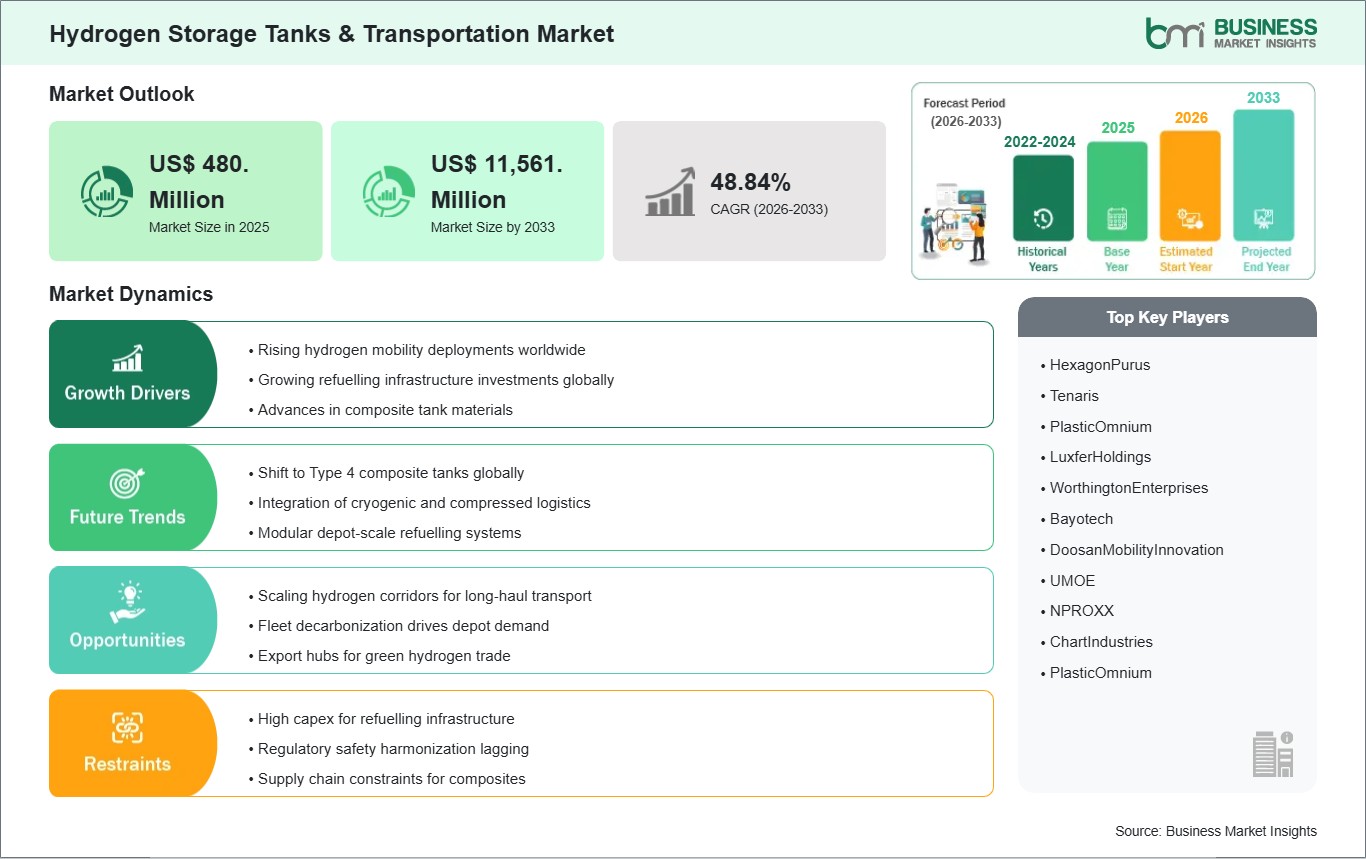
The Hydrogen Storage Tanks & Transportation Market size is expected to reach US$ 11,561.0 Million by 2033 from US$ 480.0 Million in 2025.The market is estimated to record a CAGR of 48.84% from 2026 to 2033.
Hydrogen storage tanks and transportation systems refer to engineered solutions that safely store compressed or liquefied hydrogen and move it across supply networks. These systems use high-pressure vessels, cryogenic technologies, and composite materials to keep hydrogen secure under different operational conditions. Their use supports energy transition efforts aimed at low-carbon fuel distribution. Increasing decarbonization targets and hydrogen-based energy plans are changing infrastructure planning in industrial and mobility sectors. Governments and private companies are focusing on hydrogen logistics networks to aid fuel cell integration and support clean mobility routes. Compatibility requirements are also affecting how storage is standardized across distribution systems. The differences between market segments are now mostly based on tank material and pressure tolerance levels. Type 4 composite tanks are becoming popular because they are lighter and more energy-efficient. We see stronger connections with mobility systems, particularly in vehicles and long-distance transportation. Technological advancements focus on composite winding techniques and improved cryogenic insulation systems. Digital monitoring solutions are being added to storage systems to track pressure changes and prevent leaks in real time. New materials are also enhancing safety and performance under high-pressure hydrogen conditions. Competitive strength is mainly held by specialized engineering firms and energy technology providers. The strategic focus is moving toward modular storage systems and scalable distribution networks. Collaboration among automotive, energy, and infrastructure stakeholders is driving the development of integrated hydrogen logistics.

Growing interest in clean transportation systems is increasing the reliance on hydrogen-based fuel storage technologies. Fuel cell vehicles need high-pressure containment systems that can maintain energy density over long operating cycles. Infrastructure developers are coordinating refueling networks with standardized storage solutions to ensure compatibility across different mobility platforms. This shift is affecting the use of advanced composite tanks in automotive and rail systems. Energy transition plans are incorporating hydrogen corridors into long-distance transport strategies. As a result, there is a wider adoption of lightweight, high-capacity storage systems designed for continuous mobility applications.
Material innovation in carbon fiber composites and polymer linings is improving hydrogen containment efficiency. These developments improve structural integrity and reduce overall system weight. Engineering improvements also tackle permeability challenges related to high-pressure hydrogen storage. Future growth is expected from scalable manufacturing techniques and automated winding processes. These innovations aid in cost optimization and broader commercial deployment. Better material performance is increasing feasibility for both stationary and mobile hydrogen infrastructure systems.
The Hydrogen Storage Tanks & Transportation Market is projected to grow from US$ 480.0 Million in 2025 to US$ 11,561.0 Million by 2033 , registering a CAGR of 48.84% from 2026 to 2033.
The hydrogen storage tanks and transportation market is valued at 2025-USD 0.35 Billion, 2033 - USD 7.12 Billion, CAGR -45.7%, reflecting structural scaling of hydrogen infrastructure ecosystems across mobility and energy sectors. Market expansion is closely linked to the development of hydrogen economy frameworks and improvements in storage technology. Tank type segmentation shows that composite-based high-pressure systems have a stronger position because of their efficiency and weight benefits. Modular storage designs are becoming more important in distributed hydrogen supply networks, which support flexible deployment models. The main applications are focused on mobility-related use cases, especially vehicles and new transport systems. Stationary storage applications also play a role in stabilizing infrastructure and balancing grid needs.
| Report Attribute | Details |
|---|---|
| Market size in 2025 | US$ 480.0 Million |
| Market Size by 2033 | US$ 11,561.0 Million |
| Global CAGR (2026 - 2033) | 48.84% |
| Historical Data | 2022-2024 |
| Forecast period | 2026-2033 |
| Segments Covered | By Modular Storage
|
|
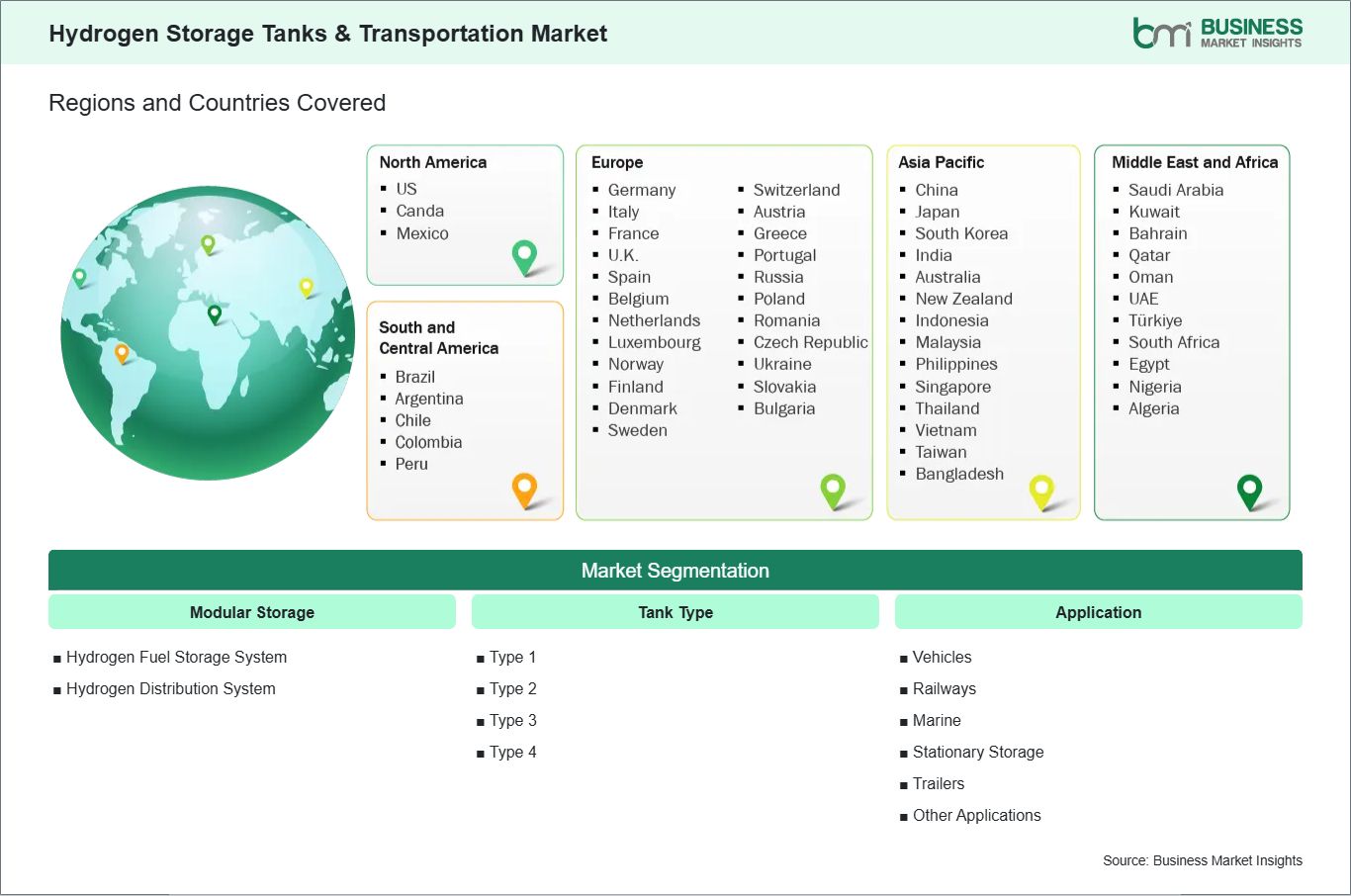
Regions and Countries Covered
| |
| North America | US, Canada, Mexico |
| Europe | Germany, Italy, France, U.K., Spain, Belgium, Netherlands, Luxembourg, Norway, Finland, Denmark, Sweden, Switzerland, Austria, Greece, Portugal, Russia, Poland, Romania, Czech Republic, Ukraine, Slovakia, Bulgaria |
| Asia-Pacific | China, Japan, South Korea, India, Australia, New Zealand, Indonesia, Malaysia, Philippines, Singapore, Thailand, Vietnam, Taiwan, Bangladesh |
| South and Central America | Brazil, Argentina, Chile, Colombia, Peru |
| Middle East and Africa | Saudi Arabia, United Arab Emirates, Kuwait, Bahrain, Qatar, Oman, Turkiye, South Africa, Egypt, Nigeria, Algeria |
| Market leaders and key company profiles |
|
The " Hydrogen Storage Tanks and Transportation Market Size and Forecast (2022-2033)" report provides a detailed analysis of the market covering below areas:
The hydrogen storage tanks and transportation market shows different regional adoption patterns. These patterns are influenced by the readiness of infrastructure, energy transition policies, and priorities for industrial decarbonization that shape strategies for deployment. Global markets exhibit various maturity levels. Advanced economies focus on integrated hydrogen logistics systems. Meanwhile, emerging regions are increasingly connecting energy diversification strategies to hydrogen-based storage frameworks. North America is expanding in a structured way, backed by hydrogen mobility pilots and initiatives for industrial-scale storage. The integration of infrastructure along transport corridors is directing system standardization and making it easier to scale deployments. Asia Pacific is making progress with large-scale investments in hydrogen aimed at mobility and industrial energy systems. Europe and emerging markets focus on aligning regulations and integrating renewable energy sources to support long-term hydrogen adoption frameworks.

Recent developments highlight accelerating investment in hydrogen mobility infrastructure and storage technology commercialization. Industry activity is increasingly focused on scaling high-pressure tank systems and transport networks.
The Hydrogen Storage Tanks & Transportation Market is valued at US$ 480.0 Million in 2025, it is projected to reach US$ 11,561.0 Million by 2033.
As per our report Hydrogen Storage Tanks & Transportation Market, the market size is valued at US$ 480.0 Million in 2025, projecting it to reach US$ 11,561.0 Million by 2033. This translates to a CAGR of approximately 48.84% during the forecast period.
The Hydrogen Storage Tanks & Transportation Market report typically cover these key segments-
The historic period, base year, and forecast period can vary slightly depending on the specific market research report. However, for the Hydrogen Storage Tanks & Transportation Market report:
The Hydrogen Storage Tanks & Transportation Market is populated by several key players, each contributing to its growth and innovation. Some of the major players include:
The Hydrogen Storage Tanks & Transportation Market report is valuable for diverse stakeholders, including:
Essentially, anyone involved in or considering involvement in the Hydrogen Storage Tanks & Transportation Market value chain can benefit from the information contained in a comprehensive market report.
Please tell us your area of interest
(Market Segments/ Regions and Countries/ Companies)