Market Summary
Executive Summary and Global Market Analysis
The Combined Heat and Power market centers on systems that create electricity and usable thermal energy from the same fuel source. These systems improve energy efficiency by cutting down transmission losses and capturing waste heat for practical uses. CHP installations typically appear in industrial facilities, commercial buildings, and residential areas that need a steady energy supply. Energy efficiency efforts continue to influence deployment strategies across different industries. Manufacturing units and institutional facilities increasingly focus on integrated power generation solutions to ensure smooth operations and make better use of fuel. Concerns about grid reliability and long-term energy management also drive the shift toward localized power generation technologies. The market features a diverse structure, categorized by technology, application, and fuel type. Gas turbines and steam turbines are popular in industrial settings because they suit large-scale operations well.
More homes are adopting micro-CHP systems, and biomass-based setups are gaining traction in facilities that prioritize alternative fuel use. Technology development is changing operational capabilities in this market. Fuel cell-based CHP systems are attracting attention due to their efficiency and lower emissions. Commercial buildings, healthcare centers, and district heating projects are implementing advanced CHP designs to meet ongoing energy needs while controlling operational costs. Competitive conditions show ongoing investment in product upgrades, efficiency improvements, and system flexibility. Market players aim to improve integration across various fuel sources and applications. Strategic partnerships, technology collaborations, and infrastructure developments continue to shape industry positioning in regional markets.
Segment Analysis
Combined Heat and Power Market Segmentation
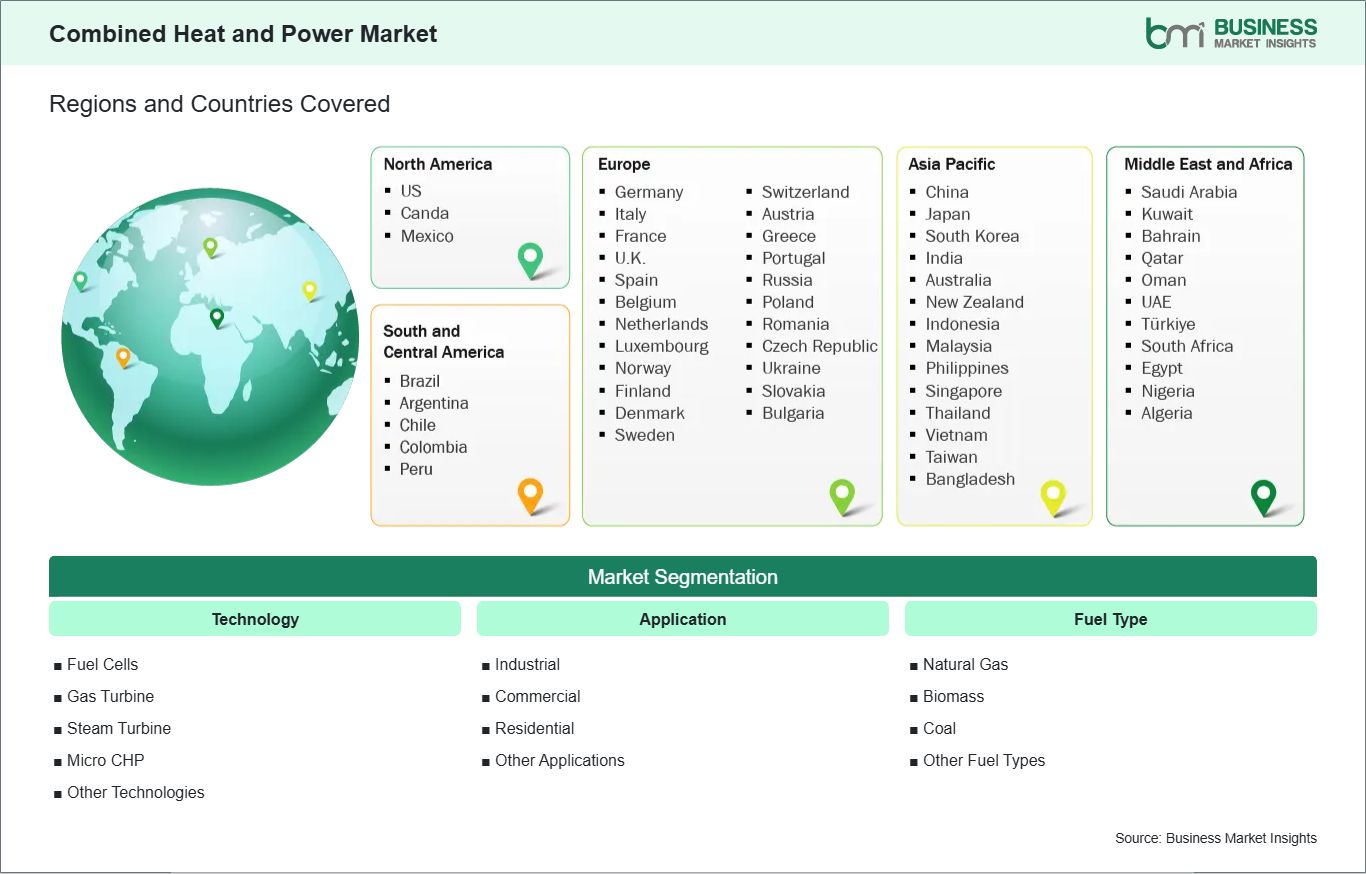
The Combined Heat and Power market is segmented based on technology, application, and fuel type, reflecting the growing demand for advanced imaging and depth-sensing solutions across multiple applications.
By Technology
- Fuel Cells – Enable low-emission distributed generation for advanced commercial infrastructure.
- Gas Turbine – Supports continuous high-capacity industrial power generation environments.
- Steam Turbine – Delivers stable thermal recovery performance in large-scale facilities.
- Micro CHP – Expands localized energy generation across compact building applications.
- Other Technologies – Addresses specialized operational and site-specific energy requirements.
By Application
- Industrial – Maintains strong utilization across energy-intensive manufacturing operations.
- Commercial – Enhances building energy optimization and backup power resilience.
- Residential – Encourages efficient onsite heating and electricity production capabilities.
- Other Applications – Supports institutional and district energy deployment requirements.
By Fuel Type
- Natural Gas – Provides efficient combustion performance with established infrastructure compatibility.
- Biomass – Aligns with decarbonization objectives and renewable energy integration initiatives.
- Coal – Supports legacy cogeneration systems in selected industrial environments.
- Other Fuel Types – Enables operational flexibility across diversified fuel availability conditions.
Market Forces
Combined Heat and Power Market Drivers and Opportunities
Rising Focus on Energy Efficiency and Operational Optimization
Industries are increasingly adopting integrated energy systems to use fuel more effectively and reduce energy waste. Combined heat and power installations generate electricity and thermal energy simultaneously. This helps facilities improve their performance. Manufacturing plants, healthcare facilities, and commercial buildings are using CHP technologies more often to maintain a stable energy supply and increase reliability during operations.
Regulatory policies that focus on efficient energy use improve market relevance in both developed and emerging economies. Energy transition policies encourage industries to upgrade old infrastructure with cleaner and more efficient technologies. Improvements in fuel flexibility and system integration also support wider use in areas that need reliable and localized energy generation.
Expansion of Distributed and Decentralized Energy Infrastructure
The shift to decentralized energy systems creates good conditions for CHP deployment. Facilities wanting independent energy management are increasingly using localized generation technologies to improve their resilience. Micro CHP systems and fuel cell-based setups are becoming popular in residential areas, institutional buildings, and commercial facilities that need reliable and flexible energy support. Long-term opportunities are growing with the modernization of urban infrastructure and smart energy management systems.
Expanding district heating projects and integrated building management systems may increase CHP use in densely populated areas. Ongoing innovation in low-emission technologies and digital monitoring is likely to encourage broader use in future energy infrastructure development programs.
Size and Share Analysis
Combined Heat and Power Market Size and Share Analysis
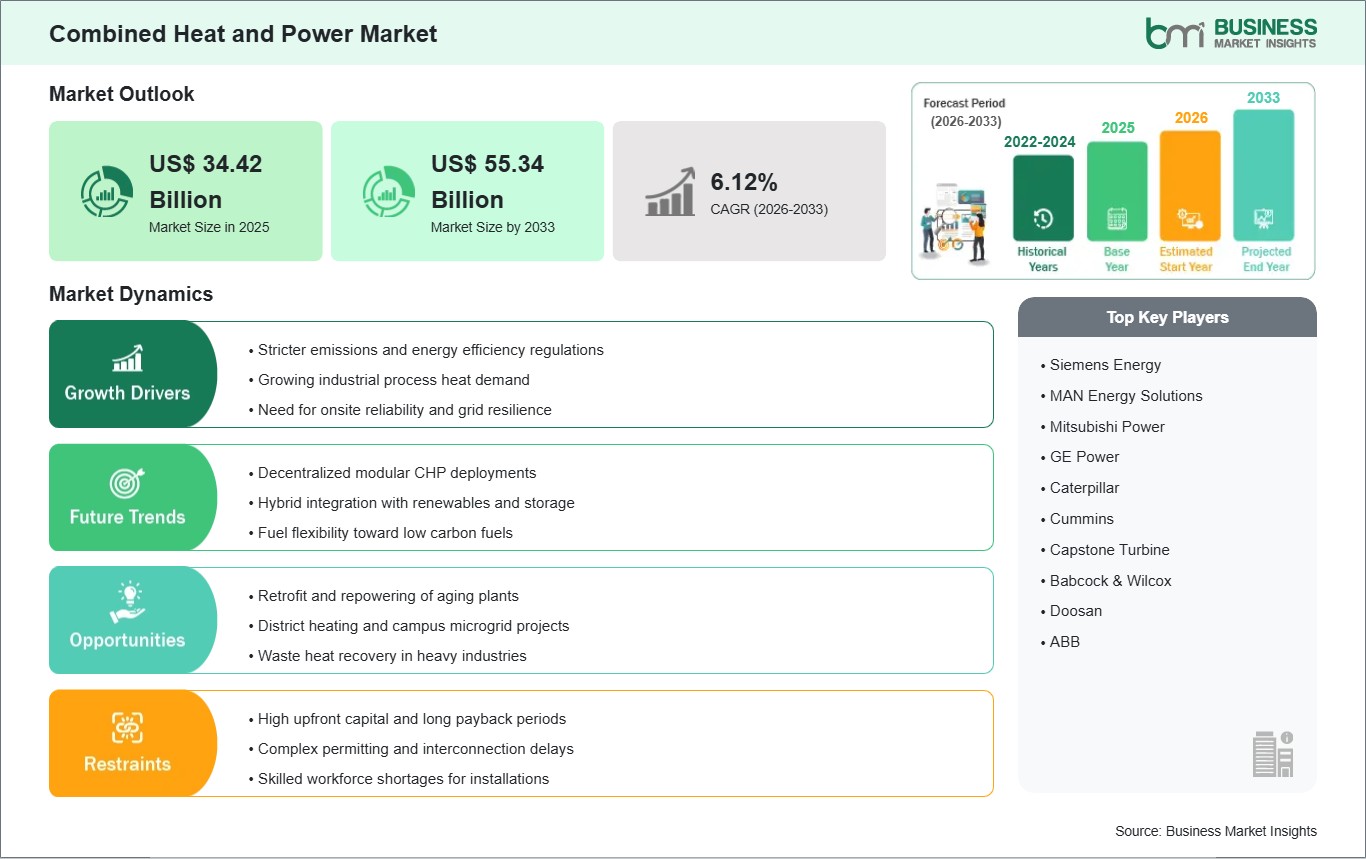
The Combined Heat and Power Market is projected to grow from US$ 34.42 Billion in 2025 to US$ 55.34 Billion by 2033 , registering a CAGR of 6.12% from 2026 to 2033. This trajectory reflects broader industry attention toward efficient power generation systems capable of supporting long-term operational stability and improved energy management practices.
Gas turbine and steam turbine technologies are still important in industrial settings because they are effective for large-scale energy operations. Fuel cell systems are attracting interest in facilities that aim to improve efficiency and control emissions. Micro CHP installations are gradually becoming more common in smaller locations that need local energy generation.
Industrial applications represent a significant portion of their use, as production facilities constantly require heating and electricity. Commercial sectors, including hospitals, schools, and office buildings, are increasingly adopting CHP systems to ensure smooth operations. Residential demand is also evolving, with a rising interest in efficient energy systems for homes.
Report Coverage
Combined Heat and Power Market Report Coverage and Deliverables
The " Combined Heat and Power Market Size and Forecast (2022-2033)" report provides a detailed analysis of the market covering below areas:
- Market size and forecast at global, regional, and country levels for all market segments covered under the scope
- Market trends, as well as drivers, restraints, and opportunities
- Market analysis covering key trends, global and regional framework, major players, regulations, and recent developments
- Industry landscape and competition analysis covering market concentration, heat map analysis, prominent players, and recent developments for the Combined Heat and Power market
- Detailed company profiles, including SWOT analysis
Geographic Insights
Combined Heat and Power Market Geographic Insights
The Combined Heat and Power market shows diverse regional adoption patterns influenced by industrial infrastructure, energy policies, and fuel availability. Developed economies continue integrating CHP systems within industrial and commercial environments to improve efficiency and support localized energy generation. Emerging markets are also evaluating distributed energy systems to strengthen operational resilience and reduce pressure on centralized power networks.
North America has a stable market penetration due to industrial modernization and energy management initiatives. The United States keeps adding CHP installations in manufacturing facilities, healthcare centers, and universities. Canada also shows adoption in district energy systems and commercial projects that focus on using energy efficiently and ensuring operational continuity.
Asia Pacific is expanding its deployment patterns with industrial growth and urban development. China keeps investing in efficient energy technologies for industrial clusters and municipal projects. Japan stays focused on fuel-efficient systems after years of energy diversification. Meanwhile, India is increasingly looking into CHP solutions for modernizing its manufacturing facilities and commercial infrastructure.
Europe has a well-structured regulatory environment that supports efficient power generation technologies across various sectors. Germany and the United Kingdom continue to back energy-efficient infrastructure projects that incorporate CHP systems in commercial and industrial facilities. Emerging regions, including parts of Latin America and the Middle East, are slowly exploring decentralized power generation models to promote industrial growth and enhance long-term energy reliability.
Industry Activity
Recent Developments
The Combined Heat and Power market is evaluated by gathering qualitative and quantitative data post-primary and secondary research, which includes important corporate publications, association data, and databases. A few of the key developments in the Combined Heat and Power market are:
- In February 2026, OandS Doors, a manufacturer in Northern Ireland, announced a US$ 10.44 million (£9 million) investment in a biomass-fueled combined heat and power (CHP) system at its Dungannon facility. This project, aimed at enhancing energy efficiency and reducing carbon emissions, has received £2.4 million in support from the Shared Island Sustainability Capital Grant Scheme. Notably, OandS Doors is the first business in Ireland to implement this system, which will convert MDF dust, a manufacturing by-product, into energy for heating and production. First Minister Michelle O'Neill and Deputy First Minister Emma Little-Pengelly endorsed the investment during a visit to the company.
- In November 2025, Power companies Teollisuuden Voima Oyj (TVO) and Rauman Biovoima Oy are launching a venture to recycle waste from the Olkiluoto nuclear power station at a combined heat and power (CHP) plant in Rauma, Finland. This initiative marks the first recycling of nuclear plant general waste in Finland, involving incineration of items such as overalls, gloves, and plastic coverings, while removing unsuitable materials before processing.
Trust & Transparency
Research Methodology
The market analysis combines proprietary research with secondary data from government agencies, company disclosures, regulatory filings, industry databases and expert interviews. Market estimates are validated through data triangulation, cross-market benchmarking and analyst
review.
View Full Research Methodology
Key Sources Referred:
European Commission
US Department of Energy
International Energy Agency
Company Websites
Company Annual Reports
Company Investor Presentations