
Semiconductor Equipment Market Size, Share, Trends & Forecast Report, 2026–2033

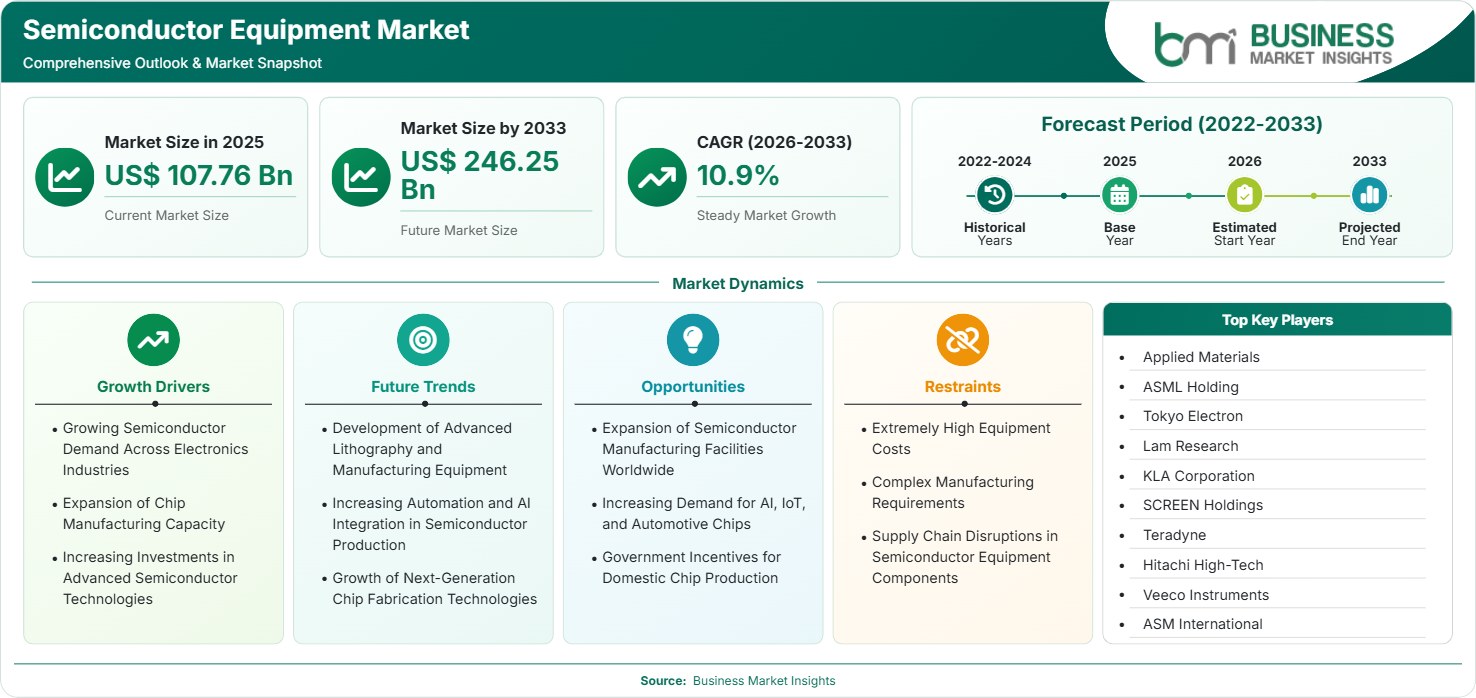
The Semiconductor Equipment Market size was valued at US$ 107.76 Billion in 2025 and is projected to reach US$ 246.25 Billion by 2033, growing at a CAGR of US$ 10.9% during 2026–2033, driven by advanced chip fabrication demand, AI infrastructure expansion, automotive electronics adoption, and investments in semiconductor manufacturing capacity.

Report Coverage
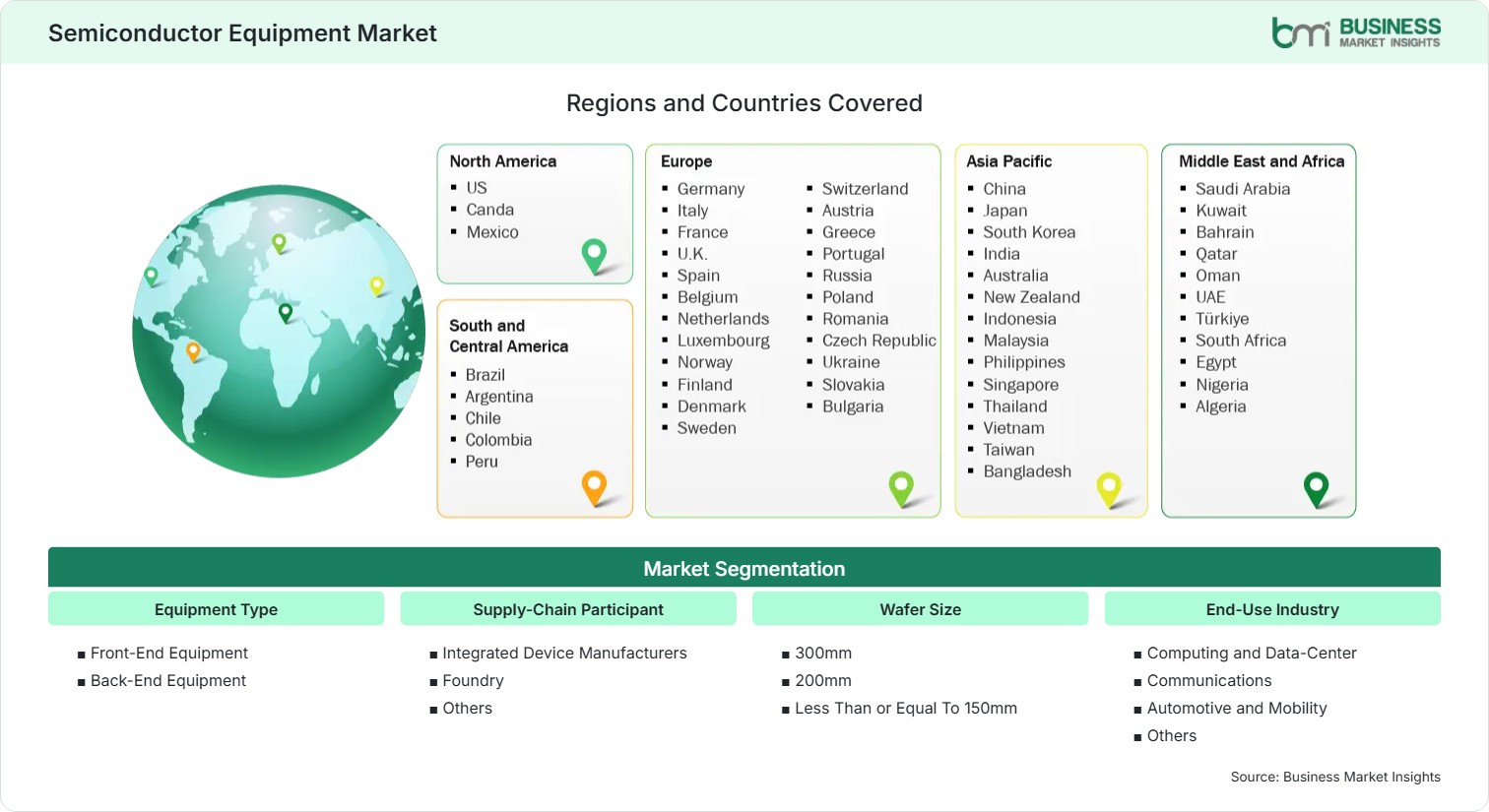
  • Equipment Type: Front-End Equipment, Back-End Equipment
  • Supply-Chain Participant: Integrated Device Manufacturers, Foundry, Others
  • Wafer Size: 300mm, 200mm, Less Than or Equal To 150mm
  • End-Use Industry: Computing and Data-Center, Communications, Automotive and Mobility, Others
US$ 107.76 Bn Market size in 2025
US$ 246.25 Bn Market Size by 2033
10.9% CAGR, 2026 - 2033
2026-2033 Forecast Period

01 AI Overview

Semiconductor Equipment Market Summary

  • North America Region: North America holds market share of 32%–35% in 2025, growing with a CAGR of 10.5%–11.5% influenced by semiconductor reshoring initiatives, AI data-center investments, and advanced fabrication expansion. The US market demonstrates strong momentum through domestic wafer capacity development, with a CAGR of 10.8%–11.8% during 2026–2033.
  • Fastest Growing Region: Asia Pacific holds market share of 38%–41% in 2025, growing with a CAGR of 11.2%–12.2% supported by semiconductor ecosystem expansion, foundry investments, memory production growth, and increasing demand for advanced process equipment across leading manufacturing hubs.
  • Leading Segment: Front-End Equipment holds market share of 72%–75% in 2025, growing with a CAGR of 10.8%–11.8% driven by advanced lithography adoption, wafer processing complexity, and increasing investments in next-generation semiconductor fabrication facilities worldwide.
  • High Growth Segment: Computing and Data-Center applications represent a high-growth segment with increasing equipment demand, supported by AI accelerator production, high-performance computing requirements, and expanding hyperscale infrastructure investments.
  • Key Market Opportunity: Advanced semiconductor manufacturing investments, AI-driven chip demand, and government-supported fabrication programs create opportunities for equipment providers through next-generation lithography, process control solutions, and specialized wafer fabrication technologies.
  • Major Market Players: Applied Materials, ASML, Tokyo Electron, Lam Research, KLA Corporation, SCREEN Holdings, Teradyne, Hitachi High-Tech Corporation, Veeco Instruments, ASM International.
02 Strategic Insights

Semiconductor Equipment Market: Strategic Insights

Semiconductor Equipment Market Strategic Framework
FREE PDF
Request your free sample
Request free sample
03 Stakeholder View

Key Takeaways

  • Semiconductor manufacturing ecosystems are becoming increasingly integrated, with equipment suppliers, foundries, integrated device manufacturers, and technology providers collaborating to improve production efficiency and accelerate advanced node development.
  • Advanced logic, memory, and AI-focused semiconductor applications represent major growth avenues as chip complexity increases and manufacturers require sophisticated deposition, inspection, lithography, and packaging equipment.
  • Equipment innovation is shifting toward extreme ultraviolet lithography support, advanced process control, automation, and artificial intelligence-enabled manufacturing optimization to improve yield rates and production scalability.
  • Asia Pacific remains a strategic investment region due to established semiconductor clusters in Taiwan, South Korea, Japan, and China, supported by extensive fabrication infrastructure and skilled manufacturing ecosystems.
  • The competitive landscape is experiencing consolidation through technology partnerships, capacity expansion investments, and strategic collaborations among equipment manufacturers seeking leadership in advanced semiconductor production.
  • Sustainability requirements are influencing equipment development, with manufacturers focusing on energy-efficient systems, reduced material consumption, and improved environmental performance in semiconductor fabrication processes.
04 Geographic Outlook

Semiconductor Equipment Market Regional Highlights

North America Semiconductor Equipment Market

North America accounted for a market share of 32%–35% in 2025 and is projected to expand at a CAGR of 10.5%–11.5% during 2026–2033. Semiconductor Equipment Market share in the region is supported by domestic fabrication expansion, AI infrastructure investment, and government-backed semiconductor programs. The United States remains the primary contributor, supported by advanced manufacturing initiatives and technology leadership.

  • Government incentives are accelerating fabrication investments by encouraging domestic semiconductor production and strengthening equipment demand across advanced wafer manufacturing facilities.
  • AI data-center expansion is increasing requirements for high-performance chips, supporting investments in advanced processing, inspection, and semiconductor manufacturing technologies.
  • Equipment suppliers benefit from partnerships with leading chip manufacturers seeking improved production efficiency and next-generation fabrication capabilities.
  • Research institutions and technology companies are supporting semiconductor innovation through advanced packaging and process development initiatives.

US Semiconductor Equipment Market

The US accounted for a market share of 27%–30% in 2025 and is expected to register a CAGR of 10.8%–11.8% between 2026–2033. Semiconductor Equipment Market expansion in the country is driven by investments in fabrication, AI semiconductor demand, and efforts to improve supply chain resilience. Domestic manufacturing programs are strengthening equipment procurement opportunities.

  • Semiconductor fabrication incentives are supporting new manufacturing projects and increasing demand for advanced wafer processing equipment.
  • AI accelerator production is creating additional requirements for sophisticated manufacturing and process control technologies.
  • Leading technology companies are investing in semiconductor infrastructure to support cloud computing and artificial intelligence applications.

Europe Semiconductor Equipment Market

Europe represented a market share of 14%–17% in 2025 and is projected to grow at a CAGR of 9.5%–10.5% during 2026–2033. Semiconductor Equipment Market share in Europe is influenced by automotive semiconductor demand, industrial applications, and strategic investments in regional chip manufacturing. Germany and the Netherlands remain important contributors, while countries such as France and Italy are expanding semiconductor capabilities.

  • Germany is strengthening semiconductor manufacturing through automotive electronics demand and industrial automation requirements, supporting equipment investments.
  • The Netherlands benefits from advanced semiconductor technology capabilities, particularly in lithography-related equipment development.
  • France and Italy are increasing semiconductor infrastructure investments through European technology initiatives and manufacturing partnerships.
  • Automotive electrification is increasing demand for semiconductor production equipment across European supply chains.

Asia Pacific Semiconductor Equipment Market

Asia Pacific held a market share of 38%–41% in 2025 and is anticipated to expand at a CAGR of 11.2%–12.2% through 2033. Semiconductor Equipment Market share in the region is driven by established semiconductor manufacturing clusters, foundry expansion, and memory production leadership. Taiwan, South Korea, Japan, and China remain major contributors, with India emerging as a developing semiconductor investment destination.

  • Taiwan continues to drive equipment demand through advanced foundry capacity expansion and leading-edge semiconductor manufacturing.
  • South Korea supports equipment adoption through memory semiconductor investments and advanced process technology development.
  • Japan is strengthening semiconductor equipment demand through material innovation and domestic manufacturing initiatives.
  • China continues expanding semiconductor capacity despite technology restrictions, increasing demand for manufacturing equipment.
  • India is developing semiconductor infrastructure through policy support and international technology collaborations.

Rest of World Semiconductor Equipment Market

The rest of the world accounted for a market share of 6%–9% in 2025 and is projected to grow at a CAGR of 8.5%–9.5% during 2026–2033. Semiconductor Equipment Market share across South and Central America, Middle East, and Africa remains limited but is supported by emerging electronics manufacturing initiatives, digital transformation, and technology investment programs.

  • South American countries are exploring semiconductor opportunities through electronics manufacturing development and technology partnerships.
  • Middle Eastern economies are investing in advanced technology sectors, creating future semiconductor ecosystem opportunities.
  • African markets are gradually improving digital infrastructure, supporting long-term semiconductor demand potential.
  • Regional technology initiatives are encouraging diversification of global semiconductor supply chains.
  • Emerging economies are focusing on workforce development to support semiconductor manufacturing capabilities.
Global Market Geography
FREE PDF
Request your free sample
Request free sample
05 Segment Analysis

Semiconductor Equipment Market Segmentation

Equipment Type

Equipment Type represents the largest segmentation category, accounting for a share of 72%–75% in 2025 and expanding at a CAGR of 10.8%–11.8% between 2026–2034. The segment benefits from increasing semiconductor complexity, advanced node transitions, and rising demand for precision manufacturing systems across wafer fabrication and semiconductor assembly processes.

  • Front-End Equipment: Supports wafer fabrication activities including lithography, deposition, etching, cleaning, and inspection. Demand is increasing due to advanced node production, semiconductor scaling, and investments in high-performance computing chips.
  • Back-End Equipment: Covers packaging, assembly, testing, and related processes. Growth is supported by advanced packaging adoption, chiplet architectures, and increasing semiconductor integration across automotive and consumer electronics applications.

Supply-Chain Participant

Supply-Chain Participant addresses equipment demand across major semiconductor manufacturing stakeholders, accounting for a share of 25%–28% in 2025 with a CAGR of 10.0%–11.0% between 2026–2034. The segment reflects increasing collaboration between manufacturers, foundries, and specialized semiconductor production partners seeking resilient supply networks and improved manufacturing capabilities.

  • Integrated Device Manufacturers: Operate integrated semiconductor production capabilities and invest in advanced equipment to improve manufacturing efficiency, technology leadership, and product diversification across semiconductor applications.
  • Foundry: Increasing foundry investments are driving equipment adoption as companies expand advanced fabrication capacity to support AI processors, mobile chips, and high-performance computing applications.
  • More: Additional supply-chain participants contribute through specialized semiconductor manufacturing services, testing capabilities, and technology partnerships supporting broader ecosystem development.

Wafer Size

Wafer Size represents a critical manufacturing segmentation, accounting for a share of 20%–23% in 2025 and growing at a CAGR of 10.2%–11.2% during 2026–2034. Semiconductor manufacturers increasingly prioritize larger wafer platforms to improve productivity, reduce costs, and support high-volume production requirements for advanced electronic applications.

  • 300mm: The preferred wafer size for advanced semiconductor manufacturing due to higher production efficiency, improved economies of scale, and compatibility with advanced fabrication technologies.
  • 200mm: Maintains relevance through mature semiconductor applications including automotive, industrial, power electronics, and specialized semiconductor production requirements.
  • Less Than or Equal To 150mm: Supports legacy semiconductor manufacturing, niche applications, and specialized components where cost-effective production remains important.

End-Use Industry

End-Use Industry demonstrates diversified semiconductor demand, accounting for a share of 28%–31% in 2025 and achieving a CAGR of 11.0%–12.0% between 2026–2034. Increasing semiconductor integration across digital infrastructure, transportation, and communication systems is influencing equipment investments and manufacturing capacity expansion.

  • Computing and Data-Center: Drives equipment demand through AI computing, cloud infrastructure expansion, high-performance processors, and increasing semiconductor requirements for data-intensive workloads.
  • Communications: Supports semiconductor equipment adoption through 5G infrastructure, networking systems, and increasing demand for advanced communication components.
  • Automotive and Mobility: Expands equipment requirements due to electric vehicles, autonomous driving technologies, and increased semiconductor content per vehicle.
06 Market Forces

Semiconductor Equipment Market Dynamics

Key Market Drivers

Growing Semiconductor Demand Across Electronics Industries

Electronics applications are causing more investments into semiconductors in consumer goods, computers, cars, and industrial tools. Growth the market is based on high demand for chips; as per industry bodies, global sales of semiconductors have crossed US$ 600 billion in the past few years. Growing use of semiconductors in cars, AI-based machines, and connectivity-enabled gadgets is increasing demand for state-of-the-art production machinery. The Semiconductor Equipment Market trends include an emphasis on higher productivity and advanced processes in equipment from manufacturers.

Expansion of Chip Manufacturing Capacity

Global semiconductor capacity expansion is leading to a rise in the demand for semiconductor equipment since firms are setting up new manufacturing plants and expanding the current ones. In this regard, the International Semiconductor Industry Association has pointed out continuous investments in wafer fabrication infrastructure in order to build regional resilience in the supply chain. The Semiconductor Equipment Market growth is being driven by the expansion of foundries, memory production, and semiconductor-related government programs.

Increasing Investments in Advanced Semiconductor Technologies

Semiconductor equipment market developments are being influenced by the fact that companies are opting to focus on smaller process nodes, advanced packaging, and high-performance computing. Suppliers of semiconductor equipment are investing in developing manufacturing equipment that helps in the manufacture of advanced chip architectures and enhanced semiconductor performances. Semiconductor market trends are characterized by the increased use of automation, process control enabled by AI, and inspection technologies. The growing demand for AI processors, advanced memories, and semiconductor integration is pushing manufacturers to develop their manufacturing capabilities.

Key Market Opportunities

Expansion of Semiconductor Manufacturing Facilities Worldwide

Growth in the construction of semiconductor manufacturing plants worldwide provides equipment makers with potential benefits due to their support of the newly created manufacturing capabilities. The development of regional manufacturing programs in North America, Europe, and the Asia-Pacific will provide an incentive for building wafer manufacturing infrastructure. Equipment companies may gain by satisfying the need for such technology as lithography, deposition, etching, and process controls that are necessary for advanced manufacturing facilities.

Increasing Demand for AI, IoT, and Automotive Chips

The increasing use of artificial intelligence, the Internet of Things, and automotive semiconductor solutions is generating numerous opportunities for the semiconductor equipment providers. The Semiconductor Equipment market forecast is fueled by the rise in demand for artificial intelligence accelerators, edge computing solutions, and electric vehicle solutions, all of which rely on the more complex semiconductors, providing higher-performance levels. Companies are acquiring new equipment to cope with the growing complexity of the chips. The expansion of the role of semiconductors in transport, communications, and industry generates long-term opportunities for equipment makers.

Government Incentives for Domestic Chip Production

Semiconductor initiatives backed by governments are boosting domestic investments in manufacturing and opening up business prospects for equipment vendors. Initiatives that aim at making the semiconductor supply chain more robust are speeding up fab investments and collaborations in technologies. Nations such as the US, EU member nations, Japan, and India have started initiatives aimed at developing their semiconductor ecosystems via funding and policies. They facilitate equipment sales by encouraging organizations to set up manufacturing operations.

Market Restraints and Challenges

Extremely High Equipment Costs

Factor: Extremely high capital requirements for semiconductor manufacturing equipment can restrict adoption among smaller manufacturers and emerging semiconductor companies.

Impact: Higher investment at the start raises the financial hurdle and prolongs the return-on-investment period of fabrication expansion initiatives. The sophisticated nature of lithography and manufacturing processes calls for greater research, engineering, and maintenance costs, affecting purchasing decisions. Companies have to find a delicate balance between new technologies and cost-effectiveness amid competitive dynamics. The equipment providers have started reacting accordingly through their productivity and automation capabilities.

Complex Manufacturing Requirements

Factor: Increasing semiconductor process complexity creates challenges related to precision control, technical expertise, and manufacturing integration.

Impact: Higher requirements in production processes may lead to higher development times and higher risks associated with operations, as well as optimization problems. For advanced nodes, there is a need for process monitoring, contamination control, and specialized engineering solutions. There is always a need for improvements in technical infrastructure on the part of semiconductor producers. There is a demand for reliability from equipment suppliers.

07 Company Analysis

Competitive Landscape

The Semiconductor Equipment Market analysis indicates a highly concentrated competitive environment where global equipment manufacturers compete through technological innovation, process optimization capabilities, service networks, and strategic collaborations with semiconductor producers. Leading companies focus on advanced lithography, wafer processing, inspection, deposition, and packaging technologies to support evolving semiconductor manufacturing requirements. The competitive landscape is shaped by continuous research investments, expansion of product portfolios, and partnerships with foundries and integrated device manufacturers.

Company Name

Overview

Products and Services relevant to this market

Applied Materials

Global semiconductor equipment provider offering advanced manufacturing solutions for chip production industries worldwide.

Deposition systems, etching technologies, inspection solutions, semiconductor manufacturing equipment, and process optimization services.

ASML

Leading semiconductor equipment company specializing in advanced lithography systems for semiconductor fabrication.

Extreme ultraviolet lithography, deep ultraviolet lithography systems, metrology solutions, and semiconductor manufacturing support.

Tokyo Electron

Japanese semiconductor equipment manufacturer providing production technologies for global chip manufacturers.

Coating, developing, etching, cleaning, deposition equipment, and semiconductor process solutions.

Lam Research

Semiconductor equipment supplier focused on wafer fabrication and advanced manufacturing technologies.

Etch systems, deposition equipment, wafer cleaning technologies, and semiconductor process engineering solutions.

KLA Corporation

Semiconductor process control company supporting manufacturing quality and yield improvement.

Inspection systems, metrology equipment, defect detection technologies, and process control solutions.

SCREEN Holdings

Semiconductor manufacturing equipment provider serving global semiconductor production markets.

Cleaning systems, wafer processing equipment, and semiconductor manufacturing solutions.

Teradyne

Technology company providing semiconductor testing solutions and automated manufacturing technologies.

Semiconductor test systems, automated testing equipment, and advanced production testing solutions.

Hitachi High-Tech Corporation

Technology provider delivering semiconductor manufacturing and analytical equipment.

Electron beam systems, inspection equipment, semiconductor process tools, and measurement technologies.

Veeco Instruments

Semiconductor equipment company specializing in precision manufacturing technologies.

Deposition systems, lithography equipment, compound semiconductor manufacturing solutions, and process technologies.

ASM International

Semiconductor equipment manufacturer focused on advanced wafer processing solutions.

Atomic layer deposition systems, wafer processing equipment, and semiconductor fabrication technologies.

08 Industry Activity

Recent Developments

June 2026

Applied Materials, Inc. expanded its Singapore manufacturing and R&D footprint with a new US$500 million Tampines Campus to increase advanced semiconductor equipment production capacity and support AI-driven semiconductor demand. The facility more than doubles Applied Materials’ advanced cleanroom capacity in Singapore and strengthens its global manufacturing network.

May 2026

ASML Holding N.V. announced a strategic partnership with Tata Electronics to support the development and ramp-up of Tata Electronics’ upcoming 300 mm semiconductor fab in Dholera, India. The collaboration includes lithography equipment solutions, workforce training, and development of local semiconductor manufacturing capabilities.

February 2026

Lam Research Corporation entered into a new multi-year agreement with CEA-Leti to accelerate research on advanced semiconductor materials and processes for energy-efficient specialty devices. The collaboration focuses on process innovation and next-generation semiconductor manufacturing technologies.

December 2025

Tokyo Electron Limited launched CLEAN TRACK LITHIUS Pro DICE, a new 300 mm wafer coater/developer system designed for advanced semiconductor manufacturing, including EUV lithography applications. The system targets improved defect control, productivity, and support for logic, DRAM, and NAND production.

10 Trust & Transparency

Research Methodology

The market analysis combines proprietary research with secondary data from government agencies, company disclosures, regulatory filings, industry databases and expert interviews. Market estimates are validated through data triangulation, cross-market benchmarking and analyst review.

View Full Research Methodology

11 Questions Answered

Frequently Asked Questions

What does the Semiconductor Equipment Market Report highlight about future opportunities?

The Report highlights opportunities from advanced packaging, AI-driven semiconductor demand, regional manufacturing expansion, automation adoption, and investments in next-generation semiconductor production technologies.

What role do government semiconductor programs play in market development?

Government semiconductor initiatives support domestic manufacturing through incentives, infrastructure funding, and technology programs that encourage fabrication expansion and increase demand for semiconductor production equipment.

How are AI applications affecting semiconductor manufacturing investments?

AI applications are increasing demand for advanced processors, high-bandwidth memory, and specialized chips, encouraging semiconductor manufacturers to invest in sophisticated production equipment and fabrication technologies.

Which equipment category contributes the highest demand?

Front-end equipment contributes the largest demand due to its importance in wafer fabrication processes, including lithography, deposition, etching, and inspection required for advanced semiconductor production.

What factors are influencing semiconductor equipment demand worldwide?

Semiconductor equipment demand is influenced by advanced chip manufacturing expansion, AI computing growth, automotive electronics adoption, semiconductor supply-chain diversification, and increasing investments in fabrication capacity across major manufacturing regions.

Access the Full Semiconductor Equipment Market Report

Get segment-level forecasts, regional estimates, competitive benchmarking, company profiles and downloadable Excel datasets.

Access the full Semiconductor Equipment Market Report
350 pages PDF & Excel | 2026-07-30